Key takeaways
- AI search engines like ChatGPT, Perplexity, and Google AI Overviews are now a primary discovery channel for learners researching courses, platforms, and tools -- e-learning brands that aren't cited are invisible.
- GEO (Generative Engine Optimization) tools help you track where you appear in AI-generated answers, identify gaps where competitors are mentioned instead of you, and create content that closes those gaps.
- Most tools on the market only monitor. The best ones -- like Promptwatch -- go further by helping you act on what you find.
- E-learning has specific prompt patterns (course comparisons, certification questions, platform recommendations) that require targeted tracking, not generic keyword monitoring.
- Budget matters: there are solid options from free to enterprise, but the tools that combine monitoring with content generation deliver the fastest ROI.
Why e-learning brands need GEO tools right now
Think about how a prospective student actually searches today. They don't type "best online Python course" into Google and scroll through ten blue links. They ask ChatGPT. They ask Perplexity. They ask Google's AI Mode. They get a direct answer with three or four recommendations -- and if your platform isn't in that answer, you don't exist for that person.
According to Search Engine Journal, 37% of users now start their searches in AI rather than traditional search engines. In education, that number skews even higher among younger learners. The practical implication: your Google ranking matters less than whether AI models have enough quality information about your courses to recommend you.
This is the core problem GEO tools solve. They show you what AI engines are saying about your brand, which competitors they're recommending instead of you, and what content gaps are causing you to be overlooked. For e-learning companies -- whether you sell corporate training, language learning, professional certifications, or K-12 content -- this visibility gap is already costing you enrollments.
What makes e-learning a unique GEO challenge
E-learning isn't like SaaS or e-commerce. The prompts learners use are specific, and the AI responses tend to be detailed and opinionated. A few patterns worth understanding:
Comparison prompts dominate. Learners ask "Coursera vs Udemy for data science" or "best platform for AWS certification prep." If you're not in these comparisons, you're losing to whoever is.
Certification and outcome queries are high-intent. "What's the best course to pass the PMP exam?" is a buying signal. AI engines answer these with specific recommendations, and those recommendations are based on what's in their training data and what they can retrieve from the web.
Persona matters more than in other verticals. A corporate L&D manager asking about compliance training gets a very different AI response than a self-directed learner asking about the same topic. GEO tools that let you set custom personas are genuinely more useful here.
Content freshness affects citations. AI models tend to cite recent, authoritative content. E-learning platforms that publish course updates, outcome data, and expert-authored guides get cited more often than those with static landing pages.
The best GEO tools for e-learning in 2026
Promptwatch -- best overall for action-oriented teams
Promptwatch is the tool I'd recommend first for any e-learning brand serious about AI visibility. The reason isn't just the monitoring -- it's what happens after you see the data.
Most tools show you that a competitor is being cited for "best UX design course" and leave you to figure out what to do about it. Promptwatch's Answer Gap Analysis shows you exactly which prompts competitors are winning that you're not, then its Content Agents generate articles, comparisons, and briefs engineered to fill those specific gaps. That cycle -- find the gap, create the content, track the result -- is what separates it from monitoring-only dashboards.
For e-learning specifically, the multi-persona tracking is useful. You can set up prompts as a corporate training buyer, a self-directed learner, or a university administrator and see how AI responses differ by audience. The crawler logs also show you which pages AI engines are actually reading on your site, which is often surprising -- and useful for deciding where to invest content effort.
It tracks 10 AI models including ChatGPT, Perplexity, Google AI Overviews, Claude, Gemini, and Grok. Pricing starts at $99/month.

Profound -- best for enterprise e-learning platforms
Profound is a strong choice for larger e-learning organizations that need deep analytics and don't mind a higher price point. It covers 9+ AI engines and gives you detailed brand mention tracking, sentiment analysis, and competitive benchmarking.
Where Profound shines is in its enterprise reporting -- if you're presenting AI visibility data to a CMO or board, the dashboards are clean and credible. The tradeoff is that it's primarily a monitoring platform. You'll see where you're missing, but the content strategy work is still on your team.
Profound

Otterly.AI -- best for quick setup and prompt monitoring
Otterly.AI is a focused prompt monitoring tool that's fast to set up and easy to use. You define a set of prompts relevant to your e-learning niche, and it tracks how often you appear in AI answers for those prompts across ChatGPT, Perplexity, and Google AI Overviews.
It's a good starting point if you're new to GEO and want to understand your current baseline without a big investment. The limitation is that it stops at monitoring -- there's no content gap analysis, no crawler logs, and no content generation. Think of it as a visibility thermometer, not a treatment plan.
Otterly.AI

Semrush -- best for teams already using traditional SEO tools
If your team lives in Semrush for keyword research and site audits, the AI Toolkit add-on gives you a reasonable entry point into AI visibility tracking. It monitors brand mentions across AI engines and integrates with your existing SEO workflow.
The honest caveat: Semrush uses fixed prompt templates rather than letting you define custom prompts, which limits how precisely you can track the specific queries your learners are actually asking. For a general awareness of your AI visibility position, it works. For the granular prompt-level tracking that e-learning requires, you'll want something more specialized.
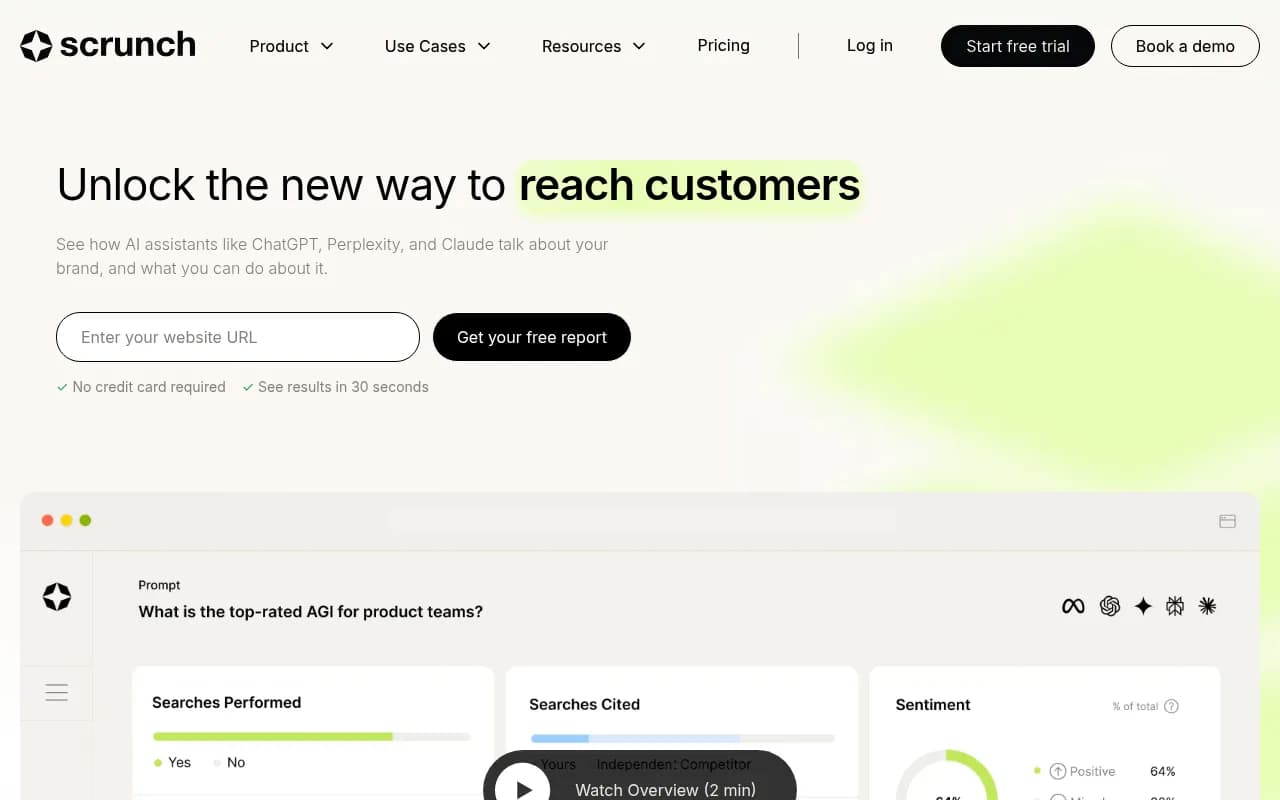
Scrunch AI -- best for content-focused e-learning teams
Scrunch AI combines AI visibility tracking with content analysis, making it a reasonable choice for e-learning brands that produce a lot of content and want to understand which pieces are getting cited by AI engines.
The platform shows you citation sources, lets you analyze competitor content strategies, and gives you some guidance on what to create next. It's not as comprehensive as Promptwatch's content generation capabilities, but it's a step beyond pure monitoring.
Peec AI -- best budget option for small e-learning brands
Peec AI is a lightweight AI visibility tracker that covers the major models at a price point accessible to smaller teams. If you're running a niche e-learning platform or a solo creator with a course business, Peec gives you enough data to understand whether you're showing up in AI answers without the overhead of an enterprise tool.
The feature set is limited -- no content generation, no crawler logs, no advanced competitive analysis -- but for basic monitoring it does the job.

AthenaHQ -- best for structured competitive analysis
AthenaHQ focuses on competitive AI visibility benchmarking. For e-learning brands that want to understand exactly how they stack up against Coursera, LinkedIn Learning, or niche competitors in AI responses, the competitive heatmaps are genuinely useful.
Like most tools in this space, it's monitoring-focused. The competitive data is good; the path from insight to action is still manual.

Feature comparison table
| Tool | AI models covered | Custom prompts | Content generation | Crawler logs | Competitive analysis | Starting price |
|---|---|---|---|---|---|---|
| Promptwatch | 10 | Yes | Yes (Content Agents) | Yes | Yes | $99/mo |
| Profound | 9+ | Yes | No | No | Yes | Higher |
| Otterly.AI | 3+ | Yes | No | No | Basic | Lower |
| Semrush AI Toolkit | Multiple | Fixed only | No | No | Yes | Add-on |
| Scrunch AI | Multiple | Yes | Partial | No | Yes | Mid-range |
| Peec AI | Multiple | Yes | No | No | Basic | Low |
| AthenaHQ | Multiple | Yes | No | No | Strong | Mid-range |
How to actually use these tools for e-learning
Buying a GEO tool is the easy part. Getting value from it requires a bit of strategy specific to your vertical.
Start with your highest-intent prompts
Don't try to track everything. Start with the prompts that represent real buying decisions: "best platform for [certification]", "online course for [skill] beginners", "[your category] course comparison". These are the queries where being cited translates directly to enrollments.
Tools like Promptwatch give you prompt volume estimates and difficulty scores, so you can prioritize the prompts that are both high-traffic and winnable -- rather than going after queries dominated by Coursera with a $50M content budget.
Map your content against what AI engines actually want
Run your top prompts and look at what AI engines cite in their responses. Are they citing blog posts? Course pages? Reddit threads? YouTube videos? This tells you where to publish and what format works.
For e-learning, AI engines tend to cite:
- Comparison articles ("X vs Y for [goal]")
- Outcome-focused content ("How to pass [certification] with [platform]")
- Expert-authored guides on specific skills
- Reviews and testimonials aggregated in structured formats
If your site is mostly course landing pages and not much editorial content, that's a gap worth addressing.
Use persona tracking to understand your different audiences
An L&D manager evaluating enterprise training solutions is asking different questions than a self-taught developer looking for a Python course. Set up separate prompt sets for each persona and track them independently. The AI responses -- and your visibility in them -- will differ significantly.
Track offsite citations too
Your AI visibility isn't just about your own website. AI engines cite Reddit threads, YouTube videos, third-party review sites, and industry publications. Tools like Promptwatch show you which external sources are driving citations for your category, so you can identify where to build a presence beyond your own domain.
What to look for when choosing a GEO tool for e-learning
Not every GEO tool is built the same, and some features matter more for education than for other verticals.
Custom prompt support. You need to define the exact questions your learners ask, not work from a fixed template library. E-learning prompts are specific and varied.
Persona and location targeting. Corporate buyers, individual learners, and international students all prompt differently. Tools that let you customize the "who" behind each prompt give you more accurate data.
Content gap analysis. Knowing you're invisible is only useful if you can figure out why. Look for tools that show you what content competitors have that you don't.
Page-level citation tracking. Which specific pages on your site are being cited? This tells you what's working and where to double down.
Multi-language support. If you serve learners in multiple markets, you need to track AI visibility in those languages. English-only monitoring misses a lot.
Integration with your existing workflow. Can you export data to Looker Studio? Connect to your CMS? The best tools fit into how your team already works rather than creating a new silo.
A practical starting point
If you're just getting started with GEO for your e-learning brand, here's a simple sequence:
- Pick 10-15 high-intent prompts that represent real learner searches in your category.
- Run them manually in ChatGPT, Perplexity, and Google AI Mode. Note who gets cited and who doesn't.
- Set up a GEO tool to track these prompts automatically over time.
- Identify the content gaps -- what do cited competitors have that you don't?
- Create content that directly addresses those gaps, using real prompt data to guide the angle and format.
- Track whether your new content gets crawled and cited, and iterate.
The tools that support all six steps in one platform -- rather than requiring you to stitch together four different tools -- are the ones worth paying for. That's the core argument for a platform like Promptwatch over a collection of point solutions.
The e-learning market is competitive, and AI search is already reshaping how learners discover platforms. The brands that understand this now and act on it will have a real advantage over those that figure it out two years from now.