Key takeaways
- AI search engines like ChatGPT, Perplexity, and Google AI Overviews are now a primary discovery channel for homebuyers, sellers, and investors — and most real estate brands have no idea if they're being cited.
- GEO (Generative Engine Optimization) tools let you track brand mentions, citations, and recommendations across AI models, then act on the gaps.
- The real estate vertical has specific tracking needs: local market queries, agent recommendations, neighborhood comparisons, and mortgage/investment prompts.
- Most monitoring-only tools show you the problem but leave you stuck. The best platforms close the loop by helping you create content that actually gets cited.
- Promptwatch is the only platform rated "Leader" across all GEO categories in 2026, with crawler logs, content generation, and Reddit/YouTube tracking that matter specifically for real estate.
Why real estate brands need GEO tracking now
A homebuyer in 2026 doesn't start with Zillow. They open ChatGPT and ask: "What are the best neighborhoods in Austin for families under $600k?" Or they ask Perplexity: "Which real estate agents in Denver specialize in first-time buyers?"
If your brand isn't in the answer, you don't exist for that buyer.
This is the core problem GEO tracking solves. Traditional SEO tools tell you where you rank in Google's blue links. But AI search engines don't show blue links — they synthesize answers from sources they've already decided to trust. By the time a user reads the response, the decision about who to cite has already been made.
Real estate is particularly exposed here. The queries AI models handle for real estate are highly local, highly specific, and high-intent. "Best real estate agent in [city]" prompts are being answered by ChatGPT, Gemini, and Perplexity millions of times per month. The brands that show up in those answers are capturing leads. The ones that don't are invisible.
The good news: this is a solvable problem. GEO tools can show you exactly where you're missing, which competitors are being cited instead of you, and what content you need to create to change that.
What makes real estate GEO tracking different
Before diving into tools, it's worth understanding what makes real estate a distinct use case for AI visibility tracking.
Local intent dominates. Most real estate queries are geographically scoped. "Best neighborhoods in Phoenix" and "top realtors in Chicago suburbs" are fundamentally local questions. You need a platform that tracks AI responses by city, state, or region — not just at a national level.
Agent and listing recommendations matter. AI models increasingly recommend specific agents, brokerages, and listing platforms. Tracking whether your brand appears in those recommendation sets is different from tracking generic brand mentions.
The "source stack" is narrow. AI models cite a small set of trusted sources for real estate: major listing platforms, local news, review sites, Reddit threads, and authoritative local content. Understanding which sources are driving citations in your market is essential.
Prompt volume varies wildly by market. A query like "best real estate agent in Manhattan" gets asked far more often than the same query for a smaller market. Good GEO tools give you prompt volume estimates so you can prioritize where to invest.
Competitor visibility is hyperlocal. In real estate, your competitor isn't Zillow nationally — it's the top three brokerages in your specific market. You need competitor heatmaps that reflect local dynamics.
The best GEO tools for real estate AI visibility tracking
Promptwatch — the full-cycle platform
Promptwatch is the most complete option for real estate brands that want to go beyond monitoring and actually fix their AI visibility.

What makes it relevant for real estate specifically:
The Answer Gap Analysis shows you exactly which prompts your competitors are appearing in but you're not. For a real estate brand, this means you can see that a competitor is being cited for "best buyer's agents in [city]" and you're not — and then understand why. Is it a content gap? A citation gap? A structured data issue?
The Content Agents generate articles, neighborhood guides, comparison pages, and FAQs grounded in real prompt data. This isn't generic content — it's engineered to answer the specific questions AI models are already asking about your market.
The AI Crawler Logs show you when ChatGPT, Perplexity, and Claude are crawling your site, which pages they're reading, and whether those pages are making it into citations. For a real estate site with hundreds of neighborhood pages and listing descriptions, this is genuinely useful — you can see which pages AI engines are ignoring and fix them.
Multi-region and multi-language tracking matters for real estate brands operating across multiple markets or serving international buyers.
Promptwatch also tracks Reddit and YouTube — two channels that heavily influence AI recommendations in real estate. Discussions on r/RealEstate, r/FirstTimeHomeBuyer, and local subreddits are frequently cited by AI models. Knowing what those discussions say about your brand (or your competitors) is actionable intelligence.
Pricing starts at $99/month for the Essential plan (1 site, 50 prompts). The Professional plan at $249/month adds crawler logs and city-level tracking, which is the tier most real estate brands will want.
Profound — enterprise-grade prompt intelligence
Profound

Profound is a strong choice for larger real estate enterprises — think national brokerages, large property management companies, or REITs that need deep prompt intelligence across many markets.
Its strength is in tracking prompt volume and difficulty at scale. For a brand operating in 20+ markets, Profound's ability to surface which prompts are high-value and winnable is genuinely useful. The trade-off: it's monitoring-focused. You get excellent data about where you stand, but the platform doesn't help you create content to close the gaps. That means your team needs to act on the data themselves, or pair Profound with a content tool.
Pricing is on the higher end, which makes it better suited to enterprise budgets.
Otterly.AI — lightweight monitoring for smaller teams
Otterly.AI

Otterly.AI is a simpler, more affordable option for independent agents, small brokerages, or property management companies that just want to know if they're showing up in AI answers.
It tracks brand mentions across ChatGPT, Perplexity, and Google AI Overviews. Setup is fast, the interface is clean, and you don't need a technical background to use it.
The limitation is that it's purely monitoring. There's no content gap analysis, no crawler logs, no content generation. If you discover you're invisible in AI search, Otterly.AI tells you that — but doesn't help you fix it. For real estate brands that are serious about AI visibility, this becomes a ceiling fairly quickly.
Semrush — for teams already in the SEO ecosystem
Semrush added AI visibility tracking to its platform, which makes it a reasonable starting point for real estate marketing teams already using it for traditional SEO. The advantage is consolidation — you're not adding another tool to your stack.
The limitation is depth. Semrush uses fixed prompt sets rather than dynamic prompt tracking, which means you're not seeing the full picture of how AI models respond to real user queries in your market. For a national real estate brand running broad SEO campaigns, this might be acceptable. For a regional brokerage trying to dominate AI search in specific markets, it's not enough.
AthenaHQ — solid monitoring, limited action

AthenaHQ does a good job of tracking brand visibility across AI search engines and presenting it in a clean dashboard. Real estate teams that want a clear view of their AI presence without a steep learning curve will find it accessible.
Like Otterly.AI, though, it's monitoring-focused. The platform doesn't offer content optimization or generation capabilities, so you're on your own when it comes to actually improving your visibility.
Peec AI — affordable entry point
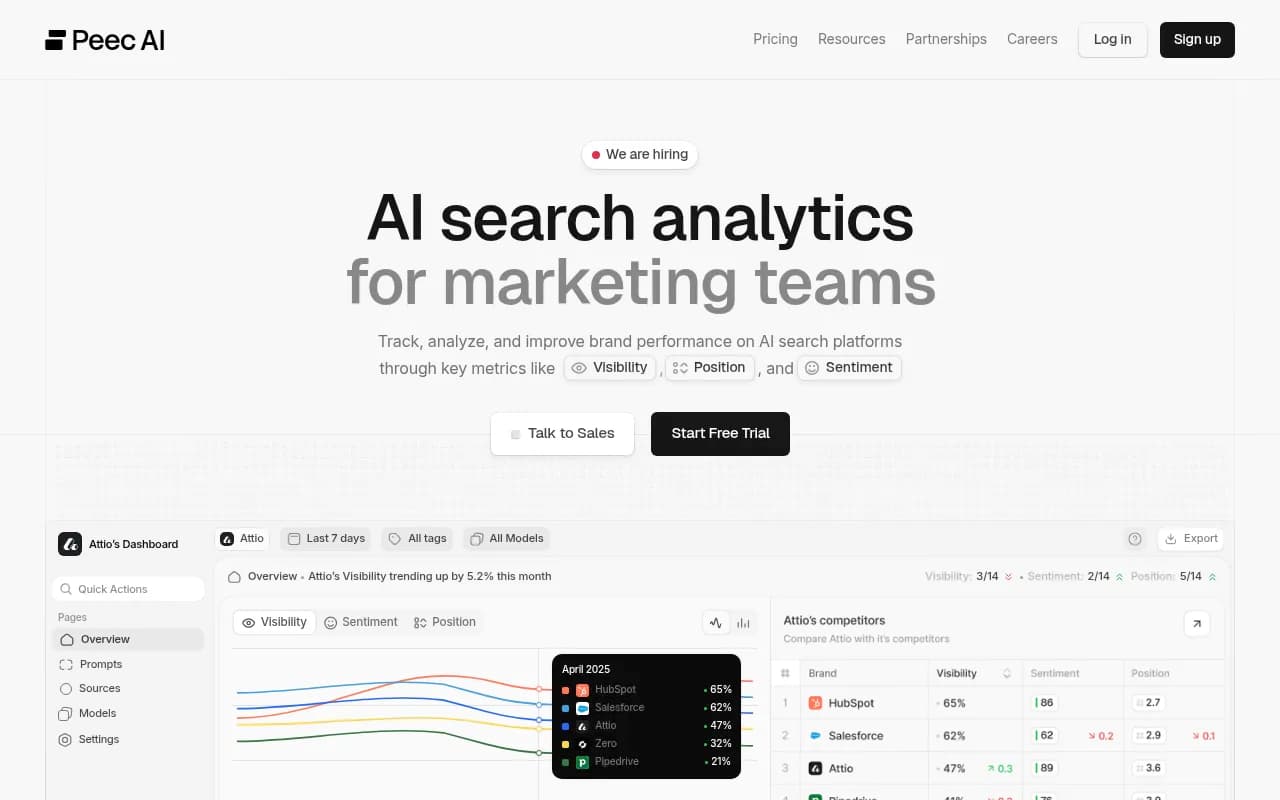
Peec AI is worth mentioning for real estate professionals who want to dip their toes into AI visibility tracking without committing to a larger platform. It tracks brand mentions across major AI engines and provides basic reporting.
It's a monitoring tool, not an optimization platform. But for an independent agent or a small team that just wants to understand the landscape before investing in a more complete solution, it's a reasonable starting point.
LLM Pulse — focused brand tracking
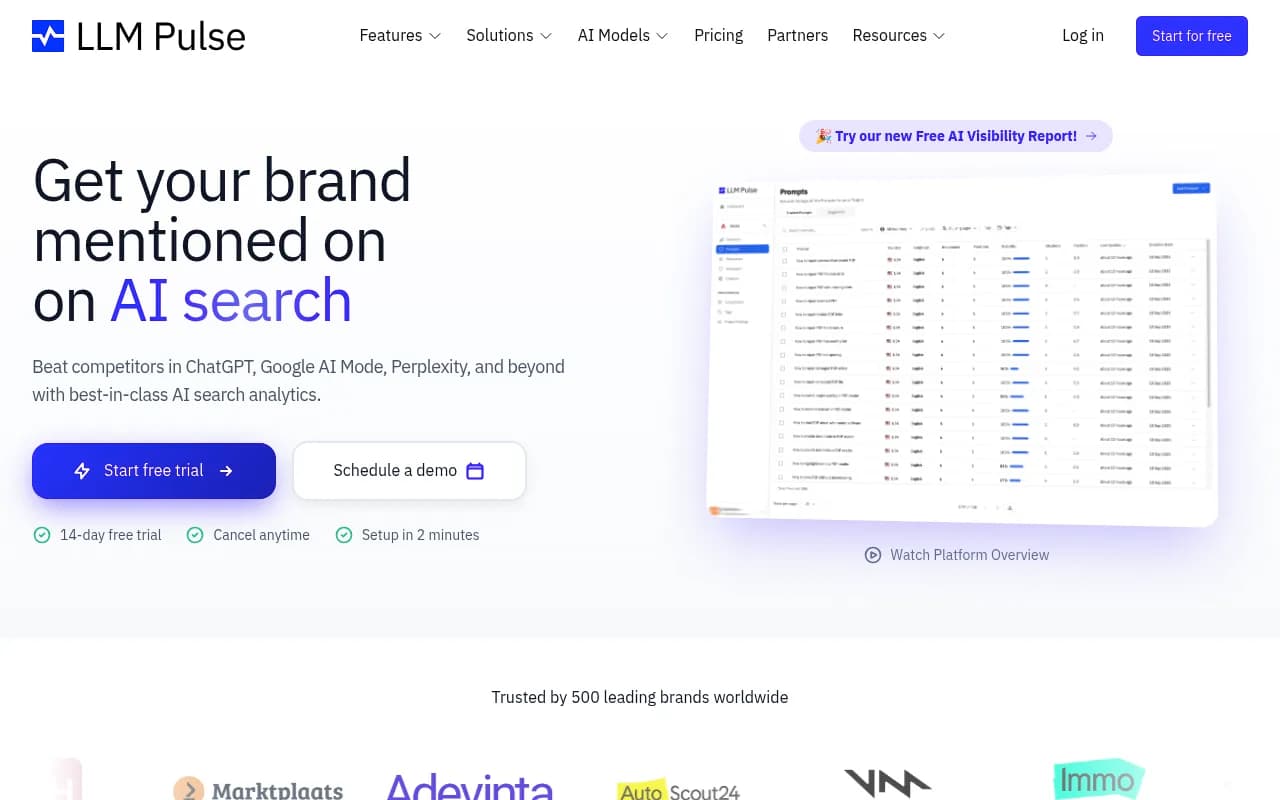
LLM Pulse tracks brand visibility across ChatGPT, Perplexity, and other AI search engines. It's a clean, focused tool that works well for real estate brands that want to monitor specific brand mentions and competitor comparisons without the complexity of a full GEO platform.
Comparison: GEO tools for real estate AI visibility
| Tool | Monitoring | Content generation | Crawler logs | Local/city tracking | Reddit/YouTube | Best for |
|---|---|---|---|---|---|---|
| Promptwatch | Yes | Yes | Yes | Yes | Yes | Full-cycle optimization, any size |
| Profound | Yes | No | No | Limited | No | Enterprise monitoring |
| Otterly.AI | Yes | No | No | No | No | Small teams, basic monitoring |
| Semrush | Yes | Partial | No | No | No | Teams already using Semrush |
| AthenaHQ | Yes | No | No | No | No | Clean monitoring dashboards |
| Peec AI | Yes | No | No | No | No | Entry-level monitoring |
| LLM Pulse | Yes | No | No | No | No | Brand mention tracking |
How to use GEO tools effectively for real estate
Start with the right prompts
The prompts you track determine the value you get. For real estate, the most important prompt categories are:
- Agent recommendation queries: "best real estate agent in [city]", "top buyer's agents near me"
- Neighborhood research: "best neighborhoods in [city] for families", "up-and-coming areas in [city]"
- Market condition queries: "is it a good time to buy in [city]", "real estate market forecast [city] 2026"
- Brokerage comparisons: "Keller Williams vs RE/MAX in [city]", "best real estate companies in [state]"
- Investment queries: "best cities to invest in real estate 2026", "rental yield by neighborhood [city]"
Most GEO platforms let you set up custom prompt tracking. Start with 20-30 prompts that reflect your actual business — the markets you serve, the buyer types you target, and the questions your clients ask before they contact you.
Map your content to AI citation patterns
AI models cite specific types of content for real estate queries. Neighborhood guides with structured data, market reports with specific statistics, FAQ pages that directly answer common buyer questions, and third-party review profiles (Google Business, Yelp, Realtor.com) all influence what gets cited.
Use your GEO tool's citation analysis to see which pages on your site are actually being cited — and which aren't. A common finding for real estate brands: their homepage gets crawled but their neighborhood guides (which are the actual content AI models want) aren't being indexed properly.
Track competitors locally, not nationally
Real estate competition is local. Set up competitor tracking for the specific brokerages and agents competing in your markets, not just national brands. Seeing that Compass is being cited more than you in your specific city is more actionable than a national comparison.
Act on Reddit and YouTube data
This is underutilized. AI models frequently cite Reddit discussions when answering real estate questions — particularly for "is [neighborhood] safe", "what's it like to live in [city]", and agent recommendation queries. If your brand is being discussed negatively on local subreddits, that's influencing AI responses. If competitors are being recommended on r/RealEstate, that's a gap you can close by building your own presence in those communities.
Building a GEO content strategy for real estate
Tracking is only half the job. Once you know where you're invisible, you need to create content that changes that.
The content types that tend to get cited by AI models for real estate queries:
Neighborhood guides with specific data points: median home prices, school ratings, commute times, walkability scores, recent development activity. The more specific and data-rich, the more useful AI models find them.
Market reports published regularly. AI models favor fresh, authoritative data. A quarterly market report for your specific market, with actual transaction data and trend analysis, is exactly the kind of content that gets cited.
FAQ pages that directly answer the questions buyers and sellers ask. Structure these with clear question-and-answer formatting. AI models are essentially pattern-matching against question-answer pairs when generating responses.
Agent and team pages with structured data markup. If AI models are recommending agents, they need to be able to identify who your agents are, what they specialize in, and where they operate. Schema markup for local businesses and real estate professionals helps here.
Third-party presence: Ensure your brand is well-represented on Realtor.com, Zillow agent profiles, Google Business, and local review platforms. AI models pull from these sources heavily for real estate recommendations.
Platforms like Promptwatch can generate content briefs and full articles grounded in the specific prompt gaps your tracking reveals — which is significantly faster than building this content strategy from scratch.
What to expect from AI visibility in real estate
One thing worth being honest about: AI visibility in real estate is volatile. Citation patterns can shift 40-60% month-over-month as models retrain and update their knowledge. A neighborhood guide that's being cited heavily today might drop off next month if a competitor publishes something more comprehensive.
This means GEO isn't a one-time project. It's an ongoing cycle: track what's happening, identify gaps, create content, track the results. The brands that treat it as a continuous process will compound their advantage over time. The ones that do a one-time audit and move on will find themselves back at square one within a few months.
The real estate brands winning in AI search right now are the ones that have built this cycle into their marketing operations — not as a separate "AI SEO" project, but as a core part of how they produce and publish content.
Choosing the right tool for your situation
If you're a national or regional brokerage with multiple markets and a dedicated marketing team, Promptwatch's Professional or Business plan gives you the full picture: city-level tracking, crawler logs, content generation, and competitor heatmaps across all your markets.
If you're a mid-size brokerage or property management company that wants to start tracking without a large investment, Otterly.AI or Peec AI let you get started quickly. Just know you'll likely outgrow them as you start wanting to act on the data.
If you're an independent agent or small team, even basic monitoring is better than nothing. Start with a lightweight tool, understand where you stand, and upgrade when you're ready to invest in optimization.
The common thread: the real estate brands that will own AI search in their markets are the ones that start tracking now, while most competitors are still ignoring the channel entirely.