Key takeaways
- Ahrefs Brand Radar costs at least $398/mo on top of an existing Ahrefs subscription -- Authoritas starts at £99/mo as a standalone product, making it far more accessible for smaller teams.
- Brand Radar's biggest strength is scale: 210M+ search-backed prompts drawn from Ahrefs' web index. Authoritas relies on a smaller custom prompt set but covers 7 AI platforms including DeepSeek.
- Both tools are monitoring-first. Neither generates content to fix the gaps they find -- they show you where you're invisible but leave the remediation to you.
- Authoritas covers traditional SEO (rank tracking, site audits, eCommerce) alongside AI tracking in one subscription. Brand Radar is AI visibility only, bolted onto Ahrefs' existing suite.
- If you're already paying for Ahrefs, Brand Radar is a natural extension. If you're not, the combined cost of an Ahrefs plan plus Brand Radar makes it one of the pricier options in this space.
- Neither tool offers AI crawler logs, prompt volume scoring, or content generation -- capabilities that matter if you want to do more than watch your visibility score move.
Overview
Ahrefs Brand Radar
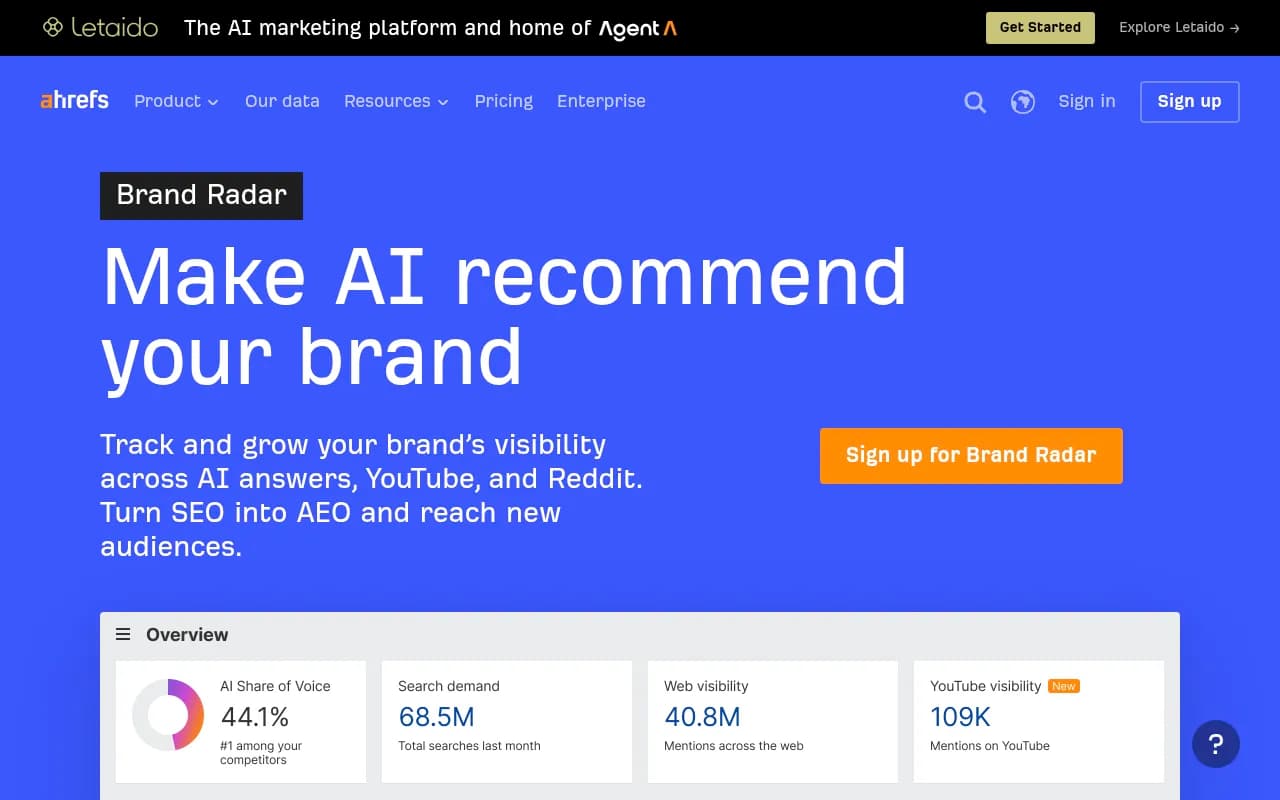
Ahrefs Brand Radar is the AI visibility layer inside the Ahrefs platform. It tracks how your brand (and competitors) appear in AI-generated search results across six AI tools, pulling from Ahrefs' proprietary index of 210M+ search-backed prompts. The pitch is breadth: because the prompts come from real search data rather than a manually curated list, you get coverage across a huge range of queries without having to set anything up yourself.
The catch is the pricing model. Brand Radar isn't a standalone product -- it's an add-on. You need an active Ahrefs subscription first, then pay extra for Brand Radar access. That makes it a logical choice if your team already lives in Ahrefs, but a hard sell if you don't.
Authoritas
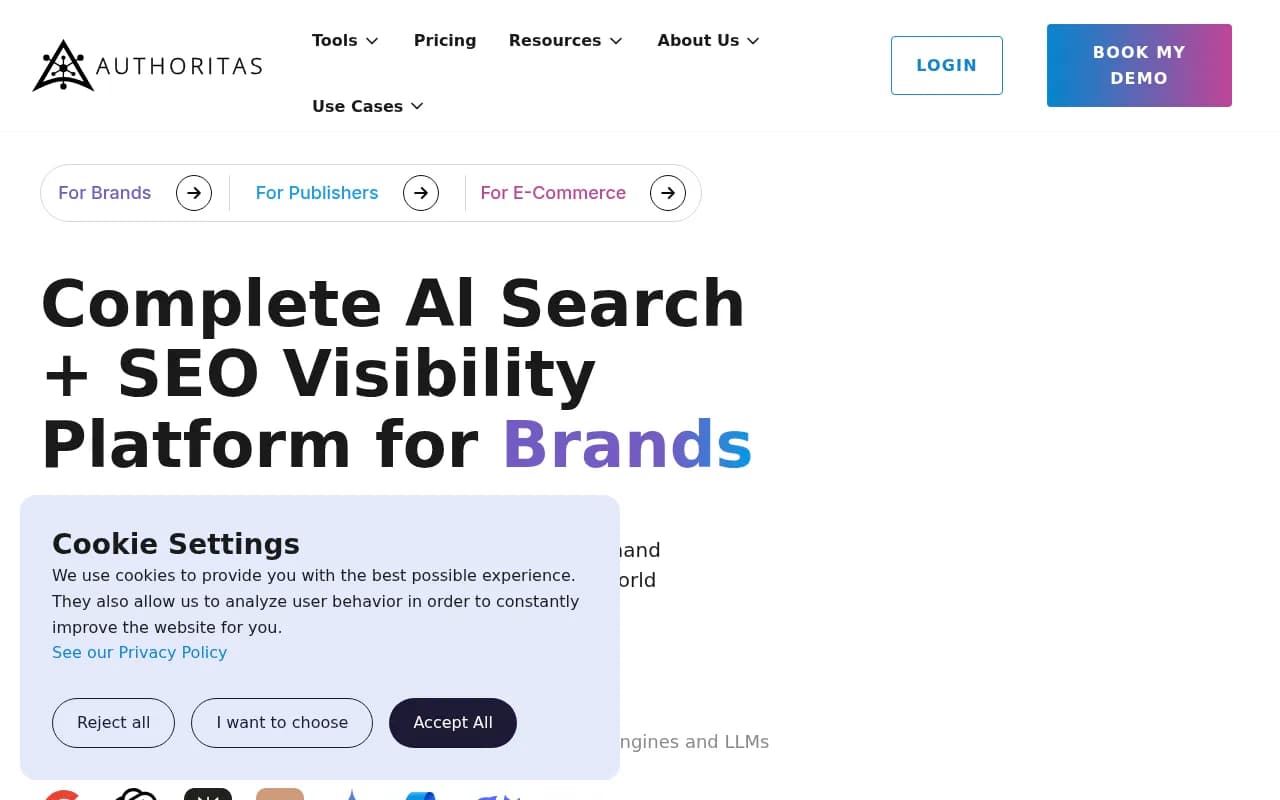
Authoritas positions itself as a complete AI Search + SEO Visibility Platform, covering brands, publishers, and eCommerce businesses. It tracks AI brand mentions across ChatGPT, Perplexity, Claude, Gemini, Copilot, Google AIO, and DeepSeek, while also offering traditional SEO features like rank tracking and site audits.
The platform has been around longer than most dedicated GEO tools, which shows in its breadth of SEO features. The AI tracking layer feels like a genuine extension of an established product rather than a rushed add-on. Pricing starts at £99/mo, which is meaningfully lower than Brand Radar's entry point -- and it doesn't require a separate base subscription.
Side-by-side comparison
| Feature | Ahrefs Brand Radar | Authoritas |
|---|---|---|
| Standalone product | No (requires Ahrefs subscription) | Yes |
| Entry price | $398/mo (add-on) | £99/mo |
| Full AI coverage price | $699/mo (add-on) | £399/mo (Advanced) |
| AI models covered | 6 | 7 (incl. DeepSeek) |
| Prompt dataset | 210M+ search-backed prompts | Custom prompts |
| Custom prompts | Yes | Yes |
| Competitor tracking | Yes | Yes |
| Traditional SEO tools | Via Ahrefs base plan | Yes (built-in) |
| Rank tracking | Via Ahrefs | Yes |
| Site audit | Via Ahrefs | Yes |
| eCommerce features | No | Yes |
| Publisher features | No | Yes |
| AI content generation | No | No |
| Crawler logs / agent analytics | No | No |
| Prompt volume scoring | No | No |
| Reddit/YouTube tracking | No | No |
| Free tier | No | Free trial |
| Setup required | Zero (auto-populated prompts) | Low |
Head-to-head feature deep-dive
Prompt data and coverage
This is where the two tools diverge most sharply.
Ahrefs Brand Radar draws on 210M+ prompts derived from Ahrefs' web crawl and search data. The idea is that these prompts reflect what people are actually searching, so your visibility data maps to real-world query patterns. You don't need to manually add prompts to get broad coverage -- the system populates them automatically. You can still add custom prompts for specific branded or niche queries.
Authoritas uses a custom prompt approach. You define the prompts that matter to your brand, and the platform tracks your visibility across those. This gives you more control over what you're measuring, but the coverage depends on how well you've thought through your prompt set. There's no equivalent of Brand Radar's auto-populated 210M prompt library.
For teams that want breadth without setup work, Brand Radar has a real edge here. For teams that care about specific, highly targeted queries, Authoritas's custom approach is more flexible.
Verdict: Brand Radar wins on scale; Authoritas wins on control.
AI model coverage
| AI platform | Ahrefs Brand Radar | Authoritas |
|---|---|---|
| ChatGPT / OpenAI | Yes | Yes |
| Google AI Overviews | Yes | Yes |
| Perplexity | Yes | Yes |
| Claude | Yes | Yes |
| Gemini | Yes | Yes |
| Copilot | Yes | Yes |
| DeepSeek | Not confirmed | Yes |
Both tools cover the major platforms. Authoritas explicitly lists DeepSeek, which is a meaningful addition given its growing usage. Brand Radar covers 6 AI tools -- the exact lineup isn't always spelled out clearly in their marketing, which is a minor frustration when you're trying to compare.
Verdict: Roughly even, slight edge to Authoritas for confirmed DeepSeek coverage.
Traditional SEO integration
This is a structural difference, not a feature gap.
Ahrefs Brand Radar sits inside the Ahrefs ecosystem. If you're already using Ahrefs for keyword research, backlink analysis, site audits, and rank tracking, Brand Radar slots in without any workflow change. Your AI visibility data lives in the same platform as your organic search data. That's genuinely useful -- you can cross-reference AI visibility with organic rankings, see which pages rank in both, and build a unified picture of search performance.
Authoritas is a standalone platform that includes traditional SEO features natively. Rank tracking, site audits, keyword research, and AI visibility all live in one subscription. For teams that don't already use Ahrefs (or don't want to), this is a cleaner setup. You're not paying for two separate products.
The tradeoff: Ahrefs' traditional SEO data is deeper and more established than Authoritas's. If you're a serious SEO team, Ahrefs' backlink index and keyword data are hard to match. But if you're primarily focused on AI visibility and want a capable-enough SEO layer without the Ahrefs price tag, Authoritas makes sense.
Verdict: Ahrefs wins on SEO data depth; Authoritas wins on value if you're not already an Ahrefs customer.
Competitor analysis
Both tools let you track competitor brands alongside your own. You can see share of voice across AI platforms, compare how often competitors get cited versus your brand, and identify which AI models favor which brands.
Authoritas shows this as a share of voice trend over time, with visualizations that make it easy to spot when a competitor gains ground. Brand Radar offers similar competitive benchmarking, with the advantage that its large prompt dataset gives you a broader competitive picture across more query types.
Neither tool goes deep on why a competitor is winning -- they show you the gap but not the content or citation sources driving it.
Verdict: Roughly equal; Brand Radar has broader coverage, Authoritas has cleaner trend visualization.
Content optimization and gap analysis
Neither tool does this well, and that's worth saying plainly.
Both Ahrefs Brand Radar and Authoritas are monitoring tools. They tell you where you're visible and where you're not. They don't tell you what content to create, which pages to optimize, or how to close the gaps they surface. You get the data, then you're on your own.
This is the biggest limitation of both products if your goal is to actually improve your AI visibility rather than just measure it. For teams that want to move from tracking to fixing, you'd need to layer in a separate tool. Promptwatch is built specifically around this loop -- find gaps, generate content grounded in real prompt data, then track whether the new content gets cited.

Verdict: Both tools fall short here. Neither is an optimization platform.
Ease of use and setup
Brand Radar's zero-setup promise is real. Because prompts are auto-populated from Ahrefs' search data, you can get a visibility snapshot without manually building a prompt list. For teams that don't know where to start with AI tracking, this removes a meaningful barrier.
Authoritas requires more upfront configuration -- you define your prompts, set up your brand, and configure the tracking parameters. It's not complicated, but it's not instant either. The payoff is that your tracking is more tailored to your specific use case.
Verdict: Brand Radar is faster to get started; Authoritas gives you more control over what you're tracking.
Pricing comparison
| Plan | Ahrefs Brand Radar | Authoritas |
|---|---|---|
| Free tier | No | Free trial |
| Entry / Essential | $398/mo (add-on to Ahrefs) | £99/mo (~$125/mo) |
| Mid-tier | Not specified | £399/mo (~$505/mo) |
| Advanced / Full coverage | $699/mo (add-on) | $799/mo (Expert) |
| Base subscription required | Yes (Ahrefs from ~$129/mo) | No |
| Effective entry cost (all-in) | ~$527/mo+ | £99/mo |
The pricing gap at entry level is significant. Authoritas at £99/mo is a standalone product. Brand Radar at $398/mo requires you to already be paying for Ahrefs -- so the real cost for a new customer is closer to $527/mo or more depending on which Ahrefs plan you're on.
At the high end, the gap narrows. Full AI coverage on Brand Radar is $699/mo (plus Ahrefs), while Authoritas's Expert tier is $799/mo. But by that point, Authoritas includes traditional SEO features in the price, whereas Brand Radar's $699 is just the AI visibility add-on.
Pros and cons
Ahrefs Brand Radar
Pros:
- 210M+ search-backed prompts means broad, automatic coverage without manual setup
- Seamless integration if you're already an Ahrefs customer
- Ahrefs' underlying data quality is strong and well-established
- Zero setup -- visibility data available immediately
Cons:
- Requires an existing Ahrefs subscription -- not a standalone product
- Effective entry cost is $527/mo+ for new customers
- Fixed prompts only -- no prompt volume scoring or difficulty data
- No AI traffic attribution or crawler logs
- No content generation or gap remediation tools
- Covers 6 AI platforms (DeepSeek coverage unclear)
Authoritas
Pros:
- Standalone product -- no base subscription required
- Much lower entry price (£99/mo)
- Covers 7 AI platforms including DeepSeek
- Traditional SEO features (rank tracking, site audits) included
- Publisher and eCommerce-specific features
- Free trial available
Cons:
- Smaller prompt dataset than Brand Radar's 210M+ library
- No AI content generation or optimization tools
- No crawler logs or agent analytics
- Less established SEO data than Ahrefs' index
- Custom prompt setup requires more upfront work
Who should pick which tool
Pick Ahrefs Brand Radar if:
- You're already paying for Ahrefs and want AI visibility without switching tools
- You want broad, auto-populated prompt coverage without manual setup
- Your team is SEO-heavy and values Ahrefs' backlink and keyword data alongside AI tracking
- You're tracking a large number of queries and want the 210M prompt library
Pick Authoritas if:
- You're not an Ahrefs customer and don't want to pay for two separate subscriptions
- Budget is a constraint -- £99/mo is a real entry point, not a teaser
- You need traditional SEO features (rank tracking, audits) alongside AI visibility in one tool
- You serve eCommerce clients or publishers who need platform-specific features
- You want DeepSeek coverage confirmed out of the box
Final verdict
These two tools solve the same core problem -- tracking brand visibility in AI search -- but they come from very different starting points.
Ahrefs Brand Radar is the right call if you're already inside the Ahrefs ecosystem and want to extend your existing workflow into AI visibility. The 210M prompt dataset is a genuine differentiator, and zero-setup coverage is a real convenience. But the pricing model is punishing for anyone who isn't already an Ahrefs customer, and the tool doesn't do anything to help you fix the gaps it finds.
Authoritas is the more accessible option for teams that want a standalone platform. The lower price, built-in SEO features, and confirmed DeepSeek coverage make it a practical choice for smaller teams or agencies that don't want to commit to the Ahrefs stack. The prompt dataset is smaller, but for most teams tracking a defined set of queries, that won't matter much.
The honest summary: both are monitoring tools, and monitoring alone won't improve your AI visibility. If you're serious about closing the gaps these tools surface, you'll need something that goes further than a dashboard.