Subconscious.ai Review 2026
Subconscious.ai is a behavioral simulation platform that replaces traditional market research with AI-powered digital twins. Using Nobel Prize-winning discrete choice models, it runs causal experiments to predict customer behavior with 93% accuracy. Test pricing, messaging, product features, and seg
Key Takeaways
- Behavioral simulation, not surveys: Subconscious.ai predicts what customers will actually do (not what they say they'll do) by running causal experiments on digital twins trained on 3.5M real decision patterns -- achieving 93% human-level accuracy
- Speed and cost advantage: Complete experiments in 5 minutes that traditionally take 3-6 months and cost $20K-$120K. ROI typically 100× within the first quarter.
- Causal inference, not correlation: Built on Nobel Prize-winning discrete choice models that reveal true behavioral drivers and hidden motivations -- not just demographic patterns or surface-level correlations
- Limitations: Pricing not publicly disclosed (enterprise/custom only), steep learning curve for teams unfamiliar with causal modeling, and limited transparency on how the 3.5M training dataset was constructed
- Best for: Product teams, pricing strategists, and growth marketers at mid-to-late stage startups or enterprises who need to validate high-stakes decisions (pricing changes, product launches, messaging pivots) without burning months on traditional research
Subconscious.ai is a behavioral simulation platform that fundamentally rethinks how companies understand customer decision-making. Instead of running surveys or focus groups that ask people what they might do, it simulates what they will do by creating digital twins of your actual customers and running causal experiments on them. The platform is built on discrete choice modeling -- a Nobel Prize-winning framework from behavioral economics -- and claims 93% accuracy in predicting real human behavior.
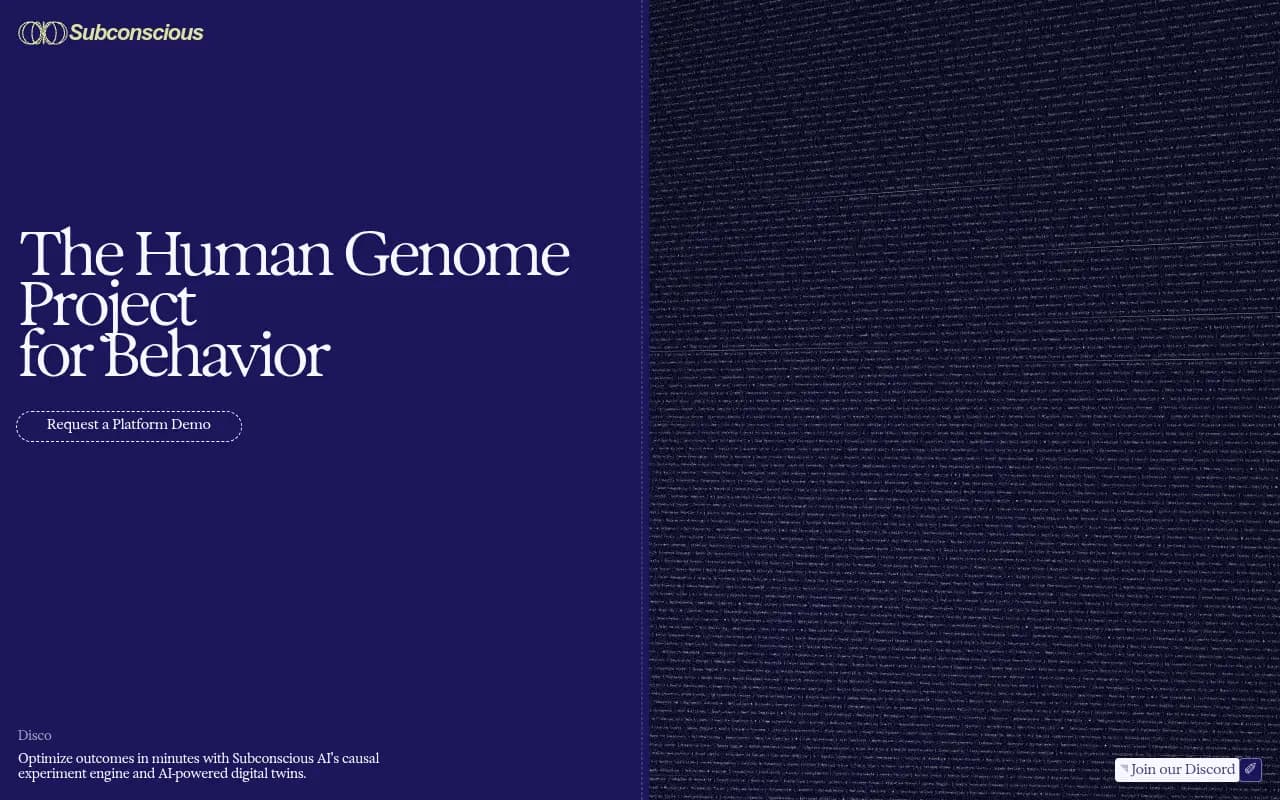
The company positions itself as "the Human Genome Project for Behavior," aiming to map the hidden variables (attitudes, motivations, psychological traits) that actually drive decisions. It's designed for product teams, growth marketers, pricing strategists, and anyone making high-stakes decisions about customer behavior where traditional research is too slow or too expensive.
Subconscious.ai was founded by researchers and engineers with backgrounds in causal inference and computational social science. The platform has worked with clients ranging from aerospace manufacturers (one saved $8M in research costs) to SaaS companies like Finta (which used it to justify a 5× price increase that drove +92% revenue) to global consulting firms like PwC and Deloitte. It's SOC 2 Type II certified and designed for enterprise use.
Core Capabilities: Causal Experiments on Digital Twins
The platform's central feature is its Causal Intelligence Engine, which runs true experiments (not just A/B tests or correlational analysis) on synthetic populations that mirror your customer base. Here's how the major capabilities break down:
Behavioral Simulation: You upload a business question ("Will customers pay $99/month for this feature?") and connect your customer data (CRM, CDP, or use pre-trained models). Subconscious.ai builds digital twins of your audience and runs experiments to predict behavior. Each simulation produces causal maps showing what drives choices and how to influence them. The platform models latent variables -- hidden psychological traits like risk aversion, status sensitivity, or price elasticity -- that demographics alone can't capture. This is the core differentiator: it's not predicting based on "30-year-old males in California" but on the underlying motivations that actually move people.
Causal Inference Framework: Built on discrete choice models (specifically referencing McFadden's Nobel Prize-winning work), the platform identifies cause-and-effect relationships rather than correlations. If you test 50 price points, it doesn't just tell you which one got the most clicks in a survey -- it tells you which one will maximize revenue and why, accounting for substitution effects, willingness-to-pay distributions, and behavioral elasticity. The causal maps show you the decision tree: "Customers who value X are willing to pay Y, but only if you message Z."
Continuous Learning: Each experiment improves the accuracy of future simulations. The platform claims organizational knowledge compounds exponentially -- the more you use it, the better it gets at predicting your specific customer base. This is a major advantage over one-off surveys or static personas.
Enterprise Data Integration: Import customer lists directly from your CRM (Salesforce, HubSpot) or CDP (Segment, mParticle). Simulations run on your actual customers, not generic segments or proxies. You can also use the platform's pre-trained models covering 3.5 million decision patterns if you don't have enough first-party data yet.
Privacy-Safe Architecture: GDPR and CCPA compliant. Your data never trains external models or gets shared with third parties. Digital twins are synthetic representations, not real individuals. SOC 2 Type II certified for enterprise security.
Fraud Elimination: No bots, no survey fatigue, no social desirability bias. Because you're simulating behavior rather than asking people questions, you eliminate the noise that plagues traditional research (people lying, misremembering, or not knowing their own preferences).
Use Cases: Pricing, Messaging, Product Validation, Segmentation
The platform is designed for six primary use cases, each with specific workflows:
Pricing Optimization: Test 50+ price points in an hour. Identify the revenue-maximizing plan before launch. Example: Finta used Subconscious.ai to validate a 5× price increase ($20/mo to $99/mo) and saw +92% revenue growth. The simulation showed that their target segment (CFOs at Series A startups) had much higher willingness-to-pay than they assumed, and the higher price actually increased perceived value.
Messaging and Creative Testing: Run 100 message variants instantly. Launch with copy that converts. Instead of running weeks of A/B tests or focus groups, simulate how different customer segments respond to different value propositions, emotional appeals, or feature callouts. The causal maps show which messages drive action for which personas.
Product Design and Validation: Kill losing features early. Double down on winners. Save quarters of burn. Test feature bundles, onboarding flows, or product roadmap priorities before building. One aerospace manufacturer saved $8M by using Subconscious.ai to validate product concepts before committing to tooling and production.
Behavioral Segmentation: Discover hidden customer segments by behavior and motivation, not just demographics. The platform clusters customers based on latent variables (e.g., "price-sensitive early adopters" vs. "status-driven late majority") that traditional RFM or demographic segmentation misses. These segments are actionable -- you can target them with different messaging, pricing, or product bundles.
Lead Scoring and Prediction: See who will convert before they raise a hand. Point sales where it counts. Predict which leads are most likely to buy based on behavioral signals, not just firmographics. This is particularly useful for B2B sales teams with long cycles.
Patient or Member Journeys (healthcare/insurance): Test timing, outreach, and incentives. Improve engagement and outcomes. Simulate how patients respond to different communication strategies, appointment reminders, or benefit designs.
Who Is Subconscious.ai For?
The platform is built for mid-to-late stage startups and enterprises making high-stakes decisions where traditional research is too slow or too expensive. Specific personas:
Product teams at Series B+ SaaS companies deciding which features to build, how to bundle them, or whether to launch a new tier. If you're about to spend $500K on engineering a feature that might not move the needle, Subconscious.ai can validate demand in 5 minutes for a fraction of the cost.
Pricing strategists and revenue ops teams at companies with complex pricing (multiple tiers, usage-based models, enterprise vs. self-serve). If you're considering a price change that could swing ARR by millions, you need more than gut feel or a Gartner report. Subconscious.ai models elasticity, substitution effects, and willingness-to-pay at the segment level.
Growth marketers and demand gen teams at companies spending $50K+/month on ads. If you're testing 10 landing page variants or 20 ad creatives, traditional A/B testing takes weeks and burns budget. Subconscious.ai simulates performance before you spend a dollar.
Consulting firms and agencies (PwC, Deloitte, boutique strategy shops) advising clients on market entry, product launches, or pricing strategy. The platform lets you deliver insights in days instead of months, at higher margins.
Healthcare and insurance companies optimizing member engagement, benefit design, or patient outreach. If you're trying to increase preventive care visits or reduce churn, Subconscious.ai simulates how different interventions perform across patient segments.
Who should NOT use this: Early-stage startups (pre-Series A) without enough customer data or budget for enterprise software. Teams that need simple A/B testing or basic survey tools (use Optimizely or Typeform instead). Companies in highly regulated industries where synthetic data or AI-driven predictions face legal/compliance hurdles. Teams without someone who understands causal inference or behavioral economics -- the platform requires some sophistication to interpret results correctly.
Integrations and Ecosystem
Subconscious.ai integrates with major CRMs and CDPs: Salesforce, HubSpot, Segment, mParticle. You can also upload CSV files or use the platform's API for custom workflows. The platform writes results back to your stack (e.g., updating lead scores in Salesforce or triggering campaigns in HubSpot based on simulation outcomes).
There's a GitHub repository (Subconscious-ai/sublime) labeled "Behavior Change as a Service," suggesting an open-source component or developer toolkit, though details are sparse. The platform also has a Discord community for users to share best practices and ask questions.
No mention of browser extensions, mobile apps, or Zapier integration. This is an enterprise platform accessed via web app, not a consumer tool.
Pricing and Value
Pricing is not publicly disclosed. Based on the website and case studies, this is a high-touch enterprise sale with custom pricing. The platform mentions "ROI typically 100× within the first quarter" and compares itself to traditional research that costs $20K-$120K per study and takes 3-6 months. If you're replacing even one major research project per year, the math works.
No free trial or freemium tier mentioned. You request a demo and go through a sales process. This is not a self-serve product.
For context: traditional conjoint studies or discrete choice experiments from firms like Qualtrics, Sawtooth Software, or market research agencies cost $50K-$200K and take 2-4 months. If Subconscious.ai delivers comparable insights in 5 minutes, even at $50K-$100K/year, the ROI is obvious for companies making multi-million-dollar decisions.
Strengths and Limitations
Strengths:
- Causal rigor: This is not another correlation dashboard. The platform uses Nobel Prize-winning models to identify true cause-and-effect relationships, which is rare in the martech/research space.
- Speed: 5 minutes vs. 3-6 months is a genuine 100× improvement. For fast-moving companies, this is the difference between validating a decision before launch vs. after.
- Accuracy: 93% human-level accuracy (validated on a leaderboard) is impressive. Most predictive models in marketing are 60-70% accurate at best.
- Fraud-free: No bots, no survey fatigue, no social desirability bias. You're simulating behavior, not asking people to predict their own behavior (which humans are notoriously bad at).
- Privacy-safe: GDPR/CCPA compliant, SOC 2 Type II certified. Your data stays yours.
- Continuous learning: Each experiment improves future accuracy, creating a compounding knowledge advantage.
Limitations:
- Pricing opacity: No public pricing makes it hard to evaluate fit without going through a sales process. This is common for enterprise software but still a barrier.
- Learning curve: The platform requires some understanding of causal inference and behavioral economics to interpret results correctly. Teams without a data scientist or economist may struggle.
- Training data transparency: The 3.5M decision patterns claim is impressive, but there's limited detail on how that dataset was constructed, what domains it covers, or how representative it is. A preprint is mentioned but not linked prominently.
- Limited self-serve: No free trial or freemium tier. You can't kick the tires without talking to sales.
- Validation questions: While 93% accuracy is cited, the leaderboard link goes to an archive page, and the validation methodology isn't fully transparent on the website. Independent third-party validation would strengthen credibility.
Bottom Line
Subconscious.ai is a serious tool for serious decisions. If you're a product leader at a Series B SaaS company deciding whether to build a $2M feature, a pricing strategist at an enterprise considering a price change that could swing $10M in ARR, or a consultant advising a client on market entry, this platform can save you months and hundreds of thousands of dollars in research costs. The causal inference rigor and speed are genuinely differentiated.
It's not for everyone. Early-stage startups, teams without data sophistication, or companies that just need basic A/B testing should look elsewhere. But for organizations making high-stakes decisions where traditional research is too slow or too expensive, Subconscious.ai is one of the most compelling tools in the behavioral prediction space.
Best use case in one sentence: Validate pricing, product, and messaging decisions in minutes using causal experiments on digital twins of your actual customers -- replacing months of traditional research at 1% of the cost.
Tags:
Frequently asked questions
What is Subconscious.ai and what does it do?
How much does Subconscious.ai cost?
Who is Subconscious.ai best for?
How accurate is Subconscious.ai at predicting customer behavior?
How fast can Subconscious.ai complete experiments compared to traditional research?
Does Subconscious.ai offer a free trial or free plan?
What are the limitations of Subconscious.ai?
How is Subconscious.ai different from traditional market research surveys?
Similar and alternative tools to Subconscious.ai