Key takeaways
- These tools don't compete. Ahrefs Brand Radar monitors AI search visibility; Bardeen scrapes leads and enriches contact data. If you're choosing between them, you're really deciding which problem to solve first.
- Bardeen is dramatically cheaper -- free tier available, paid plans from $10/mo per user vs. Ahrefs Brand Radar's $398/mo minimum (on top of an existing Ahrefs subscription).
- Ahrefs Brand Radar covers 6 AI tools using 210M+ search-backed prompts, but it's monitoring-only -- no content generation, no AI traffic attribution, no crawler logs.
- Bardeen's agentic scraper can pull leads from virtually any website, then qualify and enrich them with verified contact info -- a full top-of-funnel workflow in one tool.
- If your team is already paying for Ahrefs, Brand Radar is a reasonable add-on. If you're not, the entry cost is steep for what is essentially a brand monitoring dashboard.
- Neither tool is a direct substitute for the other. The only real overlap is that both use AI in some capacity -- but the use cases are completely different.
Overview
Ahrefs Brand Radar
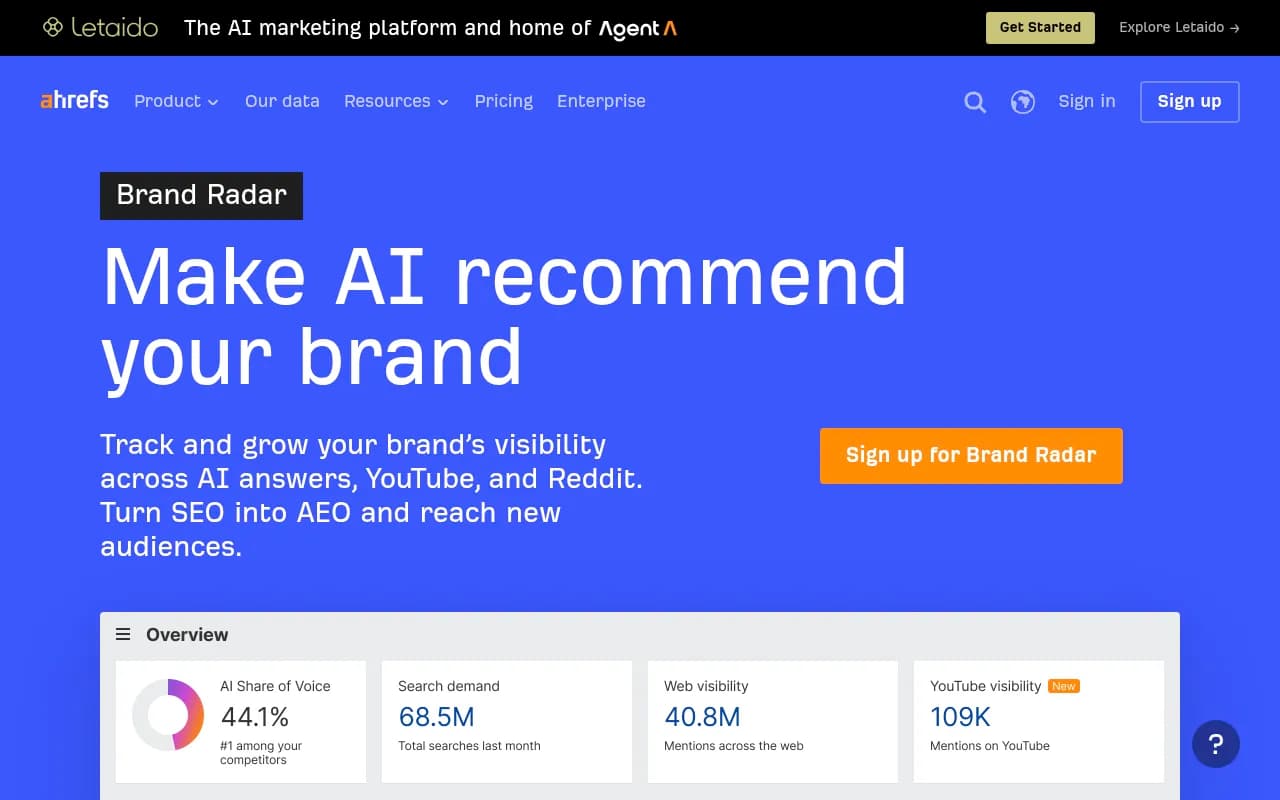
Ahrefs Brand Radar is the AI visibility module inside the Ahrefs suite. It tracks how any brand shows up in AI-generated search results across platforms like ChatGPT, Perplexity, and Google AI Overviews. The pitch is breadth: 210M+ search-backed prompts (the live website claims 405M+), zero setup required, and the ability to monitor competitors just as easily as your own brand.
It's squarely aimed at SEO and marketing teams who already live inside Ahrefs and want to extend their traditional keyword tracking into AI search territory. The tool answers questions like "Is our brand being mentioned when users ask AI about our category?" and "Which competitors are getting cited more than us?"
What it doesn't do: help you fix any of that. There's no content generation, no gap analysis that tells you what to write, and no AI traffic attribution connecting visibility to actual site visits or revenue.
Bardeen
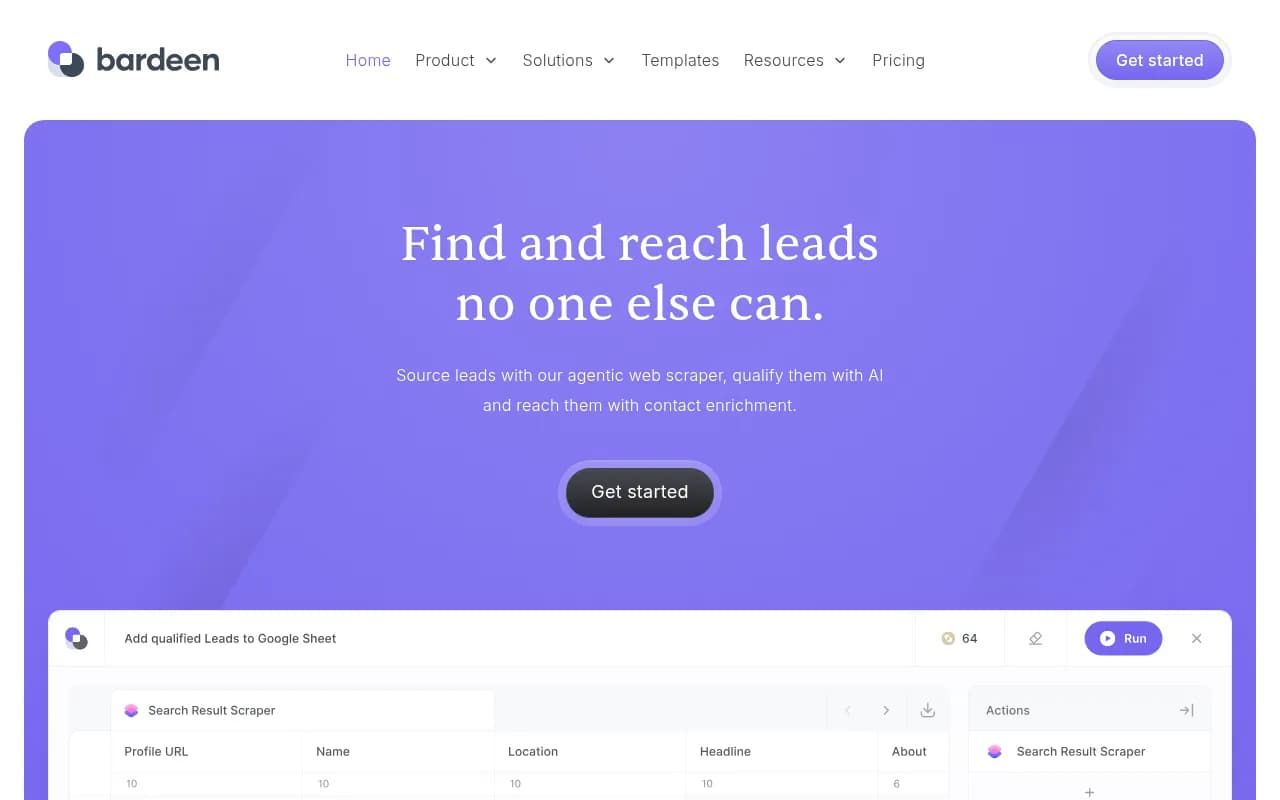
Bardeen is a lead generation and sales automation platform built around an agentic web scraper. The core workflow is: find leads on any website, qualify them using AI against your ideal customer profile, enrich them with verified contact info, and export them to your CRM or a spreadsheet.
It's aimed at sales teams and solopreneurs who need to source leads from places that don't have a neat API -- think LinkedIn profiles, niche directories, company websites, or any page where the data you need lives but isn't easily exportable. The AI qualification layer is genuinely useful: you describe your ideal lead in plain language and Bardeen prioritizes accordingly.
Side-by-side comparison
| Feature | Ahrefs Brand Radar | Bardeen |
|---|---|---|
| Primary use case | AI search brand monitoring | Lead scraping & enrichment |
| Target user | SEO/marketing teams | Sales teams, solopreneurs |
| Free plan | No | Yes |
| Starting price | $398/mo (add-on) | $10/mo per user |
| AI models tracked | 6 (ChatGPT, Perplexity, Gemini, etc.) | N/A |
| Prompt database | 210M+ search-backed prompts | N/A |
| Custom prompts | Yes | N/A |
| Web scraping | No | Yes (agentic) |
| Contact enrichment | No | Yes (credits-based) |
| AI lead qualification | No | Yes |
| Content generation | No | No |
| CRM/export integrations | Limited | CSV, Google Sheets, Airtable, Notion |
| Competitor monitoring | Yes | No |
| AI traffic attribution | No | No |
| Crawler logs | No | No |
| Setup required | Zero | Low |
Head-to-head feature deep-dive
Core purpose and audience
This is where the comparison gets a bit awkward: these tools don't overlap. Ahrefs Brand Radar is a brand monitoring tool for AI search. Bardeen is a sales prospecting tool. The only reason you'd be comparing them is if you're a small team or solo operator deciding where to spend a limited budget across marketing and sales functions.
If that's you, the question isn't "which is better" -- it's "which problem is more urgent right now?"
Verdict: No winner here. They solve different problems.
Pricing and value
| Plan | Ahrefs Brand Radar | Bardeen |
|---|---|---|
| Free | No | Yes (limited) |
| Entry paid | $398/mo (add-on to Ahrefs plan) | $10/mo per user |
| Mid-tier | $699/mo (all platforms) | $25/mo per user |
| Enterprise | Custom | Custom |
| Notes | Requires existing Ahrefs subscription | Enrichment credits sold separately |
Bardeen wins on price, and it's not close. The free plan alone gives you access to the scraper and basic automation. Even the paid tiers are accessible for small teams.
Ahrefs Brand Radar's pricing is harder to evaluate in isolation because it's an add-on -- you need an Ahrefs subscription first (which starts at $129/mo for Lite). So the real entry cost for Brand Radar is closer to $527/mo minimum. That's a significant commitment for a monitoring-only tool.
The $699/mo "all platforms" tier covers all 6 AI tools Brand Radar tracks. Whether that's worth it depends entirely on how central AI search visibility is to your marketing strategy.
Verdict: Bardeen wins on pricing by a wide margin.
AI and automation capabilities
Ahrefs Brand Radar uses AI in the sense that it monitors AI-generated search results. The 210M+ prompt database is genuinely large, and the ability to track any brand (not just your own) is useful for competitive research. Custom prompts let you go beyond the default dataset.
Bardeen uses AI more actively in the workflow. The AI qualification layer -- where you describe your ideal customer and the tool scores leads against that description -- is practical and saves real time. The agentic scraper can navigate complex pages, not just static HTML. The web search feature lets you research leads at scale using AI search providers.
Neither tool generates content. Neither has anything resembling a feedback loop that connects monitoring to action.
Verdict: Different kinds of AI use. Bardeen's AI is more embedded in an active workflow; Brand Radar's AI is more observational.
Data coverage and depth
Ahrefs Brand Radar's 210M+ search-backed prompts (sourced from Ahrefs' own web index) is a real differentiator. The prompts reflect actual search behavior, which means you're tracking AI responses to questions people genuinely ask -- not a curated list someone at Ahrefs thought was representative. Coverage spans 6 AI platforms.
The limitation is that Brand Radar uses fixed prompts. You can add custom prompts, but the core dataset isn't dynamic in the way that real user-facing AI queries are. There's also no AI traffic attribution -- you can see that your brand was mentioned, but you can't connect that to actual traffic or conversions.
Bardeen's data depth is about lead quality. The enrichment layer pulls verified contact info (email, phone, LinkedIn), which is the difference between a list of names and a list of people you can actually reach. The scraper works across virtually any website, so the coverage is as broad as the web itself.
Verdict: Depends on what data matters to you. Brand Radar for AI visibility breadth; Bardeen for actionable lead data.
Integrations and workflow fit
Bardeen integrates with the tools sales teams actually use: Google Sheets, Airtable, Notion, CSV export, and presumably CRM connections. The workflow is linear and practical -- scrape, qualify, enrich, export.
Ahrefs Brand Radar sits inside the Ahrefs ecosystem. If you're already using Ahrefs for keyword research, backlink analysis, and site audits, Brand Radar slots in naturally. If you're not an Ahrefs user, there's no standalone version -- you're buying into the whole platform.
Verdict: Bardeen is more flexible for integration. Brand Radar is better if you're already in the Ahrefs ecosystem.
Ease of use
Both tools are relatively low-friction. Ahrefs Brand Radar advertises "zero setup" -- you enter a brand name and start seeing data. That's accurate for the monitoring side.
Bardeen has a slightly higher learning curve because you're building scraping workflows, but the template library helps. The AI qualification setup is straightforward: describe your ideal lead in plain text and the system handles the rest.
Verdict: Brand Radar is marginally simpler to start with. Bardeen takes a bit more configuration but gives you more control.
Pros and cons
Ahrefs Brand Radar
Pros:
- Massive prompt database (210M+) backed by real search data
- Zero setup -- enter a brand, get data immediately
- Competitor monitoring is just as easy as self-monitoring
- Natural fit for existing Ahrefs users
- 6 AI platforms covered in one view
Cons:
- Expensive, especially when you factor in the required Ahrefs base subscription
- Monitoring only -- no content generation, no gap analysis, no fix recommendations
- Fixed prompts limit how dynamic the tracking is
- No AI traffic attribution connecting visibility to revenue
- No crawler logs or page-level citation tracking
Bardeen
Pros:
- Free plan available -- genuinely useful, not just a teaser
- Affordable paid tiers for small teams
- Agentic scraper works on virtually any website
- AI qualification saves time on manual lead scoring
- Clean export to common tools (Sheets, Airtable, Notion)
- Active workflow tool, not just a dashboard
Cons:
- Enrichment credits sold separately -- costs can scale fast at volume
- No brand monitoring or SEO capabilities
- Not useful for marketing teams focused on visibility
- Scraper quality can vary by website complexity
- No native CRM integrations listed prominently
Who should pick which tool
Pick Ahrefs Brand Radar if:
- You're already an Ahrefs subscriber and want to extend into AI search monitoring
- Your team's primary concern is brand visibility in AI-generated answers
- You need competitive intelligence on how rivals appear in ChatGPT, Perplexity, or Google AI Overviews
- You have the budget for a $398-699/mo add-on and can justify it with brand strategy goals
Pick Bardeen if:
- You're a sales team or solopreneur who needs leads from non-standard sources
- You want to automate the scrape-qualify-enrich pipeline without stitching together multiple tools
- Budget is a real constraint -- the free plan and $10/mo entry point are hard to argue with
- You need verified contact info, not brand monitoring data
Use both if:
- You have separate marketing and sales functions with distinct needs and budgets
- Your marketing team wants AI visibility data while sales needs lead enrichment -- these tools don't overlap at all
A note on AI search visibility
If AI search visibility is your focus, it's worth knowing that Brand Radar's monitoring-only approach is a common limitation across the category. Tools like Promptwatch go further by combining visibility tracking with content gap analysis and AI-powered content generation -- so you can see where you're missing and actually do something about it.

Final verdict
Ahrefs Brand Radar and Bardeen are not competing for the same buyer. Brand Radar is for marketing teams who want to know where their brand stands in AI search results -- it's a solid monitoring tool with a large prompt database, but it stops there. Bardeen is for sales teams who need to find, qualify, and reach leads at scale -- it's an active workflow tool with a price point that makes it accessible to almost anyone.
If you're genuinely torn between the two, the real question is: does your business have a bigger gap in AI search visibility or in lead generation? Answer that, and the choice is obvious.