Bardeen Review 2026
Bardeen is an AI-powered automation platform that helps sales teams and solopreneurs find, qualify, and reach leads through intelligent web scraping, contact enrichment, and AI-driven qualification. Built for teams who need to source leads from anywhere on the web, it combines agentic scraping, AI s
Key Takeaways:
• Best for: Sales teams, recruiters, solopreneurs, and agencies who need to build custom lead lists from non-traditional sources (not just LinkedIn) • Core strength: Agentic web scraper that can extract structured data from any website, combined with AI qualification and contact enrichment in one workflow • Limitations: Steeper learning curve than point-and-click tools; requires some technical comfort to build custom scrapers • Pricing: Free plan available; paid plans from $10/month for individuals up to custom enterprise pricing • Standout feature: End-to-end lead generation workflow — scrape, qualify with AI, enrich contacts, export to CRM — all automated
Bardeen is an AI-powered automation platform designed to solve a problem most sales and recruiting teams face daily: their best leads aren't neatly organized in a CRM or database. They're scattered across company websites, industry directories, event pages, social platforms, and niche communities. Bardeen's core value proposition is giving teams the ability to build custom lead lists from anywhere on the web, then automatically qualify and enrich those leads before pushing them into their sales workflow.
Founded in 2020 and backed by notable investors, Bardeen has grown to serve customers like Deel, Kearney, Humane, and Jotform. The platform is SOC 2 Type II, GDPR, and CASA Tier 2/3 certified, making it enterprise-ready despite its accessible pricing. Unlike traditional RPA tools that require IT involvement or no-code scrapers with limited flexibility, Bardeen sits in a sweet spot: powerful enough for complex workflows but accessible enough for individual contributors to build and deploy automations themselves.
Agentic Web Scraper
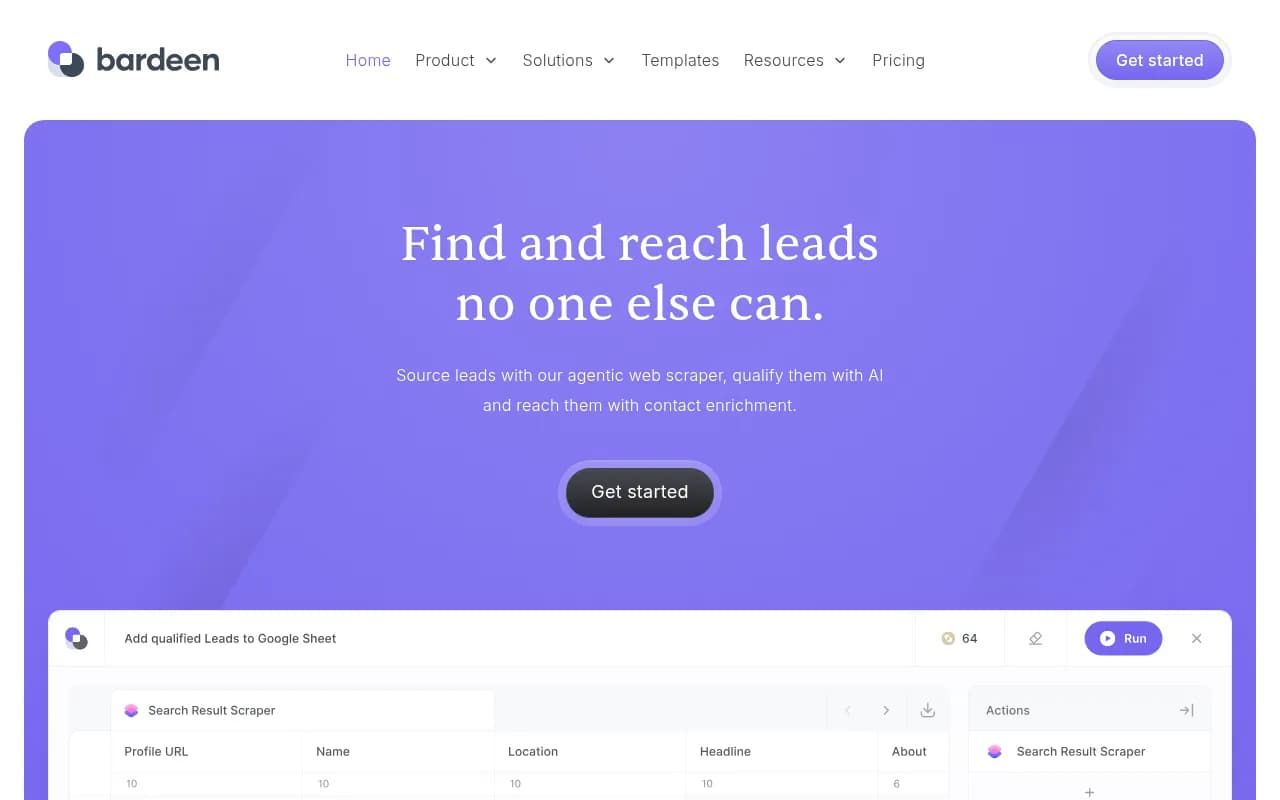
Bardeen's flagship feature is its agentic web scraper, which uses AI to understand page structure and extract data without requiring CSS selectors or XPath knowledge. You can scrape profiles, company pages, directories, search results, or any structured data on a webpage. The scraper adapts to layout changes automatically, which means your automations don't break when a website redesigns.
The platform offers both custom scrapers (build your own for any site) and premium pre-built scrapers for popular platforms. These premium scrapers are maintained by Bardeen's team and optimized for sites like LinkedIn, Twitter, Google Maps, Crunchbase, and dozens of others. For example, the LinkedIn scraper can extract profile data, company information, job postings, and search results without hitting API limits or requiring Sales Navigator.
What makes this "agentic" is the AI's ability to navigate multi-page workflows. You can tell Bardeen to scrape a list page, click into each detail page, extract specific fields, then move to the next item — all automatically. This is particularly powerful for building lead lists from industry-specific directories, event attendee pages, or company team pages where traditional scrapers struggle.
The scraper runs in your browser as a Chrome extension, which means it can handle JavaScript-heavy sites and authenticated pages (sites you're logged into). Data is extracted in real-time and can be immediately passed to the next step in your workflow — no CSV exports and re-imports required.
AI-Powered Lead Qualification
Once you've scraped a list of potential leads, Bardeen's AI qualification layer helps you prioritize who to reach out to. You describe your ideal customer profile in plain English (e.g., "SaaS companies with 50-200 employees in the healthcare vertical that raised Series A in the last 12 months"), and Bardeen's AI scores and tags each lead based on how well they match.
This qualification happens automatically as part of your workflow. The AI can analyze scraped data, visit company websites to gather additional context, search for funding announcements, check tech stacks, and more. It's essentially an AI research assistant that runs in the background, enriching your understanding of each lead before you decide whether to pursue them.
The qualification engine supports custom prompts and can be fine-tuned based on your specific criteria. For recruiting use cases, you might qualify candidates based on years of experience, specific skills, or company backgrounds. For sales, you might prioritize companies showing buying signals like recent job postings, new funding, or technology migrations.
Contact Enrichment with Verified Data
Scraping a lead's name and company is only half the battle — you need their email and phone number to actually reach them. Bardeen's enrichment feature finds verified contact information for your leads, pulling from multiple data providers to maximize coverage and accuracy.
The enrichment action integrates directly into your workflows. After scraping and qualifying leads, Bardeen can automatically enrich each contact with their business email, personal email, phone number, LinkedIn URL, and additional firmographic data. The platform validates emails to reduce bounce rates and flags confidence scores so you know which contacts are most reliable.
Unlike standalone enrichment tools that charge per lookup regardless of whether data is found, Bardeen's pricing is based on successful enrichments. You're not paying for failed lookups or duplicate checks. The enrichment database is continuously updated, and the platform can waterfall across multiple providers if the first source doesn't have data.
For privacy-conscious teams, Bardeen is GDPR-compliant and provides transparency into data sources. You can see where each piece of contact information came from and ensure your outreach complies with regional regulations.
AI Web Search and Research
Bardeen's web search capability lets you generate leads or research companies at scale using AI-powered search. You can ask questions like "Find 50 SaaS companies in the HR tech space that raised funding in 2025" and Bardeen will search the web, compile results, and structure the data for you.
This feature leverages leading AI providers (OpenAI, Anthropic, Perplexity) and traditional search engines to gather information. It's particularly useful for building lead lists when you don't have a specific source website to scrape from, or when you need to aggregate data from multiple sources.
The AI can also instantly find answers on a specific website. Point it at a company's site and ask "What industries do they serve?" or "What's their pricing model?" — Bardeen will read the site and extract the answer. This is helpful for qualifying leads or doing pre-call research without manually browsing dozens of websites.
Workflow Automation and Integrations
Bardeen's automation builder (called "Studio") lets you chain together scraping, qualification, enrichment, and export actions into end-to-end workflows. These workflows can run on-demand (you trigger them manually) or on a schedule (daily, weekly, etc.).
The platform integrates with 100+ tools including Google Sheets, Airtable, Notion, HubSpot, Salesforce, Pipedrive, Slack, and more. You can scrape leads from a website, qualify them with AI, enrich their contact info, and automatically add them to your CRM or outreach sequence — all without touching a CSV file.
Bardeen also supports conditional logic, loops, and data transformations within workflows. For example, you can scrape a list of companies, check if each one is already in your CRM, skip duplicates, enrich new ones, and only add qualified leads. This level of control makes it possible to build sophisticated lead generation systems that run on autopilot.
The Chrome extension interface makes it easy to trigger workflows from any webpage. You can highlight text, right-click, and run a Bardeen automation — for instance, scraping a LinkedIn profile and adding it to your outreach list in one click.
Pre-Built Templates and Community
For teams who don't want to build workflows from scratch, Bardeen offers a library of pre-built templates covering common use cases: scraping LinkedIn search results, enriching leads from a Google Sheet, copying job postings to Notion, monitoring competitor websites, and more.
These templates are fully customizable. You can clone a template, adjust the scraping fields, change the qualification criteria, or swap out the destination tool. The template library is searchable by use case, industry, and integration, making it easy to find a starting point.
Bardeen also has an active community where users share workflows, troubleshoot issues, and request new integrations. The company's support team is responsive and often helps users build custom solutions for complex use cases.
Who Is Bardeen For?
Bardeen is built for anyone who needs to build custom lead lists from non-standard sources. The primary user personas include:
Sales Development Reps and Account Executives at B2B companies who need to prospect beyond LinkedIn. If your ideal customers hang out on niche industry directories, attend specific conferences, or are listed on government procurement sites, Bardeen lets you scrape those sources and build targeted outreach lists. It's particularly valuable for teams selling into specific verticals (healthcare, real estate, logistics) where leads aren't easily found in traditional databases.
Recruiters and Talent Acquisition Teams who need to source candidates from GitHub, Dribbble, Behance, conference speaker lists, or company team pages. Bardeen can scrape candidate profiles, enrich contact info, and automatically add qualified candidates to your ATS. Humane's talent team saves 15 hours per week using Bardeen for market research and candidate sourcing.
Solopreneurs and Freelancers who can't afford enterprise tools like Clay or Phantombuster but need similar capabilities. Bardeen's free plan and affordable paid tiers make it accessible for individuals building their own businesses. The platform is particularly popular with consultants, coaches, and agency owners who need to generate leads on a budget.
Market Researchers and Analysts who need to gather competitive intelligence, track industry trends, or compile datasets from multiple sources. Kearney, a leading management consulting firm, uses Bardeen to save 5 hours per web scraping task, allowing analysts to focus on insights rather than data collection.
Real Estate Agents and Investors who need to scrape property listings, track new developments, or build lists of property owners. Bardeen's real estate templates can scrape Zillow, Realtor.com, and local MLS sites, then enrich property data with owner contact information.
Music Industry Professionals (A&R reps, managers, promoters) who need to discover emerging artists by scraping Spotify playlists, SoundCloud charts, YouTube channels, and music blogs. Bardeen can track new releases, follower counts, and engagement metrics to identify rising talent.
Bardeen is NOT ideal for teams who only need to scrape LinkedIn and already have Sales Navigator, or for users who want a fully managed service where someone else builds their workflows. It requires some hands-on setup and a willingness to experiment with automation logic.
Integrations and Ecosystem
Bardeen integrates with 100+ tools across CRM, spreadsheets, project management, communication, and marketing categories. Key integrations include:
CRMs: HubSpot, Salesforce, Pipedrive, Copper, Zoho CRM, Attio Spreadsheets & Databases: Google Sheets, Airtable, Notion, Coda, SmartSuite Communication: Slack, Gmail, Outlook, Discord Productivity: Asana, Trello, ClickUp, Monday.com Marketing: Mailchimp, ActiveCampaign, Lemlist Developer Tools: GitHub, Jira, Linear
The platform also offers a REST API for custom integrations and webhooks for triggering workflows from external systems. Data can be exported as CSV, JSON, or directly pushed to integrated tools.
Bardeen runs as a Chrome extension, which means it works on any website you can access in your browser. There's no need to set up proxies, manage IP rotation, or worry about server infrastructure — the scraping happens locally in your browser.
Pricing and Value
Bardeen offers four pricing tiers:
Free Plan: Unlimited non-premium automations, basic scraping, limited AI actions. Good for individuals testing the platform or running simple workflows.
Professional Plan ($10/month billed annually, $15/month monthly): Unlimited premium automations, unlimited AI actions, priority support, advanced scraper features. Best for solopreneurs and small teams.
Business Plan ($25/month per user billed annually, $30/month monthly): Everything in Professional plus team collaboration, shared workflows, usage analytics, and dedicated account manager. Designed for sales teams and agencies.
Enterprise Plan (custom pricing): Custom limits, SSO, advanced security controls, SLA, and dedicated support. For large organizations with compliance requirements.
Enrichment credits are sold separately and priced based on usage. The platform only charges for successful enrichments (when contact data is found), not for failed lookups.
Compared to alternatives like Clay ($149-$800/month), Phantombuster ($59-$439/month), or Apify ($49-$499/month), Bardeen is significantly more affordable for individuals and small teams. The free plan is genuinely useful, not just a trial, which makes it accessible for bootstrapped founders and freelancers.
The value proposition is strongest for teams who need the full workflow — scrape, qualify, enrich, export — rather than just one piece. If you only need scraping, Apify might be cheaper. If you only need enrichment, Apollo or ZoomInfo might have better data. But if you need to build a custom lead generation system from scratch, Bardeen's integrated approach saves time and money.
Strengths
Agentic scraping that adapts to website changes: Unlike traditional scrapers that break when a site redesigns, Bardeen's AI-powered scraper understands page structure and adjusts automatically. This reduces maintenance overhead significantly.
End-to-end lead generation in one platform: Most competitors force you to use multiple tools (scraper + enrichment + CRM integration). Bardeen handles the entire workflow, reducing context switching and data transfer headaches.
Accessible pricing for individuals: The free plan and $10/month Professional tier make enterprise-grade automation accessible to solopreneurs and small businesses who can't afford Clay or Phantombuster.
Browser-based execution: Running in your browser means you can scrape authenticated pages (sites you're logged into) and JavaScript-heavy sites without managing proxies or server infrastructure.
Strong security and compliance: SOC 2 Type II, GDPR, and CASA certifications make Bardeen suitable for enterprise customers with strict security requirements.
Limitations
Bardeen requires more hands-on setup than fully managed services. If you want someone else to build and maintain your scrapers, you'll need to hire a freelancer or use a service like Phantombuster's done-for-you plans.
The AI qualification feature, while powerful, can be inconsistent if your criteria are vague. You need to provide clear, specific descriptions of your ideal customer profile to get reliable results. This improves with iteration but requires some trial and error.
Enrichment coverage is good but not as comprehensive as dedicated providers like Apollo or ZoomInfo. For high-volume outbound teams where contact data accuracy is critical, you might need to supplement Bardeen with a specialized enrichment tool.
The Chrome extension dependency means workflows only run when your browser is open (for on-demand automations) or on Bardeen's cloud (for scheduled automations). This isn't a problem for most use cases but limits real-time scraping scenarios.
Documentation and onboarding could be more comprehensive. While the template library is helpful, building complex workflows from scratch requires some experimentation and community support.
Bottom Line
Bardeen is the best choice for sales teams, recruiters, and solopreneurs who need to build custom lead lists from non-traditional sources and can't afford enterprise automation tools. It's particularly strong for teams who value flexibility and control over their lead generation process and are willing to invest time upfront to build workflows that run on autopilot.
If you're tired of paying for LinkedIn Sales Navigator and Apollo and still not finding the right leads, or if you're manually copying data from websites into spreadsheets, Bardeen will save you dozens of hours per week. The platform shines when your leads live in niche directories, industry-specific sites, or communities that traditional lead databases don't cover.
Best use case in one sentence: Building custom B2B lead lists by scraping niche industry directories, qualifying leads with AI, enriching contact data, and automatically pushing qualified prospects into your CRM or outreach sequence.
Tags:
Similar and alternative tools to Bardeen