Adobe Marketo Measure Review 2026
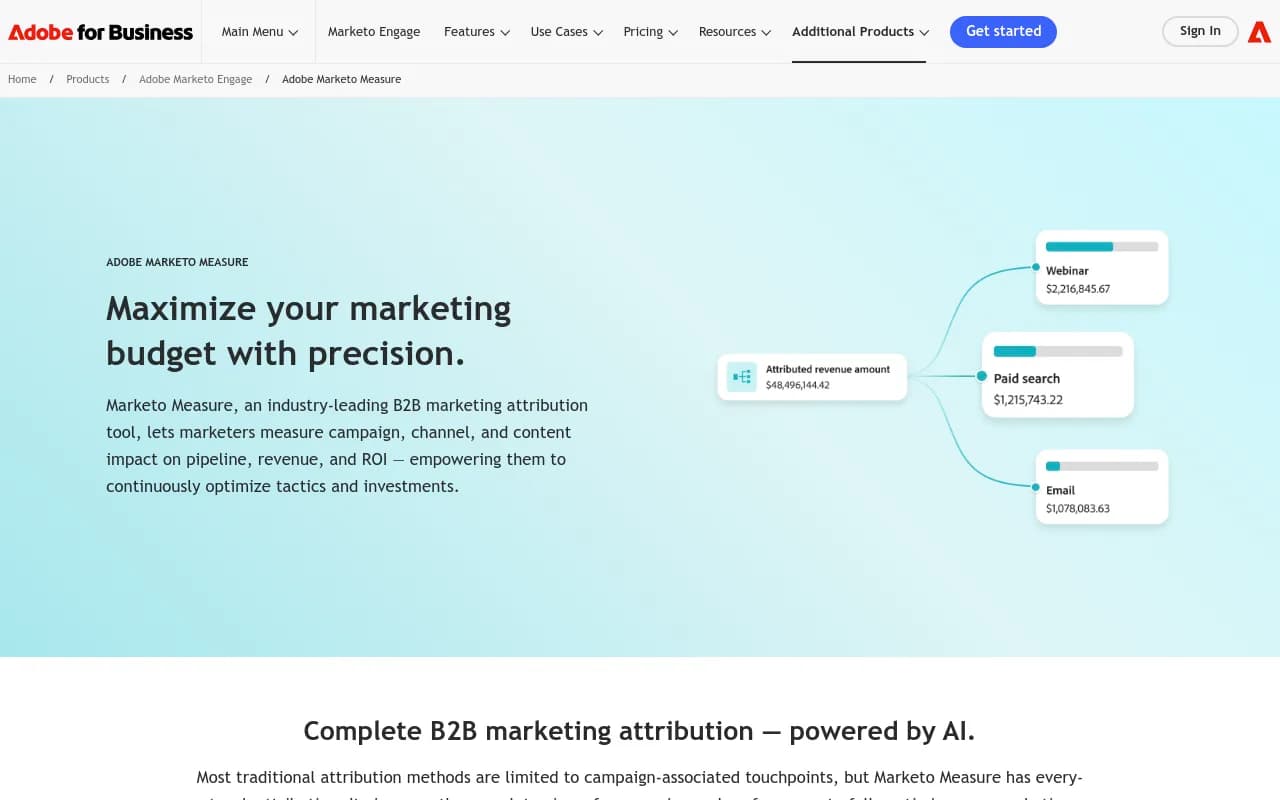
Adobe Marketo Measure (formerly Bizible) is an enterprise-grade B2B marketing attribution platform that tracks every buyer touchpoint across marketing and sales channels to measure campaign, channel, and content impact on pipeline, revenue, and ROI. Built for complex B2B buying cycles with multiple
Key Takeaways:
• Enterprise attribution built for complex B2B: Tracks every touchpoint across long sales cycles (100+ interactions per deal) with native integrations to marketing and sales systems, going far beyond campaign-level tracking • AI-powered modeling: Combines pre-built attribution models with custom modeling and Adobe's Attribution AI to separate signal from noise in multi-stakeholder buying journeys • Revenue-focused reporting: Delivers role-specific dashboards and data exploration tools that connect marketing activities directly to pipeline and closed revenue, not just engagement metrics • Best for mid-market to enterprise: Designed for B2B companies with complex sales processes, multiple buying committee members, and the need to justify significant marketing spend • Pricing barrier: Part of Adobe's enterprise marketing stack with custom pricing -- not accessible for small teams or startups looking for quick-start attribution
Adobe Marketo Measure is Adobe's answer to the perennial B2B marketing challenge: proving which marketing activities actually drive revenue. Originally launched as Bizible before Adobe's acquisition, it's now positioned as the attribution layer for Adobe's Marketo Engage marketing automation platform, though it can work with other marketing stacks through integrations. The platform is built specifically for B2B companies dealing with long sales cycles, multiple decision-makers, and the need to track dozens or hundreds of touchpoints before a deal closes.
The target audience is clear: mid-market to enterprise B2B marketing teams (typically 10+ marketers) managing six or seven-figure marketing budgets across multiple channels. Think SaaS companies with $50K+ average contract values, manufacturing firms with 6-12 month sales cycles, or professional services organizations where deals involve 5-10 stakeholders. If your sales cycle is under 30 days or you're selling low-ticket B2C products, this is overkill. Marketo Measure is designed for scenarios where a single deal might involve 20 webinar registrations, 15 email clicks, 8 content downloads, 3 sales calls, and 2 in-person events across 4 different people at the buying company.
Every-Touch Data Aggregation
The core differentiator is what Adobe calls "every-touch attribution" -- the ability to capture and account for every trackable buyer interaction across your entire marketing and sales ecosystem. Most attribution tools only track campaign-associated touchpoints (form fills, ad clicks, email opens). Marketo Measure goes deeper with native integrations to CRM systems (Salesforce, Microsoft Dynamics), marketing automation platforms (Marketo Engage, HubSpot, Eloqua), ad platforms (Google Ads, LinkedIn, Facebook), web analytics, and offline channels.
Omnichannel aggregation: The platform automatically pulls touchpoint data from connected systems -- website visits tracked via JavaScript, form submissions, email engagement, ad impressions and clicks, event attendance, sales calls logged in CRM, and even offline interactions like trade shows or direct mail (when manually logged). Each touchpoint is timestamped and associated with specific contacts, accounts, and opportunities.
Campaign and content associations: Beyond just tracking that someone clicked an ad, Marketo Measure connects each touchpoint to specific campaigns, content assets, channels, and sub-channels. You can see not just that a webinar drove pipeline, but which specific webinar topic, which promotion channel brought attendees, and which follow-up content they consumed afterward.
Flexible data framework: The platform uses a "Buyer Touchpoint" data model that captures touchpoint type, date, campaign, channel, medium, landing page, form, and custom fields you define. This data is synced back to your CRM as custom objects, making it available for reporting in Salesforce/Dynamics or for use in other tools. The framework handles complex scenarios like multiple contacts from the same account engaging with different content, or the same person interacting across multiple devices and channels.
This aggregation layer is critical because traditional attribution breaks down when data is incomplete. If your attribution model only sees 40% of actual touchpoints (because it's missing offline events, sales interactions, or cross-device activity), your conclusions about what's working will be wrong. Marketo Measure's integration depth aims to capture 80-90%+ of trackable interactions.
Advanced Attribution Modeling
Once you have comprehensive touchpoint data, the next challenge is determining which touchpoints actually matter. In a B2B deal with 100+ interactions, not every touchpoint deserves equal credit. Marketo Measure provides multiple modeling approaches:
Pre-built models: The platform includes standard attribution models that marketing teams can apply immediately without custom configuration. These include First Touch (credits the first known interaction), Last Touch (credits the final interaction before conversion), U-Shaped (credits first touch, lead creation, and opportunity creation), W-Shaped (adds closed-won to U-Shaped), and Full Path (distributes credit across all major milestone touches). Each model can be applied to different metrics -- lead creation, opportunity creation, pipeline value, or closed revenue.
Custom modeling: For teams with specific business logic, Marketo Measure allows custom attribution models where you define the rules. You might want to weight certain channels higher (e.g., product demos get 3x credit vs content downloads), apply different models to different product lines, or create stage-specific models that change based on where the buyer is in the journey. Custom models use a point-based system where you assign credit percentages or multipliers to touchpoint types, channels, or specific campaigns.
Attribution AI: This is where Adobe's machine learning comes in. Instead of using predefined rules, Attribution AI analyzes your historical data to determine which touchpoints statistically correlate with conversions and revenue. The AI model learns patterns like "deals that include a product demo in the first 30 days close 40% faster" or "accounts that engage with case studies are 2.3x more likely to close" and adjusts attribution credit accordingly. The model continuously learns as new data comes in, adapting to changes in buyer behavior or market conditions.
The modeling layer is particularly important for complex B2B scenarios. In a deal where 8 people from the buying company each had 15+ touchpoints over 9 months, a simple last-touch model would give 100% credit to whatever happened right before they signed -- probably a sales call or contract review. That's not useful for optimizing marketing spend. Marketo Measure's models distribute credit across the journey in ways that reflect actual influence on the decision.
Enterprise-Wide Insight and Reporting
Attribution data is only valuable if the right people can access and act on it. Marketo Measure provides multiple reporting layers:
Role-specific reporting: Different stakeholders need different views. CMOs want high-level ROI by channel and campaign type. Demand gen managers need granular performance data by campaign, content asset, and audience segment. Sales leaders want to see which marketing touches are associated with their pipeline. CFOs need revenue attribution that ties back to budget allocation. Marketo Measure provides pre-configured report templates for each role, with the metrics and visualizations most relevant to their decisions.
Pre-built dashboards: The platform includes out-of-the-box dashboards for common use cases -- Marketing ROI (revenue and pipeline by channel, campaign, and spend), Content Performance (which assets drive engagement and conversions), Channel Mix (how different channels work together), Velocity Analysis (which touchpoints accelerate deals), and Account-Based Marketing (engagement and attribution at the account level for ABM programs). These dashboards are built on top of the data synced to your CRM, so they update automatically as new touchpoints and deals flow through.
Data exploration and sharing: For teams that want to dig deeper, Marketo Measure provides a Discover interface (a BI-style tool) where you can build custom reports, filter by any dimension (date range, channel, campaign, product line, region, deal size, etc.), and export data. The platform also supports data sharing via API, so you can pull attribution data into other tools like Looker, Tableau, Google Data Studio, or custom dashboards. Since the core data lives in your CRM as custom objects, you can also build reports directly in Salesforce or Dynamics using their native reporting tools.
The reporting layer is designed to make attribution insights actionable. It's not just "here's what happened" -- it's "here's what's working, here's what's not, and here's where to reallocate budget." For example, if the data shows that paid search drives 30% of opportunities but only 15% of closed revenue, while webinars drive 10% of opportunities but 25% of closed revenue, that's a clear signal to shift spend from search to webinars.
Integrations and Ecosystem
Marketo Measure's value depends heavily on its ability to connect with your existing marketing and sales stack. Key integrations include:
• CRM: Native, bi-directional sync with Salesforce and Microsoft Dynamics 365. Touchpoint data flows into CRM as custom objects (Buyer Touchpoints, Buyer Attribution Touchpoints), and opportunity/account data flows back to Marketo Measure for attribution calculations. • Marketing automation: Deep integration with Marketo Engage (obviously), plus connectors for HubSpot, Eloqua, Pardot, and other MAP platforms. Syncs campaign membership, email engagement, form fills, and program success. • Ad platforms: Connects to Google Ads, LinkedIn Ads, Facebook Ads, and other paid media platforms to pull impression, click, and spend data. Automatically associates ad interactions with known contacts and accounts. • Web analytics: JavaScript tracking tag for website visits, plus integrations with Google Analytics and Adobe Analytics for additional behavioral data. • Data warehouses: API access and data export options for syncing attribution data to Snowflake, BigQuery, Redshift, or other data warehouses for custom analysis.
The platform does not have a free tier or self-service option. It's sold as part of Adobe's Marketo Engage ecosystem, typically bundled with Marketo's marketing automation platform or sold as an add-on. Implementation requires Adobe professional services or a certified partner to configure integrations, set up attribution models, and build initial reports.
Who Is It For
Marketo Measure is purpose-built for specific B2B scenarios:
Ideal users: Marketing operations teams at B2B companies with $10M+ annual revenue, 50+ employees, and complex sales processes. Companies where the average deal involves multiple stakeholders, 3+ month sales cycles, and significant marketing investment across multiple channels. Industries like enterprise SaaS, manufacturing, financial services, healthcare technology, and professional services are common users. Teams that need to justify marketing spend to CFOs or boards, or that are trying to optimize budget allocation across 5+ channels.
Team size and structure: Works best for marketing teams of 10+ people with dedicated roles for demand generation, content marketing, events, paid media, and marketing ops. You need someone (or a team) who can manage the platform, interpret attribution data, and make strategic decisions based on insights. Smaller teams (under 5 marketers) typically don't have the complexity or budget to justify the investment.
Not a fit for: Startups or small businesses with simple sales processes, short sales cycles (under 30 days), or limited marketing budgets (under $500K/year). B2C companies or transactional B2B businesses where attribution is straightforward. Teams looking for quick-start, self-service attribution tools. Companies not already using Marketo Engage or willing to invest in enterprise marketing automation. If you're just trying to track which blog posts drive the most form fills, you don't need Marketo Measure -- Google Analytics and a simple CRM report will suffice.
Pricing and Value
Adobe does not publish pricing for Marketo Measure. It's sold through Adobe's enterprise sales team with custom quotes based on company size, data volume, number of integrations, and whether you're bundling it with Marketo Engage. Based on industry reports and user discussions, expect pricing in the range of $30K-$100K+ annually for mid-market companies, with enterprise deals potentially much higher.
The value proposition is clear for the right buyer: if you're spending $2M/year on marketing and can't definitively say which channels or campaigns drive revenue, Marketo Measure can help you reallocate 10-20% of that budget to higher-performing tactics. That's $200K-$400K in improved efficiency, easily justifying a $50K software investment. But if your marketing budget is $200K/year, the math doesn't work -- you'd be spending 25% of your budget on attribution software.
There is no free trial in the traditional sense. Adobe offers proof-of-concept engagements where they'll implement Marketo Measure in your environment for a limited time to demonstrate value before you commit to a full contract.
Strengths
• Comprehensive data capture: The depth of integrations and every-touch tracking provides a more complete view of the buyer journey than most attribution tools, which miss offline interactions, sales touches, and cross-device activity. • Sophisticated modeling: The combination of pre-built models, custom modeling, and AI-powered attribution gives teams flexibility to match their specific business logic and continuously improve accuracy. • CRM-native data: Syncing attribution data back to Salesforce/Dynamics as custom objects means it's available everywhere -- in CRM reports, in sales workflows, in other tools that connect to your CRM. You're not locked into a separate reporting interface. • Enterprise-grade infrastructure: Built to handle large data volumes, complex org structures (multiple business units, regions, product lines), and strict security/compliance requirements. Adobe's platform reliability and support are strong. • Gartner recognition: Adobe was recognized as a notable vendor in Gartner's marketing attribution research, indicating industry validation of the platform's capabilities.
Limitations
• Pricing and accessibility: The enterprise-only pricing model and lack of self-service options make it inaccessible for small and mid-sized companies. There's no way to "try before you buy" without engaging Adobe's sales process. • Implementation complexity: Setting up Marketo Measure requires significant time and expertise -- integrations to configure, data models to map, attribution models to define, reports to build. Expect 1-3 months from purchase to full deployment, plus ongoing management. • Marketo ecosystem lock-in: While Marketo Measure technically works with other marketing automation platforms, it's clearly optimized for Marketo Engage users. If you're on HubSpot or Eloqua, you may not get the full value, and Adobe's sales team will likely push you toward Marketo Engage as well. • Learning curve: The platform is powerful but not intuitive. Marketing teams need training to understand attribution concepts, interpret reports, and make data-driven decisions. Smaller teams may struggle to extract value without dedicated marketing ops resources.
Bottom Line
Adobe Marketo Measure is the right choice for mid-market to enterprise B2B companies with complex sales processes, significant marketing budgets, and the need to prove marketing's impact on revenue. If you're spending $1M+ annually on marketing across multiple channels, have sales cycles longer than 60 days, and need to justify budget allocation to executive leadership, Marketo Measure provides the comprehensive attribution data and sophisticated modeling to optimize your marketing mix. It's particularly strong for companies already using Marketo Engage or willing to adopt Adobe's marketing stack.
For smaller companies, startups, or teams with simpler attribution needs, the investment doesn't make sense. Look at more accessible alternatives like HubSpot's attribution reporting (for HubSpot users), Ruler Analytics, Dreamdata, or even basic CRM reporting combined with UTM tracking. Marketo Measure is enterprise software with enterprise pricing -- powerful and comprehensive, but only valuable if you have the scale and complexity to justify it.
Best use case in one sentence: B2B marketing teams at companies with $50M+ revenue, 6+ month sales cycles, and multi-million dollar marketing budgets who need to prove ROI and optimize spend across complex, multi-touch buyer journeys.
Tags:
Similar and alternative tools to Adobe Marketo Measure