Key takeaways
- Hourly-billing agencies need GEO tools priced for short, defined engagements (audits, diagnostics); per-client subscription tools built for ongoing retainers will bleed margin on a one-off project.
- Retainer agencies can absorb flat monthly tool costs more easily, but per-workspace pricing (Profound charges $399/mo per added client workspace) still eats into margin faster than flat-fee alternatives as the roster grows.
- A rough rule from agency operators: GEO tool spend should stay at 15-20% of the retainer value per client, not a fixed dollar figure.
- Most mid-size agencies end up running a tool year-round for monitoring and bringing in project-based (hourly or fixed-fee) work only for structural fixes like schema or thin content.
- The real differentiator in 2026 isn't the monitoring dashboard, it's whether the tool also helps you close the gap with content, crawler diagnostics, and CMS publishing, because that's the work agencies actually bill for.
If you run a GEO or AI-visibility practice inside an agency, the tool decision isn't really about features. It's about how you get paid. An hourly consultant selling a four-week audit has a completely different cost tolerance than a retainer shop running twelve clients through the same dashboard every month. Most buying guides skip this and just rank tools by feature count, which is how agencies end up with a $2,000/month subscription attached to a $3,000/month client.
Why billing model changes the tool math
GEO agency pricing in 2026 breaks into roughly four buckets: monthly retainers ($1,500 to $50,000+), one-time audits ($2,500 to $15,000), hourly consulting ($50 to $450/hour), and DIY tool subscriptions clients buy themselves ($29 to $3,000+/month). Content production alone eats 40-60% of a typical retainer, which is exactly why tool cost discipline matters so much on the rest of the margin.
An hourly consultant charging $200 to $450 an hour for GEO advisory work (on the higher end of the broader $50-$400/hour SEO/GEO consulting range) has maybe 10-20 billable hours against a diagnostic engagement. If the monitoring tool alone costs $500/month and the project only lasts six weeks, that's a real chunk of the fee gone before any strategy work gets billed. A retainer agency running the same tool across 15 clients for a year has a completely different depreciation curve.
This is the part most GEO tool comparisons miss: pricing structure, not raw feature depth, is often the deciding factor for an agency's P&L.
How GEO tool pricing actually scales for agencies
Here's where it gets uncomfortable. Several popular GEO platforms price per client workspace, which sounds reasonable at first glance and then turns ugly at scale.
| Tool | Pricing structure | Cost at 10 clients | Cost at 20 clients |
|---|---|---|---|
| Profound (Agency Growth) | $99/mo base + $399/mo per client workspace | ||
| Ayzeo | $149/mo for 3 projects, +$49/mo per added client | ||
| Peec AI | Credit-based tiers, Essential to Scale | $245-$795/mo depending on prompt volume needed | Scales with credits, not per-seat |
| Otterly.AI | Flat tiers + per-engine add-ons | $189-$489/mo base, +Claude/Gemini add-ons stack fast | Enterprise custom from ~$1,000/mo |
| Semrush AI Visibility Toolkit | $99/mo per domain | ~$990/mo (billed annually) | ~$1,980/mo |
The gap between Profound's per-workspace model and a flat-fee tool like Ayzeo is roughly 8x at scale, according to one vendor comparison. That doesn't make Profound bad software, its prompt volume and multi-engine depth are genuinely strong, it means the pricing model only makes sense if your retainers are large enough to absorb $400+ per client in tooling alone. For a shop running $1,500/month retainers, that math doesn't work. For a shop running $8,000/month enterprise retainers, it barely registers.
Profound

Matching tool pricing to your billing model
If you bill hourly or run fixed-scope audits
Hourly and project-based work rewards tools you can spin up fast, run for a defined window, and cancel without a long commitment. You're not paying for a dashboard for twelve months, you're paying for enough data to write a defensible report. Entry-tier self-serve plans fit this better than enterprise agency packages: Otterly.AI's Lite tier at $29/month or a time-boxed Profound trial can cover a 4-6 week diagnostic without locking in annual spend.
Otterly.AI

The trade-off is depth. Cheap entry tiers cap prompt volume and often limit engine coverage, which matters if the client wants to know how they show up across ChatGPT, Perplexity, Gemini, and AI Overviews simultaneously. A one-time audit for $2,000-$4,000 covering 50-100 queries across 2-3 engines is a realistic scope at this price point; stretching a $29/month tool to cover 500 queries across six engines for a single client isn't.
If you bill retainer
Retainer agencies get more mileage out of flat-fee, unlimited-project pricing because the cost amortizes across a growing roster instead of per workspace. Tools positioned explicitly for agencies, flat $149/month regardless of client count, or credit-pooled models like Peec AI, protect margin better as you add accounts.

The bigger shift for retainer shops in 2026 is that monitoring alone doesn't justify the fee anymore. Clients increasingly expect the retainer to include the fix, not just the finding: content that closes citation gaps, crawler log review, schema work. This is where Promptwatch sits differently from most of the pure trackers above. Instead of stopping at "here's your visibility score," it ships Content Agents that plan, write, and publish GEO-optimized content directly to a client's CMS (Webflow, Framer, WordPress), plus Unified Actions, a prioritized to-do list generated from the client's actual citation and crawler data. For an agency billing retainer, that turns the tool from a cost center into something that reduces the manual hours you'd otherwise bill against the account.

Promptwatch's agency tiers start at $199/month (Kick-off, 10,000 responses, 7-day free trial), scaling to $399 (Growth, 25,000 responses) and $799 (Scale, 65,000 responses), all with unlimited projects and prompts and 10 seats, so the per-client math looks a lot closer to the flat-fee challengers than to per-workspace pricing like Profound's.
If you're hybrid (most agencies by 2026)
Most shops don't pick one model cleanly. A common pattern: run a flat-fee or pooled-credit tool year-round for every retainer client's baseline monitoring, then bill hourly or as a fixed project for anything structural, a technical migration, a schema overhaul, a content gap sprint. The tool subscription covers ongoing measurement; the hourly or project fee covers the work the measurement surfaces.
Comparison table: tools by agency billing fit
| Tool | Pricing model | Best fit | Watch out for |
|---|---|---|---|
| Promptwatch | Flat agency tiers, unlimited projects/prompts | Retainer and hybrid agencies that need monitoring plus content execution | Higher-tier response caps if you run very high prompt volumes |
| Profound | Per-client workspace add-on | Large retainers with few, high-value clients | Cost scales steeply per added client |
| Peec AI | Credit-pooled tiers | Agencies with variable prompt needs across accounts | Credit usage needs monitoring to avoid overage |
| Ayzeo | Flat per-client fee | Lean retainer shops watching per-client margin closely | Shallower feature depth than full-stack platforms |
| Otterly.AI | Tiered self-serve + add-ons | Hourly/project-based audits, single-engine scope | Add-ons for Claude/Gemini stack cost quickly |
| Semrush AI Visibility Toolkit | Per-domain add-on | Agencies already on Semrush for traditional SEO | Requires existing Semrush plan for full value |
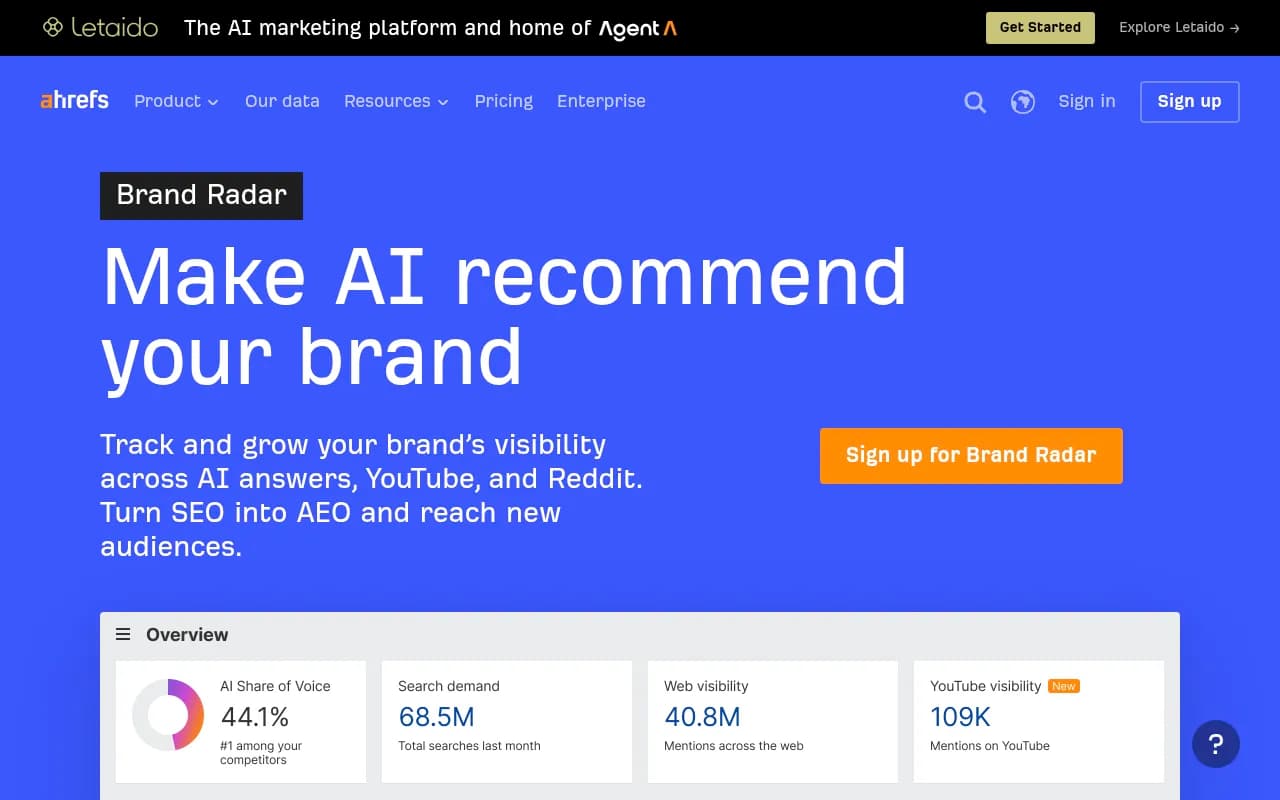
| Ahrefs Brand Radar | Per-engine add-on, up to $699/mo for all six | Agencies that need Ahrefs' backlink data alongside AI tracking | No free trial, priced as premium add-on |
What's actually changing in the content agencies need to bill for
Tool pricing isn't the only moving part. Promptwatch's data on ChatGPT query fanouts shows the average number of sub-queries per response dropped from 2.15 in early December to close to 1.0 by April 2026, and average query length shrank from roughly 117 characters to about 53, more than half. That means the short, keyword-style H2 structure agencies used to treat as a secondary tactic now matches how ChatGPT actually searches, which changes what a content deliverable should look like inside a retainer scope (How to Use ChatGPT Query Fanouts in 2026).
Separately, Promptwatch's August 2026 citation-type data shows how-to content more than doubled its share of ChatGPT citations in the back half of the month (4.3% to 9.1%) while social post citations collapsed to under 1% the same week Reddit's citation share fell off a cliff (ChatGPT Citation Types Over Time - August 2026). If an agency is still billing clients for Reddit-mention chasing as a core GEO deliverable, that's a scope worth revisiting regardless of which tool is doing the monitoring.
Avoiding the two most common agency mistakes
One agency founder's account put it plainly: covering 10 clients at 25 prompts each across 5 LLMs ran close to $1,500/month on a well-known tool, before scaling prompt volume any further. That number alone doesn't sink a retainer business, but stacked against retainers priced under $2,500/month, it erodes margin fast if the agency didn't price the tool cost into the contract from day one.
The second mistake is treating a blended cross-LLM visibility score as a real metric. A brand can be strong on Perplexity and invisible on Gemini, and a single blended number hides that completely, which matters a lot if you're reporting that score to a retainer client as proof of progress. Favor tools that break out per-engine data and show source URLs for specific citations rather than one rolled-up percentage.
Final recommendation by business model
For hourly and project-based GEO work, start with a low-commitment, self-serve plan, Otterly.AI's entry tiers or a time-boxed Profound trial, and scope the engagement around a fixed deliverable like an audit or a 90-day sprint rather than open-ended monitoring.
For retainer agencies managing a growing client roster, flat or credit-pooled pricing protects margin better than per-workspace models as you scale past five or six accounts. If the retainer includes content production, not just monitoring, a platform like Promptwatch that combines citation tracking, crawler logs, and automated content publishing reduces the manual hours you'd otherwise need to bill separately for the "fix" half of the work.
If you're still deciding between a software-only approach and bringing in outside help, it's worth comparing the broader directory of GEO platforms at bestgeosoftware.com or the agentic SEO tool options at agenticseotools.com before locking in a contract. And if the gap you're facing is less about tooling and more about strategy and execution capacity, 1001 SEO Media works with agencies and in-house teams on GEO and AI search visibility programs without long-term contracts, which is a reasonable fallback if you decide your own team shouldn't own this function at all.