Key takeaways
- Finseo locks pricing behind a demo and ties content output to a shared credit pool, so Business-tier buyers effectively get around 15 articles a month for roughly €210
- Writesonic, ContentMonk, GrackerAI, and Sorank all bundle AI visibility tracking with actual article generation, at prices starting between $49 and $99 a month
- Pure trackers like Peec AI, Otterly.AI, and Profound either skip content generation entirely or cap it so low it barely matters
- Content types that actually get cited by ChatGPT and Google AI Overviews are shifting toward product pages, how-tos, and documentation, not generic listicles, which should shape which content-gen tool you pick
- Promptwatch takes a different approach: Content Agents that publish directly to your CMS, paired with crawler logs and traffic attribution that show whether the content is actually working
Why people go looking for a Finseo alternative
Finseo built a decent AI visibility tracker on top of its SEO roots, and it has real enterprise customers in automotive and pharma. But three things send buyers elsewhere pretty consistently.
First, there's no public pricing. Every tier, including the Business plan, requires a demo call before you see a number. That's a dealbreaker for a lot of small teams who just want to compare a spreadsheet of prices and move on.
Second, Finseo's content generation isn't really a separate feature, it's a credit draw against the same pool used for GEO audits and the in-app AI Agent. On the Business plan (€210/month), you get roughly 7,500 credits, and since each article costs 500 credits, that nets out to about 15 articles a month, assuming you don't spend any credits on audits. The Starter tier, at €84/month, doesn't include article generation in any meaningful volume at all.
Third, and this matters if you're shopping around: Finseo has changed its pricing structure three separate times in under a year, moving from a $19/$49 tier, to a Creator/Business/Enterprise split, to the current Starter/Business/Growth model. If a vendor's pricing page keeps changing underneath you, that's worth factoring into a buying decision, not just a footnote.

What "content generation built in" actually needs to mean in 2026
Before comparing tools, it's worth being precise about what kind of content is worth generating right now. A lot of GEO platforms still pitch themselves around churning out listicles, because that's what worked in 2024 and 2025. The data doesn't support that anymore.
According to Promptwatch's citation-type tracking for August 2026, product pages led ChatGPT Search citations at nearly 29% on average, while how-to content more than doubled its citation share over the month, climbing from about 4.3% to 9.1% (ChatGPT Citation Types Over Time, August 2026). Documentation pages rose from 3.3% to 8.2% in the same window. Meanwhile social posts, which briefly spiked, collapsed to under 1% after August 14.
Google AI Overviews tells a similar story. Listicles led the format mix through most of July 2026 at around 18%, but from July 28 onward, product pages overtook them as the daily leader (AI Overviews Citation Types Over Time, July 2026). Zoom out further and the shift is even clearer: product pages roughly doubled their AI Overviews citation share from about 9% in January to 16-18% by July.
The practical takeaway: a content-generation tool that only knows how to write generic "best X tools" roundups is optimizing for a shrinking slice of AI citations. The tools worth paying for in 2026 need to be comfortable producing comparison pages, product-style content, and documentation-adjacent how-tos, not just blog listicles.
The lineup: Finseo alternatives that write content too
Here's how the main contenders stack up on price, article volume, and engine coverage at their entry tier.
| Tool | Entry price | Articles/mo at entry | Engines tracked at entry |
|---|---|---|---|
| Finseo | €84/mo (Starter, 0 real article output) | ~0 (Business tier ~15 at €210/mo) | 3 of 10+ |
| Writesonic | $79/mo (annual) | 15 | 3 (ChatGPT, Gemini, AI Overviews) |
| ContentMonk | $99/mo | 10 | 4 (ChatGPT, Perplexity, Claude, AI Overviews) |
| GrackerAI | $99/mo | 3 | 3 |
| Sorank | $49/mo (yearly billing) | 20 | 3 (ChatGPT, Claude, Gemini) |
| Otterly.AI | $29/mo | 0 (audit-focused, not article generation) | 4 |
| Peec AI | ~$80-95/mo | 0 (no content gen by design) | varies |
| Profound | $399/mo | 6 | 3 |
Writesonic
Writesonic's pitch is the "closed loop": its Brand Presence Explorer tracks seven AI engines, including ChatGPT, Google AI Overviews, Claude, Perplexity, Gemini, Copilot, and Meta AI, then flags prompts where competitors show up instead of you. From there you generate a publish-ready article targeting that exact prompt, without leaving the tool.

Pricing starts at $79/month on annual billing for the Starter tier (50 prompts, 15 articles/month), climbing to $399/month for Growth, which adds sentiment analysis and a trial of its Action Center. Watch the monthly-vs-annual gap though: Basic jumps from $199/month annual to $249/month if you pay monthly, and extra seats run $40-50 each.
ContentMonk
ContentMonk leans into the sentiment angle: its pitch is built around an analysis of 78 million AI answers showing that AI engines increasingly deliver a "verdict" on vendors before a buyer ever visits a website. So alongside article generation it tracks the tone behind every brand mention, not just whether you were mentioned.
Starter is $99/month (10 articles, 50 prompts tracked daily, 200 keywords, all four major engines covered even at entry). One independent review cites 91% of content experts rating ContentMonk's first drafts above typical human-writer output, generated in under two minutes, though that's a vendor-cited stat worth your own testing.
GrackerAI
GrackerAI started life serving cybersecurity and B2B SaaS companies, and it still carries that DNA with CVE monitoring and industry-specific prompt libraries. Its "Autopilot Engine" content generator pulls live data before writing, specifically to avoid publishing stale statistics, a nice touch for GEO content that often gets cited precisely because it's current.
Starter is $99/month for 3 articles, which is thin. Scale at $499/month ($399 annual) bumps that to 10 articles and adds publishing integrations to WordPress, HubSpot, Webflow, Ghost, Contentful, and Sanity. One hands-on reviewer found the citation tracking strong but the generated content itself "still needs work," so budget for editing time regardless of tier.
Sorank
Sorank is the cheapest entry point on this list with the deepest built-in content stack. Essential is $49/month on yearly billing (or $99 month-to-month) and includes 20 articles a month, written, illustrated, and auto-published, plus 25 AI prompts tracked across ChatGPT, Claude, and Gemini, backlink exchanges, and roughly 400 keywords researched monthly.
Every Sorank tier bundles AI image generation, internal linking, anti-cannibalization logic, fact-checking, and auto-publishing to over 10 CMS platforms. It's explicitly positioned as a unified GEO-plus-SEO platform rather than a single-purpose tracker, which shows in how much is crammed into the $49 tier.
Where pure trackers fit (and where they don't)
If you want the clean baseline for comparison, Peec AI is useful precisely because it has no content generation, by its own design, according to its public AI-instructions page. Pricing runs $80-95/month at entry up to $420-495/month for Advanced. That's a fine choice if you already have a content team and just need tracking, but it means running a second subscription and a second workflow for anything you publish.

Otterly.AI sits in a similar spot. It's marketed as "the marketer-founded GEO tool with a fair price tag," starting at $29/month, transparent, no annual lock-in. But its core product is GEO audits and MCP requests, not full article generation, even though some roundups lump it in with content-gen tools. Check the actual scope before you buy expecting articles.
Otterly.AI

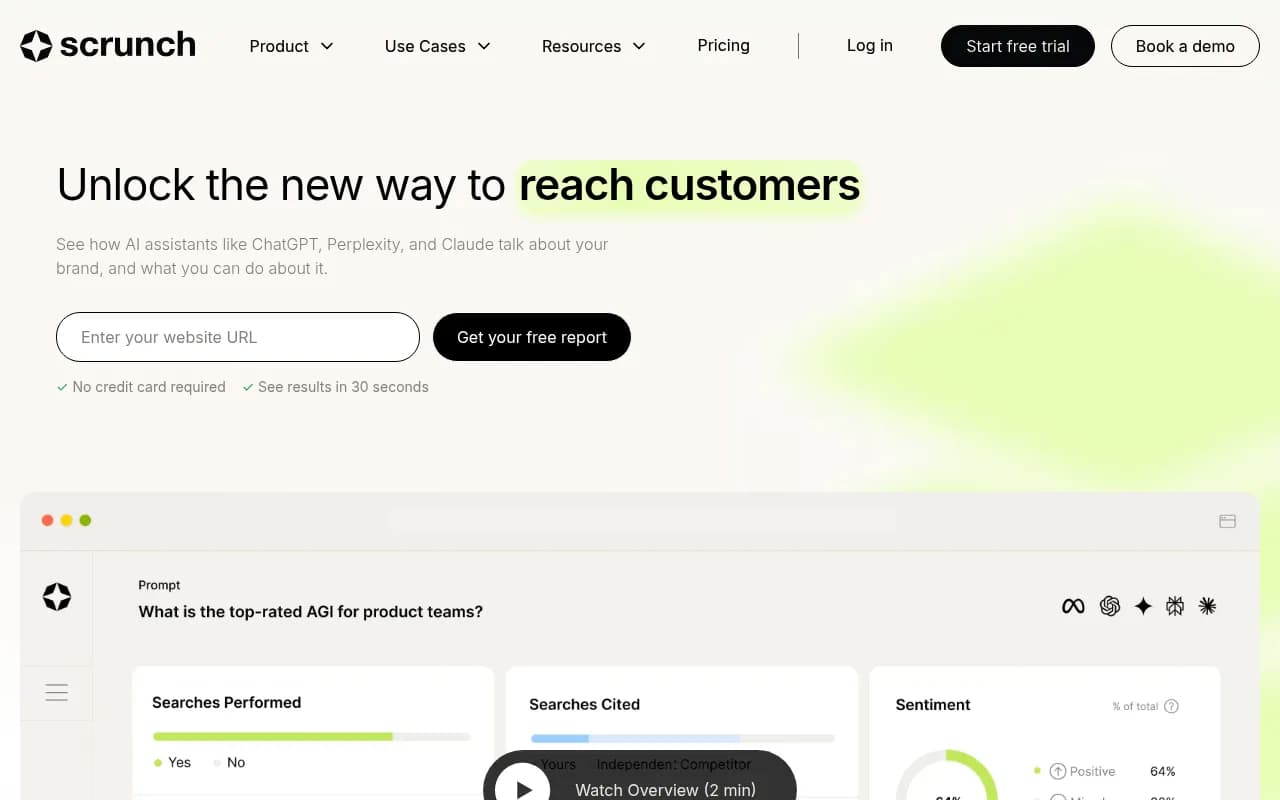
Profound and Scrunch AI both sit at the premium end and both ration content generation tightly. Profound's Growth plan ($399/month) includes just 6 articles a month, unlimited only at Enterprise. Scrunch's lower tiers reportedly skip content generation altogether, reserving it for Enterprise customers. If content output matters to you, these two are priced like trackers but marketed like more.
Profound

Where Promptwatch fits into this
Most of the tools above treat content generation as a bolt-on: a fixed article quota drawn from a shared credit pool, handed to you as a finished draft you still have to review, format, and publish yourself. Promptwatch approaches it differently. Its Content Agents plan, write, and publish GEO-optimized content directly to your CMS, Webflow, Framer, or WordPress, on a schedule you set, either through a review inbox or fully automated.

That matters because of the citation-type data above. Promptwatch's Content Gap Analysis maps your existing pages against what AI engines are actually citing, with coverage scores by topic, so you're not guessing whether to write another listicle when product pages and how-tos are where the citation growth is happening. It also runs Content Refresh, which generates git-diff-style update suggestions for pages you've already published, useful since a lot of GEO content decays in citation share within weeks of its initial ramp-up.
The other piece most content-generation bundles skip entirely is proof of impact. Promptwatch's crawler logs (Agent Analytics) show exactly when ChatGPTBot, ClaudeBot, PerplexityBot, and 400+ other crawlers visit a page, what they read, and whether the crawl actually converts into a citation. Paired with visitor analytics tracking real AI-referred traffic and conversions, you get a feedback loop that most trackers and most content-only tools can't offer on their own. Crisp, a Promptwatch customer, used this loop to scale to 5-10 published articles a day while seeing 2x higher conversion rates from AI traffic versus traditional channels.
Pricing starts at $95/month for Essential (1 site, 50 prompts, 5 AEO articles/month, full LLM tracking), moving to $245/month for Professional, which adds automated content generation and shopping insights, up to $579/month for Business with 30 articles a month and dedicated support. There's a free Explore tier (10 prompts, ChatGPT only) if you want to see the tracking side before committing.
How to pick between them
If your budget is tight and you mainly need volume, Sorank's $49/month entry tier with 20 articles is hard to beat on pure output per dollar. If you want the tightest loop between "we're losing visibility here" and "here's a published article fixing it," Writesonic and ContentMonk both do that well at the $79-99/month range. If you're already deep in a niche like cybersecurity, GrackerAI's vertical tuning might save you editing time even with its thinner entry tier.
If you want the content generation tied to crawler-level proof that it's working, not just a quota of articles, Promptwatch's combination of Content Agents, Agent Analytics, and visitor attribution is the more complete stack, particularly for teams past the point of just wanting to know if they're mentioned and ready to act on it.
For a broader look at the category, the GEO software directory at bestgeosoftware.com is a reasonable place to keep comparing options as pricing and feature sets keep shifting month to month, which, based on Finseo's own history, they clearly do.