Key takeaways
- Bloomreach announced on November 16, 2026 that it has acquired AthenaHQ, an answer engine optimization (AEO) platform. The price was not disclosed.
- The logic is commerce-first: AI agents now search and shop for consumers, and Bloomreach says that if an agent can't find a brand, it won't recommend it.
- The prize is the Athena Citation Engine (ACE), a machine learning model that forecasts how likely a piece of content is to be cited by AI. It will sit next to Loomi, Bloomreach's customer engagement AI.
- The pitch is attribution: tracing a shopper from the AI answer that first named a brand to orders placed months later. That is a roadmap claim, not a shipped product.
- If you use AthenaHQ today, or are shopping for a GEO platform, there are open questions about pricing, roadmap, and whether it stays useful outside the Bloomreach stack.
What was announced
Bloomreach, which describes itself as the AI company for personalized customer engagement, said it has acquired AthenaHQ. Forbes covered the deal, and the Business Wire release went out the same day. Bloomreach says its AI, Loomi, connects to applications and agents for more than 1,400 brands.
AthenaHQ's own site now carries a banner saying it is part of Bloomreach. Its founders, Andrew Yan (CEO) and Alan Yao, are Y Combinator alumni, and Bloomreach's Chief Product Officer Anirban Bardalaye, also a YC alum, welcomed them in a LinkedIn post.
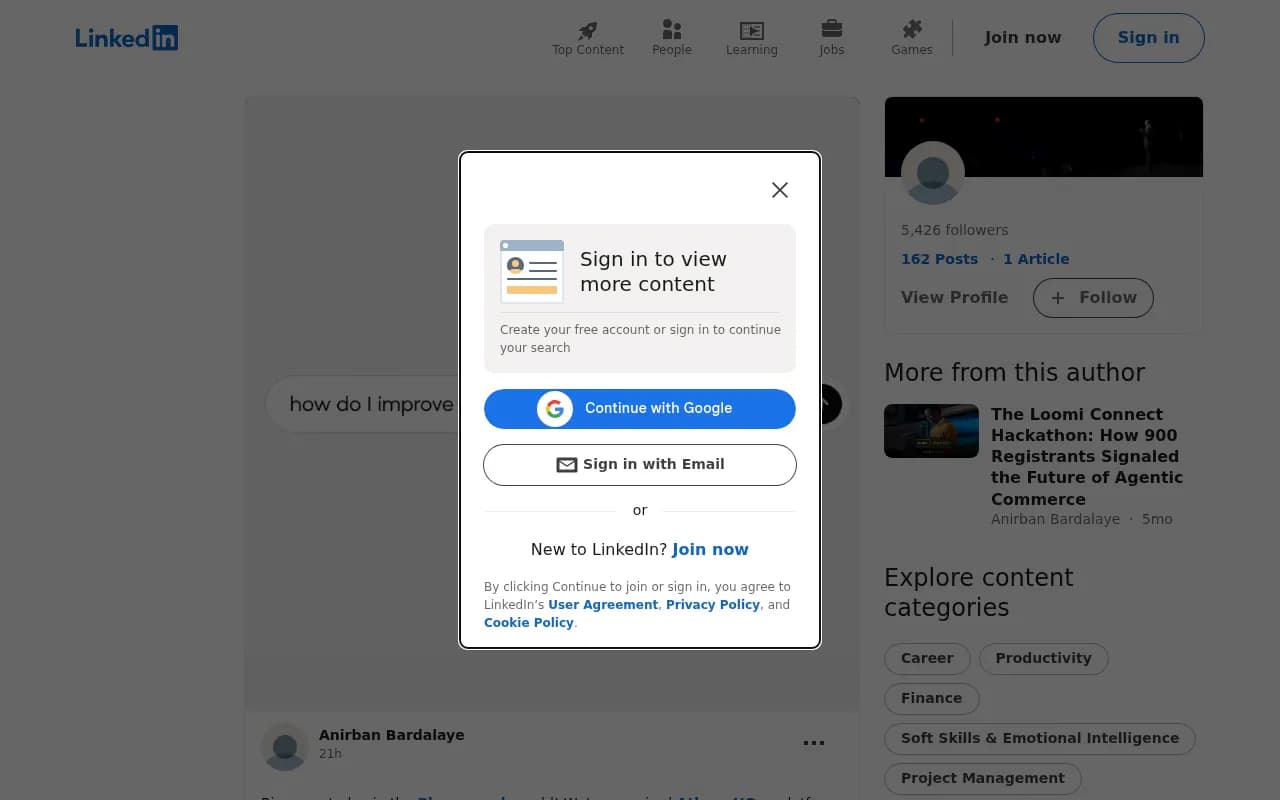
The screenshot is worth a read because Bardalaye says more about the intent than the press release does. His two points: ACE finally gives teams that have been guessing about AI search a way to decide what to work on first, and Bloomreach already sees what shoppers do once they land on a site.
Why a commerce search company wants an AEO platform
Bloomreach's core business is product discovery. Its site search product lets merchants control the recall, ordering, and personalization of results on their own stores. That works when the shopper starts on the merchant's site. Increasingly they don't. They start in ChatGPT, Google AI Mode, or an agent that shops for them, and the merchant's search box never sees the query.
Bloomreach CEO Raj De Datta put it to Forbes in shelf terms: "Think about AI search, a lot of it is that shelf." With AthenaHQ, he said, "Bloomreach can help brands decide what to put on the shelf." Bloomreach already owns the experience after the click (personalization, email, onsite search). Buying AthenaHQ gives it the step before the click.
I think that is a sensible move, and a fairly obvious one. A commerce stack that only starts at your own domain has a hole at the top of the funnel, and that hole is getting bigger.
What the data says about commerce in AI answers
The case for product-page-heavy optimization is backed by citation data. In Promptwatch Data's report on ChatGPT citations by content type (Sep 28 to Oct 4, 2026), product pages were the most cited type at 22.4% of classified citations, and landing pages were next at 16.8%. Together that is 39% of citations going to pages describing what a company sells. For commercial prompts like "best X for Y", product pages got 26.0% and landing pages 20.6%.
That is good news for merchants, since product content is something they control. It is also why Bloomreach's catalog and product-data position is relevant here.
One caution on the shopping side. Promptwatch's ChatGPT shopping usage data shows that shopping features like product cards appear on only a low single-digit percentage of web-search responses, and the rate moves in steps as OpenAI tunes it. Shopping in AI is real, but it is still a small slice of responses. Treat the "agents will buy everything" framing as a direction, not today's reality.
What AthenaHQ brings
AthenaHQ is a GEO/AEO platform that tracks how brands appear in ChatGPT, Perplexity, Claude, Gemini, and other engines. Its platform page says it measures AI search visibility, identifies what shapes each answer, and turns insights into governed action across content, PR, commerce, and optimization. Its customer logos include Coinbase, SoFi, Hearst, HexClad, PagerDuty, and R/GA.
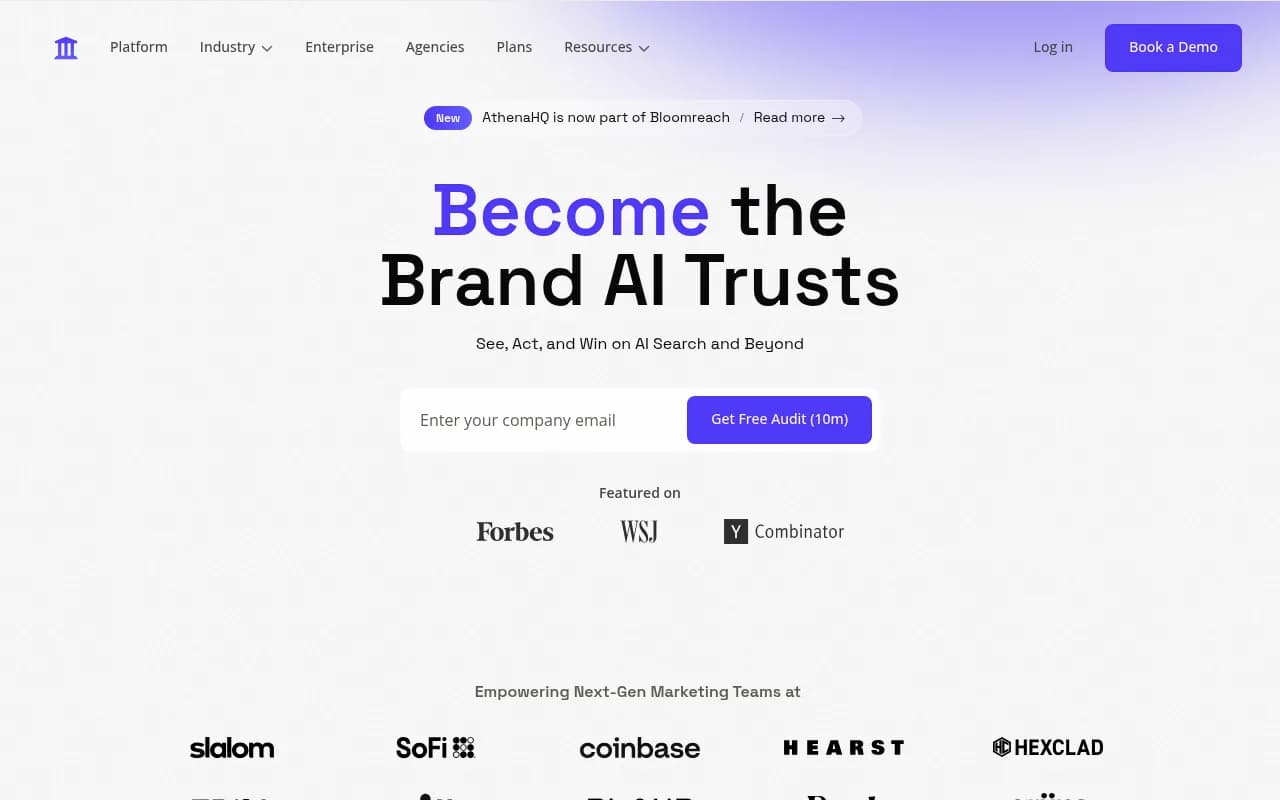
The parts that matter for this deal:
- Athena Citation Engine (ACE). A proprietary model that evaluates a piece of content and forecasts how likely AI is to cite it. Bloomreach calls it the highest-value-opportunity finder.
- Action tooling. Teams can create on-brand content built around real AI search demand, engage the sources that shape AI recommendations, and optimize product content so assistants recommend it.
- Integrations. Shopify and Google Analytics 4, plus Claude and ChatGPT through MCP. GA4 is how it ties AI visibility to traffic and conversions.
- Hallucination detection and competitive intelligence across platforms.
A Datmos executive quoted in the release, a customer of AthenaHQ and partner of Bloomreach, called it "more than just a dashboard." That is the right bar. Plain visibility dashboards are a commodity now.

What the combination could do
Here is the pitch as I read it, split into what is stated and what is inferred.
| Claim | Source | Status |
|---|---|---|
| AI visibility can be turned into measurable revenue | Bloomreach press release | Stated goal |
| ACE complements Loomi across discovery to loyalty | Bloomreach press release | Stated goal |
| Trace a shopper from the first AI mention to orders months later | Bardalaye LinkedIn post | Opportunity, not shipped |
| Decide which products to put in front of AI | De Datta in Forbes | Stated positioning |
| Shopify and GA4 integrations | Press release | Existing AthenaHQ capability |
The attribution idea is the interesting one. Most GEO tools stop at "here is your visibility score" or at most "AI sent X sessions." Linking an AI answer to a customer record and later repeat purchases needs a customer data platform, which is exactly what Bloomreach sells. Bardalaye himself says he doesn't think anyone does this well today. Fair, but it is a hard problem. AI referrers are patchy (ChatGPT stopped sending a referrer on October 8, 2026, for example), so identity stitching will rely on UTM tags, logged-in sessions, and modeling.
What is still unknown
The announcement leaves several practical questions open. I have not found answers to these, and you should ask before buying or renewing:
- Pricing. The price of the deal was not disclosed, and I have not verified AthenaHQ's current pricing or whether it changes post-deal.
- Standalone future. Will AthenaHQ stay usable for brands that don't run Bloomreach? Forbes quotes Yan saying Bloomreach's "commitment to investing in Athena's continued innovation" made it the right partner, but nothing commits to standalone support.
- Roadmap. No public timeline for the Loomi integration or the revenue attribution.
- Data handling. Merging an AEO platform with a customer data platform raises questions about what customer data flows where. Enterprise buyers should get this in writing.
What to do if you are an AthenaHQ customer
- Ask your account contact for the roadmap commitments in writing, especially around standalone use and pricing for the next 12 months.
- Export your prompt sets, historical visibility data, and reports now. It is a good habit after any acquisition.
- Check which of your workflows depend on integrations that could change.
- Run a parallel trial of another platform for a few weeks, so you have a comparison on the same prompts.
What to do if you are choosing a GEO platform now
The deal clarifies a split in the market. One group is monitoring tools that report mentions and scores. Another is platforms that connect visibility to content execution and measurement. A third, now including Bloomreach plus Athena, is suites that tie AI visibility to the rest of a commerce or marketing stack.
If you are already deep in Bloomreach, the combined offer may be the simplest path, once it ships. If you are on Shopify, Klaviyo, HubSpot, or another stack, you probably want something independent.
Alternatives worth checking
Promptwatch is the option I would put at the top for teams that want the loop closed inside one product. It tracks ChatGPT, Gemini, Claude, Perplexity, Google AI Overviews, and AI Mode from the real interfaces, then goes further: IP-verified AI crawler logs show whether bots read your pages, the Content Agent writes and publishes to WordPress, Webflow, or Framer, and visitor analytics measure the traffic and conversions AI sends. For ecommerce there is ChatGPT Shopping tracking on the Business plan. See the Promptwatch vs AthenaHQ comparison for specifics, and confirm current plans at promptwatch.com/pricing. There is also a 7-day free trial and a free AI visibility report.

Other options in our catalog:
Profound


Otterly.AI

| Platform | Type | Content execution | Crawler visibility | Best fit |
|---|---|---|---|---|
| AthenaHQ (Bloomreach) | AEO platform with ACE forecasting | Content creation tools, Shopify and GA4 links | Not covered in the announcement | Bloomreach customers, ecommerce teams |
| Promptwatch | End-to-end GEO platform | Content Agent with CMS publishing | IP-verified crawler logs | Brands and agencies wanting a full loop |
| Profound | Enterprise monitoring | Limited | Varies | Large brands focused on monitoring |
| Scrunch AI | Monitoring and optimization | Some | Varies | Mid-size marketing teams |
| Peec AI | Prompt tracker | No | No | Teams wanting simple tracking |
| Otterly.AI | Prompt tracker | No | No | Small teams, light monitoring |
For a broader view, the GEO software directory at bestgeosoftware.com lists more platforms by category.
What ecommerce teams should do now regardless of vendor
The vendor drama matters less than the groundwork. A few things pay off whichever platform you pick, and they follow from the citation data above:
- Fix product pages first. Complete specs, prices, availability, and positioning. Product pages are the single most cited content type in ChatGPT.
- Add Product schema and keep your merchant feed clean. This is the same advice Promptwatch's shopping data gives, since cards only appear on commercial and transactional prompts.
- Make products easy to compare. Comparisons and listicles together take a sizable share of commercial citations, so get listed in the best-of roundups AI already cites.
- Collect reviews on trusted sites. Reviews rise to 5.6% of citations on branded prompts.
- Check crawler access. If AI bots can't read your pages, no optimization matters. The AI crawler URL inspector is a quick free check.
- Wire up analytics. GA4 with UTM-tagged links, so AI traffic does not vanish into direct.
My take
This acquisition is a defensible bet and a slightly early one. Bloomreach is right that product discovery is leaving the merchant's domain. It is right that the data after the click is valuable. What is unproven is the bridge: reliable attribution from an AI answer to a lifetime customer. Until that ships, the deal is a roadmap and a team, plus an existing product with solid customers.
If you are a Bloomreach shop, watch the integration news. If you are not, treat this as a reminder that GEO vendors are consolidating, so pick one whose data you can export and whose value does not depend on a bigger stack.