Key takeaways
- Ads and citations are independent. Paying OpenAI does not get you cited in the answer, and being cited does not make your ads cheaper or better placed.
- Ads serve only to Free and Go users. Plus, Pro, Business and Enterprise users see answers with no ads, so organic is the only way to reach them.
- Tag every ad URL with a full UTM set before launch. An untagged ad click lands in GA4 as a plain chatgpt.com referral, the same bucket as free organic mentions.
- Ads Manager reports delivery and last-click ROAS, but no reach, demographics, frequency or incrementality. Treat the first flight as an experiment with a holdout.
- Decide budget question by question: ads where you are not cited today, content and citation work where you could be, and neither where it is unrealistic.
Why this decision showed up so fast
OpenAI started a small US pilot of ChatGPT ads on February 9, 2026. By late August it was self-serve across most of Europe, and OpenAI said the product had reached a $1 billion annualized revenue run rate in under 200 days. That is a very short time for a new ad channel to go from rumor to line item.
The awkward part is that most marketing teams already had a second ChatGPT strategy running: getting cited in answers. Now there are two ways to appear in the same conversation, one paid and one earned, and the people managing them often sit in different teams with different dashboards.
This guide is about putting them side by side. What each one is, how to measure each honestly, and how to split money between them without fooling yourself.
What a ChatGPT ad is, and what a citation is
A ChatGPT ad is a sponsored placement shown below the answer, labeled as sponsored. According to OpenAI's help documentation, ads run on systems separate from the model, and advertisers cannot shape, rank or alter what ChatGPT says. You target by describing the conversations you want to appear in (context hints, landing page, headline, ad copy) rather than bidding on keywords.
An organic citation sits inside the answer. Your brand is recommended, or your page is listed as a source. You cannot buy it. You earn it with content and sources the model finds and trusts.
| ChatGPT ads | Organic citation | |
|---|---|---|
| Where it appears | Below the answer, labeled sponsored | Inside the answer or its source list |
| Who sees it | Free and Go users, adults only | All users, including paid tiers |
| How it is chosen | Relevance to the conversation plus your bid | Content and sources the model considers reliable |
| When it stops | When budget stops | As long as the source stays valid |
| Time to results | Days | Weeks to months |
| Platform reporting | Impressions, clicks, spend, ROAS | None native; you need your own tracking |
The "who sees it" row matters more than it looks. If your buyers use ChatGPT at work on a Business or Enterprise seat, they will never see your ad. The answer is the only place you can reach them.
How often ads actually show up
Before budgeting, it helps to know how much ad inventory exists. Promptwatch Data tracked this over May 20 to August 17, 2026 in its ChatGPT ads over time report. The numbers move fast:
- ChatGPT served no ads until May 27, 2026, when they appeared in 1.69% of responses.
- Over the 90-day window, ads appeared in an average of 20.1% of responses (counting only responses where ChatGPT searched the web and returned a citation).
- Since July 1 the daily rate has mostly sat between the low 20s and high 30s, with a peak of 43.9%.
- Of ad-bearing responses over the past 7 days, 73.3% were organic prompts, 18.0% brand-specific and 8.6% competitor comparisons. Promptwatch flags that this is a volume mix, not the odds that each prompt type triggers an ad.
Seer Interactive, tracking ads in its own AI tracker, saw a similar trend and updated its figures on July 28, 2026 after about two weeks of data. Its most useful finding for this decision: across 3,697 ads, the advertiser appeared in ChatGPT's actual response only 5.4% of the time and was cited as a source 3.3% of the time. Put plainly, most advertisers are buying a slot under an answer that does not mention them. Sometimes ChatGPT recommends your brand and a competitor's ad sits right underneath it.
That cuts both ways. If you are absent from the organic answer, an ad is a way into the query while you build visibility. If you are already recommended, you may need to watch who is buying against you.
Measuring ads: what you get and what you do not
Improvado read OpenAI's help docs against one question, what can a team measure today, and checked its findings on August 25, 2026. Improvado sells analytics infrastructure, so weigh it accordingly, but the list matches what other write-ups describe.
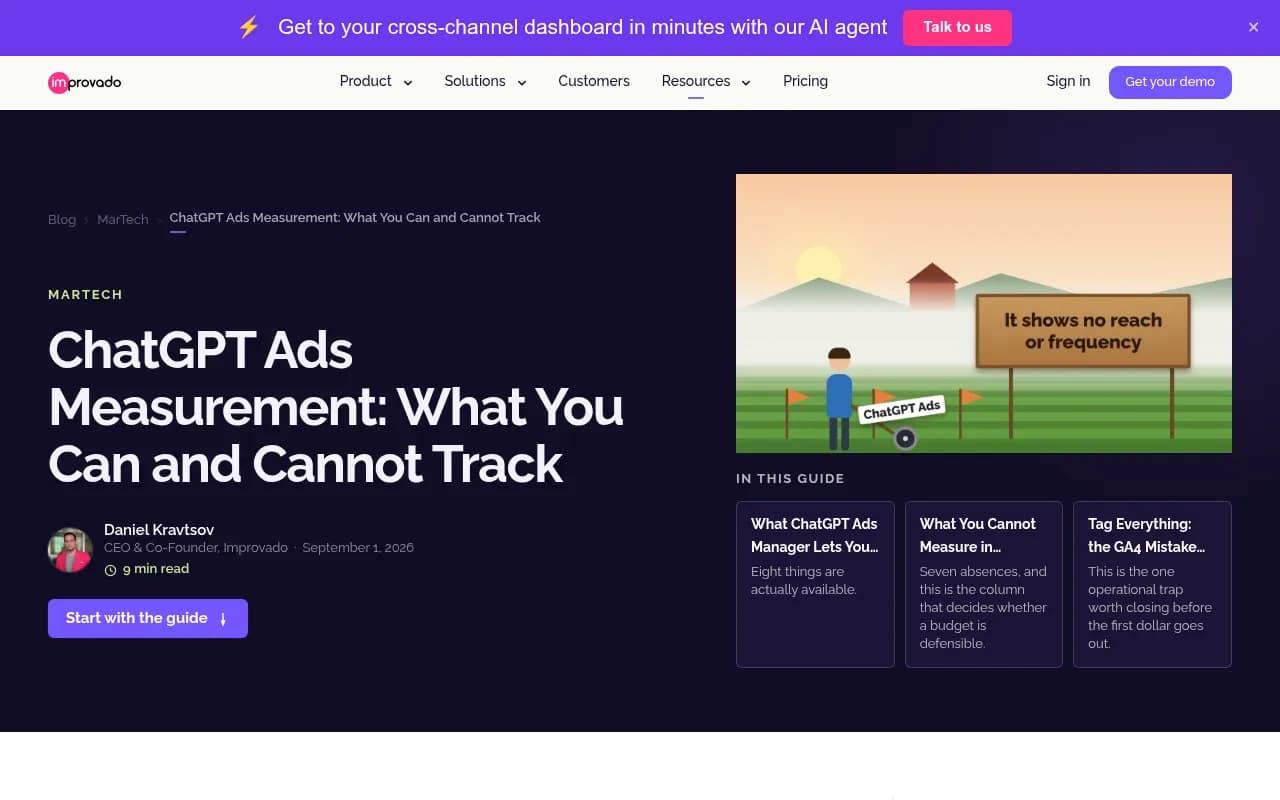
What Ads Manager gives you:
- Impressions, clicks, spend, CTR, CPC, CPM and conversions at campaign, ad group and ad level
- Revenue and ROAS from attributed order events
- A browser pixel plus a server-side Conversions API, deduplicated by a shared event ID
- An oppref click reference appended to landing URLs
- Device and country breakdowns
- Optional view-through conversions on a fixed one-day window
What it does not give you:
- Demographics, reach or frequency
- Scheduled or log-level exports
- Any incrementality or lift product
- Third-party verification (no IAS, DoubleVerify or MRC)
- The prompts that triggered your ad, which stays hidden for privacy reasons
Attribution is last-touch: each conversion is credited to the last ChatGPT ad the person clicked or saw. Budget floors are low. The minimum daily budget is $25 in the US, and there is no account minimum or setup fee. Campaigns pick one of three objectives, and under the Views objective you pay per thousand impressions.
My read: this is enough to run a test and report on it, and not enough to prove the money was well spent. You will know the ad ran and roughly what it returned on last-click terms. You will not know whether those orders would have happened anyway.
Tag everything, or paid and organic blur together
This is the one mistake worth fixing before spending a dollar. Only the oppref reference is appended automatically, and it is not a source label. An ad click with no UTM parameters shows up in GA4 as a chatgpt.com referral, which is exactly how an organic ChatGPT mention arrives. Your organic numbers get inflated and your paid numbers get understated, and you cannot undo it after the fact.
A sensible tagging scheme:
utm_source=chatgpt
utm_medium=paid_ai
utm_campaign=honeymoon-japan-q4
utm_content=ad-variant-a
Pick a medium value that nothing else in your account uses, and keep organic ChatGPT traffic on its own channel grouping in Google Analytics. There is a second wrinkle: ChatGPT stopped sending a referrer on October 8, 2026, so some organic visits now arrive as direct unless the link carries a utm_source. Analytics tools that let you count utm_source=chatgpt.com visits as ChatGPT traffic help here, and Promptwatch's guide to attributing AI traffic walks through the setup.
Measuring organic citations
There is no native dashboard for citations. You have to build the measurement yourself, and it has three layers.
Layer 1: are you cited at all
Take the 20 to 50 questions a customer asks before choosing a provider like you. Run them through ChatGPT repeatedly, in the right country and language, and record whether your brand is named, which sources back it, and who appears instead. Doing this by hand works for a first audit. It does not scale, and single runs are noisy.
Platforms built for this track mentions and citations across models on a schedule. Promptwatch monitors the real ChatGPT interface rather than only the API, reports Visibility Score, Share of Voice and citation rank, and also tracks which advertisers and landing pages show up on your prompts through Ads Radar, so one tool covers both the paid and the earned side of the same question list.

Other trackers worth a look include Profound, Peec AI and Otterly.AI, which are mostly monitoring-focused. The AI rank tracking directory lists more if you want to compare.
Profound


Otterly.AI

Layer 2: does AI read your site
A citation problem is often a crawl problem. If GPTBot or OAI-SearchBot hit errors on your pages, no amount of content work helps. IP-verified crawler logs separate an access problem from a content problem. Promptwatch's AI crawler logs do this, and its AI crawler traffic report shows what normal looks like across OpenAI, Anthropic, Google, Perplexity and Mistral.
Layer 3: does it send visitors who convert
Citations only matter if they send people. Use GA4 plus a visitor analytics script to measure AI-referred sessions and conversions. Crisp, for example, reported 2x higher conversion rates from AI traffic than from traditional channels, per its case study. That is one customer, not a benchmark, but it is the kind of number you should be able to produce for yourself.
Which pages earn citations, and how long they last
This is where the staying-power difference shows up in data. Promptwatch Data's citation share by content type report, covering September 28 to October 4, 2026, found that product pages are the most cited type in ChatGPT at 22.4%, followed by landing pages at 16.8% and listicles at 13.6%. For commercial prompts, product pages, landing pages, listicles and comparisons make up almost 70% of citations.
The content half-life report tracked every page ChatGPT cited on July 6, 2026 for 90 days:
| Content type | Still cited at 60 days | Notes |
|---|---|---|
| Landing pages | 69% | 78% still cited at 30 days |
| Docs | 67% | 76% at 30 days |
| Comparisons | 63% | 72% at 30 days |
| Listicles | 60% | Cross 50% only near window end |
| Product pages, reviews, how-tos | ~55% | Half-life of 74 to 77 days |
| News | 41% | Half of pages gone after 36 days |
The takeaway for budgeting: an evergreen landing, product or comparison page keeps earning citations for months after you publish it. An ad stops the day the budget does. News and press coverage suit short bursts, not durable visibility.
One more factor. In Promptwatch's data, almost half of ChatGPT responses cite 10 or more unique domains, so there are many seats at the table. You do not need to be the only source, just one of several.
How to split the budget
A workable process, adapted from the question-first approach several of the sources describe:
- List the questions that matter. Aim for 20 to 50 buyer questions, mixing informational, commercial and branded.
- Check who gets cited today. For each, note whether you appear, who does, and which sources support them.
- Sort into three groups. Already cited, within reach with better content or sources, and unrealistic for now.
- Assign money. Ads go on the "not cited" group where the question has real commercial value. Content work goes on the "within reach" group. Defend the "already cited" group with maintenance, not spend.
- Re-sort monthly. When a question moves from "within reach" to "already cited", release the ad budget on it. When you lose a citation, it becomes an ad candidate.
An example. A travel agency finds it is cited for "group tours in Piedmont" but never for "honeymoon in Japan", where answers cite big portals and travel blogs. It points ads at the Japan questions, publishes a complete guide, and pitches a couple of travel publications. Once it starts appearing in answers, it cuts the Japan ad spend. For a related read on what tends to get cited in travel, see Promptwatch Data's travel citation report.
A rough default split
I would not hand you a magic ratio, because nobody has the benchmarks yet. EMARKETER's advice, as relayed by Geosnap, is to treat ChatGPT ads as a structured test rather than a core channel, because early spend mostly buys learning. A defensible starting posture:
- Majority of effort on organic: evergreen pages, crawl access, third-party mentions.
- A small, capped test budget on ads, aimed only at the gap group.
- A holdout built in from day one.
Seer's guidance fits: go in with a testing plan, not just a budget. The risk is not the spend, it is spending without structure and ending with no real learning.
Making the ad test trustworthy
Platform ROAS is self-graded, and Ads Manager has no lift product. So build your own checks.
- Holdout. Run the same campaign in some countries or regions and withhold it from comparable ones, then compare conversions. Country breakdowns in Ads Manager make this practical.
- Pixel plus Conversions API. Set up both, deduplicated with the shared event ID, so you do not lose conversions to browser blocking.
- Separate landing pages. A landing page used only by the ad makes paid versus organic clean even if tagging slips.
- Compare against other channels on the same cost basis. This is where a connector helps. Improvado has an OpenAI Ads connector that lands campaign, ad group and ad level data in your warehouse next to the rest of paid media. It cannot invent missing columns like reach or demographics, and better plumbing does not replace a holdout. It just lets you see the result cleanly.
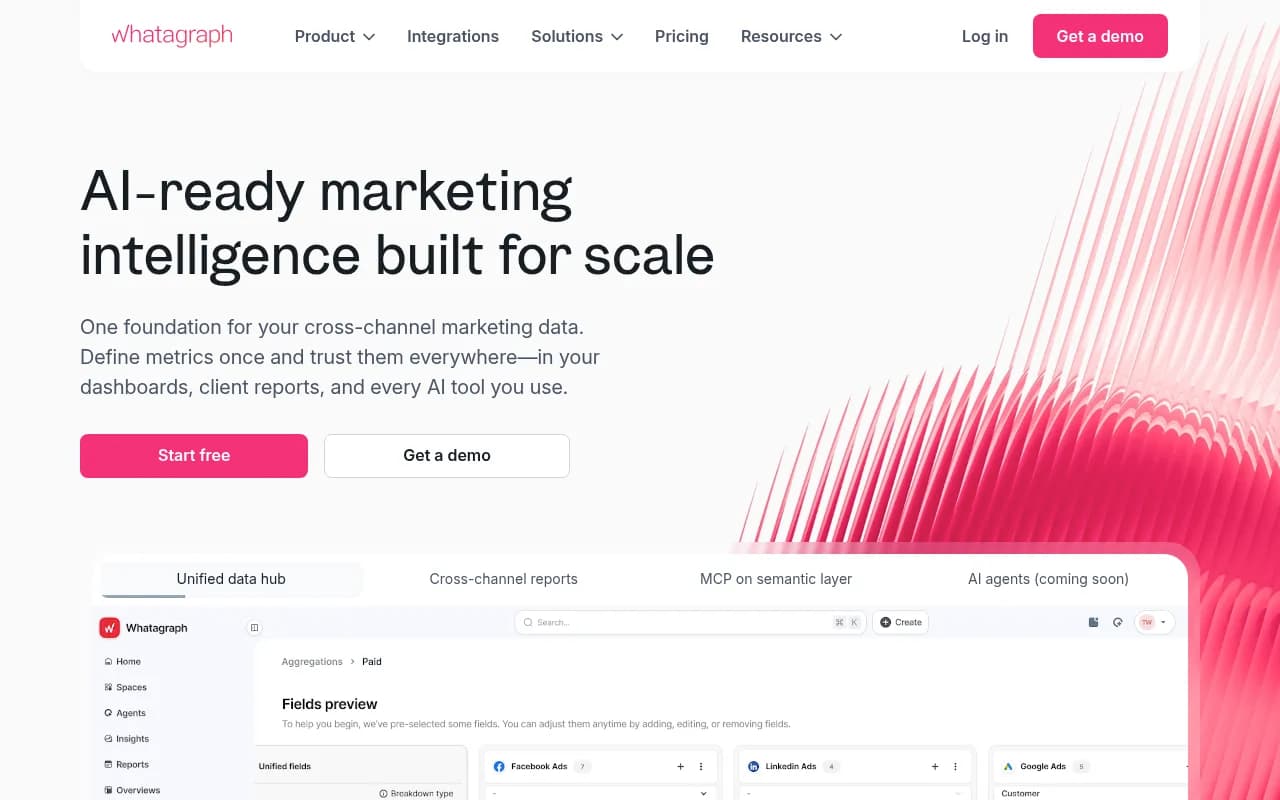
If you already run a warehouse and BI stack, pulling ad exports into Google BigQuery or a reporting tool like Whatagraph is a lighter-weight alternative, though the lack of scheduled exports means someone is downloading CSVs by hand.
A caution on targeting too. Jolly Good Web notes there is no audience insight, no placement data and no visibility into which conversation types triggered your ad or what ChatGPT said before it appeared. Plan around that. Also, OpenAI says it keeps ads out of sensitive categories like health, mental health and politics, so if you sit in those, organic is not just the better option, it may be the only one.
One scorecard for both channels
The point of all this is to read paid and earned side by side. A simple scorecard, reviewed monthly:
| Metric | Ads source | Organic source |
|---|---|---|
| Questions covered | Ads Radar or ad-by-prompt data | Citation tracker, share of tracked prompts where you appear |
| Visits | GA4, utm_medium=paid_ai | GA4 or visitor analytics, AI-referred sessions |
| Conversions | Pixel and Conversions API, holdout-adjusted | GA4 conversions on AI-referred sessions |
| Cost per conversion | Ads Manager spend divided by holdout-adjusted conversions | Content and tooling cost divided by conversions |
| Durability | Ends with budget | Citation half-life by page type |
Organic cost per conversion is harder to calculate because content costs are spread over months. Do it anyway, on a quarterly basis. Otherwise paid will always look expensive and organic will always look free, and neither is true.
Common mistakes
- Treating ad impressions as proof of visibility. If you are not in the answer, the ad is a separate impression.
- Leaving ads untagged and reading the chatgpt.com referral bucket as organic.
- Bidding on branded prompts without checking whether you are already recommended there.
- Assuming ChatGPT's paying users see your ad. They do not.
- Scaling spend on platform ROAS alone before running any holdout.
- Ignoring crawl access and then wondering why content work does not produce citations.
Where to go from here
Start with the audit. List your questions, find out where you are cited, and tag your ad URLs before any budget moves. If you want a quick baseline, Promptwatch offers a free AI visibility report, and the GEO software directory at bestgeosoftware.com lists other tools to compare. Then run a small, capped, holdout-controlled ad test against the gap questions while your evergreen pages build citations that keep working after the budget is gone.
That is the practical answer to the title: do not choose between ads and citations. Measure both with the same list of questions, let organic carry the long-term load, and use ads only where the data says you are missing.