Key takeaways
- Almost half of ChatGPT responses with citations (47.6%) cite 10 or more unique domains, and 66.1% cite at least 8, according to Promptwatch Data (Sep 28 to Oct 4, 2026).
- Brand-specific prompts are the exception: only 21.3% cite 10 or more domains, and 5 domains is the most common count.
- AthenaHQ reports the average fell from 21.4 to 9.8 distinct domains per answer over eight months. The method differs from Promptwatch's, so treat the two as separate data points.
- You will almost never be the only source in an answer. Your job is to be one of the sources, described accurately, in the right position.
- Third-party pages (reviews, listicles, forums, comparison posts) are how most brands get into crowded answers.
Why the number of domains per answer matters
Most brand teams ask one question about ChatGPT: "Are we cited?" That is a yes/no question, and it hides the more useful one. When a single answer pulls from ten or more websites, being cited is the entry fee. What matters is who else is in the answer, where you land, and what the answer says about you.
This guide walks through the data we have on unique domains per ChatGPT response, why two reports can disagree on the trend, and what to do about it. I'll be upfront: the sources use different methods, and I flag where that matters.
What the data says
Promptwatch Data: the distribution
Promptwatch published a report on unique domains per ChatGPT response covering Sep 28 to Oct 4, 2026. It only counts responses with at least one citation, and several URLs from the same domain count once. That last detail is important: ten citations from one domain is a one-domain answer.
The headline numbers:
- 47.6% of responses cite 10 or more domains
- 66.1% cite at least 8
- Only 6% cite three or fewer
- About 1% cite a single domain
- The share climbs with every extra domain from 1 to 9
So answers built on a handful of sites are the exception. Sharing the answer is the default.

The prompt type changes everything
The same report splits results by prompt type, and the gap is large.
| Prompt type | Example | 10+ domains | Notes |
|---|---|---|---|
| Organic | "best project management software for small teams" | 52.5% | 71.8% cite at least 8; 4.5% cite 3 or fewer |
| Competitor comparison | "Asana vs Monday.com" | 49.1% | 66.5% cite at least 8; only 0.35% cite a single domain |
| Brand-specific | "is Asana good for small teams" | 21.3% | 5 domains most common (14.9%); 13.8% cite 3 or fewer |
| All prompts | n/a | 47.6% | 66.1% cite at least 8 |
Organic questions are the most crowded. This is where buyers discover options, and it is also where you share the stage with the most competitors. Brand questions draw on far fewer sites, which means the handful of domains ChatGPT picks for them carry a lot of weight over how you are described.
AthenaHQ: a different method, a different story
Andrew Yan, co-founder of AthenaHQ, posted on LinkedIn on Oct 22, 2026 that their Q4 State of AI Search Report found the average number of distinct domains cited in a ChatGPT answer fell from 21.4 to 9.8 over eight months, a 54% drop.
I'd read this carefully. AthenaHQ reports a mean over time. Promptwatch reports a distribution for one week. I have not seen AthenaHQ's methodology, since the report itself wasn't available to me, so I can't tell you how prompts were sampled or which models were included. Both agree on the broad point (many domains per answer), but they disagree on the direction of travel, and a single week of distribution data can't confirm or refute a decline.
There is one plausible contributor worth knowing about. Promptwatch Data documented that average citations per ChatGPT response dropped around the GPT-5.3 rollout on March 4, 2026. Fewer citations per response would reduce unique domains too. That is a hypothesis, not a proven link between the two reports.
Also keep the older benchmark in mind: Promptwatch's average sources per response page put ChatGPT at about 5 citations per web-search answer, versus about 10 for Google AI Overviews and Perplexity. That page is dated Sep 2025 and measures citations, not unique domains, so it isn't contradicting the 47.6% figure. It is a different metric from a different time.
Who actually gets cited
Surfer's analysis of about 25.96 million ChatGPT citations in October 2026 found that the 50 most-cited domains earned only 9.6% of them. google.com led with 1.73%, followed by Reddit, Semrush, LinkedIn, itechguides.com, G2, TechRadar, Yelp and Clutch.
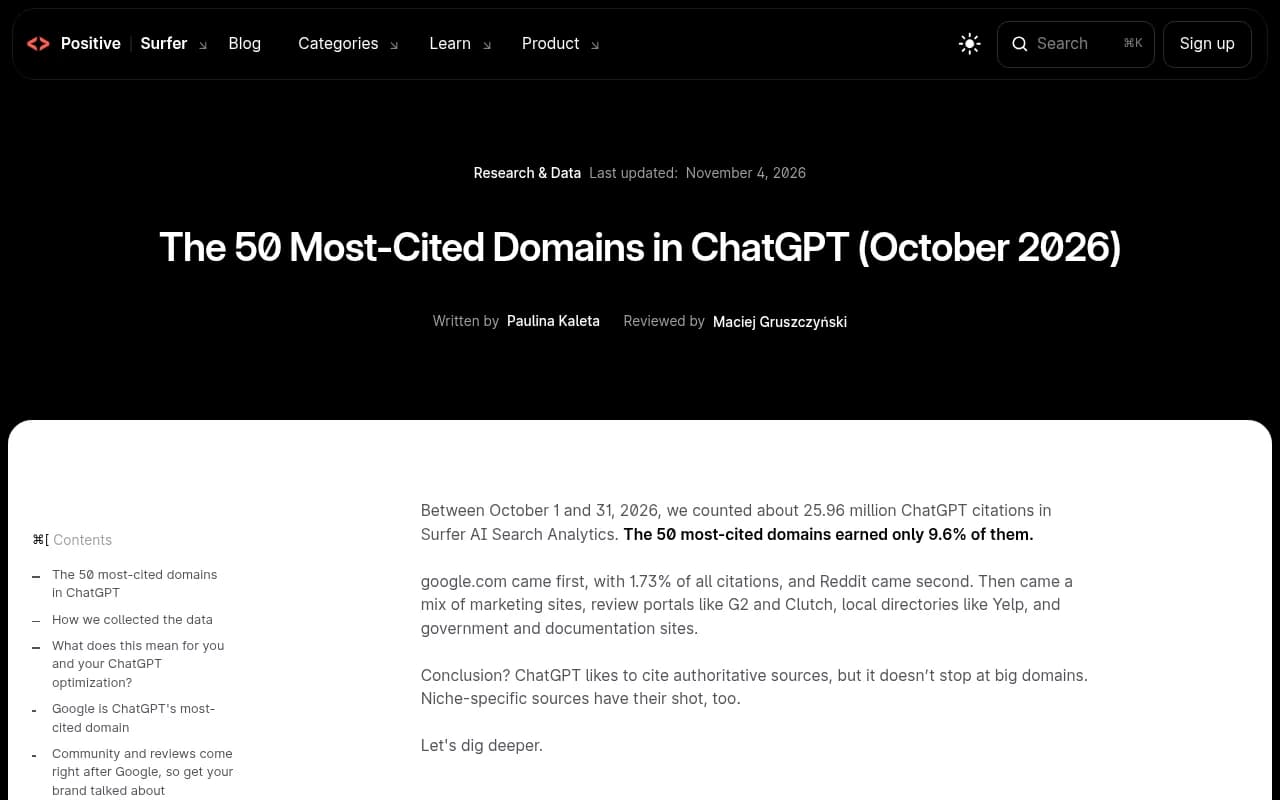
That long tail is the opportunity. If the top 50 only hold under a tenth of citations, there is plenty of room for niche sites, and Surfer's own takeaway is the same: authoritative sources get cited, but niche-specific ones have their shot too.
One caution on Reddit. Promptwatch Data shows reddit.com's share of ChatGPT citations fell from roughly 4% to 0.5% on August 14, 2026, so older advice to "just get on Reddit" needs a fresh look. The Surfer ranking measures a different tool's user base and window, so don't expect it to match exactly.
What this means for your mention strategy
Stop treating citation as the finish line
With 10 or more domains in a typical answer, your reader sees several options at once. Track three things instead of one:
- Whether you are cited or mentioned at all
- Where you appear in the answer (first recommendation or buried in a list)
- How the answer describes you (accurate, outdated, lukewarm)
A mention in position eight with a stale pricing claim is not a win.
Know who shares the answer with you
Competitors are not just the brands you think of. In a crowded answer they are also the review sites, listicle publishers and forums. Check which domains show up next to yours across many prompts. One prompt tells you very little, because answers vary run to run. Sample dozens of organic prompts per topic before drawing conclusions.
Get onto third-party pages
For organic and comparison prompts, third-party pages are often your way in. That means:
- Reviews on sites like G2, Capterra and Clutch (all in Surfer's top 20 for October 2026)
- Listicles and "best X for Y" posts that already get cited for your target prompts
- Comparison pages from publishers, not just your own
- Community threads, with realistic expectations given the Reddit drop in ChatGPT
As for which content types win, Promptwatch Data shows product pages are the most cited content type in ChatGPT at 22.4% for Sep 28 to Oct 4, 2026, followed by landing pages and listicles. So your own product pages matter alongside the third-party ones.
Own the short list for brand prompts
Brand-specific answers cite few domains, so the ones that appear are high leverage. Do these:
- Make your own site answer pricing, features, reviews and alternatives clearly
- Check which review sites and forums show up for prompts about your brand, then make sure your profiles there are complete and current
- Publish comparison pages against the competitors you are most often compared with, and spell out your differences in quotable sentences
- Check that third-party comparison pages describe you accurately
Watch for decay
Cited pages don't stay cited forever. Promptwatch Data tracked every page ChatGPT cited on July 6, 2026: landing pages and docs stayed cited longest, while news lost half its pages within 36 days. If you invest in a listicle placement, check back. Andrew Yan makes a similar point about quarterly snapshots: a source can be down-ranked and you find out weeks late.
Report per platform, not as one average
Yan's other advice is worth stealing. Don't roll everything into one blended score. Track ChatGPT, Gemini, Perplexity and AI Overviews separately, then combine. A blended average can hide a collapse on one platform. It also makes budget conversations easier, because you can tie a specific investment to a specific platform.
A practical workflow
| Step | What to do | What you learn |
|---|---|---|
| 1 | Build 30 to 50 organic prompts per topic | Your coverage across crowded answers |
| 2 | Add 10 to 15 brand and comparison prompts | How you are described where fewer sources decide |
| 3 | Log every cited domain per answer | Who shares the answer with you |
| 4 | Rank third-party domains by frequency | Your placement targets |
| 5 | Fix or publish on your own site for gaps | Pages ChatGPT can cite |
| 6 | Re-run weekly | Whether changes stuck |
You can do steps 1 to 3 by hand for a small topic, though it gets tedious fast. Tools like Promptwatch track prompts across real AI interfaces, show which domains are cited alongside you, and flag content gaps. If you want a first look without committing, the free AI visibility report scans how ChatGPT, Gemini and Perplexity talk about your brand. For more options, the GEO software directory at bestgeosoftware.com lists alternatives.
What to measure
Read the metrics together rather than one at a time. Low Share of Voice means a coverage problem. A late Position means a prominence problem. Mentions without citations to your own domain point to a content or crawlability problem, and weak sentiment points to a reputation problem. The Promptwatch academy page on citations vs mentions explains the difference if your team mixes them up.
Caveats worth keeping in mind
- The 47.6% figure is one week (Sep 28 to Oct 4, 2026) and only covers responses with citations. Responses without citations aren't in it.
- Distribution and average are different things. Half of answers at 10 or more domains is compatible with a mean near 10, and also with a mean much higher.
- Third-party studies use different prompt sets, user bases and model versions. Compare trends within a source, not levels across sources.
- ChatGPT's search behavior changes. For example, Promptwatch Data recorded the site: operator jumping from about 0.4% to about 17% of fanout queries on August 8, 2026, which shifts which pages get retrieved. Rerun your baselines after big changes.
The bottom line
Plan on sharing every answer. For organic and comparison prompts, assume ten or more domains are in the room, and spend effort on the third-party pages that put you there. For brand prompts, the list is short, so make sure the few domains on it say the right things. Then measure weekly, per platform, because the numbers move.