Key takeaways
- Since 25 August 2026, BotScope has recorded zero ads across 1,878 collected ChatGPT answers, and a public index sampling roughly 100,000 answers a day shows zero since 28 August.
- The most likely explanation is that signed-out, automated collection can no longer see the ads. It is not that OpenAI stopped selling them. OpenAI reported a $1bn annualised ads run rate on 31 August.
- A zero on a dashboard is only a finding if the tool could see ads in the first place. Good tools mark these answers as "not measured".
- Promptwatch's own public data covers May 20 to August 17, 2026, so it shows the ramp-up but not the late-August drop. Verify any vendor's current ad coverage yourself before trusting it.
- Ads are also changing shape, with Sponsored Agents turning an ad click into a conversation, which makes measurement harder.
What happened to ChatGPT ads in the dashboards
In July, ads under ChatGPT answers were routine for anyone watching. Jamie Stevens, who founded the AI visibility tracker BotScope, saw Monday.com under a CRM pricing question, Guitar Center under a beginner guitar question, and SoFi under a home-buying question. Then they stopped appearing in his data.
His numbers are specific. Using the same 44 prompts in the same market, an ad showed on 23 answers on 12 August and on none three weeks later. Since 25 August, not one of 1,878 collected answers carried an ad.
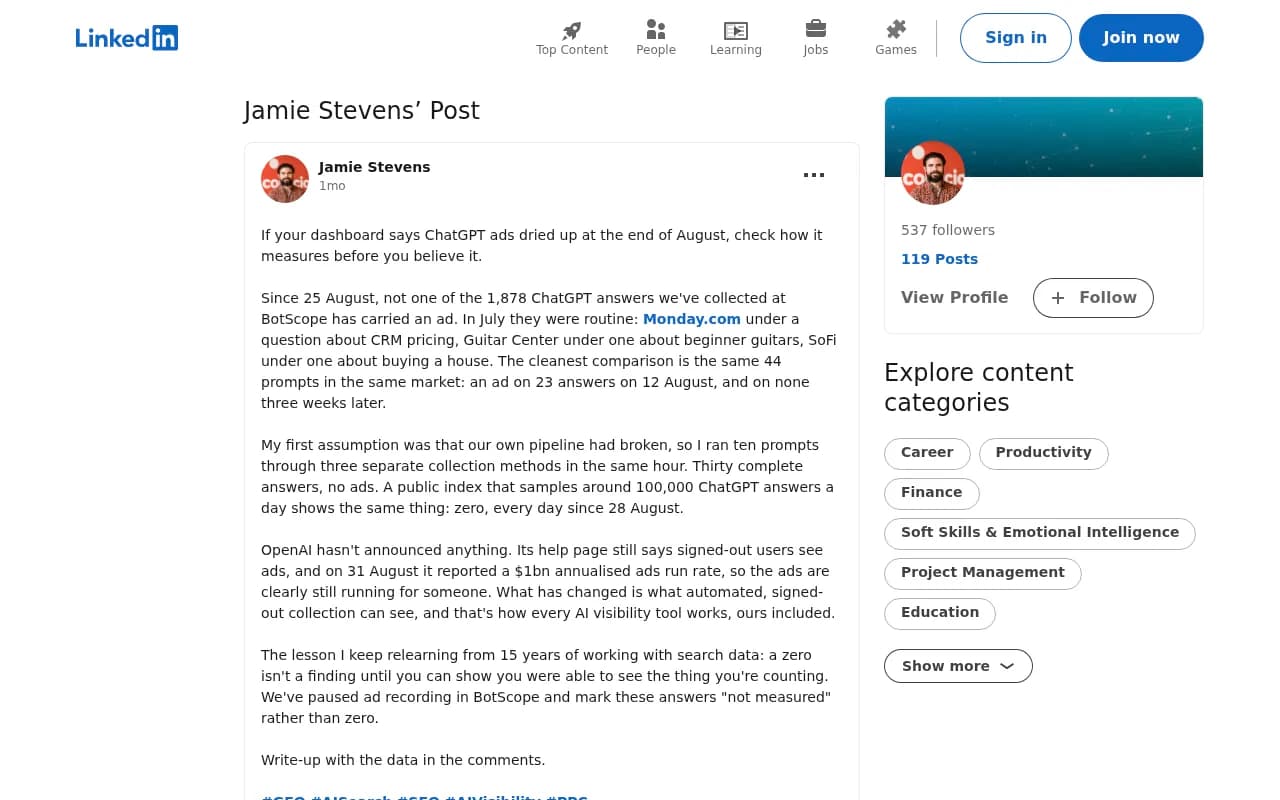
What I like about his write-up is that his first assumption was that his own pipeline had broken. He ran ten prompts through three separate collection methods in the same hour. Thirty complete answers, no ads. A public index that samples about 100,000 ChatGPT answers daily showed the same thing: zero, every day since 28 August.
Meanwhile OpenAI has announced nothing. Its help page still says signed-out users see ads. So the ads are clearly still running for someone. The more plausible reading is that something changed in what automated, signed-out collection can see. That describes how almost every AI visibility tool works.
To be clear, this is one practitioner's account plus a public index, not an OpenAI statement. I would treat the cause as a strong hypothesis and the symptom as well documented.
Why a zero is not the same as no ads
This is the part many teams get wrong. A dashboard that reports 0% ad presence looks like a measurement. It might be a blind spot.
Think about how most tools collect answers:
- They send a prompt to ChatGPT from a scripted session, usually without a logged-in account.
- They parse the response for text, citations and, in some tools, ad units.
- They store what they found and chart it.
If the ad unit stops rendering for that kind of session, the parser finds nothing and the chart goes flat. Nothing in the pipeline errors out. The data just becomes quietly wrong.
Stevens put it well: a zero is not a finding until you can show you were able to see the thing you are counting. His team paused ad recording in BotScope and now labels those answers "not measured" rather than zero. That is the behaviour I would look for in any vendor.
Who sees ads in the first place
OpenAI's ad rules matter for interpreting any data. According to a summary from get3rd, Plus, Pro and Enterprise users see no ads. OpenAI also reviews the landing page, not just the ad, and some categories such as politics, gambling, alcohol and weapons are closed. Ads stay away from sensitive conversations like health, mental health and politics, even when the advertiser is allowed.
So even a perfectly working collector will see ads on only a slice of prompts. That is another reason to compare a tool against itself over time rather than against a fixed expectation.
What the last pre-drop data looked like
The best public baseline I found is Promptwatch Data's report, ChatGPT Ads Over Time - Last 90 Days, published August 18, 2026 by Klaas Foppen. It covers May 20 to August 17, 2026, and counts only responses where ChatGPT ran a web search, returned at least one citation and completed ad extraction.
| Metric (May 20 to Aug 17, 2026) | Value |
|---|---|
| Average share of responses with ads over 90 days | 20.1% |
| First day with ads | May 27 (1.69% of responses) |
| Level after July 1 | Above 30% and held |
| Highest daily rate | 43.9% |
| 7-day average at report time | 32.4% |
| 30-day average at report time | 29.6% |
The mix of ad-bearing responses was heavily organic: about 73% organic prompts, 18% brand-specific and 9% competitor comparison. The report itself warns that this is a volume mix, so adding more organic prompts to a monitor raises their share even if nothing changed at OpenAI.
The important caveat for this article: the report ends on August 17. It does not cover the late-August disappearance Stevens describes, so it neither confirms nor contradicts it. I also could not verify whether any vendor, Promptwatch included, still sees ads after that date. Ask before you buy.
Ads are also changing shape
There is a second reason ad measurement is getting harder. Vikas Chawla, who runs ChatGPT Ads for clients, posted in September that some ads no longer end at a click. They open into a conversation with a business-sponsored agent. OpenAI calls the format Sponsored Agents, and it is being tested with select US advertisers alongside partnerships with HubSpot and Shopify.
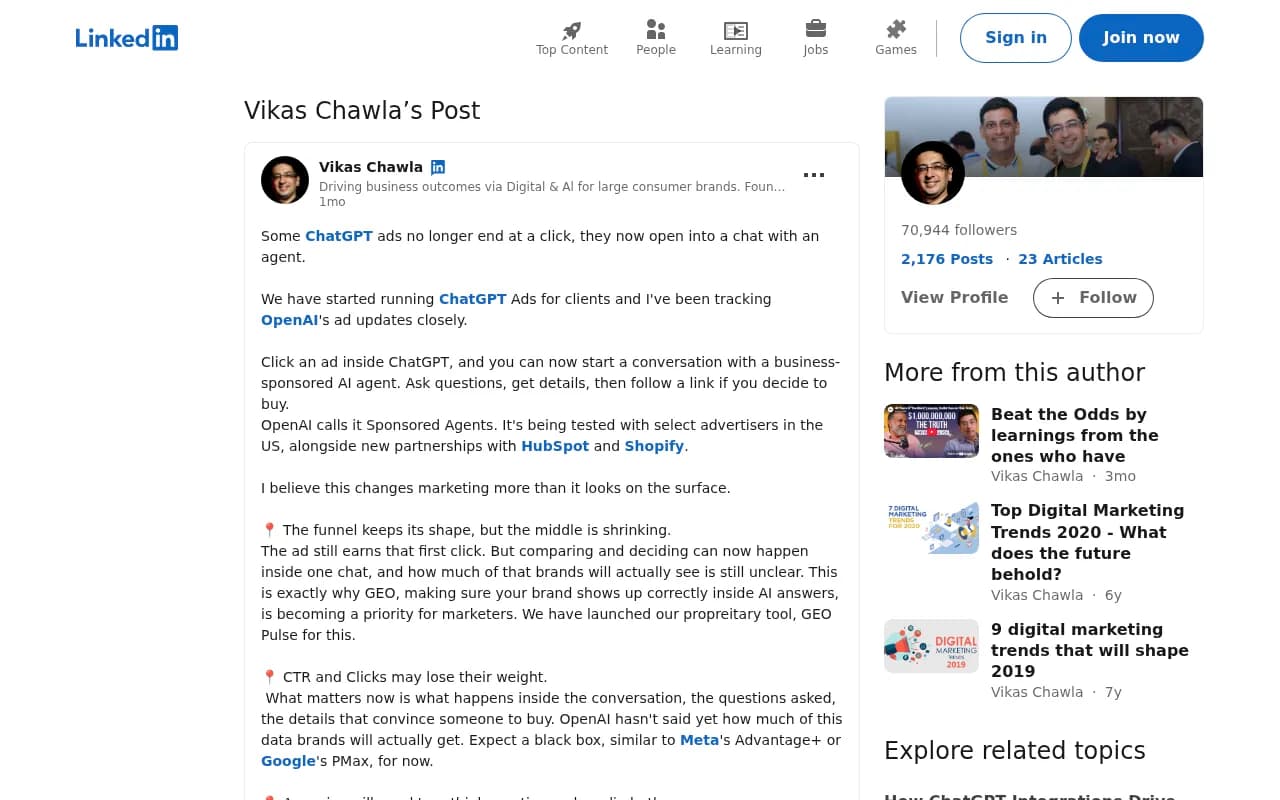
Chawla expects a black box at first, similar to Meta's Advantage+ or Google's PMax, with clicks mattering less than what is asked inside the conversation. A separate item in the research also mentions a Text Customization feature that personalizes ad headlines and descriptions with AI. Personalized copy means two people can see different ad text for the same prompt, which makes a single scraped sample even less representative.
Put those together and the picture is clear. Fewer ads visible to bots, more ad formats that live inside a chat, and traffic that sometimes lands in analytics as direct. One LinkedIn post flagged exactly that last problem, ChatGPT traffic misclassified as direct, which is worth checking in your own reports.
How to test whether your tool still sees ads
You do not need to trust anyone's marketing page. Run a simple audit.
- Pick 10 to 20 prompts where you know ads were appearing in July or early August, ideally commercial queries in a category with big advertisers.
- Check the tool's ad history for those prompts. Did the rate fall to exactly zero around 25 to 28 August?
- Run the same prompts yourself in a logged-out browser, then in a free logged-in account. Note whether ads show up. Remember that paid tiers see none.
- Ask the vendor directly: do you still collect ad units, and do you label unmeasurable answers as not measured?
- Look at multiple days. Promptwatch's own advice is to check across several days before concluding anything, because one run can land on an outlier day.
- Compare against an independent source, such as a public sample or a second tool.
If a dashboard drops from a steady 25 to 30 percent to a perfect zero within days, treat that as an instrument problem first and a market change second.
Who still reports ChatGPT ads
Here is the honest answer: I cannot name a tool that I have verified still reports ads after 17 August. What I can do is tell you who advertises ad tracking and what to ask them.
| Tool | Ad tracking claim | What to verify |
|---|---|---|
| Promptwatch | Ads Radar shows which advertisers appear on tracked ChatGPT prompts, what they promote and where ads send visitors; collects from real UIs | Ask whether ad capture still works after late August 2026; its public report ends Aug 17 |
| BotScope | Paused ad recording and labels answers "not measured" | Good transparency, but no current ad data by its own account |
| Other trackers (Profound, Peec AI, Otterly.AI and similar) | Not verified in this research | Ask for dated screenshots of ads captured after 28 August |
Promptwatch is the one I would test first, mostly because ad tracking is a documented feature and it collects from the actual interfaces of AI platforms rather than only APIs, which can differ from what users see.
Promptwatch pairs Ads Radar with prompt tracking, citation data and AI crawler logs, so you can see ad presence next to organic visibility. It is available on Business and Enterprise, and every agency plan includes Ads Radar. Confirm pricing at promptwatch.com/pricing.

If you want to compare broader options, the GEO software directory at bestgeosoftware.com lists many trackers. Some in our catalog worth asking the same questions:
Profound


Otterly.AI

I have not verified ad coverage for any of these, so treat the question as open until a vendor shows you a dated capture.
What to do with your ad budget in the meantime
If you are buying ChatGPT ads, you cannot lean on third-party dashboards for competitive ad intelligence right now. A few practical moves:
- Rely on OpenAI's own ad reporting for your campaigns, and expect limited insight into conversation-level behavior.
- Track organic visibility separately. get3rd's advice is sensible: when the organic answer already names you, cut the ad on that prompt and move the budget to the next gap.
- Fix attribution. OpenAI stopped sending a referrer for ChatGPT on October 8, 2026, so tag your links with utm_source=chatgpt.com and use analytics that can count AI-referred visits rather than leaving them in direct.
- Remember the market is narrow. ChatGPT is the only assistant with a dedicated chat ad platform in Europe, according to get3rd, and Perplexity stopped pursuing ads in February 2026. Anthropic has said Claude will stay ad-free.
Organic citations remain a separate and larger lever. Promptwatch's data shows product pages are the most cited content type in ChatGPT at 22.4% of citations (Sep 28 to Oct 4, 2026), so the work of becoming the cited answer does not depend on ad visibility at all.
Questions to put to any AI visibility vendor
- Do you collect from signed-out sessions, signed-in sessions, or both?
- Can you show me an ad your system captured this month?
- When a response cannot be measured for ads, do you record zero or "not measured"?
- Can I export raw responses so I can audit ad extraction myself?
- How do you handle personalised ad text and conversation-style ads?
A vendor who answers these plainly is more trustworthy than one with a polished ads dashboard and no explanation for a flat line.
Bottom line
The disappearance of ChatGPT ads from most dashboards in late August 2026 looks like a visibility problem for the tools, not for OpenAI. Treat any perfect zero with suspicion, demand dated proof of ad capture, and keep organic tracking and traffic attribution running independently. For more category options, browse the directory at ai-rank-tools.com, and check each vendor's ad coverage yourself before you rely on it.