Key takeaways
- Start with 20 to 30 high-intent prompts per client, not 300. More prompts means more noise, and clients only read the top of the report.
- Track three or four competitors per client and four metrics: share of voice, position, citation share, and sentiment. Everything else is drill-down.
- Report each AI engine separately. They cite different numbers of sources, so blended scores hide what is happening.
- Report monthly to clients, check weekly internally, and attach a recommended action to every finding.
- Pick a tool that gives each client an isolated workspace and then helps you fix gaps, not only report them.
Why agencies drown in competitor data
I have watched agency teams go from zero AI visibility reporting to 4,000 tracked prompts across a dozen clients in about a quarter. Nobody reads that. The dashboards fill up, the weekly Slack thread turns into screenshots of line charts, and the client still asks the same question: "Are we beating our competitors in ChatGPT or not?"
The problem is rarely the tool. It is the lack of a tracking design. Competitor visibility in AI search has no rank position in the traditional sense, so the instinct is to measure everything and sort it out later. That works for one brand. For twenty clients it collapses.
A useful rule from the agency-focused write-ups I read while researching this: judge your setup by whether it produces a better client conversation, not more data. If a metric never changes what you tell the client to do, cut it.
Step 1: Define the competitive set before you define prompts
Before anyone types a prompt, write down who the client actually loses to. This is not always the list the client gives you. Sales teams name the rival they hate. AI engines name the rival that has the best-structured comparison pages.
A workable setup:
- Three or four direct competitors the client names
- One or two "AI-surfaced" competitors that keep appearing in answers even though the client never mentioned them
- Any aggregator or marketplace that shows up as a cited source (G2, Tripadvisor, Autotrader and similar)
That third group matters more than agencies expect. In Promptwatch Data's automotive citation report for August 2026, marketplaces like Autotrader and Cars.com outranked every car brand in ChatGPT citations. In the software report for September 28 to October 4, 2026, GitHub, Microsoft's docs, and G2 led. If your client's real competitor for attention is a directory, a pure brand-vs-brand view misses it.
Step 2: Build a small, revenue-linked prompt set
The advice I trust most here is blunt: start with 20 to 30 prompts tied to queries that drive revenue, and expand only when a clear gap demands it. That figure comes from an agency practitioner (metehan.ai), so treat it as a sensible default rather than a measured law.
Split the set into three buckets:
| Prompt type | Example pattern | What it tells you |
|---|---|---|
| Category discovery | "best [category] for [buyer type]" | Are you on the shortlist at all? |
| Competitor comparison | "[Client] vs [Competitor]" | How you are framed against a named rival |
| Alternatives | "alternatives to [Competitor]" | Whether you capture people leaving a rival |
That second and third bucket deserve extra weight. Promptwatch's ChatGPT query fanout data shows average fanout queries getting shorter through early 2026, with the average length falling from roughly 117 characters in December to about 53 characters in April. ChatGPT's searches increasingly look like short keyword queries, so "X vs Y", pricing and alternatives phrasing is worth including on purpose. Promptwatch also reports that ChatGPT began using the site: operator at scale on August 8, 2026, which you can read about in its site: operator report.
Use personas and locations sparingly
Personas are useful when a client sells to two distinct buyers, say a CFO and a developer. They multiply your data fast, though. Add a persona only when you can name the decision it would change. The same goes for countries and cities: track the markets the client actually sells in, and nothing else.
Step 3: Pick four metrics and ignore the rest
Most platforms offer a dozen scores. Agencies need a short list that maps to a diagnosis:
- Share of voice: your slice of all brand mentions. Low means a coverage problem.
- Position: where you land in the order of brands within an answer. Late means a prominence problem.
- Citation share: how often your domain is a cited source. Mentions without citations usually mean a content or crawlability problem.
- Sentiment: how the answer describes you. Weak sentiment is a reputation problem.
Read together, these tell you what to fix. A client with high share of voice but zero self-citations does not need more mentions. It needs pages AI can read and trust. Promptwatch's academy has plain definitions of Share of Voice and citations vs mentions if you need to explain the difference to a client.
Step 4: Report each engine separately
Blended visibility scores are comfortable and misleading. Engines behave differently. According to Promptwatch's average sources per response report (published September 2025, so treat the exact numbers as a snapshot), ChatGPT cites about 5 sources per web-search answer, while Google AI Overviews and Perplexity sit near 10. Copilot swung from under 2 to nearly 17 within a few weeks before settling low.
Two practical consequences:
- A client can have a smaller share of citations in ChatGPT simply because there are fewer slots. Compare against competitors on the same engine, not against another engine.
- Perplexity's steady count makes it a clean test bench. If a client's citations there change after you publish something, content is the likely reason, not engine noise.
The citation pool also shifts under your feet. Promptwatch Data found that reddit.com's share of ChatGPT citations fell from about 4% to about 0.5% on August 14, 2026, and that ChatGPT drew 0.46% of citations from social platforms while Google AI Overviews drew 12.2% (September 28 to October 4, 2026). If you previously told a client to invest in Reddit for ChatGPT visibility, that advice needs revisiting, and a per-engine report is how you spot it.
Step 5: Set a cadence that matches the client
You do not need daily alerts for most clients. A sensible rhythm:
- Weekly, internal: someone on your team scans for large swings and new competitors appearing. Fifteen minutes per client.
- Monthly, client-facing: the report. Kreativa and metehan.ai both land on monthly or biweekly as the practical range for audits and reporting.
- Event-driven: faster tracking only for a launch, a rebrand, or a competitor campaign.
A reporting structure that has held up across verticals, adapted from the framework metehan.ai describes:
| Section | Keep it to |
|---|---|
| Executive summary | Three bullets: trend, biggest win, biggest risk |
| Competitor comparison | Client vs top three rivals, per engine |
| Citation sources | The five URLs or domains doing the work |
| Prompt category breakdown | Discovery, comparison, alternatives |
| Recommendations | Two to four actions with owners |
The last row is the one clients pay for. A report without it is a status update.
Step 6: Choose tooling built for rosters, not single brands
Most AI visibility tools were built for one brand. For an agency the checklist is different:
- Can a client see their data without seeing anyone else's? Look for isolated workspaces and access roles.
- Can you export or schedule branded reports without rebuilding them in slides?
- What happens after a gap is found? Reporting it is table stakes. Some tools stop there.
- Does pricing scale with clients, or punish you for adding the tenth one?
Here is how the main options differ on those points. Verify current pricing and limits on each vendor's site, since I did not confirm every agency plan.
| Tool | Strength for agencies | Limitation to check |
|---|---|---|
| Promptwatch | Agency plans with unlimited projects and seats, plus content creation, crawler logs and visitor analytics to close the loop | Content Agent and white-label portal sit on Enterprise for agencies |
| Profound | Isolated client workspaces, broad engine coverage on Enterprise | Enterprise pricing and setup |
| Peec AI | Multi-client monitoring, pitch projects | Monitoring-focused |
| Scrunch AI | Partner program with referral commission | Fewer execution features |
| Otterly.AI | Simple, quick to start | Basic tracking |
| SE Ranking | Familiar for teams already using it | AI tracking is an add-on to an SEO suite |
Where Promptwatch fits
Promptwatch is the platform 1001 SEO Media uses for GEO and AI visibility work. For competitor tracking specifically, it lets you set competitors per monitor, compare them on a heatmap by engine, topic or country, and see Share of Voice, Position, Citation Share and Sentiment side by side. The part that keeps agencies out of the data swamp is that the Action Board turns findings into a prioritized to-do list, and Agent Chat can pull a competitor gap analysis on demand or build a dashboard for a specific client.

Agency plans start at $199/mo (Kick-off), with Growth at $399/mo and Scale at $799/mo, and all include unlimited projects, prompts and team seats. Confirm current figures at promptwatch.com/pricing. There is also a page for agencies, and a case study on how Monks used citation gaps to build client content roadmaps.
Other tools worth a look
Profound is the usual pick for large enterprise rosters that want isolated workspaces and wide engine coverage.
Profound

Peec AI is a common choice for pure multi-client monitoring on a budget.

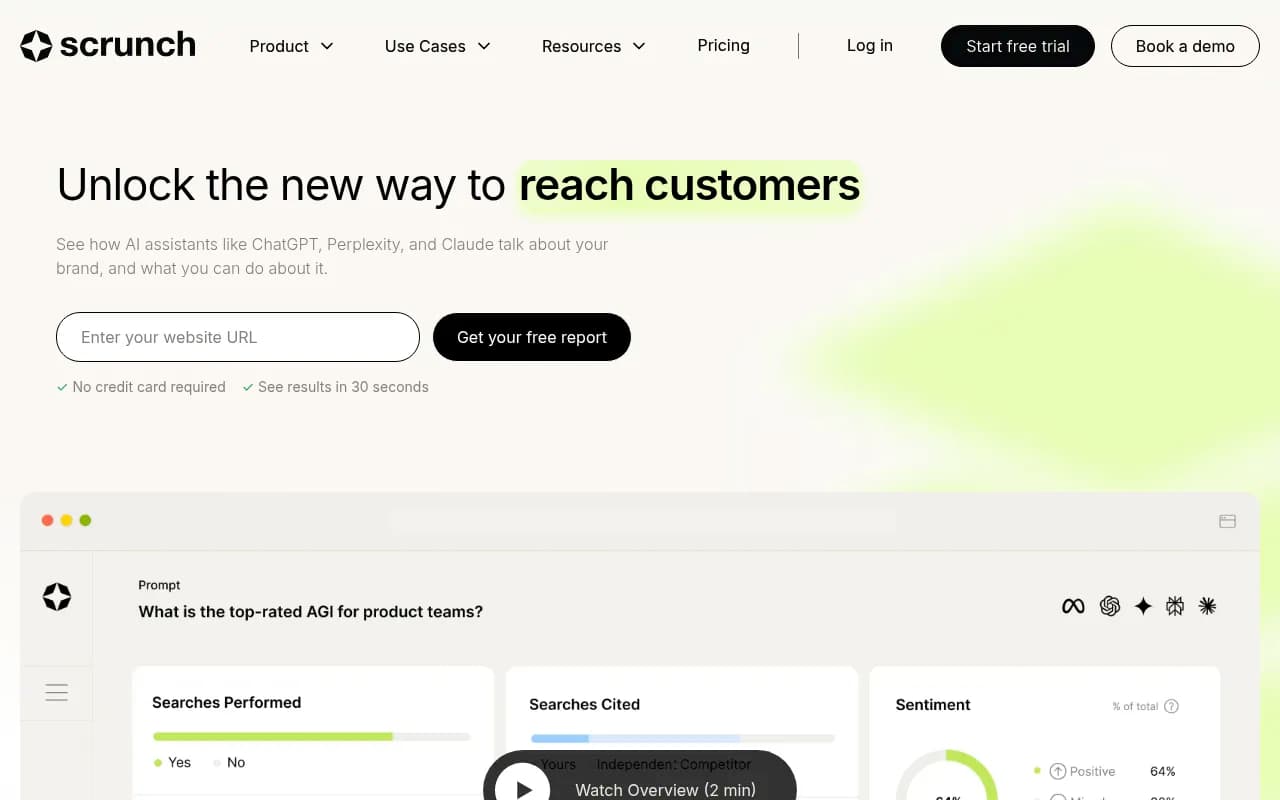
Scrunch AI has a partner program and a prospecting license that helps with pitches.
Otterly.AI works if you want something lightweight to test the service line before committing.
Otterly.AI

If you want a broader view of the category, the GEO software directory lists many more options.
Step 7: Keep traditional SEO data in the same view
Clients still care about Google. A page that ranks but never gets cited is an important finding, and so is the reverse. Pull Search Console data next to your AI numbers so you can ask which pages rank in Google and Bing but never get cited by AI. Google Search Console is free for this, and some AI visibility platforms overlay it with citation data directly.
AI-referred traffic belongs in the same picture. Tracking mentions without visits makes the retainer hard to defend. Promptwatch's guide to attributing AI traffic covers the setup, including the fact that ChatGPT stopped sending a referrer on October 8, 2026, so tagged utm_source=chatgpt.com visits need to be counted deliberately.
A lightweight weekly workflow per client
- Open the competitor heatmap, one engine at a time.
- Note any competitor that gained more than a few points of share of voice.
- Click into the prompts behind the change and read two or three actual answers.
- Check which sources were cited. Is a competitor winning through a comparison page, a review site, or a forum thread?
- Log one action. If nothing changed, log nothing.
If a client roster needs this at scale, delegate steps 1 to 3 to an assistant or scheduled briefing and keep humans on steps 4 and 5. The judgment is the part you bill for.
Common mistakes
- Tracking 200 prompts "to be safe". You will read none of them.
- Reporting a blended score across engines. It hides the one engine where the client is actually losing.
- Comparing against competitors the client chose rather than the ones AI keeps naming.
- Reporting mentions without citations or traffic. Mentions alone are easy to dismiss.
- Skipping recommendations. A report that ends with a chart gets filed and forgotten.
Quick checklist
- 3 to 4 competitors plus any aggregator that dominates citations
- 20 to 30 prompts across discovery, comparison and alternatives
- 4 metrics: share of voice, position, citation share, sentiment
- Per-engine reporting
- Weekly internal scan, monthly client report
- One to four recommended actions per report
- Traffic and Search Console data alongside AI visibility
Agencies that win retainers this year are the ones whose reports end with a plan. Keep the data small enough that you can explain every number on the page, and let the tooling do the repetitive part.
If you would rather hand the whole program to specialists, 1001 SEO Media runs AI search and GEO work for brands and can be reached at [email protected].