Key takeaways
- Three GEO vendors changed hands in 2026: Sitecore acquired Scrunch (announced June 3), Tracksuit acquired Hall (disclosed August 3), and Bloomreach acquired AthenaHQ (reported November 16).
- Each buyer already owned something AI visibility data can plug into: a CMS, a brand tracker, or a commerce and CDP stack. Measurement alone is becoming a feature, not a product.
- No price or terms were disclosed for any of the three deals, so be careful with claims about valuation.
- If you use one of these tools, check your contract, roadmap and pricing now. Plans listed before the deals may change.
- Favor platforms that close the loop from monitoring to content to measurement, and that stay independent of any single CMS or suite.
What happened
I have been watching this category since the first wave of prompt trackers appeared, and the pattern in the last six months is hard to miss. Standalone GEO tools are being bought by companies that sell something else.
Here are the three deals in order.
| Deal | Announced | Buyer's core business | What the buyer gets |
|---|---|---|---|
| Sitecore acquires Scrunch | June 3, 2026 | Digital experience and CMS | Insights, recommendations and the Agent Experience Platform (AXP) |
| Tracksuit acquires Hall | August 3, 2026 | Brand tracking | AI visibility alongside human brand perception |
| Bloomreach acquires AthenaHQ | Reported November 16, 2026 | Commerce discovery, CDP, marketing automation | AI answer visibility tied to shopping and revenue |
None of the sources I found gave a deal price. Anyone quoting a number is guessing.
Sitecore and Scrunch
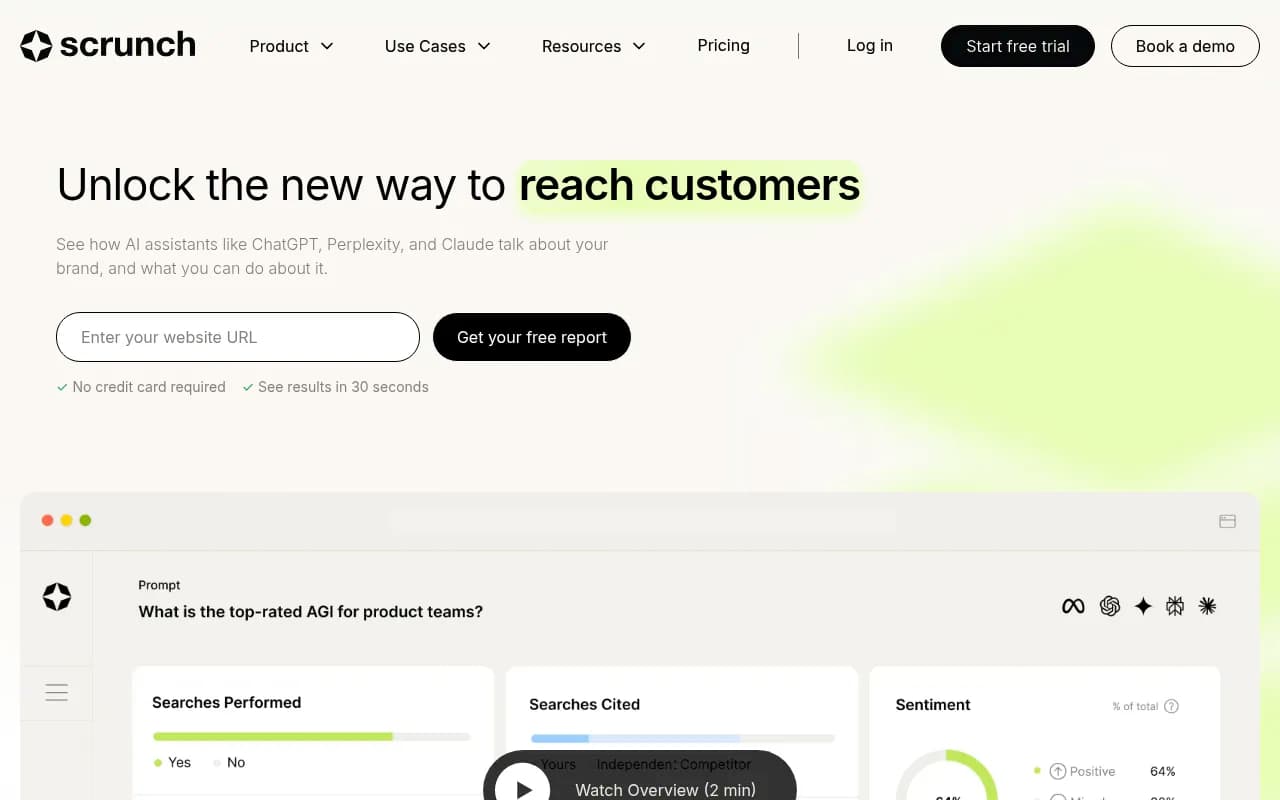
Sitecore described Scrunch as an "AI customer experience platform" in its PRNewswire announcement. The plan is to fold Scrunch's insights, recommendations and AXP into SitecoreAI, and to automate recommendations inside SitecoreAI Content Management, Content Marketing and Digital Asset Management.
AXP is the interesting piece. It serves AI agents a version of your content formatted for LLMs, without changing what human visitors see. Sitecore CEO Eric Stine put the thesis bluntly: "the internet must be written for machines to understand."
The release also cites customer numbers. Akamai compared AXP-enabled pages against comparable pages without AXP and reported a 364% increase in brand presence for non-branded prompts and a 218% increase in citations. Runpod reported a 400% increase in paying customers tied to its AI search work. These are vendor-published figures, so treat them as directional, not as a benchmark.
The release also takes a swipe at "standalone AEO platforms," saying they only show which questions a brand wins or loses. That is a fair description of a lot of the market, and it is exactly the argument Sitecore uses for why Scrunch belongs inside a content workflow.

Scrunch's own guide above is worth reading for the framework, even though it is vendor-authored. It rates tools on four steps: observe, understand, act and deliver. Scrunch scores itself green on all four. It marks AthenaHQ as partial on observe and no on deliver. Take the self-scoring with salt, but the four-step model is a useful way to test any tool.
Tracksuit and Hall
Tracksuit completed its acquisition of Hall, disclosed August 3, 2026. Hall is a Sydney-based AI visibility startup. Tracksuit tracks brand perception through surveys. Both were Blackbird VC portfolio companies, which probably explains how quickly this came together.
Tracksuit's stated reason: "Acquiring Hall allows us to combine human perception with AI visibility, giving marketers a more complete understanding of their brand." Hall's site now says it is part of Tracksuit and adds a line I found refreshingly honest: "We also learned that measuring AI visibility on its own tells you very little."
That sentence is basically the whole argument of this article, coming from a company that was in the business of measuring AI visibility.
Bloomreach and AthenaHQ
MarTech reported the Bloomreach deal on November 16, 2026, and it is the freshest of the three. Bloomreach bought Exponea in 2021, which added a CDP and marketing automation. In January 2026 it launched Loomi Connect, bringing its product discovery into ChatGPT apps and other AI experiences via MCP. Loomi Connect pushes catalog intelligence into AI apps. AthenaHQ covers the other direction: how brands earn visibility in AI-generated answers.
MarTech compared the logic to Adobe's Semrush deal. AthenaHQ's CEO Andrew Yan told Forbes, via Yahoo Finance, that "AI agents are going to become the front door for how products get found."
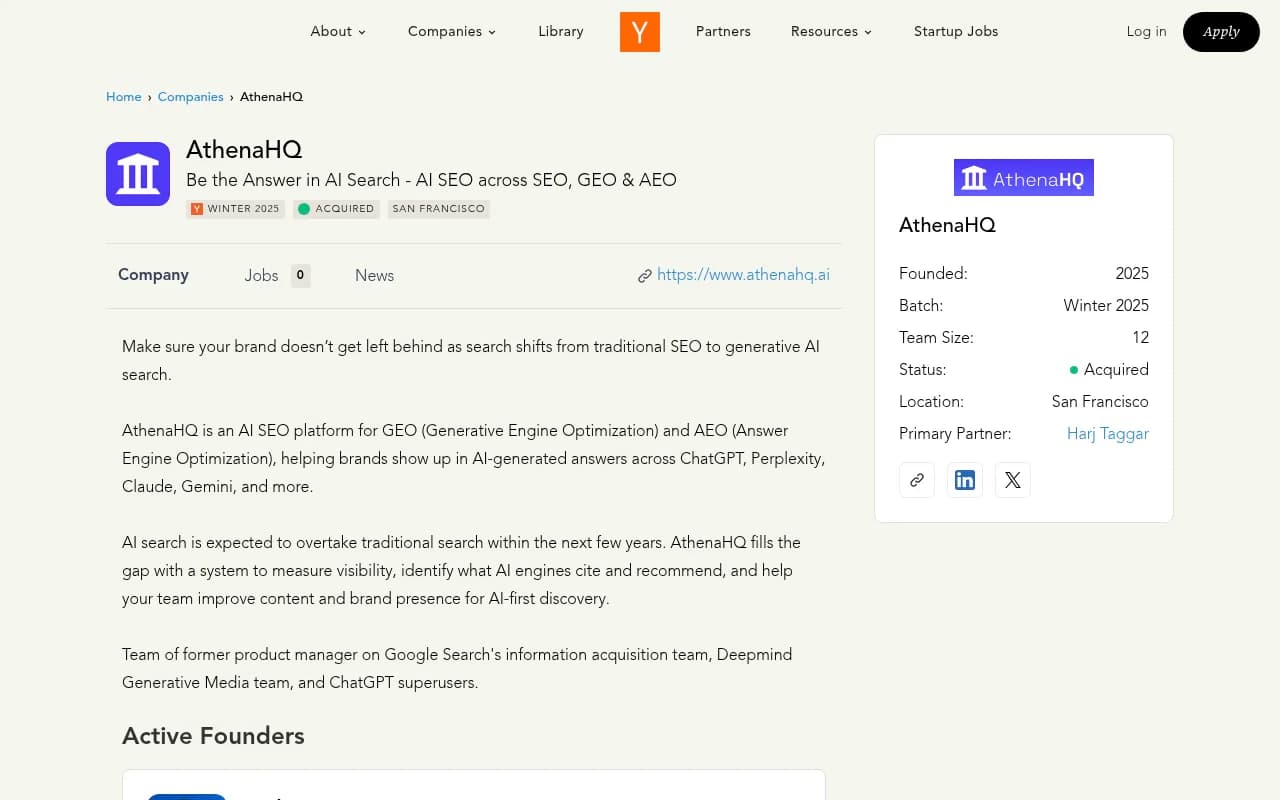
AthenaHQ came out of Y Combinator's Winter 2025 batch. Its YC listing now shows it as acquired, and an earlier Scrunch comparison put its funding at around $2.7M. A small, fast company with a big acquirer is a familiar story.

The wider pattern
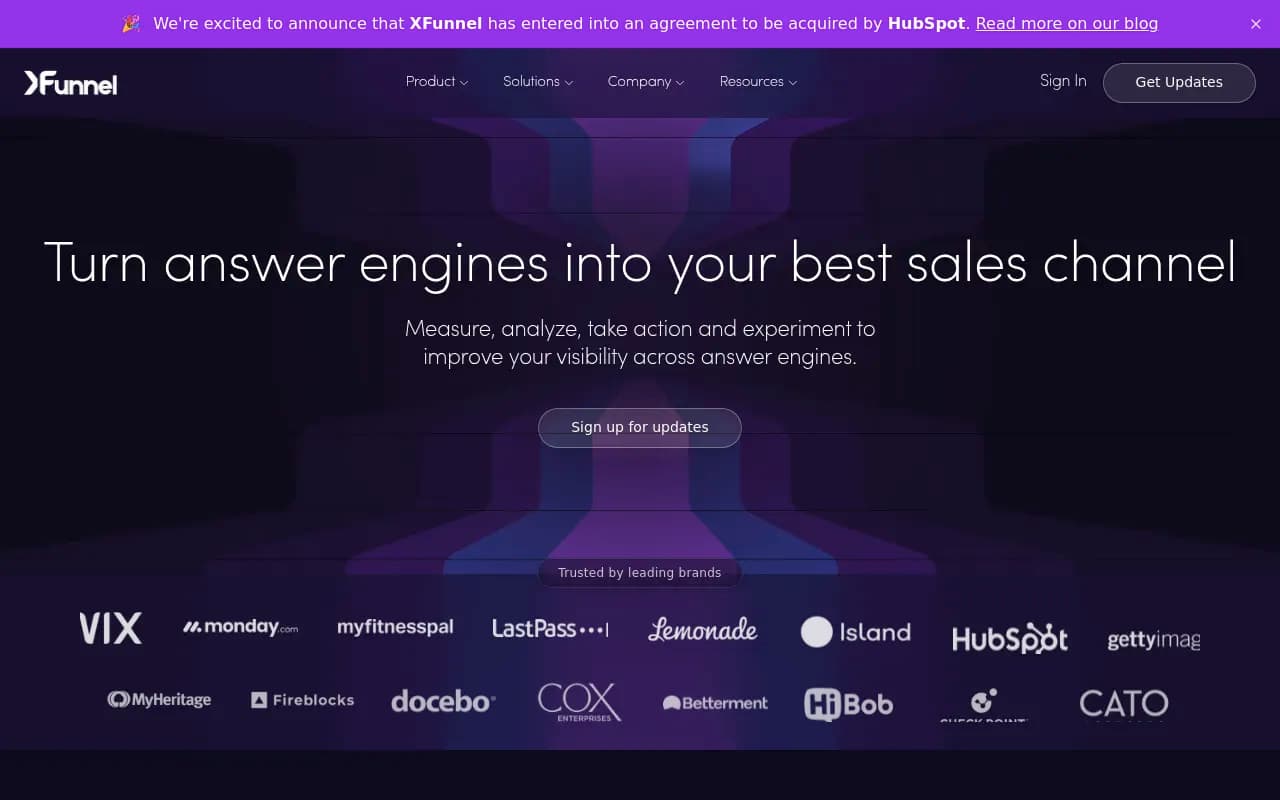
These three deals sit inside a larger run. According to Deepak Gupta's GEO Compass research from September 2026 (a single secondary source, so weigh it accordingly), Adobe bought Semrush for about $1.9B in cash, announced November 19, 2025 and closed April 28, 2026. HubSpot bought XFunnel, announced October 31, 2025 and closed December 1, 2025, and HubSpot AEO became generally available April 14, 2026. That research predates the AthenaHQ and Hall deals.
Gupta also tracks who built instead of bought: Wix, Squarespace, Cloudflare and Optimizely (partnered with Conductor) all shipped something native or partnered. Contentful, Sanity, Drupal and Salesforce had shipped nothing at the time of writing. Webflow had a private-beta AEO for Enterprise, and Shopify went with Agentic Storefronts.
His thesis is that buying beats building because measurement infrastructure takes roughly 18 months to build properly. I think that is half right. Measurement is hard. But the thing buyers are really paying for is a customer base and a data pipeline that already works.
What the acquirers have in common
Line the buyers up and the logic is consistent.
- Sitecore wants AI visibility recommendations to land inside the system where content is already edited and published.
- Tracksuit wants AI visibility sitting next to survey-based brand tracking.
- Bloomreach wants AI answer visibility tied to shopping behavior and customer data.
- Adobe and HubSpot made the same bet from the SEO and CRM sides.
Every one of them owns a place where the work happens. The visibility dashboard is the easy part to add. The hard part is turning "you are missing from this prompt" into a published page, and the buyers already own the publishing layer.
That is also why Hall's line about measurement matters. A score with no action attached has a short shelf life.
What this means if you are a customer
If you use AthenaHQ, Scrunch or Hall today, nothing is necessarily wrong. But acquisitions change products in predictable ways, and it is worth getting ahead of them.
Check these things now
- Contract terms. Look at renewal dates, price-change clauses and what happens if the product is folded into a bundle.
- Pricing. Published plans may be stale. Scrunch was listed at Core $250/mo and Agency Core $500/mo, and AthenaHQ at a free Essential tier and Starter at $295/mo, but those figures came from before the deals. Confirm directly with the vendor.
- Roadmap independence. Ask whether the product will keep working if you do not use the acquirer's CMS, CDP or suite. Scrunch inside SitecoreAI is the clearest case where tighter integration might come with more pull toward one stack.
- Data export. Make sure you can pull your prompt sets, historical responses and citation data in a usable format.
- Support and team continuity. Small-team products often lose their best people within a year of an acquisition.
Questions to ask a vendor in any evaluation
- Who owns you, and who might in 12 months?
- Can I get my data out as CSV or through an API?
- Does the platform work without locking me into one CMS?
- What does it do after it finds a gap?
How to choose a platform in a consolidating market
The four-step model from Scrunch's guide is a decent filter: observe, understand, act, deliver. Most monitoring tools stop at the second step. The buyers above are paying to get to the third and fourth.
Here is how I would sort the options.
| Category | Examples | Strength | Watch out for |
|---|---|---|---|
| Suite-attached AI visibility | Sitecore plus Scrunch, Adobe plus Semrush, HubSpot AEO | Fits an existing workflow | Lock-in, fixed prompt sets, slower product pace |
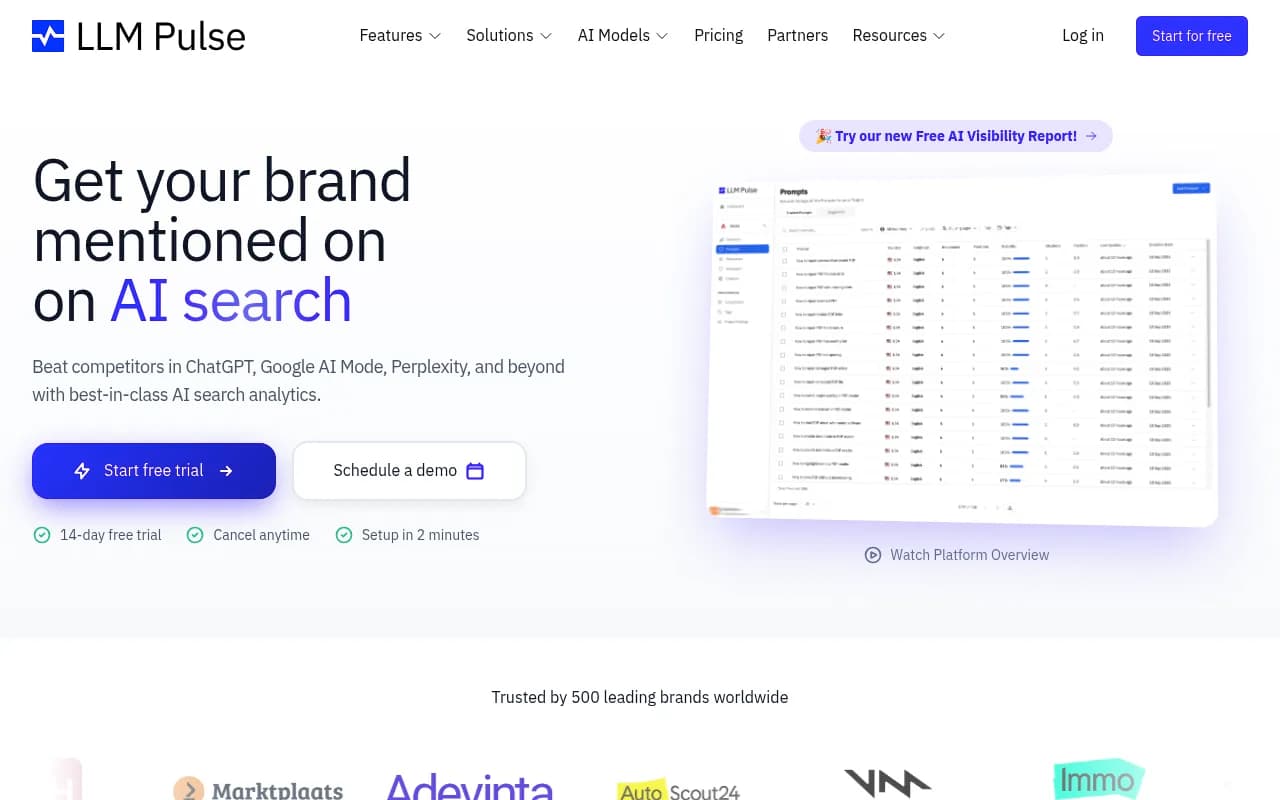
| Standalone monitoring | Otterly.AI, Peec AI, Rankshift, LLM Pulse | Cheap and fast to start | Reports a score, leaves the work to you, acquisition risk |
| Independent end-to-end platforms | Promptwatch | Monitoring, content and measurement in one product, no CMS lock-in | Heavier setup than a simple tracker |
Otterly.AI



If you want to survey the wider market, the GEO software directory at bestgeosoftware.com lists dozens of options, and ai-rank-tools.com focuses on AI rank trackers.
Where an independent platform fits
I will be upfront: 1001 SEO Media, which publishes this site, uses Promptwatch as its GEO platform, so I have a view here. The reason it fits this moment is that it was built as a closed loop rather than a dashboard. It tracks how ChatGPT, Gemini, Claude, Perplexity, Google AI Overviews and others mention your brand using the real user interfaces, traces which pages and third-party sources get cited, then acts through the Action Board and Content Agent, which writes and publishes to WordPress, Webflow or Framer. IP-verified AI crawler logs and visitor analytics then show whether the published page got crawled, cited and clicked.

That matters here for two reasons. First, it is the same observe, understand, act, deliver chain that Sitecore is paying for with Scrunch, but without tying you to one CMS. Second, it answers Hall's point about measurement on its own: the product checks whether a fix worked, not just whether a score moved.
Pricing starts at $95/mo for Essential, $245/mo for Professional and $579/mo for Business, which is the first plan with the Content Agent. Agency plans run from $199/mo. Confirm current numbers at promptwatch.com/pricing, and there is a 7-day free trial plus a free AI visibility report if you want to test before committing. If you are comparing specific vendors, the head-to-head pages cover Promptwatch vs AthenaHQ and Promptwatch vs Scrunch.
Why measurement alone is not enough
The data on how AI answers get built supports the shift toward action. Promptwatch Data found that almost half of ChatGPT responses cited 10 or more unique domains in the week of September 28 to October 4, 2026. With that many sources in play, knowing you are absent from an answer tells you little. You need to know which sources fill the gap and what content type wins. In the same period, product pages were the most cited content type in ChatGPT at 22.4%, followed by landing pages and listicles.
The source mix also shifts quickly. Reddit's share of ChatGPT citations fell from about 4% to 0.5% on August 14, 2026, and ChatGPT started using the site: operator at scale on August 8. A tool that gives you a weekly score but cannot show you why it moved leaves you guessing, which is the weakness Hall described.
There is also a technical access layer that dashboards often miss. If AI bots cannot read your pages, no amount of content fixes it. Promptwatch's AI crawler data tracks verified crawler requests from OpenAI, Anthropic, Google, Perplexity and Mistral, and the AI crawler logs feature lets you see it on your own site. Scrunch's AXP is one answer to the rendering side of that problem. Prerendering tools such as Prerender.io are another.
What I would do this quarter
A practical sequence, depending on where you are.
If you use AthenaHQ, Scrunch or Hall
- Export your prompt sets and historical data this month.
- Ask your account manager in writing about pricing, roadmap and CMS requirements.
- Run a parallel trial of one independent platform on the same prompts so you have comparison data before renewal.
If you are choosing a tool now
- Decide whether you need monitoring or a platform that also produces and publishes content. Be honest about your team size.
- Check ownership and integration. If you already run Sitecore, Scrunch inside SitecoreAI may be the natural fit. If you run Bloomreach for commerce, AthenaHQ may become one. If you do not, prefer something independent.
- Run a 7-day trial and test with 30 to 50 real prompts from your buyers, not generic ones.
If you run an agency
Consolidation is a client-risk issue. A tool your clients rely on can change owners with a few weeks of notice. Favor platforms with API and export access, and keep your own reporting layer. Promptwatch's agency plans include unlimited projects and API and MCP access for that reason.
What happens next
I expect more of the same. Several mid-size players are still standalone, including Profound, Otterly.AI, Peec AI, Rankshift and others, and any of them could be next. What matters is whether the buyers can turn a monitoring product into a working content and publishing loop. Sitecore has the clearest path through its CMS. Bloomreach has the commerce angle. Tracksuit has the perception data. Whether any of them ships a better product than a team focused on nothing else is the open question, and no one has the answer yet.
For buyers, the safest move is to treat any AI visibility tool as replaceable: keep your data portable, keep your content on your own stack, and judge platforms by what happens after the gap report, not by the dashboard.
For more tools in this category, browse surferstack.com.