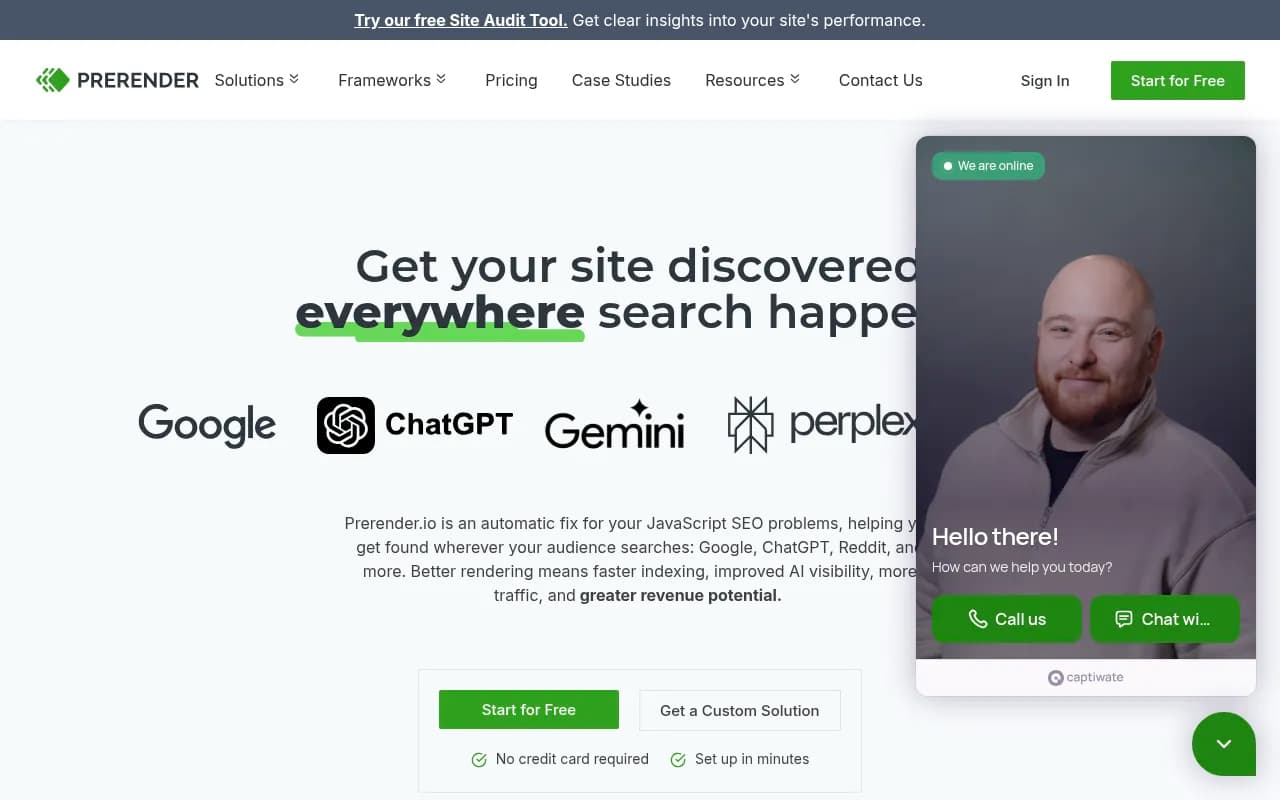
Prerender.io Review 2026
Technical optimization platform that ensures AI crawlers can properly access and index dynamic website content for better AI search visibility.
Summary
- Best for: JavaScript-heavy sites (React, Angular, Vue, Next.js) struggling with indexing, slow PageSpeed scores, or broken social previews
- Core strength: Automatic JavaScript rendering that makes content accessible to search crawlers and AI engines without code rewrites
- Standout feature: AI crawler support for ChatGPT, Claude, Perplexity, and other LLMs that can't execute JavaScript
- Limitation: Only solves rendering issues -- doesn't help with content strategy, keyword research, or other SEO fundamentals
- Pricing: $90-$990+/month based on page renders; 30-day free trial available
Prerender.io is a technical SEO infrastructure tool that solves a specific but critical problem: making JavaScript-rendered websites accessible to search engine crawlers, AI models, and social media platforms. Founded over a decade ago when single-page applications started breaking traditional SEO, it's now used by 100,000+ brands including Spotify, Walmart, Microsoft, Salesforce, and On Running. The platform sits between your server and incoming bot traffic, serving pre-rendered HTML snapshots instead of forcing crawlers to execute JavaScript -- a process that's slow, unreliable, and often fails entirely.
The core value proposition is simple: if you've built your site with React, Angular, Vue, Next.js, or any JavaScript framework, search engines and AI crawlers are probably struggling to index your content properly. Google can technically render JavaScript, but it takes 9x longer than static HTML and often misses dynamic content. AI crawlers like ChatGPT, Claude, Perplexity, Gemini, and Meta AI don't execute JavaScript at all -- meaning your site is completely invisible to them unless you serve pre-rendered HTML. Prerender.io automates this entire process with a middleware layer that detects bot traffic and serves cached HTML versions of your pages.
How It Actually Works
The setup is straightforward for developers. You install a small middleware package (available for Node.js, Apache, Nginx, IIS, Ruby, Python, PHP, and more) that intercepts requests from known crawlers. When a bot hits your site, your server pings Prerender's API. If the page hasn't been rendered yet, Prerender spins up a headless Chrome instance, fully renders the page with all JavaScript executed, captures the final HTML, and serves it to the bot. That rendered version gets cached for future requests, so subsequent crawls are near-instant (average 0.03 seconds). Human visitors still get your normal JavaScript app -- only bots see the pre-rendered HTML.
The platform maintains an up-to-date list of search engine user agents (Googlebot, Bingbot, Yandex, Baidu, DuckDuckBot) and AI crawler agents (ChatGPT-User, Claude-Web, PerplexityBot, GoogleOther for AI Overviews, Meta-ExternalAgent, and more). You can also configure custom user agents or whitelist specific IPs. The rendering engine handles complex scenarios like lazy-loaded images, infinite scroll, modal popups, AJAX requests, and client-side routing. It waits for network requests to complete and the DOM to stabilize before capturing the final HTML.
AI Search Visibility (The 2026 Differentiator)
This is where Prerender.io has carved out a new market position. In 2024-2026, AI search engines like ChatGPT, Perplexity, Claude, and Google AI Overviews became major traffic sources -- but they fundamentally can't execute JavaScript. If your product pages, blog posts, or documentation are rendered client-side, AI models literally cannot read them. They'll either skip your site entirely or cite incomplete/incorrect information from the initial HTML shell.
Prerender.io's AI crawler support ensures your content is accessible to these engines. Clients report up to 100% improvement in AI search visibility after implementation -- going from zero citations to appearing in ChatGPT answers, Perplexity results, and Google AI Overviews. For ecommerce brands, this is critical: as AI-powered shopping assistants become mainstream (ChatGPT Shopping, Google Shopping in AI Mode), being invisible to AI crawlers means missing an entire channel. Popken Fashion Group specifically cited this as a key reason for adopting Prerender, stating "Shopping directly in LLMs doesn't quite exist yet, but it will soon. We're using Prerender.io to help us stay visible in AI search when that day comes."
The platform doesn't just make content accessible -- it also improves how AI models interpret your site. Properly rendered HTML includes all metadata, structured data (JSON-LD), Open Graph tags, and semantic markup that AI models use to understand context and extract accurate information. Without rendering, AI crawlers see an empty <div id="root"></div> and move on.
PageSpeed Improvements
Beyond crawlability, Prerender.io dramatically improves PageSpeed Insights scores for bot traffic. Because crawlers receive lightweight HTML instead of a JavaScript bundle that needs parsing and execution, page load times drop from seconds to milliseconds. Clients report PageSpeed scores jumping from red (30-50) to green (90-100) after implementation. Empowering Cloud saw their server response time drop to under 0.05 seconds. Haarshop achieved a 99 PageSpeed score.
This matters because Google uses PageSpeed as a ranking factor, and slow JavaScript execution directly impacts crawl budget -- the number of pages Google will crawl per day. Faster rendering means more pages indexed, which means more organic traffic. On Running saw a 67% increase in Google traffic and 98% increase in Bing traffic after implementing Prerender. Haarshop's indexing rate jumped to 10,000 pages per day.
Social Media Link Previews
A secondary but valuable benefit: Prerender.io fixes broken link previews on Facebook, Twitter, LinkedIn, WhatsApp, Pinterest, and Slack. Social platforms use crawlers to generate preview cards when someone shares a link, but they don't execute JavaScript. Without pre-rendering, your links show up as blank cards with no image, title, or description -- killing click-through rates. Prerender ensures social crawlers see fully rendered Open Graph tags and Twitter Card metadata, so your shared links look professional and drive clicks.
Structured Data & Rich Snippets
For sites that rely on structured data (product schemas, recipe markup, FAQ schemas, review stars), Prerender.io ensures search engines can actually read it. If your structured data is injected via JavaScript, Google may not see it at all -- meaning you miss out on rich snippets, product carousels, and other SERP features. Prerender renders the page with all structured data in place, improving your chances of enhanced search results. Clients report higher click-through rates and better SERP positioning after fixing structured data rendering issues.
Dashboard & Monitoring
The Prerender.io dashboard provides real-time visibility into rendering activity. You can see which pages are being rendered, how often, by which crawlers, cache hit rates, and rendering errors. The platform tracks metrics like total renders per month, cache efficiency, average response time, and crawler activity by bot type. You can manually recache pages when content changes, set custom cache lifetimes, and configure rendering rules (e.g. "always render product pages, skip admin URLs").
The dashboard also includes a site audit tool that crawls your site and identifies JavaScript SEO issues -- pages that aren't rendering properly, missing metadata, broken structured data, slow load times, and more. This helps you prioritize fixes and measure improvement over time. There's also a free ROI calculator that estimates traffic and revenue gains based on your current indexing issues.
Integrations & Tech Stack Compatibility
Prerender.io works with virtually any modern web stack. Official middleware packages exist for Node.js (Express, Koa, Fastify), Apache, Nginx, IIS, Ruby on Rails, Django, Flask, PHP, Laravel, WordPress, and more. It integrates seamlessly with hosting platforms like Netlify, Vercel, AWS, Google Cloud, Azure, and Heroku. For JavaScript frameworks, it supports React, Angular, Vue, Next.js, Nuxt, Gatsby, Svelte, Ember, Backbone, and any other client-side framework.
The platform also offers a REST API for custom integrations and programmatic cache management. You can trigger recaches via API when content updates, fetch rendering status, and query cache metadata. There's also a Chrome extension for testing how your pages render for bots.
Who Should Use Prerender.io
Ideal users:
- Ecommerce brands with JavaScript storefronts (React, Vue, Angular) struggling with product page indexing or missing from AI shopping results
- SaaS companies with documentation sites built on Gatsby, Next.js, or Docusaurus that need to appear in ChatGPT/Perplexity answers
- Media and publishing sites using headless CMS + React frontends where articles aren't getting indexed quickly enough
- Enterprise sites with 10,000+ pages that need reliable, scalable rendering without building in-house infrastructure
- Agencies managing multiple client sites that need a plug-and-play solution for JavaScript SEO issues
- Developers who want to use modern frameworks without sacrificing SEO or building custom SSR setups
Not ideal for:
- Static HTML sites or server-rendered sites (WordPress, traditional PHP) -- you don't have a JavaScript rendering problem
- Sites with minimal bot traffic or no SEO goals
- Teams that already have robust server-side rendering (Next.js SSR, Nuxt SSR) working well
- Sites where content changes every few seconds (real-time dashboards, live sports scores) -- caching won't work
Pricing & Value
Prerender.io uses a tiered pricing model based on monthly page renders (each time a bot requests a page and it gets rendered or served from cache). Plans start at $90/month for up to 10,000 renders, $250/month for 50,000 renders, and $990+/month for 250,000+ renders. There's a 30-day free trial with no credit card required. Custom enterprise pricing is available for high-volume sites (1M+ renders/month).
Compared to building in-house server-side rendering, Prerender.io is significantly cheaper and faster to implement. On Running estimated 90% engineering cost savings vs building their own solution. Empowering Cloud saved $120,000 by switching from a custom rendering setup to Prerender. For most teams, the monthly cost is far less than the engineering time required to build, maintain, and scale a custom rendering infrastructure.
The main alternative is implementing true server-side rendering (SSR) with Next.js, Nuxt, or similar frameworks -- but that requires rewriting your entire frontend architecture and ongoing maintenance. Prerender.io is a middleware solution that works with your existing codebase, making it ideal for teams that want results in hours, not months.
Limitations & Honest Drawbacks
Prerender.io solves one specific problem very well, but it's not a complete SEO solution. It makes your content crawlable, but it doesn't help with keyword research, content strategy, link building, or technical SEO issues beyond rendering. If your site has fundamental SEO problems (thin content, poor site structure, slow server response times for human visitors), Prerender won't fix those.
The caching model has trade-offs. Pages are cached after the first render, which means the first bot to hit a new page experiences a slower response while Prerender renders it. For sites with millions of pages that change frequently, you'll need to implement cache invalidation rules or manually recache pages when content updates. The platform offers webhooks and API endpoints for this, but it requires setup.
Rendering costs scale with traffic. High-traffic sites with millions of bot requests per month will hit higher pricing tiers. For very large sites (10M+ pages), the cost can become significant. However, most clients find the ROI justifies the expense -- On Running's 67% traffic increase and Haarshop's 50% organic traffic boost far outweigh the monthly fee.
It's a black box for crawlers. From a crawler's perspective, they're receiving HTML from your server, not from Prerender. This is by design (cloaking is fine when you're serving equivalent content to bots and users), but it does mean you're trusting Prerender's infrastructure. The platform has 99.9% uptime SLA and serves 100,000+ clients, so reliability is proven, but it's still a dependency in your stack.
Bottom Line
Prerender.io is the industry-standard solution for JavaScript SEO and AI search visibility. If you've built your site with React, Angular, Vue, or any client-side framework, and you're seeing indexing issues, poor PageSpeed scores, or missing from AI search results, Prerender.io will fix it in a few hours. The platform is mature, reliable, and used by major brands that depend on organic traffic for revenue. It's not a complete SEO platform -- it won't help with content strategy or link building -- but for the specific problem of making JavaScript content crawlable, it's the best tool available. The 30-day free trial makes it risk-free to test, and most clients see measurable results (faster indexing, better PageSpeed, more traffic) within days of implementation. For ecommerce brands, SaaS companies, and publishers using modern JavaScript frameworks, it's a must-have infrastructure layer.
Tags:
Similar and alternative tools to Prerender.io