Local Falcon Review 2026
Map-based local ranking tool that visualizes your Google Business Profile visibility across different locations with heat maps and detailed reports.
Key Takeaways:
- Visual geo-grid tracking: Local Falcon's signature heat maps show your Google Business Profile rankings across hundreds of points in your service area, making it instantly clear where you're visible and where you're not
- AI search visibility monitoring: First local-focused platform to track how your business appears in ChatGPT, Google AI Overviews, Gemini, Grok, and AI Mode alongside traditional Map Pack rankings
- Best for: Local SEO agencies managing 10-200 client locations, multi-location businesses (franchises, retail chains, healthcare networks), and enterprise brands tracking thousands of locations across markets
- Pricing: Starts at $24.99/month for 7,500 credits (Starter plan), $49.99/month for 15,000 credits (Basic), with enterprise packages and pay-as-you-go options available
- Limitations: Credit-based pricing can get expensive for agencies running frequent scans; no built-in content optimization tools like some competitors; primarily focused on tracking rather than actionable SEO fixes
What Local Falcon Is and Who Built It
Local Falcon is a specialized local rank tracking platform that visualizes Google Business Profile visibility using interactive geo-grid heat maps. Instead of checking rankings from a single point, Local Falcon scans hundreds of locations across your service area and displays results as a color-coded grid overlaid on a map. This approach gives businesses and agencies a bird's-eye view of exactly where they rank in the Google Map Pack (the three featured businesses that appear atop local search results and capture 70% of clicks).
The platform has become the go-to tool for local SEO professionals who need to demonstrate ranking performance to clients or track multi-location visibility at scale. Major brands using Local Falcon include Walmart, Burger King, Apple, Olive Garden, Tim Hortons, and Rankings.io, along with 6,000+ agencies and local businesses. In 2026, Local Falcon expanded beyond traditional Map Pack tracking to become the first local-focused generative engine optimization (GEO) platform, adding visibility monitoring for ChatGPT, Google AI Overviews, Gemini, Grok, and AI Mode.
The platform is built for three primary audiences: local SEO agencies managing client portfolios (typically 10-200 locations), multi-location businesses like franchises and retail chains tracking performance across markets, and enterprise organizations monitoring thousands of locations nationwide. It's also used by individual consultants and small business owners who want to understand their local search footprint without hiring an agency.
Key Features: How Local Falcon Actually Works
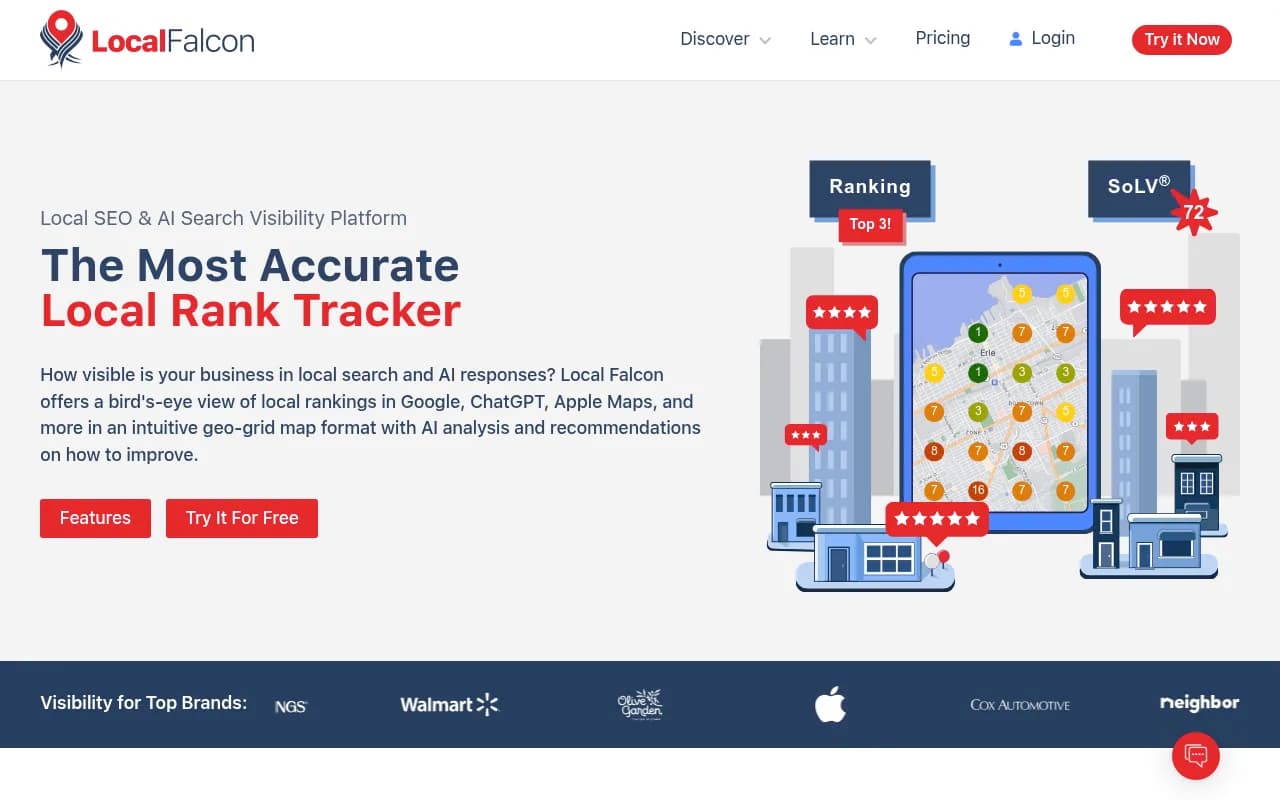
Geo-Grid Heat Map Scanning: This is Local Falcon's signature feature. You input your business location, select a keyword (e.g. "pizza delivery"), choose a scan radius (from 0.5 miles to 50+ miles), and set the grid density (how many points to check). Local Falcon then queries Google Maps from each grid point and maps your ranking position with color-coded markers: green for top 3 (Map Pack), yellow for positions 4-10, orange for 11-20, and red for 20+. The result is an instant visual showing exactly where your business dominates and where competitors own the map. You can overlay multiple competitors on the same grid to see head-to-head performance. This beats traditional rank trackers that only check from one ZIP code or city center.
Share of Local Voice (SoLV): Local Falcon's proprietary metric that quantifies your Map Pack visibility across the entire scan area. SoLV is calculated based on how frequently your listing appears in the top 3 results across all grid points. A SoLV of 72 means you're in the Map Pack at 72% of the scanned locations. This single number makes it easy to track improvement over time and compare performance across different keywords, locations, or competitors. Agencies use SoLV as a KPI in client reports because it's more meaningful than "you rank #3 in downtown."
AI Search Visibility Tracking: In 2026, Local Falcon became the first local rank tracker to monitor AI-generated search results. The platform now tracks how your business appears in ChatGPT recommendations (200M+ weekly users), Google AI Overviews (appearing in billions of searches), Gemini, Grok, and AI Mode. You can run geo-grid scans for AI platforms just like traditional Map Pack scans, seeing where AI models recommend your business vs competitors. Local Falcon introduced Share of AI Voice (SAIV), a metric parallel to SoLV that measures your visibility across AI responses. This is critical because customers increasingly ask ChatGPT or Google AI for local recommendations, and those results don't always match traditional Map Pack rankings.
Falcon AI Analysis and Recommendations: Every scan report includes AI-generated insights powered by Falcon AI. The system analyzes your rankings, competitor performance, Google Business Profile data, reviews, and citations, then provides specific recommendations to improve visibility. For example, Falcon AI might identify that you're missing key service categories, have inconsistent NAP (name, address, phone) citations, or need more reviews in specific keyword areas. Falcon Agent is a conversational AI assistant you can chat with to ask follow-up questions about your scan results, get clarification on recommendations, or explore local SEO strategies. This is helpful for users who aren't local SEO experts but want to act on the data.
Campaign Reports (Multi-Location Tracking): Campaigns let you group multiple locations and keywords into a single automated tracking project. For example, a franchise with 50 locations can set up a campaign that scans all 50 stores weekly for 5 core keywords, then view aggregated performance in a dashboard. You can compare SoLV across locations, identify underperforming stores, and track trends over time. This is essential for enterprise brands and agencies managing large portfolios. Campaign scans can be scheduled to run automatically (daily, weekly, monthly), and results are stored historically so you can generate trend reports showing ranking changes over weeks or months.
Competitor Analysis Reports: Local Falcon's competitor reports let you scan any business (not just your own) and compare performance side-by-side. You can see which competitors rank where, analyze their Google Business Profile data (categories, attributes, review counts, photos), and identify gaps in your own profile. The platform also shows opportunity analysis: keywords and locations where competitors rank but you don't, giving you a roadmap for improvement. Agencies use this feature for prospecting — scan a potential client's competitors, show them the gaps, and close the deal with visual proof.
Falcon Guard (GBP Monitoring): Falcon Guard monitors your Google Business Profile 24/7 for unauthorized edits or changes. It tracks critical fields like business name, address, phone, hours, categories, and attributes, then alerts you immediately if anything changes. This prevents issues like competitors vandalizing your profile, Google auto-updating incorrect information, or rogue employees making unauthorized edits. For multi-location businesses, Falcon Guard scales to monitor hundreds or thousands of profiles simultaneously.
Reviews Analysis: Local Falcon's reviews analysis feature aggregates reviews from Google, Facebook, and other platforms, then uses AI to identify common themes, sentiment trends, and keyword mentions. You can see which aspects of your business customers praise or complain about most, compare review sentiment vs competitors, and track review velocity over time. This helps prioritize operational improvements and informs content strategy (e.g. if customers rave about your "fast delivery," make sure that's prominent in your GBP description).
Looker Studio Integration and API: Local Falcon integrates with Google Looker Studio (formerly Data Studio) so you can pull scan data, SoLV metrics, and trend reports into custom dashboards. This is popular with agencies that want to combine Local Falcon data with Google Analytics, Search Console, and other sources in a single client report. The Local Falcon API ($199/month + $0.0032 per request) lets developers programmatically run scans, retrieve results, and build custom workflows. For example, an agency might automate weekly scans for 200 clients and push results into their own reporting platform.
MCP Servers (Model Context Protocol): Local Falcon recently launched MCP server support, allowing AI agents (like Claude Desktop or custom GPT assistants) to query Local Falcon data directly. This means you can ask an AI agent "How does my pizza shop rank in Brooklyn?" and it will fetch live scan data from Local Falcon, analyze it, and provide recommendations — all without leaving the chat interface. This is cutting-edge stuff that most rank trackers haven't touched yet.
Local Keyword Research Tool: A free tool that helps identify high-value local keywords based on search volume, competition, and AI reasoning. It suggests keyword variations, related queries, and geo-modifiers (e.g. "near me," city names) that are worth tracking. This is useful for building out your initial keyword list before running scans.
Who Local Falcon Is For (and Who It's Not For)
Local Falcon is purpose-built for three core user groups:
Local SEO Agencies (10-200 clients): Agencies use Local Falcon to audit prospects, onboard new clients with baseline scans, track ongoing performance, and generate visual reports that justify retainers. The geo-grid heat maps are presentation gold — clients immediately understand where they're winning and losing without needing to interpret spreadsheets. Agencies typically run 50-200 scans per month across their portfolio, using Campaign reports to monitor all clients in one dashboard. The competitor analysis and prospecting features are also heavily used for lead generation.
Multi-Location Businesses (Franchises, Retail Chains, Healthcare Networks): Brands with 10-500+ locations use Local Falcon to benchmark performance across markets, identify underperforming stores, and allocate local SEO resources strategically. For example, a quick-service restaurant chain might discover that 15 of their 200 locations have terrible SoLV scores and need immediate GBP optimization. Enterprise features like bulk scanning, cross-portfolio benchmarking, and Falcon Guard monitoring are critical for this audience. Pricing scales with usage — enterprise packages support thousands of locations.
Individual Consultants and SMBs: Solo local SEO consultants and small business owners use Local Falcon to track their own rankings or manage a handful of clients. The Starter plan ($24.99/month, 7,500 credits) is affordable for someone managing 1-5 locations. However, if you're a single-location business with a tight budget, Local Falcon might be overkill — you could get by with free tools like Google Business Profile Insights and manual rank checks.
Who Should NOT Use Local Falcon: If you're doing traditional organic SEO (not local), Local Falcon won't help — it's laser-focused on Google Business Profile and Map Pack rankings. If you need keyword research, backlink analysis, or on-page SEO tools, you'll need Ahrefs, Semrush, or similar. Local Falcon also doesn't provide content optimization or citation building services — it shows you the data, but you have to act on it yourself (though Falcon AI does give recommendations). Finally, if you're on a shoestring budget and only need to check rankings occasionally, the credit-based pricing might feel expensive compared to one-time manual checks.
Integrations and Ecosystem
Local Falcon integrates with Google Looker Studio for custom reporting dashboards. The Local Falcon API allows developers to build custom integrations with CRM systems, reporting platforms, or internal tools. The platform also supports MCP (Model Context Protocol) servers, enabling AI agents like Claude Desktop to query Local Falcon data directly.
There's no direct integration with Google Search Console, Google Analytics, or major SEO platforms like Semrush or Ahrefs — Local Falcon is a standalone tool. However, agencies often export Local Falcon data (via Looker Studio or API) and combine it with other sources in their own reporting systems.
Local Falcon offers browser-based access (no desktop app required) and works on mobile devices, though the interface is optimized for desktop use. There's no mobile app, but the web app is responsive.
Pricing and Value
Local Falcon uses a credit-based pricing model. Each scan consumes credits based on the number of grid points checked. For example, a 25-point scan might cost 25 credits, while a 400-point scan costs 400 credits. AI scans (ChatGPT, Gemini, etc.) typically cost more credits per point than traditional Map Pack scans.
Retail Pricing Tiers (Monthly):
- Starter: $24.99/month for 7,500 credits (~75-300 scans depending on grid size)
- Basic: $49.99/month for 15,000 credits
- Professional: Higher tiers available (pricing not publicly listed, contact sales)
- Enterprise: Custom pricing for large portfolios (1,000+ locations)
Annual Plans: Available with discounts (typically 10-20% off monthly pricing).
Pay-As-You-Go: You can purchase credits on-demand without a subscription, useful for one-off audits or prospecting.
API Access: $199/month subscription + $0.0032 per request ($3.20 per 1,000 requests).
Free Trial: Local Falcon offers a free trial with limited credits so you can test the platform before committing.
Value Assessment: For agencies managing 20+ clients, Local Falcon is excellent value — the visual reports alone save hours of manual work and help close deals. For multi-location businesses, the ability to benchmark hundreds of stores in one scan is worth the cost. However, for solo consultants or single-location businesses, the credit system can feel expensive if you're running frequent scans. A single 400-point scan might consume a significant chunk of your monthly credits, so you need to be strategic about scan frequency and grid density.
Compared to competitors like BrightLocal (which offers local rank tracking as part of a broader local SEO suite starting at $39/month), Local Falcon is more expensive on a per-scan basis but offers superior visualization and AI tracking capabilities that BrightLocal lacks. Whitespark's Local Rank Tracker is cheaper for basic tracking but doesn't have geo-grid heat maps or AI visibility monitoring.
Strengths and Limitations
Strengths:
- Best-in-class visualization: The geo-grid heat maps are unmatched for communicating local ranking performance to clients or stakeholders. No other tool makes it this easy to see exactly where you rank across an entire service area.
- AI search visibility tracking: Local Falcon is the only local rank tracker (as of early 2026) that monitors ChatGPT, Google AI Overviews, Gemini, Grok, and AI Mode. This is a massive differentiator as AI search adoption grows.
- SoLV and SAIV metrics: Proprietary metrics that distill complex ranking data into a single, trackable number. Perfect for KPI dashboards and trend analysis.
- Enterprise scalability: Campaign reports, bulk scanning, and cross-portfolio benchmarking make Local Falcon viable for brands tracking thousands of locations.
- Falcon AI recommendations: The AI analysis provides actionable next steps, not just raw data. Helpful for users who aren't local SEO experts.
Limitations:
- Credit-based pricing can get expensive: If you're running frequent scans with large grids (e.g. 400-point scans weekly for 50 locations), credits burn fast. Agencies need to budget carefully or risk overage charges.
- No built-in optimization tools: Local Falcon shows you the problems but doesn't fix them. You still need to manually update your GBP, build citations, or create content. Competitors like BrightLocal offer citation building and reputation management in the same platform.
- Learning curve for advanced features: While basic scans are straightforward, mastering Campaign reports, API integrations, and MCP servers requires technical knowledge. The platform could benefit from more onboarding tutorials.
- Limited integration ecosystem: No native integrations with Google Analytics, Search Console, or major SEO platforms. You have to export data manually or use the API to connect with other tools.
Bottom Line
Local Falcon is the best local rank tracking tool for agencies, multi-location businesses, and enterprise brands that need visual, scalable, and AI-inclusive visibility monitoring. The geo-grid heat maps are unmatched for client reporting, and the addition of AI search tracking (ChatGPT, Google AI Overviews, Gemini) makes it future-proof as search behavior shifts toward AI assistants. The SoLV metric and Campaign reports are perfect for tracking performance at scale.
However, it's not the cheapest option, and the credit-based pricing requires careful budgeting if you're running frequent scans. Solo consultants or single-location businesses might find better value in simpler tools like BrightLocal or Whitespark unless they specifically need the advanced visualization and AI tracking features.
Best use case in one sentence: Local SEO agencies managing 20+ client locations who need presentation-ready heat maps and AI visibility tracking to justify retainers and demonstrate ROI.
Tags:
Frequently asked questions
What is Local Falcon and what does it do?
How much does Local Falcon cost?
Who is Local Falcon best for?
What are Local Falcon's key features?
Does Local Falcon offer a free plan?
What are the limitations of Local Falcon?
What is geo-grid rank tracking in Local Falcon?
Can Local Falcon track AI search results?
Similar and alternative tools to Local Falcon