Keysearch Review 2026
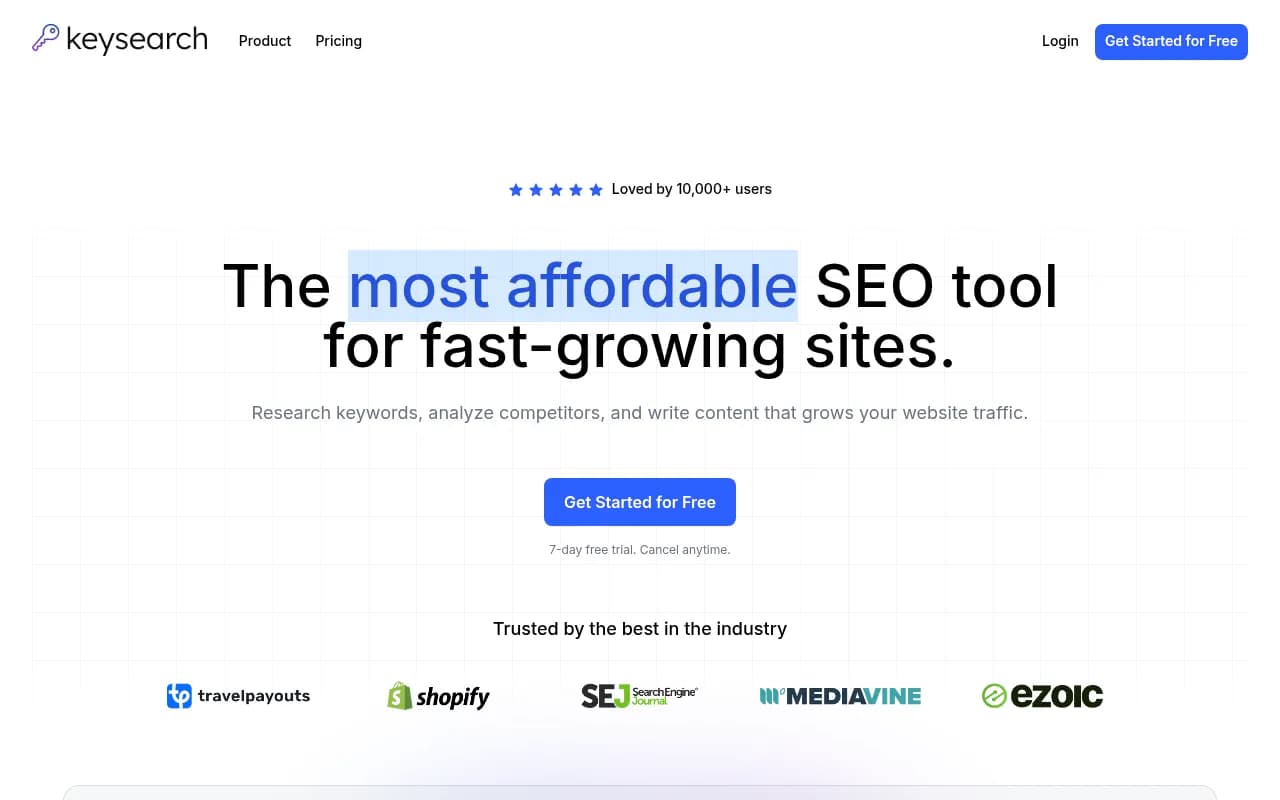
KeySearch is an affordable all-in-one SEO platform offering keyword research, competitor analysis, rank tracking, site audits, and AI-powered content optimization. Designed for bloggers, niche site owners, and small businesses, it delivers essential SEO tools at $24-48/month—a fraction of enterprise
Key Takeaways:
- Budget-conscious alternative: KeySearch offers comprehensive SEO tools starting at $24/month, positioning itself as an affordable replacement for Ahrefs ($99+/mo) and Semrush ($139+/mo)
- Best for small-scale operators: Ideal for bloggers, niche site owners, affiliate marketers, and small businesses managing 1-5 sites—not built for agencies handling dozens of clients
- Foresight AI is the standout feature: The Pro plan's AI recommendation engine analyzes your site's authority and suggests winnable keywords, then helps create optimized content to rank for them
- Limitations to know: Smaller backlink index than enterprise tools, daily search limits (200-500 queries), and less granular data for highly competitive keywords
- Strong community endorsement: Widely recommended in the niche site and affiliate marketing communities, with testimonials from Niche Pursuits, NicheSiteLady, and other trusted voices
Keysearch launched in 2015 as a direct response to the pricing problem in SEO software. While tools like Ahrefs and Semrush were adding features and raising prices, a gap emerged for solo operators and small teams who needed solid keyword research and competitor analysis without enterprise budgets. Over the past decade, KeySearch has carved out a loyal following among bloggers, affiliate marketers, and niche site builders—people running 1-3 content sites who need actionable data, not dashboards with 50 modules they'll never touch.
The platform is trusted by over 10,000 users and has earned endorsements from Mediavine, Ezoic, Search Engine Journal, and Shopify. It's particularly popular in the niche site community, where cost-per-site matters and simplicity beats feature bloat.
Keyword Research with Difficulty Scoring
KeySearch's core strength is finding low-competition keywords that smaller sites can actually rank for. Enter a seed keyword and you get monthly search volume, CPC data, PPC competition scores, and KeySearch's proprietary difficulty score (0-100 scale). The difficulty metric considers domain authority of ranking pages, backlink profiles, and on-page optimization—giving you a realistic assessment of whether you can compete.
The tool surfaces long-tail variations, question-based queries, and related keywords with filtering options for search volume ranges, difficulty thresholds, and word count. You can export keyword lists to CSV or save them to projects for ongoing tracking. The SERP analysis view shows exactly who's ranking for each keyword—their domain strength, backlink count, page authority, and content length—so you can reverse-engineer what it takes to rank.
Unlike Ahrefs or Semrush, KeySearch doesn't try to index the entire web. Its backlink database is smaller, which means less comprehensive data for highly competitive keywords in saturated niches like finance or insurance. But for most content sites targeting informational keywords with search volumes under 10K/month, the data is more than sufficient.
Foresight: AI-Powered SEO Strategy Engine
Foresight (available on the Pro plan) is where KeySearch differentiates itself from basic keyword tools. It's an AI recommendation engine that analyzes your website's niche, current authority, and existing rankings to suggest specific keywords you should target next. Instead of manually sifting through thousands of keyword ideas, Foresight identifies opportunities where you have a realistic chance of ranking on page one.
The system works in three stages. First, you enter your domain and Foresight crawls your site to understand your topical focus and authority level. Second, it suggests keyword opportunities categorized by difficulty—some are "quick wins" where weak competitors are ranking, others are keywords you're already ranking for on page 2-3 that could be pushed to page one with optimization. Third, it generates AI-optimized content outlines and drafts based on analysis of top-ranking pages.
The content recommendations include topic coverage analysis (which subtopics competitors cover that you're missing), suggested heading structures, and even AI-generated introductory paragraphs. You can customize by language and country, making it useful for international SEO. Foresight essentially pilots your content strategy—telling you what to write about and how to structure it for maximum ranking potential.
This is a significant advantage over monitoring-only tools. Many SEO platforms show you data but leave you to figure out what to do with it. Foresight closes that gap by turning insights into action items.
Competitor Analysis and Backlink Research
The competitor analysis module lets you enter any domain and see their estimated organic traffic, top-ranking keywords, backlink profile, and referring domains. You get a Domain Strength score (0-100) that estimates how authoritative the site is, plus a "Score to Target" metric that tells you how much authority you'd need to compete.
For each competitor, you can view their top-performing pages, the keywords driving traffic to those pages, and their backlink sources. The backlink analysis shows anchor text distribution, referring domain quality, and new vs. lost backlinks over time. You can export competitor keyword lists and add them to your own projects for tracking.
The backlink index is smaller than Ahrefs (which has 30+ trillion links) or Majestic, so you won't see every single backlink to a domain. For most small-to-medium sites, though, you'll see enough data to understand their link profile and identify link-building opportunities. The tool is better suited for analyzing competitors in your weight class (other niche sites, small businesses) rather than Fortune 500 brands.
AI Content Assistant and Editor
KeySearch includes an AI writing assistant that helps optimize content for target keywords. Paste in your draft or start from scratch, and the assistant analyzes top-ranking content to suggest topics you should cover, optimal content length, heading structures, and keyword density targets.
The editor provides real-time optimization scores as you write, flagging missing topics, thin sections, or keyword usage issues. It's not a full content generation tool like Jasper or Copy.ai—it won't write entire articles for you—but it guides your writing to ensure you're covering what search engines expect to see.
The AI credits system (5K-15K per month depending on plan) covers content analysis, outline generation, and AI-assisted writing. If you're producing 4-8 articles per month, the included credits are sufficient. High-volume content operations will hit limits quickly.
Rank Tracking and Reporting
The rank tracker monitors your keyword positions across Google search results, with daily updates and historical trend data. You can track 80-200 keywords per month depending on your plan, organized by project or campaign. The dashboard shows net rank changes, average position, and keywords by ranking tier (top 3, top 10, top 20, etc.).
Rank tracking supports multiple locations and languages, so you can monitor local SEO performance or international rankings. You can set up automated email reports to track progress over time. The reporting is straightforward—no white-label options or client-facing dashboards like you'd find in agency-focused tools like SE Ranking.
Website Audit and Technical SEO
The SEO Auditor crawls your site (up to 2K-5K pages depending on plan) and identifies technical issues: broken links, missing meta tags, duplicate content, slow-loading pages, mobile usability problems, and more. Issues are categorized by priority (high, medium, low) with explanations of why each matters and how to fix it.
You get an overall Optimization Score and a breakdown of site-level checks (HTTPS enabled, sitemap found, robots.txt configured). The audit is less granular than Screaming Frog or Sitebulb—it won't catch every edge case—but it surfaces the issues that actually impact rankings for most sites.
YouTube Keyword Research
KeySearch includes a dedicated YouTube research tool for finding video keyword opportunities. Enter a topic and see search volume estimates, competition levels, and top-ranking videos for that keyword. You can analyze competitors' channels to see their most popular videos and the keywords driving views.
This is useful for content creators running both a blog and a YouTube channel, or for finding video topics that complement written content. The YouTube data is less robust than TubeBuddy or VidIQ, but it's a nice bonus feature included at no extra cost.
Who Should Use KeySearch
KeySearch is purpose-built for:
- Niche site owners and affiliate marketers managing 1-5 content sites, targeting informational keywords with search volumes under 20K/month. If you're building sites in niches like home improvement, hobbies, or product reviews, this is your tool.
- Bloggers and solo content creators who need keyword research and rank tracking without a $100+/month budget. The Starter plan at $24/month covers the essentials.
- Small business owners doing their own SEO for a local service business or e-commerce store. The site audit and rank tracking features help you stay on top of technical issues and monitor progress.
- Freelance SEO consultants working with 2-5 small business clients. The Pro plan's Foresight feature helps you deliver strategic recommendations quickly.
KeySearch is NOT ideal for:
- Agencies managing 10+ client sites: The daily search limits (200-500 queries) and tracked keyword caps (80-200 keywords) won't scale. You'd need SE Ranking, Semrush, or Ahrefs.
- Enterprise SEO teams: If you're optimizing a site with 100K+ pages or competing for highly competitive commercial keywords, you need the deeper data and advanced features of enterprise tools.
- Link builders focused on outreach: The backlink index is smaller, and there's no email finder or outreach automation like Pitchbox or BuzzStream.
Integrations and Platform Support
KeySearch is a standalone web app with no native integrations. You can export data to CSV for use in Google Sheets, Excel, or other tools, but there's no API, Zapier connection, or direct integrations with Google Search Console, Google Analytics, or WordPress.
This is a tradeoff for simplicity and cost. If you need automated workflows or data syncing across platforms, you'll miss the integration ecosystem of Semrush or Ahrefs. For most users, manual exports are sufficient.
Pricing and Value
KeySearch offers two plans:
- Starter Plan: $24/month (or $17/month billed annually) – 200 keyword searches per day, 80 tracked keywords, 2K audited pages per month, 5K AI credits. Does NOT include Foresight.
- Pro Plan: $48/month (or $34/month billed annually) – 500 keyword searches per day, 200 tracked keywords, 5K audited pages per month, 15K AI credits. Includes Foresight AI.
Both plans include all core features: keyword research, SERP analysis, competitor analysis, backlink research, YouTube research, site audits, AI content assistant, and rank tracking. There are no long-term contracts—cancel anytime. A 7-day free trial is available.
Compared to competitors:
- Ahrefs Lite: $99/month – More comprehensive backlink data, larger keyword database, but 4x the cost
- Semrush Pro: $139/month – Broader feature set including PPC and social tools, but 5x the cost and steeper learning curve
- Ubersuggest: $29/month – Similar pricing, but less accurate data and fewer features
- SE Ranking: $65/month – More features but more complex interface
For niche site owners and small businesses, KeySearch delivers 80% of what you'd get from Ahrefs or Semrush at 20-30% of the cost. You sacrifice some data depth and advanced features, but you gain simplicity and affordability.
Strengths
- Exceptional value for money: $24-48/month for a full SEO toolkit is hard to beat
- Foresight AI: The recommendation engine genuinely helps prioritize keyword opportunities and content strategy
- User-friendly interface: Clean, intuitive design with minimal learning curve
- Strong community reputation: Widely recommended by niche site builders and affiliate marketers who've actually used it
- No long-term contracts: Monthly billing with easy cancellation
Limitations
- Smaller backlink index: Less comprehensive than Ahrefs, Majestic, or Moz for deep link analysis
- Daily search limits: 200-500 keyword searches per day can feel restrictive during intensive research sessions
- No integrations: Lack of API or native integrations with GSC, GA, or WordPress
- Limited for agencies: Tracked keyword caps and search limits don't scale for multi-client operations
Bottom Line
KeySearch is the best SEO tool for bloggers, niche site owners, and small businesses who need solid keyword research, competitor analysis, and rank tracking without enterprise pricing. The Foresight AI feature on the Pro plan is a genuine differentiator—it doesn't just show you data, it tells you what to do next and helps you create content to act on those insights. If you're managing 1-5 sites, targeting informational keywords, and working with a limited budget, KeySearch delivers more value per dollar than any competitor. If you're an agency managing dozens of clients or competing in highly saturated niches, you'll eventually outgrow it and need Ahrefs or Semrush. But for the target audience—solo operators and small teams—this is the tool to start with.
Tags:
Similar and alternative tools to Keysearch