WalkMe Review 2026
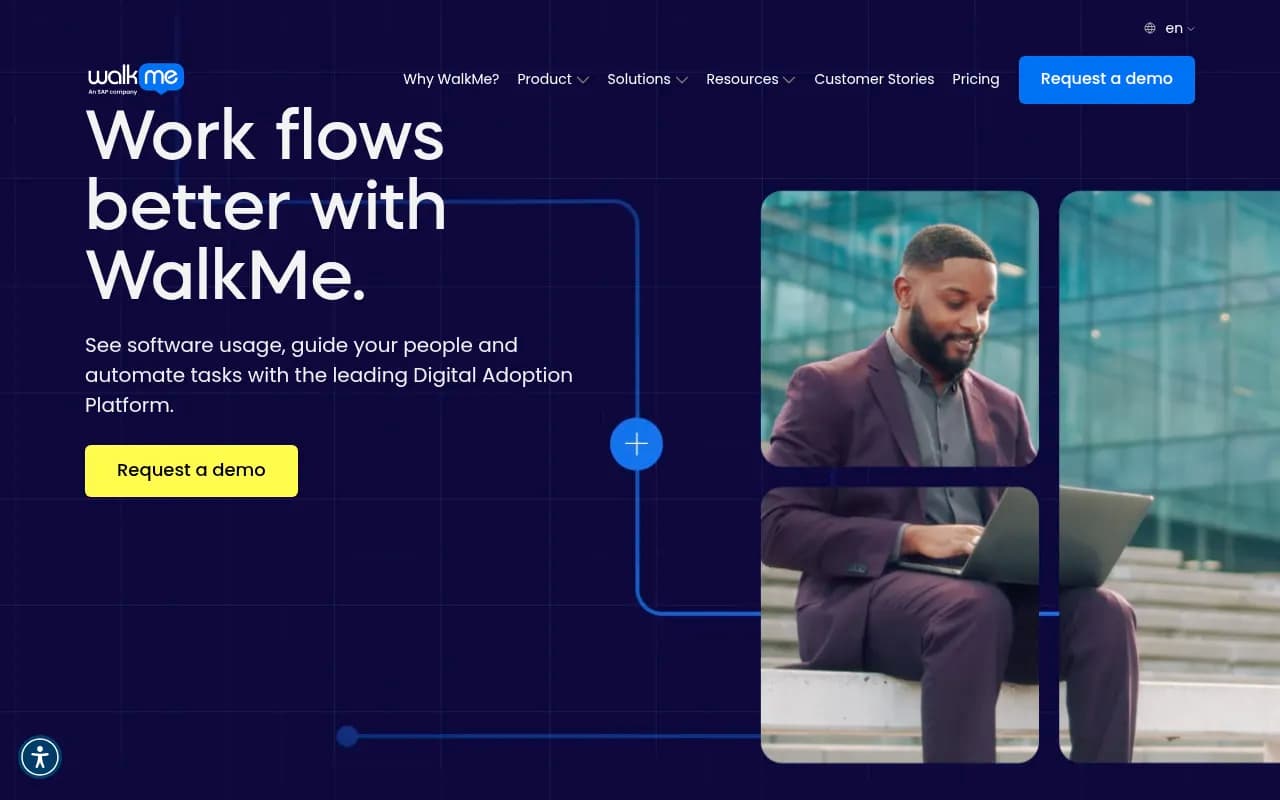
WalkMe is a Digital Adoption Platform (DAP) that overlays on any application to provide in-app guidance, workflow automation, and usage analytics. Used by enterprise teams in sales, HR, IT, and customer care to reduce training time, improve software ROI, and eliminate friction in complex business pr
Summary: Key Takeaways
- Enterprise-grade DAP: WalkMe is the market-leading Digital Adoption Platform built for large organizations managing complex software stacks -- think Salesforce, SAP, Workday, ServiceNow. It overlays on any application to provide contextual guidance, automate repetitive tasks, and surface usage analytics.
- Three-pillar approach: Data (software usage visibility), Action (no-code guidance and automation), Experience (frictionless workflows across desktop, mobile, and web). Most competitors focus on one or two pillars -- WalkMe covers all three.
- Real enterprise results: Customers report 30-50% reductions in support tickets, millions of productivity hours returned, and ROI within 12 months. These aren't vanity metrics -- they're tied to actual business outcomes like faster onboarding, higher compliance, and improved data quality.
- Not for small teams: Pricing starts around $1-2.50/user/month but realistically targets mid-market to enterprise (500+ employees). The platform requires dedicated admin resources to build and maintain content. Solo founders and small startups should look elsewhere.
- Strong ecosystem: 12,000+ questions answered in the community, 125+ yearly events, and a robust partner network of systems integrators and ISVs. You won't be alone figuring this out.
WalkMe is what happens when you take the concept of interactive product tours and scale it to enterprise complexity. It's not a lightweight onboarding tool you slap on your SaaS app in an afternoon. It's a full platform for organizations drowning in software -- companies that have rolled out Salesforce, SAP, Workday, ServiceNow, and a dozen other enterprise apps, only to watch employees struggle, create workarounds, or just give up and call IT.
The company was founded in 2011 and has since become the category leader in Digital Adoption Platforms (DAP). They went public on NASDAQ in 2021 (ticker: WM) and serve over 2,000 enterprise customers including Deloitte, Nestlé, KeyBank, Adobe, and IBM. The platform processes billions of user interactions annually, giving WalkMe a dataset that informs how people actually use enterprise software -- not how vendors think they use it.
WalkMe's core insight: most enterprise software adoption problems aren't about the software itself. They're about the gap between what the software can do and what employees know how to do with it. Training doesn't stick. Documentation goes unread. And when a new process or system rolls out, productivity craters for weeks while everyone figures it out.
Data: Software usage visibility
WalkMe's analytics engine sits on top of your entire software stack and tracks how employees interact with applications. Not just "did they log in" but "did they complete the process correctly, where did they get stuck, and how long did it take."
Discovery scans your organization to identify all software in use -- including shadow IT that procurement doesn't know about. You get a complete inventory of applications, usage frequency, and cost per user. This alone can surface $100K+ in wasted licenses.
Insights goes deeper into specific workflows. Say you've rolled out a new expense reporting process in SAP. WalkMe shows you:
- How many employees started the process vs completed it
- Where they abandoned or made errors
- Which steps took the longest
- Segmentation by department, role, or location
You can set benchmarks ("expense reports should take under 5 minutes") and get alerts when performance degrades. One customer used this to identify a single form field that was causing 40% of users to drop off -- a field that wasn't even required but looked like it was.
Behavior-based segmentation lets you group users by how they actually use software, not just their job title. You might discover that your "power users" in sales are only using 30% of Salesforce's features, or that a specific team has invented a workaround that's faster than the official process.
The data layer integrates with your existing BI tools (Tableau, Power BI, Looker) and can export to data warehouses. API access is available for custom reporting.
Action: No-code guidance and automation
This is where WalkMe earns its keep. Once you know where friction exists, you can deploy fixes without waiting for IT or the software vendor.
WalkThrus are step-by-step guides that overlay on the application itself. Not a separate help center or video tutorial -- the guidance appears exactly where the user needs it, highlighting the next field to fill, the next button to click. Think of it as a GPS for software.
You can trigger WalkThrus based on context:
- User role (new hires get more hand-holding)
- Location in the app (stuck on a specific screen for 30+ seconds)
- Time of day (end-of-quarter reminders for sales reps)
- Behavior patterns (user keeps making the same error)
SmartTips are contextual tooltips that appear when users hover over or click on specific elements. Use them for quick definitions, policy reminders, or warnings ("This field is required for compliance").
Launchers are persistent menus that give users access to resources, shortcuts, and automations without leaving their workflow. One customer built a launcher with links to HR policies, IT support, and a "report a bug" form -- support tickets dropped 30% because employees could self-serve.
Automations (called ActionBots) handle repetitive tasks on behalf of the user. Examples:
- Auto-fill form fields with data from another system
- Navigate through multi-step processes with one click
- Validate data entry in real-time and flag errors before submission
- Copy data between applications (e.g. CRM to ERP)
One customer automated their employee onboarding checklist -- new hires just click a button and WalkMe fills out 12 different forms across 5 systems. What used to take 3 hours now takes 15 minutes.
The builder is no-code but not simplistic. You can set conditional logic (if X then Y), create variables, and chain actions together. Power users can write custom JavaScript for complex scenarios. There's also a Chrome extension for building content directly in the browser.
Experience: Multi-platform delivery
WalkMe works across desktop applications (Windows, Mac), web apps, and mobile (iOS, Android). The same content can be deployed everywhere or customized per platform.
Desktop: A small agent runs on the employee's machine and overlays on any application -- even legacy on-prem software that hasn't been updated since 2005. This is huge for enterprises stuck with old ERP or CRM systems.
Web: JavaScript snippet or browser extension. Works on any web app including Salesforce, Workday, ServiceNow, SAP SuccessFactors, and custom internal tools.
Mobile: Native SDKs for iOS and Android. Supports both native apps and mobile web. Guidance appears as overlays, tooltips, or in-app messages.
The experience layer also includes:
- Surveys and feedback forms to capture user sentiment at the moment of friction
- Announcements and notifications for change management ("New feature launching Monday")
- Resource center (a searchable knowledge base embedded in the app)
- Multilingual support (50+ languages)
Who is it for
WalkMe is built for mid-market to enterprise organizations (500+ employees) with complex software environments. Specific personas:
IT and digital transformation teams managing software rollouts, migrations, and consolidation projects. If you're moving from Oracle to SAP, or rolling out Microsoft 365 to 10,000 employees, WalkMe helps you manage the change without hiring an army of trainers.
HR and people ops teams trying to improve onboarding, benefits enrollment, performance reviews, and other employee-facing processes. One customer reduced onboarding time from 6 weeks to 3 weeks by automating the paperwork and providing in-app guidance for new systems.
Sales enablement and RevOps teams who need reps to actually use Salesforce correctly. WalkMe can enforce data hygiene ("You can't close this deal without filling out these fields"), automate quote generation, and provide just-in-time training on new products.
Customer support and success teams dealing with high ticket volumes because customers can't figure out your product. WalkMe can be embedded in your customer-facing app to provide self-service guidance and reduce support load.
Who should NOT use WalkMe: Small startups, solo founders, and teams under 100 employees. The platform is overkill for simple use cases and requires dedicated resources to manage. If you just need basic product tours for your SaaS app, look at Appcues, Pendo, or Chameleon instead. WalkMe is for organizations where software adoption is a strategic initiative, not a nice-to-have.
Integrations and ecosystem
WalkMe integrates with the enterprise software you're already using:
- CRMs: Salesforce, Microsoft Dynamics, HubSpot
- ERPs: SAP, Oracle, Workday, NetSuite
- HRIS: Workday HCM, SAP SuccessFactors, ADP, BambooHR
- Service desks: ServiceNow, Zendesk, Jira Service Management
- Collaboration: Microsoft Teams, Slack, SharePoint
- SSO: Okta, Azure AD, OneLogin
- Analytics: Tableau, Power BI, Looker, Google Analytics
There's also a GitHub integration for version control of WalkMe content (useful for enterprises with multiple admins), and a REST API for custom integrations and data export.
The WalkMe Community has 12,000+ members, 5,000+ hours of content, and 125+ events per year. It's one of the most active vendor communities in the enterprise software space. You'll find best practices, templates, and answers to "how do I..." questions.
The partner ecosystem includes systems integrators (Deloitte, Accenture, PwC), ISVs (Salesforce, SAP, Microsoft), and agencies that specialize in DAP implementations. If you don't have internal resources to build WalkMe content, you can hire a partner.
Pricing and value
WalkMe doesn't publish pricing on their website -- it's custom quoted based on number of users, applications covered, and features needed. Industry sources suggest:
- Starting point: $1-2.50 per user per month for basic plans
- Enterprise average: $78,817 per year (roughly $6,500/month)
- Large deployments: $200K-500K+ annually for Fortune 500 companies with 10,000+ users
Pricing is typically annual with a 1-3 year commitment. There's no free trial -- you go through a demo and POC process with their sales team.
What you get:
- Full platform access (Data, Action, Experience)
- Unlimited WalkThrus, SmartTips, and Automations
- Multi-platform support (desktop, web, mobile)
- Analytics and reporting
- Customer success manager
- Access to the community and partner network
Higher tiers add:
- Advanced analytics and AI-powered insights
- Custom integrations and API access
- Dedicated technical account manager
- Professional services for implementation
ROI: An IDC study found that WalkMe customers achieved a 3-year ROI of 494%, with payback in under 12 months. Specific benefits:
- 30-50% reduction in support tickets (Deloitte, others)
- Millions of productivity hours returned (Nestlé)
- 20-40% faster onboarding for new employees
- 15-25% improvement in process completion rates
- $100K+ savings from eliminating unused software licenses
One customer calculated that WalkMe saved them $2.3M in the first year by reducing training costs, support tickets, and software waste.
Strengths and limitations
What WalkMe does exceptionally well:
Enterprise-grade infrastructure: This platform is built to handle 50,000+ users across global deployments. It's stable, secure (SOC 2, GDPR compliant), and integrates with enterprise SSO and identity management.
Cross-application coverage: Unlike competitors that focus on web apps, WalkMe works on desktop software, legacy systems, and mobile apps. If you're stuck with a 15-year-old ERP system, WalkMe can still overlay guidance on it.
No-code automation: The ActionBot capability is more powerful than most competitors. You're not just showing tooltips -- you're actually automating tasks and moving data between systems.
Analytics depth: The insights you get go beyond "did they click the button" to "did they complete the workflow correctly, and if not, where did they fail." This is what you need to actually improve processes.
Proven at scale: With 2,000+ enterprise customers and a decade of experience, WalkMe has seen every edge case and integration challenge. The platform is mature.
Honest limitations:
Requires dedicated resources: You need at least one full-time admin (often called a "Digital Adoption Manager") to build and maintain WalkMe content. Small teams will struggle.
Steep learning curve: The builder is no-code but not simple. Expect 2-4 weeks of ramp-up time for new admins. The community helps, but there's a lot to learn.
Pricing opacity: The lack of transparent pricing is frustrating. You have to go through a sales process to get a quote, and it's hard to budget without knowing the ballpark.
Overkill for simple use cases: If you just need basic product tours for a single SaaS app, WalkMe is too much. Competitors like Appcues or Pendo are faster to implement and cheaper.
Mobile experience lags desktop: While WalkMe supports mobile, the experience isn't as polished as the desktop/web version. Mobile-first companies might find it limiting.
Bottom line
WalkMe is the right choice for mid-market to enterprise organizations (500+ employees) that are serious about software adoption and have the resources to manage a DAP. If you're rolling out new systems, managing complex workflows, or drowning in support tickets because employees can't figure out your software, WalkMe will pay for itself quickly.
Best use case in one sentence: Large enterprises managing multiple business-critical applications (Salesforce, SAP, Workday, ServiceNow) who need to improve adoption, reduce training costs, and automate repetitive tasks across their entire software stack.
If you're a startup, small business, or just need basic onboarding for a single app, look at lighter alternatives like Appcues, Pendo, Chameleon, or Userpilot. WalkMe is enterprise software for enterprise problems.
Tags:
Frequently asked questions
What is WalkMe and what does it do?
How much does WalkMe cost?
Is WalkMe free to use?
Who is WalkMe best suited for?
What are the key features of WalkMe?
What kind of ROI can companies expect from WalkMe?
What applications does WalkMe integrate with?
When was WalkMe founded and is it publicly traded?
Does WalkMe require technical resources to implement?
What support and resources does WalkMe provide?
Similar and alternative tools to WalkMe