RollWorks Review 2026
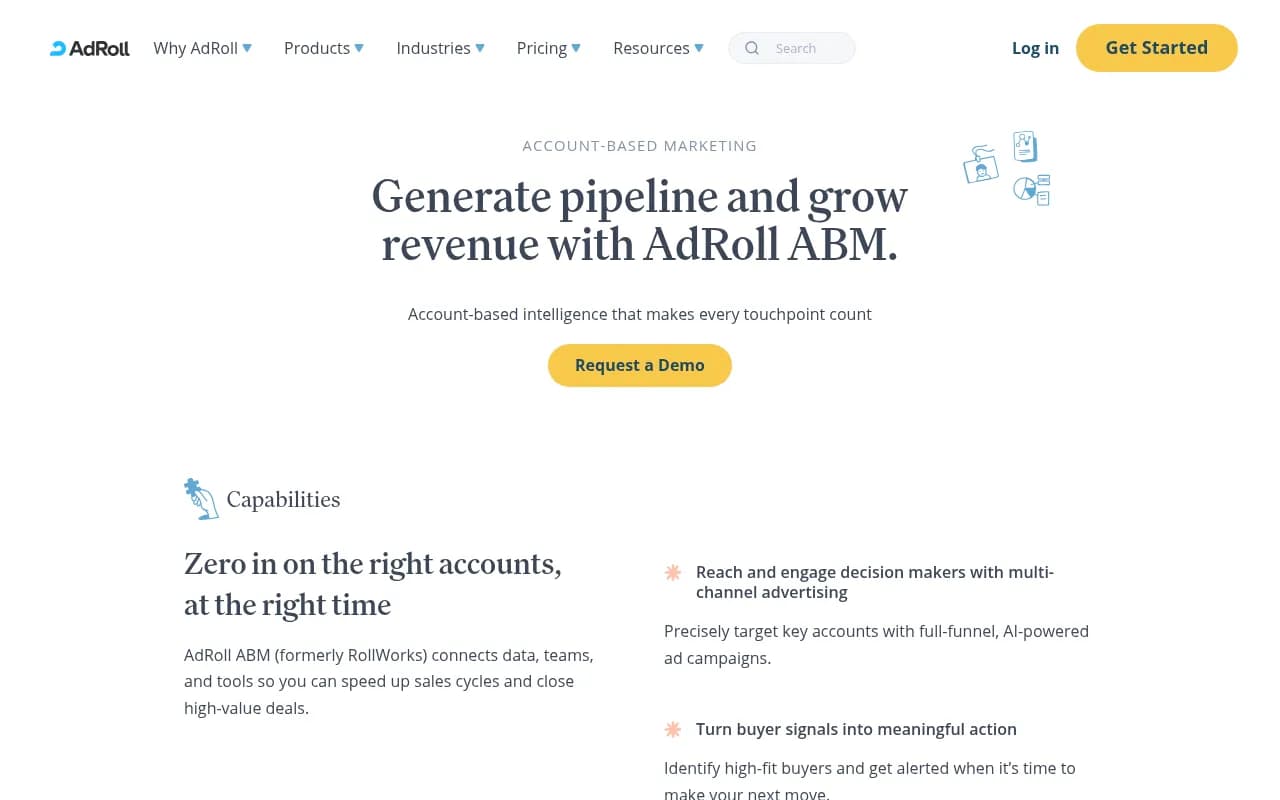
AdRoll ABM (formerly RollWorks) is an account-based marketing and advertising platform that combines buyer intelligence with multi-channel advertising to help B2B teams identify high-value accounts, engage decision-makers, and accelerate sales cycles. Built on 2.6 billion digital identities and powe
Key Takeaways:
- AdRoll ABM (formerly RollWorks) is a comprehensive account-based marketing platform that combines buyer intelligence, multi-channel advertising, and sales alignment tools to help B2B teams identify and close high-value accounts
- Built on 2.6 billion digital identities and 92 million contacts, with proprietary AI engines (InIQ for buyer insights, BidIQ for ad optimization) that surface buying signals and recommend next actions
- Delivers 5X more ROI than competing ABM platforms according to vendor claims, with customers like Snowflake reporting 50% new opportunity rates and average 16% increase in pipeline opportunities
- Pricing starts around $1,000/month, positioning it as a mid-market to enterprise solution -- significantly higher than monitoring-only tools but competitive with full-featured ABM platforms like Terminus
- Best for B2B marketing and sales teams at companies with defined ideal customer profiles, multiple stakeholders in the buying process, and the budget to support multi-channel advertising campaigns
AdRoll ABM is what happens when a demand-side advertising platform decides to solve the account-based marketing problem from the ground up. Originally launched as RollWorks (a spinoff from AdRoll's B2C advertising business), it was rebranded as AdRoll ABM in 2024 to unify the company's B2B and B2C offerings under one roof. The core insight: most ABM platforms are either data tools that don't help you act on insights, or advertising platforms that don't know which accounts to target. AdRoll ABM tries to be both -- a single application that identifies your best-fit accounts, tells you when they're showing buying intent, then helps you reach them with personalized ads across every channel that matters.
The target audience is B2B marketing teams at mid-market and enterprise companies -- think SaaS companies with $5M+ in revenue, manufacturing firms selling complex equipment, professional services firms chasing Fortune 500 accounts. You need a defined ideal customer profile, a sales team that works named accounts (not just inbound leads), and the budget to run sustained advertising campaigns. If you're a startup with five customers and no ad spend, this isn't for you. If you're a 50-person company trying to break into enterprise accounts and your sales team is drowning in unqualified leads, this might be exactly what you need.
AdRoll ABM's history is worth understanding because it explains the product's DNA. AdRoll started in 2006 as a retargeting platform for e-commerce brands -- think Shopify stores chasing abandoned carts with display ads. In 2018, they spun out RollWorks to bring the same advertising infrastructure to B2B, but with account-level targeting instead of individual cookies. The 2024 rebrand back to AdRoll ABM signals a bet that the future is unified: the same AI and advertising tech should work for both B2C and B2B, just with different targeting logic. NextRoll (the parent company) is privately held, founded by Aaron Bell and Adam Berke, with backing from Foundation Capital and others. They've been profitable for years, which matters -- this isn't a VC-funded experiment that might disappear.
Buyer Intelligence and Intent Data
The foundation of AdRoll ABM is InIQ, their proprietary AI engine that sits on top of 2.6 billion digital identities and 92 million B2B contacts. This isn't just a database -- it's a constantly updating graph of who works where, which companies are in-market, and which accounts match your ideal customer profile. You feed it your existing customer data (company size, industry, tech stack, whatever signals matter to you), and InIQ builds a lookalike model to surface similar accounts you're not targeting yet. It also tracks behavioral signals: website visits, content downloads, ad engagement, third-party intent data from partners. When an account starts showing multiple buying signals, the Command Center (their real-time dashboard) surfaces it and recommends actions -- add contacts to a Salesforce campaign, build a targeted ad audience, send an alert to your sales rep.
What makes this different from standalone intent data tools (Bombora, 6sense, Demandbase): AdRoll ABM doesn't just show you the data and leave you to figure out what to do with it. The Command Center is built around workflows -- if Account X is showing intent, here are three things you can do right now. Click a button to launch an ad campaign targeting that account's decision-makers. Click another button to push the account into Salesforce with a priority flag. The goal is to collapse the time between "we see a signal" and "we take action" from days to minutes. For marketing ops teams that are already overwhelmed, this is the difference between intent data that sits unused in a dashboard and intent data that actually drives pipeline.
The contact database (92 million records) is also worth calling out. Most ABM platforms make you bring your own contact data or integrate with a separate data provider (ZoomInfo, Cognism, Apollo). AdRoll ABM includes contact data natively, which means you can build account lists and immediately see the decision-makers at those accounts -- names, titles, email addresses, LinkedIn profiles. You can export these lists to your CRM or marketing automation platform, or use them directly in AdRoll ABM's advertising campaigns. The data quality is solid but not perfect -- expect some outdated emails and job titles, same as any B2B database. The advantage is convenience: one fewer integration to manage, one fewer vendor to pay.
Multi-Channel Advertising Execution
Once you've identified your target accounts, AdRoll ABM's advertising engine (powered by BidIQ, their bid optimization AI) helps you reach decision-makers across display, social (LinkedIn, Facebook, Instagram), video (YouTube, streaming TV), and native ad networks. This is where the AdRoll heritage shines -- they've been running programmatic ad campaigns since 2006, and the infrastructure is battle-tested. You upload your creative (or use their templates), define your audience (specific accounts, job titles, or broader intent-based segments), set your budget, and BidIQ handles the rest -- bidding in real-time across thousands of ad exchanges to get your ads in front of the right people at the lowest cost.
The account-based targeting is the key differentiator. Instead of targeting "VP of Marketing in the SaaS industry" (which is what you'd do in LinkedIn Campaign Manager), you target "VP of Marketing at these 50 specific companies." AdRoll ABM uses IP address mapping, device graphs, and probabilistic matching to identify when someone from your target account is browsing the web, then serves them your ad. This is more precise than industry/title targeting but less precise than email-based targeting (which LinkedIn and Facebook support natively). The tradeoff: you can reach people across the entire open web, not just on LinkedIn. For accounts that aren't active on LinkedIn (or where LinkedIn ads are prohibitively expensive), this matters.
BidIQ's optimization is where the AI does heavy lifting. It learns which placements, times of day, and creative variations drive the most engagement and conversions for your specific accounts, then shifts budget toward what's working. This isn't revolutionary -- Google and Facebook have been doing this for years -- but it's rare in the ABM world, where most platforms treat advertising as a manual, campaign-by-campaign process. AdRoll ABM treats it like performance marketing: set your goals (impressions, clicks, conversions), let the AI optimize, check the results. For marketing teams that don't have a dedicated paid media specialist, this is a huge unlock.
One limitation: AdRoll ABM doesn't support direct mail, gifting, or event marketing -- channels that are core to many ABM strategies. If you want to send a personalized gift to your top 10 accounts, you'll need a separate tool (Sendoso, Alyce, Postal.io). If you want to invite them to a VIP dinner at a conference, you'll need to manage that outside the platform. AdRoll ABM is purely digital advertising and outreach. For some teams, that's fine -- digital is 80% of their ABM motion. For others (especially enterprise sales teams doing high-touch, relationship-driven deals), it's a gap.
Sales and Marketing Alignment
AdRoll ABM integrates with Salesforce, HubSpot, Marketo, Pardot, and other CRMs and marketing automation platforms to keep account data, contact lists, and campaign activity in sync. The integration is bidirectional: AdRoll ABM pulls account and contact data from your CRM to build target lists, then pushes engagement data (ad impressions, clicks, website visits, intent signals) back into the CRM so sales reps can see which accounts are warming up. This is table stakes for any ABM platform, but AdRoll ABM does it well -- the sync is near real-time (updates every 15 minutes), and you can map custom fields to ensure your specific data model is preserved.
The Command Center also includes sales alerts and recommended actions. When an account hits a certain intent threshold (e.g., three website visits in the last week, plus engagement with two ads, plus third-party intent signals), AdRoll ABM can send a Slack message or email to the account owner with a summary of the activity and suggested next steps. This is where the platform tries to bridge the marketing-sales gap: marketing runs the campaigns, sales gets notified when accounts are ready to talk, everyone works from the same data. In practice, this works best when you have a small number of high-value accounts (50-200) where sales reps can actually act on every alert. If you're targeting 5,000 accounts, the alerts become noise.
AdRoll ABM also supports multi-touch attribution and pipeline reporting. You can see which campaigns, channels, and tactics are contributing to opportunities and closed-won deals, with attribution models ranging from first-touch to multi-touch to custom. The reporting integrates with your CRM's opportunity data, so you're measuring actual pipeline and revenue, not just marketing metrics like impressions and clicks. This is critical for proving ABM ROI to your CFO or board. The dashboards are clean and customizable, with filters for account segment, campaign, time period, and more. You can export data to CSV or push it to a BI tool (Looker, Tableau) for deeper analysis.
Account-Based Plays and Automation
AdRoll ABM includes playbooks and automation workflows to help you execute common ABM strategies without manual work. For example: a "warm account" play that automatically adds accounts showing intent to a targeted ad campaign, sends an alert to sales, and enrolls them in a nurture sequence. Or a "competitor displacement" play that targets accounts using a competitor's product (identified via technographic data) with comparison ads and case studies. You can build these plays using a visual workflow builder (similar to Marketo or HubSpot workflows), with triggers based on account attributes, intent signals, CRM data, or campaign engagement.
The automation is helpful but not as sophisticated as dedicated marketing automation platforms. You can't build complex multi-step nurture sequences with branching logic and wait steps -- that's still better handled in Marketo or HubSpot. What AdRoll ABM does well is the account-level orchestration: "When this account does X, take these actions across advertising, CRM, and sales outreach." It's the connective tissue between your intent data, your ad campaigns, and your sales team, not a replacement for your MAP.
AdRoll ABM also offers a team of ABM strategists and customer success managers who help you design your plays, build your target account lists, and optimize your campaigns. This is included in higher-tier plans (likely the $1K+/month tier based on pricing research) and is a meaningful differentiator. Most ABM platforms give you the tools and leave you to figure out the strategy. AdRoll ABM gives you a dedicated person who's run ABM programs before and can tell you what works. For teams new to ABM or short on bandwidth, this support is worth the premium.
Analytics and Reporting
AdRoll ABM's analytics dashboard tracks account engagement, campaign performance, pipeline contribution, and ROI. You can see which accounts are most engaged (based on ad impressions, clicks, website visits, content downloads), which campaigns are driving the most pipeline, and which channels are most cost-effective. The dashboard includes account-level detail -- click into any account to see a timeline of every touchpoint (ads, emails, website visits, sales calls) and how they're progressing through your funnel.
The pipeline reporting is where AdRoll ABM tries to close the loop. By integrating with your CRM's opportunity data, it can show you which accounts moved from "target" to "opportunity" to "closed-won" and attribute revenue back to specific campaigns. The vendor claims customers see an average 16% increase in opportunities and 5X ROI compared to other ABM platforms, though these numbers should be taken with a grain of salt -- they're likely based on best-case customers, not an average across all users. Still, the ability to tie ABM spend directly to revenue is critical for justifying the investment, and AdRoll ABM makes this easier than most competitors.
One gap: AdRoll ABM doesn't include advanced analytics like cohort analysis, predictive scoring, or custom attribution modeling. If you want to build a custom multi-touch attribution model that weights different touchpoints based on your specific sales cycle, you'll need to export the data and analyze it in a BI tool. The built-in reporting is solid for standard ABM metrics (account engagement, pipeline, ROI) but not flexible enough for data science teams that want to dig deeper.
Integrations and Ecosystem
AdRoll ABM integrates with Salesforce, HubSpot, Marketo, Pardot, Microsoft Dynamics, and other major CRMs and MAPs. It also connects to data enrichment tools (Clearbit, ZoomInfo), intent data providers (Bombora, G2), and analytics platforms (Google Analytics, Looker). The integrations are pre-built and maintained by AdRoll ABM's team, so you're not writing custom API code or managing Zapier workflows. Setup typically takes a few hours to a few days depending on your CRM's complexity.
AdRoll ABM also offers an API for custom integrations and data exports. This is useful if you want to push account engagement data into a data warehouse (Snowflake, BigQuery) or build custom dashboards in Tableau or Looker. The API documentation is solid, and the support team is responsive if you run into issues. For marketing ops teams that want to build a unified data model across all their tools, the API is a key enabler.
One notable gap: AdRoll ABM doesn't integrate with direct mail or gifting platforms (Sendoso, Alyce, Postal.io), which are common in ABM programs. If you want to trigger a physical gift or direct mail piece based on account engagement, you'll need to export a list from AdRoll ABM and upload it to your gifting platform manually. This is a workflow gap that competitors like Terminus and Demandbase have solved with native integrations.
Who Is AdRoll ABM For?
AdRoll ABM is built for B2B marketing teams at mid-market and enterprise companies with defined ideal customer profiles, multi-stakeholder buying processes, and the budget to run sustained advertising campaigns. Specific personas:
- Demand gen managers at SaaS companies with $5M-$50M in revenue, targeting 500-2,000 accounts, running LinkedIn and display ads but struggling to prove ROI or align with sales. AdRoll ABM gives you the intent data, advertising execution, and pipeline reporting in one platform.
- ABM managers at enterprise companies (manufacturing, financial services, healthcare) targeting 50-200 named accounts with long sales cycles (6-18 months). You need to stay top-of-mind with decision-makers across multiple touchpoints, and you need to show your CMO which accounts are progressing.
- Marketing ops leaders at companies with 10-50 person marketing teams, managing a complex stack (Salesforce, Marketo, ZoomInfo, LinkedIn, Google Ads) and trying to unify account data and campaign execution. AdRoll ABM simplifies the stack by combining intent data, advertising, and CRM sync in one tool.
- Sales and marketing leaders at companies transitioning from lead-based to account-based strategies. You've been running inbound campaigns and passing MQLs to sales, but your sales team is complaining about lead quality and your conversion rates are dropping. AdRoll ABM helps you flip to an account-first model where marketing and sales work the same target list.
Who should NOT use AdRoll ABM: Startups with fewer than 50 target accounts and no advertising budget. Companies selling low-ticket products ($1K-$10K ACV) where the sales cycle is short and the buying process is simple -- you don't need ABM, you need inbound marketing. Teams that don't have a CRM or marketing automation platform -- AdRoll ABM assumes you have the foundational infrastructure in place. Companies that rely heavily on direct mail, gifting, or event marketing as their primary ABM channels -- AdRoll ABM is digital-only.
Pricing and Value
AdRoll ABM's pricing is not publicly listed, but based on third-party research and customer reports, plans start around $1,000/month for the base platform (likely including a set number of target accounts, ad spend, and basic support). Higher tiers (likely $3K-$10K+/month) include more accounts, higher ad spend, advanced features (predictive scoring, custom integrations), and dedicated ABM strategist support. Annual contracts are standard, with discounts for longer commitments.
This pricing positions AdRoll ABM in the mid-market to enterprise segment, competing directly with Terminus ($2K-$10K+/month), Demandbase ($3K-$15K+/month), and 6sense ($5K-$20K+/month). It's significantly more expensive than intent data tools (Bombora, G2 Buyer Intent) or standalone advertising platforms (LinkedIn Campaign Manager, Google Ads), but the value proposition is the integration: you're paying for a single platform that combines intent data, advertising execution, CRM sync, and pipeline reporting, rather than stitching together five separate tools.
Is it good value? For mid-market companies ($10M-$100M revenue) with 5-20 person marketing teams, yes -- the time savings from having everything in one platform, plus the ABM strategist support, easily justifies the cost. For enterprise companies ($100M+ revenue) with dedicated ABM teams and complex requirements, it depends -- you might need more customization and control than AdRoll ABM offers, in which case a platform like Demandbase or 6sense (which are more expensive but more flexible) might be a better fit. For startups and small businesses, no -- the pricing is too high relative to the value you'll get from ABM at that stage.
Strengths and Limitations
Strengths:
- Unified platform that combines intent data, advertising execution, and CRM sync -- you're not stitching together Bombora + LinkedIn Ads + Salesforce + custom reporting, it's all in one place
- Built-in contact database (92 million records) means you don't need a separate data provider like ZoomInfo or Cognism for basic contact enrichment
- BidIQ's ad optimization is genuinely smart -- it learns what works for your accounts and shifts budget accordingly, which is rare in ABM platforms
- ABM strategist support (on higher tiers) is a meaningful differentiator -- you get a real person who's run ABM programs before and can help you design your strategy
- Strong G2 reviews (4.0+ rating, badges for Leader, Easiest Setup, Best ROI) suggest customers are generally happy with the platform and support
Limitations:
- No support for direct mail, gifting, or event marketing -- if those are core to your ABM strategy, you'll need separate tools and manual workflows to connect them
- Contact data quality is good but not perfect -- expect some outdated emails and job titles, same as any B2B database. If you need the highest-quality data, you'll still want ZoomInfo or Cognism.
- Analytics and attribution are solid but not advanced -- no custom multi-touch attribution models, no predictive scoring, no cohort analysis. If you have a data science team that wants to build custom models, you'll need to export the data.
- Pricing is not transparent -- you have to talk to sales to get a quote, which is frustrating if you're trying to compare options quickly. Based on research, expect $1K-$10K+/month depending on your needs.
- Limited to digital channels -- if your target accounts respond better to phone calls, direct mail, or in-person meetings than digital ads, AdRoll ABM won't help you execute those tactics.
Bottom Line
AdRoll ABM is a strong choice for mid-market B2B companies that want to run account-based marketing programs without stitching together five separate tools. The combination of intent data, advertising execution, CRM sync, and pipeline reporting in one platform is genuinely valuable, and the ABM strategist support (on higher tiers) helps teams that are new to ABM or short on bandwidth. The pricing ($1K-$10K+/month) is competitive with Terminus and Demandbase, and the G2 reviews suggest customers are happy with the results.
Best use case in one sentence: Mid-market B2B companies ($10M-$100M revenue) with 500-2,000 target accounts, running multi-channel advertising campaigns, and trying to prove ABM ROI to their executive team.
Tags:
Frequently asked questions
What is RollWorks and what does it do?
How much does RollWorks cost?
Who is RollWorks best suited for?
What are the key features of RollWorks ABM platform?
How does RollWorks compare to other ABM platforms like Terminus?
What kind of results can companies expect from using RollWorks?
Is RollWorks the same as AdRoll ABM?
Does RollWorks offer a free trial or free plan?
Similar and alternative tools to RollWorks