Salesloft Review 2026
Enables sales teams to execute cadences, personalize outreach, and track engagement across multiple channels with advanced sequencing capabilities.
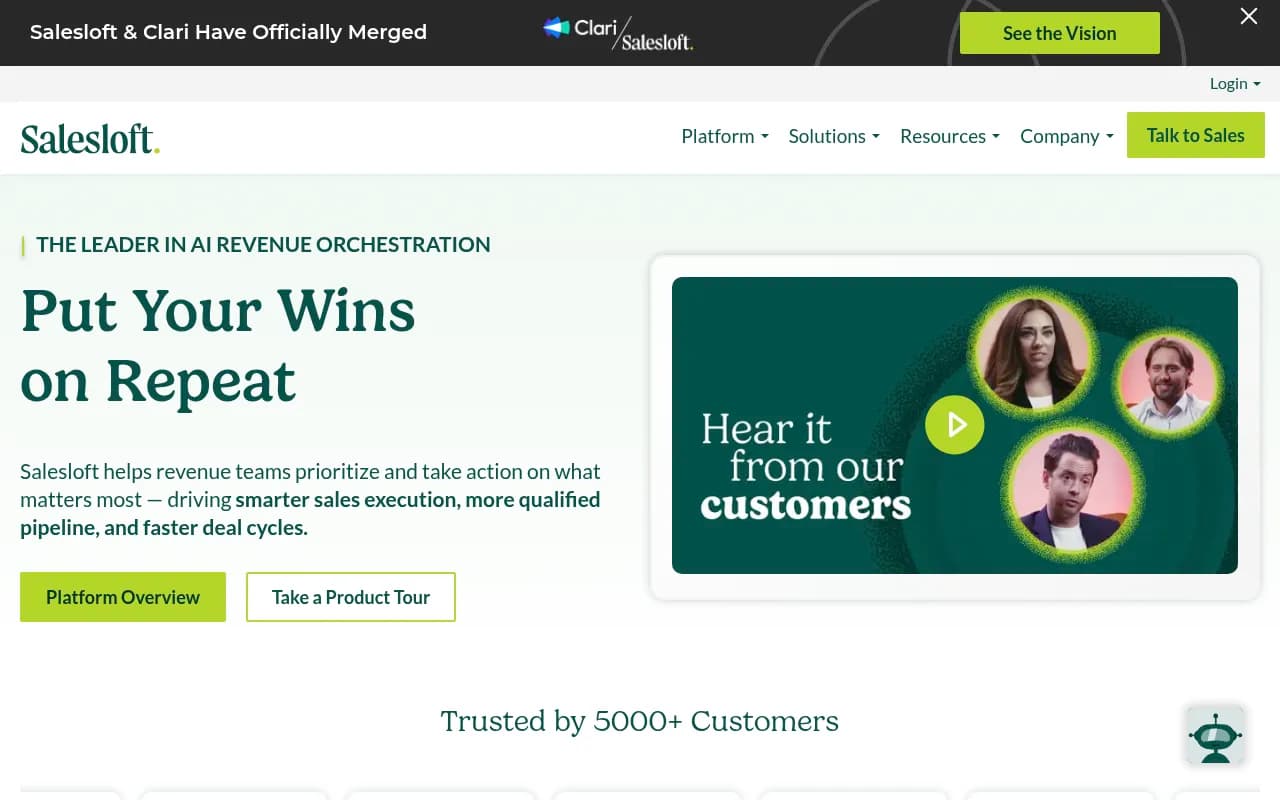
Summary: Key Takeaways
- All-in-one revenue platform: Salesloft combines sales engagement, AI chat agents (Drift), conversation intelligence, deal management, forecasting, and analytics in a single unified platform
- Proven ROI: Forrester TEI study shows 3.3x ROI over 3 years, 12% higher win rates, and $1.3M in tech stack savings from consolidation
- Fast time-to-value: Delivers meaningful productivity and pipeline action within the first 10 days, not months
- Best for: Mid-market to enterprise B2B sales teams (50-500+ sellers) in SaaS, technology, professional services, and complex sales environments
- Pricing: Starts around $1,000/month with Advanced and Elite tiers; requires annual commitment and implementation investment
Salesloft has evolved from a sales engagement tool into what it now calls an "AI Revenue Orchestration Platform" — a comprehensive system that connects every stage of the B2B sales process from first website visit to closed deal. Founded in 2011 and headquartered in Atlanta, the company serves over 5,000 customers including household names like IBM, Stripe, 3M, and Instacart. With the 2024 acquisition of Drift (the conversational marketing platform), Salesloft now offers one of the most complete revenue technology stacks available as a single integrated solution.
The platform is built for mid-market and enterprise B2B sales organizations that need to coordinate complex, multi-touch sales cycles across large teams. If you're managing 50+ sellers, dealing with 6-12 month sales cycles, and struggling to get visibility into what's actually driving revenue, Salesloft positions itself as the central nervous system for your entire revenue operation.
Core Platform Components
Salesloft Cadence (Sales Engagement): This is the foundational module that most teams start with. Cadence automates multi-channel outreach sequences across email, phone, LinkedIn, and SMS. Unlike basic email automation tools, Cadence uses AI to recommend the next best action for each prospect based on engagement signals, deal stage, and historical win patterns. You can build complex branching logic (if prospect opens email but doesn't reply, wait 2 days then call; if they click a link, trigger a different follow-up). The platform tracks every touchpoint and surfaces which cadences, messaging, and timing patterns correlate with pipeline conversion. Salesloft claims their AI can prioritize your daily task list to focus on the 20% of activities that drive 80% of results — a claim backed by their "Rhythm" AI engine that we'll cover below.
Drift AI Chat Agents: Following the Drift acquisition, Salesloft now includes AI-powered chatbots that engage website visitors in real-time. These aren't basic "Can I help you?" bots — Drift's agents can qualify leads, book meetings directly into seller calendars, answer product questions using your knowledge base, and route high-intent visitors to the right sales rep based on territory, account ownership, or deal stage. The chat data flows directly into Salesloft's engagement and analytics modules, so you can see which website conversations turn into pipeline. For companies running account-based strategies, Drift can identify target accounts visiting your site and trigger personalized playbooks or alert the account owner instantly.
Salesloft Conversations (Conversation Intelligence): This module records, transcribes, and analyzes sales calls and video meetings using AI. It automatically captures calls from Zoom, Microsoft Teams, Google Meet, and the built-in Salesloft dialer. The AI identifies key moments like pricing discussions, competitor mentions, objections, next steps, and buying signals. Managers can search across all recorded calls for specific topics ("show me every time a prospect mentioned budget concerns") and create coaching playlists of best practices. The platform tracks talk-to-listen ratios, filler words, longest monologues, and other conversation dynamics that correlate with win rates. Conversations integrates with Cadence, so if a prospect mentions a specific pain point on a call, the system can automatically trigger a follow-up cadence with relevant case studies.
Salesloft Deals (Deal Management): This is Salesloft's answer to deal inspection and pipeline management. Deals pulls data from your CRM (Salesforce, HubSpot, Microsoft Dynamics) and layers on AI-powered deal health scores, risk alerts, and next-step recommendations. It identifies deals that are stalled, missing key stakeholders, or have gone dark. The AI analyzes patterns from closed-won deals to suggest what actions (demo, pricing call, executive sponsor involvement) typically move deals forward at each stage. Deals also includes mutual action plans and deal rooms where you can collaborate with buyers on next steps, share content, and track engagement. For managers, it provides a single view of every deal in the pipeline with AI-generated summaries of recent activity and recommended interventions.
Salesloft Forecast (Forecasting & Pipeline Analytics): Forecast combines CRM data, sales activity, conversation intelligence, and AI to generate more accurate revenue predictions. Instead of relying solely on rep gut feel and stage-based forecasting, it analyzes leading indicators like meeting frequency, stakeholder engagement, email response rates, and deal velocity to predict close probability. Managers can drill into any forecast category (commit, best case, pipeline) and see the underlying deals, activities, and risk factors. The platform tracks forecast accuracy over time and learns which signals are most predictive for your specific sales motion. Salesloft claims customers see significant improvements in forecast accuracy within the first quarter of use.
Salesloft Analytics (Revenue Intelligence): This is the reporting and insights layer that sits on top of everything. Analytics provides pre-built dashboards for pipeline generation, sales activity, conversion rates, rep performance, and revenue attainment. You can track metrics like emails sent, calls made, meetings booked, pipeline created, and closed revenue — all segmented by rep, team, region, or time period. The platform identifies which activities and behaviors correlate with revenue outcomes, so you can coach reps on what actually works. For example, it might reveal that deals with 3+ stakeholders engaged and 2+ executive calls have an 80% win rate, while deals missing those criteria close at 20%. Analytics also includes cohort analysis, funnel conversion tracking, and custom report builders.
Salesloft Rhythm (AI Workflow Orchestration): Rhythm is Salesloft's AI engine that ties everything together. It continuously analyzes first-party signals (email opens, website visits, content downloads, meeting no-shows) and third-party intent data (from providers like Bombora, 6sense, or ZoomInfo) to prioritize which accounts and prospects deserve attention right now. Rhythm surfaces these insights as recommended actions in the seller's daily workflow — "Call this prospect now, they just visited your pricing page" or "This deal is at risk, schedule a check-in call." The AI learns from your team's historical data to understand which signals actually predict buying behavior in your specific market. Rhythm essentially automates the "what should I do next?" decision that reps make dozens of times per day.
Salesloft AI Agents: Announced in 2024-2025, Salesloft is rolling out autonomous AI agents that handle specific tasks without human intervention. Examples include an AI agent that researches accounts and drafts personalized email openers, an agent that updates CRM fields based on call transcripts, and an agent that identifies at-risk deals and suggests recovery playbooks. These agents work in the background, surfacing recommendations or taking action based on predefined rules and AI confidence thresholds. Salesloft positions this as "AI that works for you, not AI you work for" — the agents handle tedious tasks so sellers can focus on high-value conversations.
Integrations & Ecosystem
Salesloft integrates deeply with Salesforce (the most common pairing), HubSpot, and Microsoft Dynamics 365. The CRM sync is bidirectional — activities logged in Salesloft flow to the CRM, and CRM data (accounts, contacts, opportunities) flows into Salesloft. The platform also connects with calendar systems (Google Calendar, Outlook), email providers (Gmail, Outlook), conferencing tools (Zoom, Microsoft Teams, Google Meet), and dialers (built-in or third-party like Aircall).
For data enrichment and prospecting, Salesloft integrates with ZoomInfo, Clearbit, 6sense, Demandbase, and other intent and contact data providers. These integrations allow you to build target account lists, enrich contact records, and trigger cadences based on intent signals.
Salesloft offers a REST API for custom integrations and data extraction. Larger customers use the API to build custom dashboards, sync data to data warehouses (Snowflake, BigQuery), or integrate with homegrown systems.
The platform includes a Chrome extension for Gmail and LinkedIn, allowing reps to add prospects to cadences, log activities, and view account insights without leaving their browser. There's also a mobile app (iOS and Android) for logging calls, updating tasks, and viewing pipeline on the go.
Who Is Salesloft For?
Salesloft is built for mid-market to enterprise B2B sales organizations with complex, multi-touch sales cycles. The ideal customer profile is a company with 50-500+ sellers, average deal sizes of $10K-$500K+, and sales cycles of 3-12 months. Industries where Salesloft thrives include SaaS, technology, professional services, financial services, healthcare technology, and manufacturing.
Specific personas who benefit:
Sales Development Reps (SDRs/BDRs): Use Cadence to automate prospecting sequences, track activity metrics, and book more meetings. The AI prioritization helps SDRs focus on the warmest leads instead of working alphabetically through a list.
Account Executives (AEs): Use Deals to manage pipeline, Conversations to review calls and improve messaging, and Cadence to nurture opportunities through the sales cycle. The AI deal health scores help AEs identify which deals need attention and what actions to take.
Sales Managers: Use Analytics and Forecast to inspect pipeline, coach reps based on conversation intelligence, and predict revenue with higher accuracy. Conversations allows managers to review calls at scale and identify coaching opportunities without sitting in on every call.
Revenue Operations (RevOps): Use Analytics to measure sales effectiveness, optimize processes, and identify bottlenecks in the funnel. The platform provides visibility into which activities drive pipeline and revenue, enabling data-driven decisions about headcount, territories, and go-to-market strategy.
Customer Success Teams: Some Salesloft customers extend the platform to CS teams for renewal and expansion cadences, health score monitoring, and executive business reviews. The conversation intelligence and engagement tracking work just as well for customer calls as sales calls.
Who Should NOT Use Salesloft: Small businesses with fewer than 10 sellers, transactional sales teams with short sales cycles (e-commerce, inside sales with sub-$5K deals), or companies selling primarily through channel partners. Salesloft is overkill for simple sales motions and requires significant investment in setup, training, and ongoing management. If you're a solo founder or a 5-person startup, you'll get more value from simpler tools like Lemlist, Instantly, or even just Gmail and a spreadsheet.
Pricing & Investment
Salesloft does not publish pricing on its website, but based on third-party sources and customer reports, expect to pay $1,000-$2,500+ per user per year depending on the tier and modules selected. There are two main packages:
Advanced: Includes Cadence, Conversations, Deals, Analytics, and core AI features. This is the entry-level package for most customers.
Elite: Adds Forecast, advanced AI agents, premium integrations, and enhanced support. Designed for larger teams and more complex use cases.
The Drift AI chat agents are typically sold as an add-on with separate pricing (often $2,000-$5,000+ per month depending on website traffic and features).
Salesloft requires annual contracts and typically has a minimum seat count (often 10-20 users). Implementation and onboarding are additional costs — expect to invest in professional services, training, and potentially a dedicated customer success manager for larger deployments.
For context, a 50-person sales team could easily spend $100K-$150K+ per year on Salesloft licenses, plus implementation and integration costs. However, the Forrester TEI study found that customers see a 3.3x ROI over three years, driven by higher win rates, faster ramp times, and tech stack consolidation savings.
Strengths
Unified platform: Unlike competitors that excel at one thing (Outreach for engagement, Gong for conversation intelligence, Clari for forecasting), Salesloft offers all of these capabilities in a single platform with shared data and workflows. This reduces tool sprawl, eliminates data silos, and provides a more complete picture of the buyer journey.
AI that actually works: Salesloft's Rhythm AI and deal health scoring are genuinely useful, not just marketing fluff. The AI recommendations are based on your team's historical data, so they improve over time and reflect your specific sales motion. Customers report that the AI prioritization helps reps focus on high-value activities instead of busywork.
Fast time-to-value: Salesloft emphasizes rapid deployment and quick wins. The company claims most customers see productivity gains and pipeline impact within 10 days, not months. This is a significant differentiator in a category where implementations often drag on for quarters.
Proven at scale: With 5,000+ customers including major enterprises, Salesloft has demonstrated it can handle complex, global deployments with thousands of users. The platform is stable, secure, and compliant with enterprise requirements (SOC 2, GDPR, etc.).
Strong ecosystem: The integrations with Salesforce, ZoomInfo, 6sense, and other revenue tools are mature and well-supported. Salesloft plays well with the broader revenue tech stack.
Limitations
Price: Salesloft is expensive, especially for smaller teams. The annual contract, minimum seat counts, and add-on modules can push total cost into six figures quickly. For startups and small businesses, there are more affordable alternatives.
Complexity: The platform is powerful but not simple. Implementing Salesloft well requires dedicated RevOps or sales ops resources to configure cadences, set up integrations, define workflows, and train users. If you don't have the internal expertise, you'll need to hire consultants or rely heavily on Salesloft's professional services.
CRM dependency: Salesloft is deeply integrated with your CRM, which is a strength but also a limitation. If your CRM data is messy or your processes are poorly defined, Salesloft will amplify those problems. You need clean data and clear processes to get value from the platform.
Conversation intelligence not best-in-class: While Salesloft Conversations is solid, dedicated conversation intelligence platforms like Gong and Chorus (now part of ZoomInfo) are generally considered more advanced in terms of AI insights, coaching workflows, and deal intelligence. If conversation intelligence is your top priority, you might prefer a specialist tool.
Bottom Line
Salesloft is the right choice for mid-market and enterprise B2B sales teams that want a unified revenue platform instead of stitching together 5-10 point solutions. It's particularly strong for organizations with 50+ sellers, complex sales cycles, and a need for visibility and coordination across SDRs, AEs, managers, and RevOps.
The platform delivers on its promise of faster deal cycles, higher win rates, and more predictable revenue — but only if you invest in proper implementation, training, and ongoing optimization. This isn't a "set it and forget it" tool; it requires active management and a commitment to data-driven sales execution.
If you're a smaller team, have a simple sales motion, or are budget-constrained, look at more affordable alternatives like Outreach (similar capabilities, slightly lower price), Apollo.io (all-in-one prospecting and engagement), or HubSpot Sales Hub (good enough for many use cases at a fraction of the cost).
Best use case in one sentence: Salesloft is ideal for enterprise B2B sales organizations with 100+ sellers that need a single platform to orchestrate complex, multi-touch sales cycles and drive predictable revenue growth through AI-powered insights and automation.
Tags:
Similar and alternative tools to Salesloft