Moz Pro Review 2026
Complete SEO toolset featuring Keyword Explorer, On-Page Grader, site audits, and proprietary metrics for finding missed link-building opportunities.
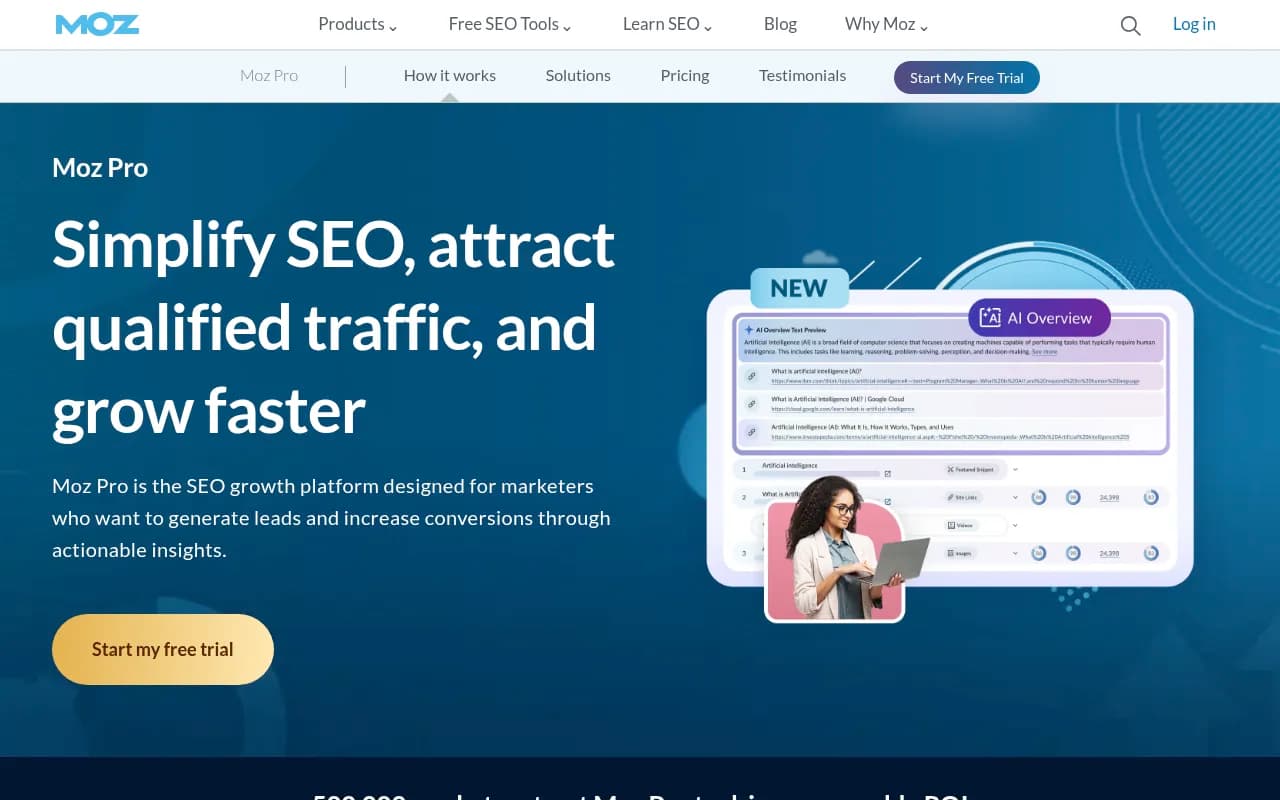
Moz Pro is one of the most established all-in-one SEO platforms in the industry, used by over 500,000 marketers including major brands like Zillow, Trivago, and Alaska Airlines. Founded in 2004 as SEOmoz, the company has evolved from a consulting firm into a comprehensive software platform that combines powerful research tools, site auditing, rank tracking, and now AI-powered insights to help businesses improve their search visibility and drive qualified traffic.
The platform is designed for marketing teams, SEO professionals, agencies, and businesses of all sizes who want a centralized solution for managing their entire SEO workflow. Unlike point solutions that focus on a single aspect of SEO, Moz Pro brings together keyword research, technical audits, competitive analysis, rank tracking, and reporting into one unified dashboard.
Key Takeaways:
• Moz Pro combines 10+ SEO tools in one platform with AI-powered features like Search Intent analysis and Domain Search Themes that help you understand what users really want • Proprietary metrics including Domain Authority (DA), Page Authority (PA), and Brand Authority provide unique competitive insights not available in other tools • Best suited for agencies, in-house marketing teams, and SEO professionals managing multiple campaigns who need accurate data and custom reporting • Pricing starts at $49/month (currently $39/month with promotion) with a 30-day free trial, making it accessible for small businesses while scaling to enterprise needs • Limitations include smaller keyword database compared to Ahrefs/Semrush and fewer backlink analysis features, but excels at on-page optimization and accurate search volume data
Keyword Research & Content Strategy
The Keyword Explorer is Moz's flagship research tool, providing access to search volume data, keyword difficulty scores, and organic CTR estimates. What sets it apart is the accuracy of its data — multiple SEO professionals have noted that Moz's search volume figures tend to be more conservative and realistic compared to inflated numbers from competitors. The tool reveals not just what people are searching for, but the potential reach and difficulty of ranking for each term.
Keyword Suggestions powered by Moz AI automatically groups related keywords by search intent, saving hours of manual work. Instead of getting a random list of keyword variations, you see thematically organized clusters that help you plan content that covers entire topic areas. For example, searching for "running shoes" might return groups like "best running shoes for beginners," "trail running shoe reviews," and "running shoe sizing guide" — each representing a distinct content opportunity.
Search Intent Analysis uses Moz's AI to categorize keywords by user intent (informational, navigational, commercial, transactional). This helps you understand the "why" behind searches and create content that actually matches what users want. If someone searches "best CRM software," the tool identifies this as commercial investigation intent, signaling you should create comparison content rather than a product page.
SERP Analysis shows you exactly who's ranking for your target keywords, what type of content is winning (blog posts, product pages, videos), and the Domain Authority of competing pages. You can analyze the top 10 results to understand what it takes to rank, including word count, page structure, and backlink profiles.
Competitive Research lets you enter any competitor's domain to see their top-ranking keywords, estimated traffic, and best-performing pages. This is invaluable for identifying content gaps — topics your competitors rank for that you don't. Agencies use this to quickly audit new clients and build data-driven content strategies.
Site Auditing & Technical SEO
Site Crawl performs comprehensive technical audits of your website, identifying issues like broken links, duplicate content, missing meta descriptions, slow page speed, mobile usability problems, and crawl errors. The tool crawls your site just like Googlebot would, flagging issues that could hurt your rankings. Each issue comes with a priority level (critical, high, medium, low) and clear instructions on how to fix it.
What makes Moz's crawler particularly useful is the On-Demand Crawl feature, which lets you re-crawl your site immediately after making fixes to validate that issues are resolved. Most tools make you wait for the next scheduled crawl, but Moz lets you get updated data within minutes. This is crucial for agencies who need to prove to clients that fixes were implemented correctly.
On-Page Grader analyzes individual pages and provides specific recommendations to improve rankings. Enter a target keyword and URL, and it evaluates your page against the top-ranking competitors, scoring factors like keyword usage, content length, page speed, and internal linking. You get a letter grade (A-F) and a prioritized list of improvements. For example, it might tell you to add your keyword to the H1 tag, increase content length to 1,500 words, or improve your meta description.
Rank Tracking & Monitoring
Rank Tracker monitors your keyword rankings across Google, Bing, and Yahoo in any location (country, state, city, or custom radius). You can track desktop and mobile rankings separately, see ranking changes over time with visual graphs, and compare your performance against competitors. The tool sends weekly email reports showing your biggest ranking gains and losses.
Search Visibility Score is Moz's proprietary metric that measures your overall visibility in search results based on your rankings for tracked keywords, weighted by search volume. It's a single number that tells you at a glance whether your SEO efforts are working. If your visibility score increases from 15% to 22%, you know you're gaining ground.
Brand Authority is a newer metric that measures how often your brand appears in search results and how prominent those appearances are. It's calculated based on search volume for branded queries, ranking positions, and SERP features you own (featured snippets, knowledge panels, etc.). This helps you track brand awareness and measure the impact of PR and marketing campaigns on search visibility.
Campaigns & Reporting
Campaigns are how you organize your SEO work in Moz Pro. Each campaign represents a website you're tracking, with its own set of keywords, competitors, and crawl settings. You can run multiple campaigns to manage different clients or business units. The campaign dashboard gives you a unified view of rankings, site health, and competitive position.
Custom Reports let you create white-labeled PDF reports with your logo, pulling in data from any Moz Pro tool. You can build templates for different report types (monthly client reports, executive summaries, technical audits) and generate them with one click. This is a huge time-saver for agencies that need to report to multiple clients. Reports include visual charts, tables, and narrative sections explaining the data.
Domain Overview provides an at-a-glance snapshot of any website's SEO health, showing Domain Authority, top-ranking keywords, linking domains, and spam score. The new Domain Search Themes feature uses Moz AI to identify the main topic clusters a site ranks for, helping you quickly understand a competitor's content strategy or identify new opportunities for your own site.
Additional Tools & Features
Link Explorer is Moz's backlink analysis tool, showing you who links to your site (or competitors), the quality of those links, and opportunities to build new ones. While Moz's link index is smaller than Ahrefs or Majestic, it's known for high data quality and low spam. The tool includes metrics like Domain Authority (DA) and Page Authority (PA) — Moz's proprietary scores predicting how well a page will rank. These metrics are widely used across the industry as a shorthand for site quality.
MozBar Premium is a Chrome extension that brings Moz data into your browser. As you browse any website or Google search results, you see instant metrics like DA, PA, and spam score overlaid on the page. You can highlight keywords, analyze on-page elements, and export SERP data — all without leaving your browser. It's like having Moz Pro available everywhere you work.
Help Hub provides in-app guidance, video tutorials, and troubleshooting tips. Whether you're a beginner learning SEO basics or an expert looking for advanced workflows, the Help Hub offers contextual help based on what you're trying to do. Moz also includes 24-hour email support from real people (not bots), with same-day response times.
Integrations & Ecosystem
Moz Pro integrates with Google Analytics and Google Search Console to pull in traffic and performance data alongside your Moz metrics. This lets you see not just rankings, but actual traffic and conversions from your SEO efforts. The platform also offers a Moz API (separate pricing) for developers who want to build custom integrations or pull Moz data into their own tools.
The Moz Local product (sold separately) helps businesses manage their local listings across directories like Google Business Profile, Yelp, and Facebook. While not included in Moz Pro, it's a natural add-on for agencies managing local SEO clients.
Moz doesn't offer as many third-party integrations as some competitors, but it covers the essentials. The focus is on providing a complete solution within the Moz ecosystem rather than connecting to dozens of external tools.
Learning Resources
One of Moz's biggest differentiators is its educational content. The company has built a massive library of SEO resources that help users not just use the tools, but become better SEO professionals:
• Moz Academy offers on-demand courses and certifications covering SEO fundamentals, technical SEO, local SEO, and link building • Whiteboard Friday is a weekly video series (running since 2006) where SEO experts explain concepts on a whiteboard — over 500 episodes available • Beginner's Guide to SEO is the industry's most popular SEO tutorial, read by over 10 million people • Moz Blog publishes expert articles on SEO trends, algorithm updates, and best practices • Learn Center provides a searchable knowledge base organized by skill level
This educational focus makes Moz particularly appealing to agencies and in-house teams who want to upskill their staff while using the tools.
Who Is Moz Pro For?
Moz Pro is best suited for SEO agencies managing 5-50 client campaigns who need accurate data, custom reporting, and a platform their team can learn quickly. The ability to create white-labeled reports and manage multiple campaigns makes it ideal for client work. Agencies appreciate that Moz's data is conservative and reliable — you won't over-promise results based on inflated metrics.
In-house marketing teams at small to mid-sized companies (10-500 employees) use Moz Pro as their primary SEO platform. It's particularly popular with B2B SaaS companies, e-commerce brands, and local businesses. The unified dashboard and actionable insights help teams that don't have dedicated SEO specialists still execute effective strategies.
SEO consultants and freelancers find Moz Pro valuable for its combination of research tools and reporting capabilities. The lower-tier plans are affordable enough for solo practitioners, while still providing enterprise-grade data.
Enterprise SEO teams at larger organizations use Moz Pro alongside other tools, often leveraging it specifically for keyword research, on-page optimization, and rank tracking. The Premium and Enterprise plans offer higher limits and additional features for large-scale SEO operations.
Moz Pro is less ideal for users who need extensive backlink analysis (Ahrefs is stronger here), those managing international SEO across dozens of countries (Semrush has better multi-language support), or users who want a single tool that also handles PPC and social media (Semrush and SpyFu offer broader digital marketing features).
Pricing & Value
Moz Pro offers four pricing tiers (currently discounted up to 40%):
• Starter: $49/month (currently $39/month) — 5 campaigns, 300 keyword rankings tracked, 30,000 pages crawled per month, 150 keyword queries per month. Good for freelancers or small businesses managing 1-5 sites.
• Standard: $99/month (currently $79/month) — 10 campaigns, 1,500 keyword rankings, 100,000 pages crawled, 5,000 keyword queries. The most popular plan for small agencies and growing businesses.
• Medium: $179/month (currently $143/month) — 25 campaigns, 3,750 keyword rankings, 250,000 pages crawled, 15,000 keyword queries. Designed for mid-sized agencies managing 10-25 clients.
• Large: $299/month (currently $239/month) — 50 campaigns, 7,500 keyword rankings, 500,000 pages crawled, 30,000 keyword queries. For larger agencies and enterprise teams.
All plans include a 30-day free trial (no credit card required), access to all core features, MozBar Premium, Help Hub, and 24-hour support. Annual billing saves 20% compared to monthly.
Compared to competitors, Moz Pro sits in the middle of the market. It's more expensive than Mangools or Ubersuggest, but less than Ahrefs or Semrush at comparable feature levels. The value proposition is strong if you prioritize data accuracy, ease of use, and educational resources. If you need the absolute largest keyword database or most extensive backlink index, you'll pay more elsewhere but get more raw data.
Strengths
• Data accuracy: Moz is known for conservative, reliable search volume and difficulty scores that don't over-promise results • Ease of use: The interface is intuitive and well-designed, with helpful onboarding and in-app guidance that makes it accessible to beginners • Proprietary metrics: Domain Authority and Brand Authority provide unique insights for competitive analysis and link prospecting • AI-powered features: New additions like Search Intent analysis and Domain Search Themes save time and provide strategic direction • Educational resources: Unmatched library of learning content helps users become better SEO professionals, not just tool operators • Custom reporting: Flexible, white-labeled reports that agencies can quickly generate for clients • On-page optimization: The On-Page Grader provides specific, actionable recommendations that are easy to implement
Limitations
• Smaller keyword database: Moz's index is smaller than Ahrefs or Semrush, so you may find fewer long-tail keyword suggestions • Limited backlink analysis: Link Explorer has a smaller link index and fewer filtering options compared to Ahrefs or Majestic • Fewer integrations: Doesn't connect to as many third-party tools as some competitors • No PPC or social features: Purely focused on SEO, unlike Semrush which offers broader digital marketing tools • Crawl limits: Even higher-tier plans have monthly crawl limits that can be restrictive for very large sites
Bottom Line
Moz Pro is the right choice for agencies, marketing teams, and SEO professionals who value data accuracy, ease of use, and a complete SEO workflow in one platform. It excels at keyword research with AI-powered insights, on-page optimization with specific recommendations, and custom reporting that makes client communication easy. The educational resources are unmatched, making it ideal for teams that want to build SEO expertise alongside using the tools.
Best use case in one sentence: SEO agencies and in-house marketing teams managing 5-50 campaigns who need reliable data, actionable insights, and professional reporting without the complexity of enterprise tools.
Tags:
Similar and alternative tools to Moz Pro