Riff Analytics Review 2026
Measures team collaboration dynamics during meetings using AI to provide objective insights on engagement, participation patterns, and communication effectiveness.
Summary: What you need to know upfront
- Monitoring-only tool that tracks brand mentions across 6-7 AI engines but lacks content generation, AI crawler logs, and traffic attribution that Promptwatch offers
- Simple setup with results in 5 minutes and a 7-day free trial, but limited to 250 prompts per brand even on the Pro plan
- Strong competitor benchmarking and citation source tracking, though no prompt volume data or difficulty scoring to prioritize optimization efforts
- Affordable entry point at $49/month, but you'll need separate tools for content optimization and measuring actual AI-driven traffic

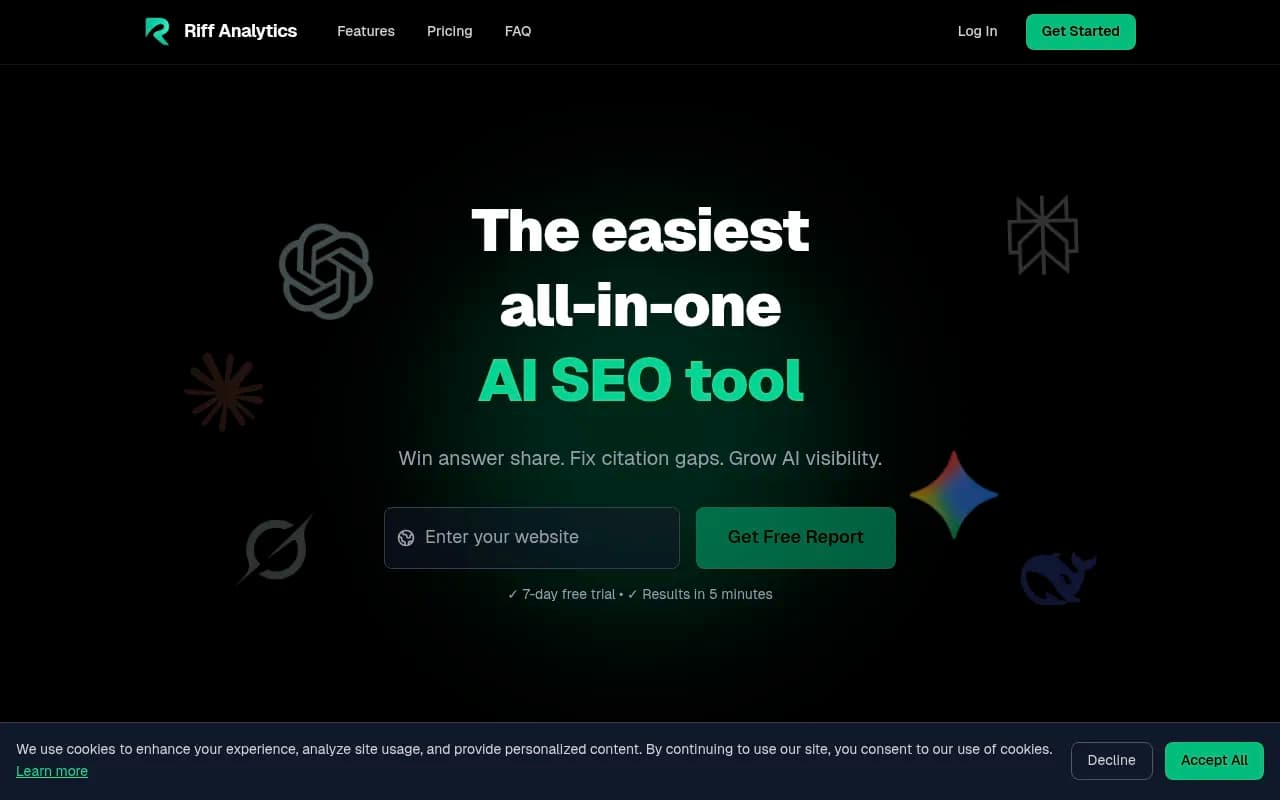
Riff Analytics positions itself as "the easiest all-in-one AI SEO tool" for tracking brand visibility across AI search engines. Launched in 2024 as the AI search landscape exploded, it targets marketers and brand managers who want to understand how ChatGPT, Perplexity, Claude, Gemini, Grok, and DeepSeek mention their company in responses. The pitch is straightforward: see where you rank in AI answers, track competitors, and identify citation gaps.
The platform covers the monitoring basics competently. You can track your brand across six major AI models (ChatGPT, Perplexity, Claude, Gemini, Grok, DeepSeek, plus Meta's Llama), set up competitor tracking with no limits on how many rivals you monitor, and get daily checks that show mention trends over time. Results appear in about 5 minutes after setup, which is genuinely fast compared to platforms that batch-process queries overnight.
But here's the reality: Riff Analytics shows you the problem without helping you fix it. It's a dashboard that tells you "your brand appeared in 23% of responses this week" but leaves you to figure out what content to create, which pages need optimization, or whether AI crawlers are even indexing your site properly. For teams that just want visibility metrics to report upward, that might be enough. For anyone trying to actually improve their AI search presence, it's only the first step.
Citation Source Tracking is the most useful feature. When an AI engine mentions your brand, Riff shows you which URLs it cited as sources. You can see if it's pulling from your homepage, a specific product page, a blog post, or third-party sites like Reddit threads or review platforms. This helps you understand which content is actually influencing AI responses versus which pages are invisible. The interface groups citations by source domain and shows frequency counts, so you can spot patterns like "Perplexity always cites our pricing page but ChatGPT never does."
What's missing: any analysis of why certain pages get cited. Riff doesn't tell you if a page has the right schema markup, if the content matches common prompt patterns, or if AI crawlers are even able to access it. You get the raw citation data and have to interpret it yourself.
AI Readiness Audit scans your website and flags optimization issues that might hurt AI visibility. It checks for things like missing meta descriptions, slow load times, broken links, and whether your robots.txt blocks AI crawlers. The audit runs instantly and gives you a checklist of fixes. It's a decent starting point, especially for teams new to AI SEO who don't know what to look for.
The limitation: it's a one-time scan, not continuous monitoring. If a developer accidentally blocks Perplexity's crawler next month, you won't get an alert. Platforms like Promptwatch run real-time AI crawler logs that show exactly when ChatGPT, Claude, or Perplexity hit your site, which pages they read, and any errors they encounter. That's the difference between a static audit and live monitoring.
Mention Trend Tracking shows how often your brand appears in AI responses over time. You get a line chart with daily or weekly mention rates, broken down by AI engine. If you publish new content or make site changes, you can see if mention frequency increases. The dashboard also shows sentiment (positive, neutral, negative) for each mention, though the sentiment analysis is basic and sometimes misses context.
This is useful for measuring progress, but only if you're actively optimizing. If you're just watching the chart without taking action, you're paying for a vanity metric.
Response Context Analysis lets you drill into individual AI responses to see exactly how your brand was mentioned. You can read the full answer the AI gave, see where your brand appeared (first mention, middle, end), and check if it was recommended or just listed as an option. The interface highlights your brand name in the response text and shows competitor mentions in the same answer.
This helps you understand positioning. If ChatGPT always mentions you after three competitors, that's a signal your content isn't as authoritative or relevant as theirs. But again, Riff doesn't tell you what to do about it. You see the problem, then you're on your own.
Competitor Benchmarking is genuinely strong. You can add unlimited competitors (most platforms cap this at 3-5) and see side-by-side mention rates, citation sources, and positioning across all AI engines. The competitor heatmap shows who's winning for each model, and you can filter by specific prompts to see where rivals are visible but you're not.
What's missing: prompt-level intelligence. Riff doesn't show you search volume estimates, difficulty scores, or query fan-outs (how one prompt branches into related sub-queries). You can see that a competitor ranks for "best project management software" but you don't know if that prompt gets 10 searches a month or 10,000, or how hard it would be to compete. Promptwatch provides prompt volume and difficulty scoring based on 880M+ citations analyzed, so you can prioritize high-value, winnable prompts instead of guessing.
Prompt Management lets you create custom prompts to test how AI engines respond. You can set up 250 prompts per brand (same limit on both Starter and Pro plans), run them daily, and track results over time. The prompts can include your brand name, competitor names, or generic queries like "best CRM for small business." You can also set up personas (e.g. "startup founder", "enterprise IT buyer") to see if responses vary by user context.
The 250-prompt limit is tight if you're tracking a competitive category. A SaaS company monitoring "best [category]" prompts across multiple use cases, industries, and buyer personas can easily hit 250 prompts. Competitors like Promptwatch offer 350+ prompts on mid-tier plans and don't cap you as aggressively.
AI Engine Coverage includes ChatGPT (GPT-4), Perplexity, Claude, Google Gemini, Grok (xAI), DeepSeek, and Meta's Llama. That's 7 models, which covers the major players. Missing: Google AI Overviews (the AI-generated summaries in Google Search), Copilot, and Mistral. Promptwatch monitors 10+ models including AI Overviews, which matters because that's where most users encounter AI-generated answers.
Riff checks all models daily, which is standard. Some competitors offer hourly checks, but daily is usually sufficient unless you're tracking a fast-moving news cycle.
Integrations and Export: Riff has no integrations. No API, no Looker Studio connector, no webhooks, no Zapier. You can export data as CSV, but that's it. If you want to pull Riff data into your existing analytics stack or build custom dashboards, you're stuck with manual exports. This is a significant limitation for agencies or enterprises that need to integrate AI visibility metrics with SEO, content, and traffic data.
Who This Is For
Riff Analytics works for brand managers and marketing teams who need basic AI visibility tracking and don't have budget for a full optimization platform. If your goal is "monitor how often we're mentioned in ChatGPT and Perplexity, track a few competitors, and report metrics to leadership," Riff does that job at a reasonable price.
It's also a decent fit for small businesses (1-10 employees) dipping their toes into AI SEO. The 7-day trial and $49/month entry point make it low-risk to test. You can see if AI engines mention you at all, identify which competitors are winning, and get a sense of the opportunity before committing to a more expensive platform.
Who should NOT use Riff: teams that want to actually improve their AI visibility, not just track it. If you need content gap analysis ("which prompts do competitors rank for that we don't?"), AI content generation, crawler logs, traffic attribution, or Reddit/YouTube tracking, Riff doesn't offer any of that. You'll end up paying for Riff plus another tool to handle optimization, which defeats the "all-in-one" claim.
Agencies managing multiple clients will hit the 5-brand limit on the Pro plan quickly. Enterprise teams need API access and integrations that Riff lacks entirely.
Pricing and Value
Starter plan: $49/month (annual billing, $54/month monthly). 1 brand, 250 prompts, 6,000 AI responses/month, 1,000 URL checks/month, unlimited competitors, daily checks, all AI models. 7-day free trial.
Pro plan: $199/month (annual billing, $220/month monthly). 5 brands, 250 prompts per brand, 20,000 AI responses/month, 5,000 URL checks/month, unlimited competitors, daily checks, all AI models.
The Starter plan is competitively priced for basic monitoring. $49/month is cheaper than most GEO platforms, which typically start at $99-$249/month. But you're getting less: no content tools, no crawler logs, no traffic attribution, no integrations.
The Pro plan at $199/month is harder to justify. For $50 more, Promptwatch Professional ($249/month) gives you 150 prompts, AI crawler logs, content gap analysis, an AI writing agent that generates 15 articles/month, state/city tracking, and visitor analytics. You're paying similar money for a tool that actually helps you optimize, not just monitor.
Riff's pricing makes sense if you only want dashboards and reports. It doesn't make sense if you want to improve your AI search rankings.
Strengths
- Fast setup and results (5 minutes to first data)
- Unlimited competitor tracking on all plans
- Clean, simple interface that non-technical users can navigate
- Affordable entry point at $49/month
- Citation source tracking shows which URLs AI engines cite
- 7-day free trial with no credit card required
Limitations
- No content gap analysis to show which prompts competitors rank for but you don't
- No AI content generation or optimization tools
- No AI crawler logs to monitor how AI engines access your site
- No traffic attribution or visitor analytics to measure actual AI-driven traffic
- No Reddit or YouTube tracking (both heavily influence AI recommendations)
- No ChatGPT Shopping tracking
- No prompt volume or difficulty scoring
- No API or integrations (Looker Studio, Zapier, webhooks)
- 250-prompt limit per brand is restrictive for competitive categories
- Missing Google AI Overviews, Copilot, and Mistral coverage
- Sentiment analysis is basic and often misses context
- AI Readiness Audit is a one-time scan, not continuous monitoring
Compared to Promptwatch: Riff is monitoring-only. It shows you where you stand but doesn't help you improve. Promptwatch combines monitoring with content gap analysis, AI content generation, crawler logs, and traffic attribution -- the full optimization loop. If you want to actually rank higher in AI search, not just track your current position, Promptwatch is the stronger choice.
Bottom Line
Riff Analytics is a simple, affordable AI visibility tracker that does one thing: show you how often your brand appears in AI engine responses. It's useful for teams that need basic monitoring and competitor benchmarking without the complexity (or cost) of a full optimization platform. The interface is clean, setup is fast, and the 7-day trial makes it low-risk to test.
But if your goal is to actually improve your AI search rankings -- to create content that gets cited, fix indexing issues, and measure traffic impact -- Riff leaves you stuck. It's a dashboard without a plan. For teams serious about AI visibility, Promptwatch offers the monitoring Riff provides plus the optimization tools you need to close citation gaps and rank higher. Best use case for Riff: small businesses testing AI SEO for the first time who want to see if there's an opportunity before investing in optimization.
Frequently asked questions
What is Riff Analytics and what does it do?
How much does Riff Analytics cost?
Is Riff Analytics free to use?
Who is Riff Analytics designed for?
What AI platforms does Riff Analytics track?
How quickly can I get results with Riff Analytics?
Can I track competitors with Riff Analytics?
What are the limitations of Riff Analytics?
Similar and alternative tools to Riff Analytics