XFunnel Review 2026
GEO platform that helps marketing teams track and improve their brand's visibility across AI-powered search engines.
Key Takeaways:
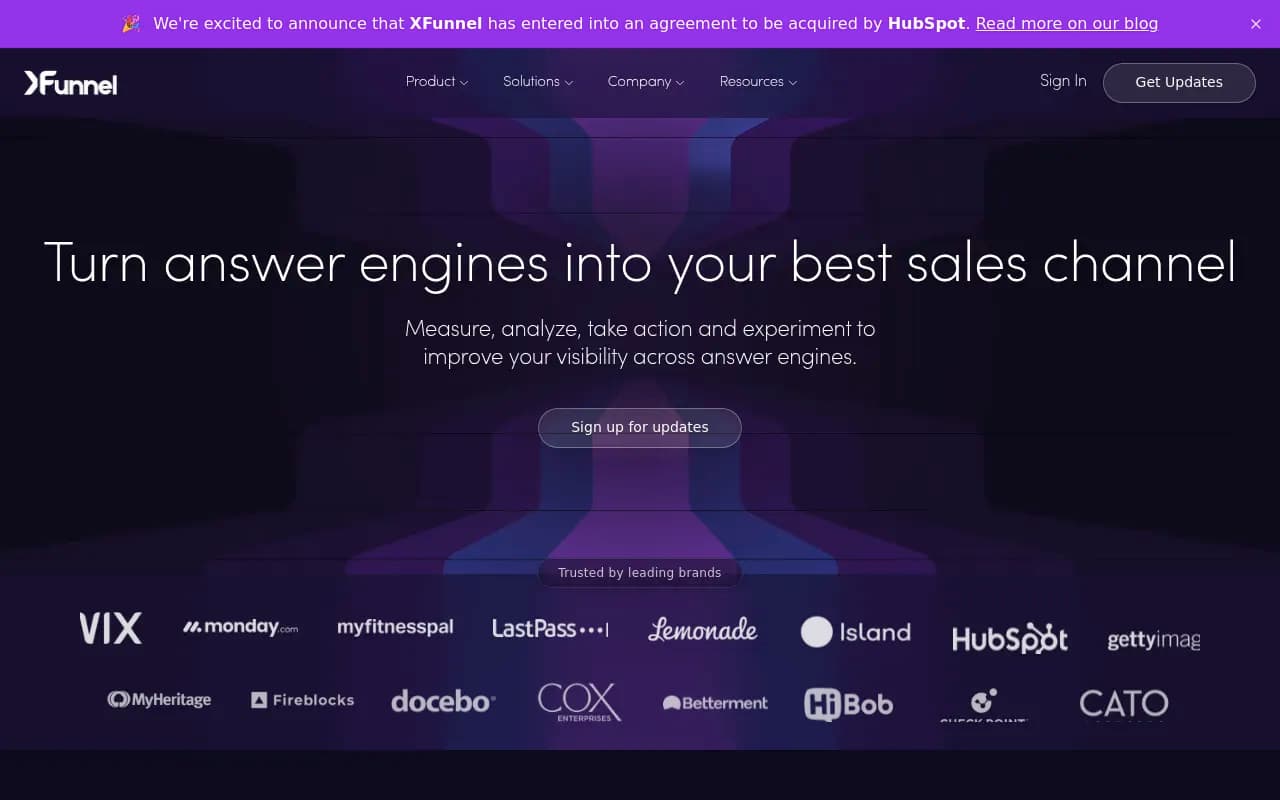
- XFunnel was acquired by HubSpot in early 2026, signaling strong validation of the GEO category and the platform's approach
- Unlike monitoring-only competitors, XFunnel pairs its tracking platform with dedicated analyst support and ready-to-execute playbooks
- Trusted by major brands including Wix, Monday.com, MyFitnessPal, LastPass, and HubSpot itself
- Tracks visibility across ChatGPT, Perplexity, Gemini, Claude, Copilot, Google AI Overviews, and Google AI Mode
- Focuses on experimentation and iteration rather than just reporting -- claims 20-40%+ improvement variability from optimization programs
XFunnel is a Generative Engine Optimization platform built for marketing teams who want to understand and improve how their brand appears in AI-powered search engines. Founded as an independent GEO platform, XFunnel entered into an acquisition agreement with HubSpot in early 2026, marking one of the first major consolidation moves in the emerging AI search optimization space. The platform serves enterprise marketing teams at companies like Wix, Monday.com, MyFitnessPal, LastPass, Lemonade, Getty Images, and Cato Networks -- brands that need to maintain visibility as search behavior shifts from Google to ChatGPT, Perplexity, and other AI answer engines.
What sets XFunnel apart from the growing field of GEO tools is its service-heavy approach. While most competitors deliver dashboards and data, XFunnel positions itself as "another dashboard? Nope" -- pairing its tracking platform with dedicated analyst support, weekly strategy meetings, and ready-to-ship content briefs. The company explicitly targets teams who want help taking action, not just seeing metrics.
Research & Question Discovery
XFunnel's research module helps teams understand what questions users are actually asking AI search engines about their product category, industry, or brand. You can explore search volume for specific queries, identify "ask keywords" (questions phrased as natural language prompts), and segment data by region, persona, and product line. The platform surfaces top questions by intent level -- informational, navigational, transactional -- so you can prioritize which queries to optimize for based on business impact. This is particularly useful for product marketing teams trying to understand how buyers research solutions in ChatGPT or Perplexity before they ever hit a traditional search engine or your website.
Visibility Tracking Across AI Engines
The core measurement capability tracks your brand's performance across seven major AI search platforms: ChatGPT, Perplexity, Gemini, Claude, Copilot, Google AI Overviews, and Google AI Mode. For each tracked query, XFunnel shows whether your brand appears in the AI-generated response, how prominently you're featured, and how you rank against competitors. The platform calculates Share of Voice metrics to quantify your visibility relative to competitors, and includes sentiment analysis to understand whether the AI's tone about your brand is positive, neutral, or negative. Persona-level analysis lets you segment visibility by different customer types -- for example, tracking how ChatGPT responds differently when prompted as a CFO versus a developer.
XFunnel published research in late 2025 analyzing 56,223 citations across four countries to determine whether AI search engines actually localize results. Their findings showed significant variation in how different engines handle geographic context -- useful data for global brands trying to understand regional visibility gaps.
Citation & Response Analysis
Beyond tracking whether you appear, XFunnel's analysis tools dig into why you appear (or don't). The citation analysis module shows which specific pages, articles, Reddit threads, YouTube videos, or third-party sources AI engines are pulling from when they mention your brand or competitors. You can see the most-cited domains in your category, identify high-impact content that drives visibility, and spot gaps where competitors are being cited but you're not. Topic analysis breaks down responses by theme to show which subject areas you're strong in and which need work. The platform also includes a Hallucination Score feature that monitors whether AI engines are accurately representing verified facts about your business -- like SOC2 compliance, service areas, or product capabilities. In a 2026 study of 270,000+ business queries across 437 companies, XFunnel found significant accuracy gaps across different AI engines, with some models consistently misrepresenting business capabilities.
Experimentation & Optimization Playbooks
This is where XFunnel diverges most sharply from monitoring-only tools. The platform includes what they call "AI optimization playbooks" -- structured programs for improving visibility through content updates, affiliate outreach, citation building, and other tactics. These aren't generic best practices; they're based on experiments XFunnel has run with its client base, with claimed improvement variability of 20-40%+ on visibility metrics. The experimentation framework lets you set up multivariate tests, track changes over time, and measure the impact of specific optimizations on your AI search presence. For example, you might test whether updating product comparison pages with more structured data improves citation rates in Perplexity, or whether publishing content on specific third-party sites increases mentions in ChatGPT.
Hands-On Analyst Support
Unlike most SaaS platforms that deliver software and leave you to figure out execution, XFunnel assigns a dedicated analyst to work directly with your team. This analyst conducts routine progress reviews, helps interpret data, recommends experiments, and tracks results in weekly meetings. The service also includes ready-to-use content briefs that your writers can execute immediately (not just suggestions or outlines), and affiliate activation kits with pre-researched lists of relevant sites and outreach tactics. This high-touch model makes XFunnel feel more like an agency partnership than a software subscription -- which is appealing if you want help but expensive if you just need data.
Who Is XFunnel For
XFunnel targets enterprise marketing teams and growth leaders at B2B SaaS companies, consumer tech brands, and digital-first businesses where AI search visibility directly impacts pipeline. The ideal customer is a VP of Marketing or Head of Growth at a company with 100-5000 employees, managing a team of 3-10 marketers, with an annual marketing budget over $500K. These are teams that already invest heavily in SEO and content marketing, understand the strategic importance of being visible where buyers research, and have the resources to execute on optimization recommendations. The platform is particularly strong for companies in competitive categories (project management, cybersecurity, HR tech, fintech) where dozens of alternatives exist and being mentioned by ChatGPT or Perplexity can swing deals.
XFunnel is less suited for small businesses, solopreneurs, or early-stage startups without dedicated marketing teams. The analyst-supported model and enterprise focus suggest pricing well above entry-level GEO tools. If you're a founder doing marketing yourself or a small team just starting to think about AI search, you'll likely find better value in self-service platforms like Promptwatch that offer robust tracking and optimization tools without requiring a dedicated analyst relationship.
Integrations & Ecosystem
With the HubSpot acquisition, expect tighter integration with HubSpot's CRM, Marketing Hub, and analytics tools -- though specific integration details weren't available at the time of the acquisition announcement. The platform likely offers standard marketing tool integrations (Google Analytics, Google Search Console, Slack for notifications), but XFunnel hasn't publicly emphasized an API or developer ecosystem the way some competitors have. The focus is on the analyst-guided workflow rather than self-service integrations.
Pricing & Value
XFunnel does not publish transparent pricing on its website. The pricing page directs prospects to "Get Started" and book a strategy call, indicating custom enterprise pricing based on company size, number of tracked queries, and level of analyst support. Based on the feature set, client roster (Wix, Monday.com, Getty Images), and high-touch service model, expect pricing in the range of $2,000-$10,000+ per month for mid-market to enterprise plans. This positions XFunnel at the premium end of the GEO market -- significantly more expensive than self-service tools like Promptwatch ($99-$579/mo) or monitoring-focused platforms, but potentially justified if the analyst support and playbooks deliver measurable pipeline impact.
There's no mention of a free trial or freemium tier. The sales process appears to be demo-first, with pricing customized based on your needs.
Strengths & Limitations
Strengths:
- Analyst support differentiates it from dashboard-only competitors -- you're not left alone to interpret data and figure out what to do
- Action-oriented playbooks based on real experiments provide a clear path from insight to execution
- Strong enterprise client roster (Wix, Monday.com, LastPass) validates the platform's effectiveness at scale
- HubSpot acquisition brings resources, credibility, and likely tighter integration with the leading marketing platform
- Comprehensive AI engine coverage including ChatGPT, Perplexity, Gemini, Claude, Copilot, and Google AI products
- Research-backed approach with published studies on localization, hallucination rates, and citation patterns
Limitations:
- No transparent pricing makes it hard to evaluate cost vs. alternatives without a sales call
- High-touch model likely means high cost -- probably not accessible for small teams or startups
- Analyst dependency could be a bottleneck if you want to move fast or experiment independently
- Limited self-service details -- unclear how much you can do in the platform without analyst involvement
- Acquisition uncertainty -- while the HubSpot deal brings resources, it also means potential product changes, integration shifts, or sunsetting of standalone features as it merges into HubSpot's ecosystem
Bottom Line
XFunnel is built for enterprise marketing teams that want a guided, high-touch approach to AI search optimization. If you're a VP of Marketing at a B2B SaaS company or consumer tech brand with budget for premium tools and you value expert support over self-service flexibility, XFunnel's analyst-driven model could accelerate your GEO program significantly. The HubSpot acquisition adds credibility and suggests the platform will become a core part of HubSpot's AI-era marketing suite.
However, if you're a smaller team, want transparent pricing, or prefer a self-service platform where you control the experimentation pace, consider alternatives like Promptwatch that offer robust tracking, content gap analysis, and optimization tools without requiring an analyst relationship. Best use case in one sentence: Enterprise marketing teams at competitive B2B or consumer tech companies who want expert-guided AI search optimization with ready-to-execute playbooks and weekly strategic support.
Frequently asked questions
What is XFunnel?
How much does XFunnel cost?
What AI search engines does XFunnel track?
Who uses XFunnel?
What makes XFunnel different from other GEO tools?
Does XFunnel offer a free trial?
What results can you expect from using XFunnel?
Was XFunnel acquired by HubSpot?
Similar and alternative tools to XFunnel