Key takeaways
- In August 2026, sites rated DR 46-75 earned about 46% of ChatGPT citations. DR 91-100 sites got 4.4%, less than the 6.3% earned by DR 0-15 sites (Promptwatch Data).
- The pattern held through November: the median cited domain sits around DR 57 in ChatGPT and Perplexity, and DR 91+ is still about 3.0% of ChatGPT citations.
- Authority works like a door, not a ranking factor. It helps a page enter the pool of citable pages, but inside a trusted domain, extra links to one page do little.
- Citations are rented. One finance study found half of the most-cited pages from a year earlier now get zero.
- Practical shift: aim outreach at DR 61-90 sites, publish one page per distinct question, and stop treating a DR 80+ placement as the only prize.
What the data actually says
The number that got passed around was in a LinkedIn post by Thibaud Guenneuguès, who works on go-to-market at Promptwatch. Sites ranked DR 46 to 75 earned 46% of ChatGPT's citations. The web's biggest domains, DR 91 to 100, got 4.4%. That is less than sites ranked DR 0 to 15.
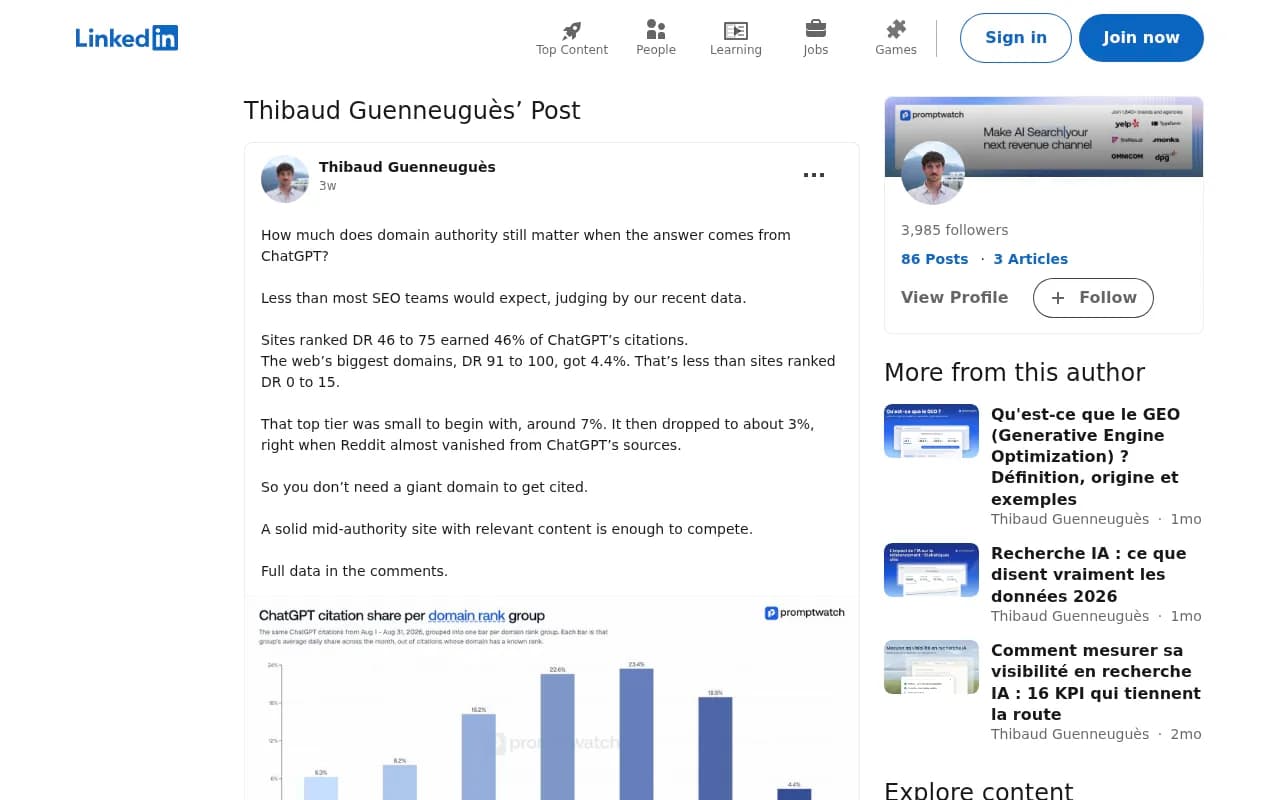
The post draws on Promptwatch's ChatGPT citation share by domain rank report for August 2026, which covers Aug 1 to Aug 31 and about 89.65% of all ChatGPT citations in that window. The remaining 10.35% came from domains with no known rank and were left out.
Here is the monthly average share by domain rank bucket:
| Domain rank | Share of ChatGPT citations (Aug 2026) |
|---|---|
| DR 0-15 | 6.3% |
| DR 0-30 | about 14% |
| DR 0-45 | almost a third |
| DR 46-60 | 22.6% |
| DR 61-75 | 23.4% |
| DR 76-90 | 18.9% |
| DR 91-100 | 4.4% |
Two details matter more than the headline. First, DR 61-75 led at 23.4%, with DR 46-60 right behind. The middle is not a single sweet spot but a broad band. Second, DR 0-45 still took almost a third of everything. Small sites are not shut out.
The top tier fell during the month
The DR 91-100 group averaged roughly 7% in the first week of August. It dropped to about 5% on Aug 8 and to about 3% on Aug 14, then stayed there. Most of the lost share went to the middle tiers: DR 61-75 gained 1.6 points and DR 46-60 gained 0.9.
Aug 14 is also the day reddit.com's share of ChatGPT citations collapsed from around 4% to 0.5%, which Promptwatch documented in its Reddit citations report. Reddit, YouTube, and Wikipedia-style giants sit at the top of any DR scale. When one of them gets cited far less, the whole DR 91-100 bucket shrinks.
So part of the mid-authority story is really a Reddit story. I would not read 46% as proof that mid-authority sites got better. It may partly be that the biggest site in the pool left.
It has not snapped back
The caveat has a counterweight. Promptwatch's domain rank distribution report for November 2026 (data from Nov 3 to Nov 16) shows DR 91 and up at 3.0% of ChatGPT citations, the same level as the end of August. Three months is long enough that I would stop calling it a blip.
That report also compares engines:
| Engine | Median cited domain | DR 31-75 share | DR 61-90 share | DR 91+ share |
|---|---|---|---|---|
| ChatGPT | DR 57 | about 61% | 41.2% | 3.0% |
| Perplexity | DR 57 | about 66% | 40.1% | 3.6% |
| AI Mode | DR 56 | about 65% | 34.8% | 8.2% |
| AI Overviews | DR 56 | about 59% | 25.6% | 17.9% |
Google's engines lean on the top tier more. The reason is social platforms. In Promptwatch's Oct 11 to Nov 9 social data, social platforms earned 13.16% of AI Overviews citations, with YouTube alone at 6.71%. For ChatGPT it was 0.64%. If you care about Google's AI surfaces, a YouTube presence matters in a way it does not for ChatGPT. You can see the wider pattern in Promptwatch's social media citations by AI model data.
Does domain authority predict citations at all?
Short answer: weakly, and not the way link builders hope.
Surfer analyzed about 5 million citation URLs across 20,000 prompts on AI Mode, AI Overviews, ChatGPT, and Perplexity. They tested PageRank, Harmonic Centrality, and their own Domain Score. All three correlated with citation frequency between roughly -0.073 and 0.026. That is inside the noise.
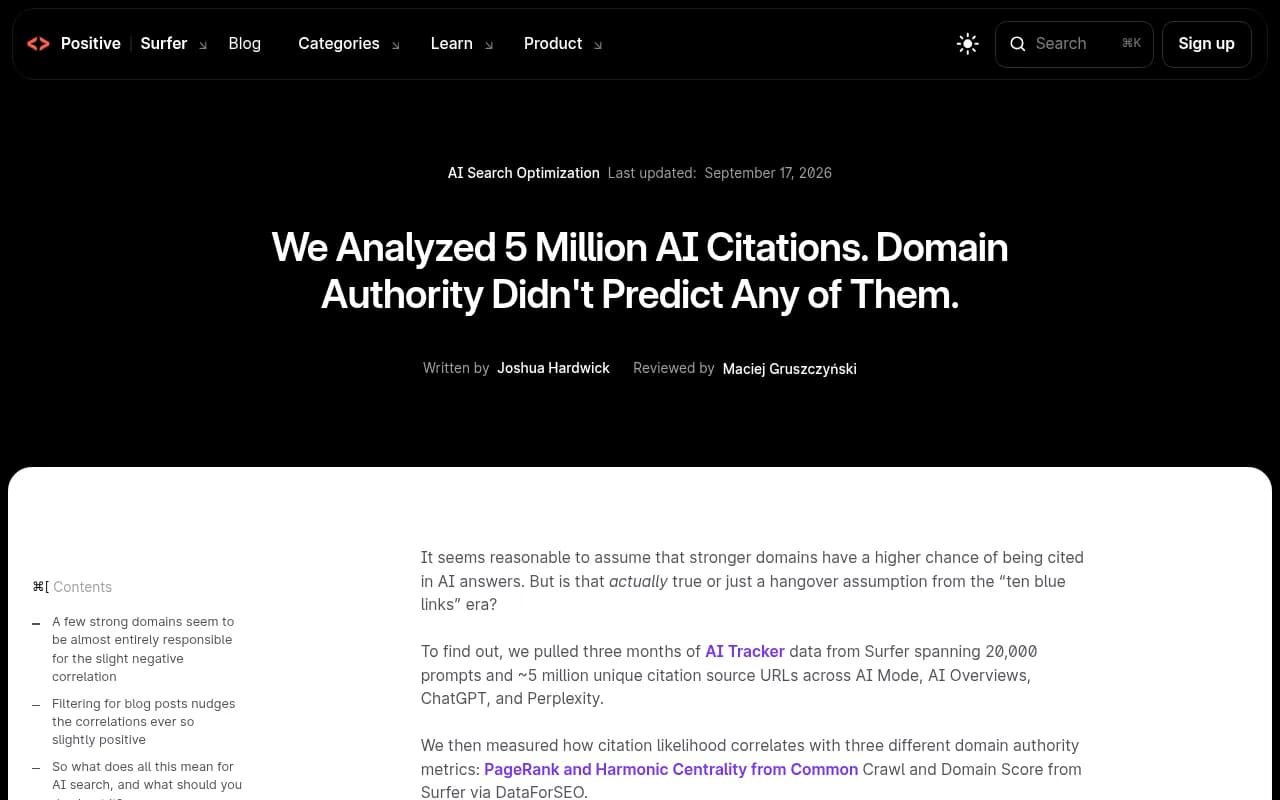
You can read the full method in Surfer's study. It measures citation frequency per source, which is a different question from Promptwatch's share-by-bucket view. Both can be true: most citations land on mid-range sites, and within that, a higher score does not buy more citations.
Green Flag Digital's personal finance study adds the most useful nuance. They re-ran it on Sept 21, 2026 against an October 2025 baseline:
- Across 999 finance domains, DR 90+ sites took half of all citations, but only because they had more pages in the cited set (median 524 pages versus 188 for sites under DR 50). Their citations per page were no higher.
- Moving a page from the 25th to the 75th percentile in followed backlinks (16 to 595) went with about 16% more citations. The same move in ranking keywords (19 to 477) went with about 15% more.
- Across 1,000 Investopedia pages, referring domains showed no positive link to citations. Ranking breadth and topic demand did.
- The three measured factors explained only 9% to 18% of the variation in citations.
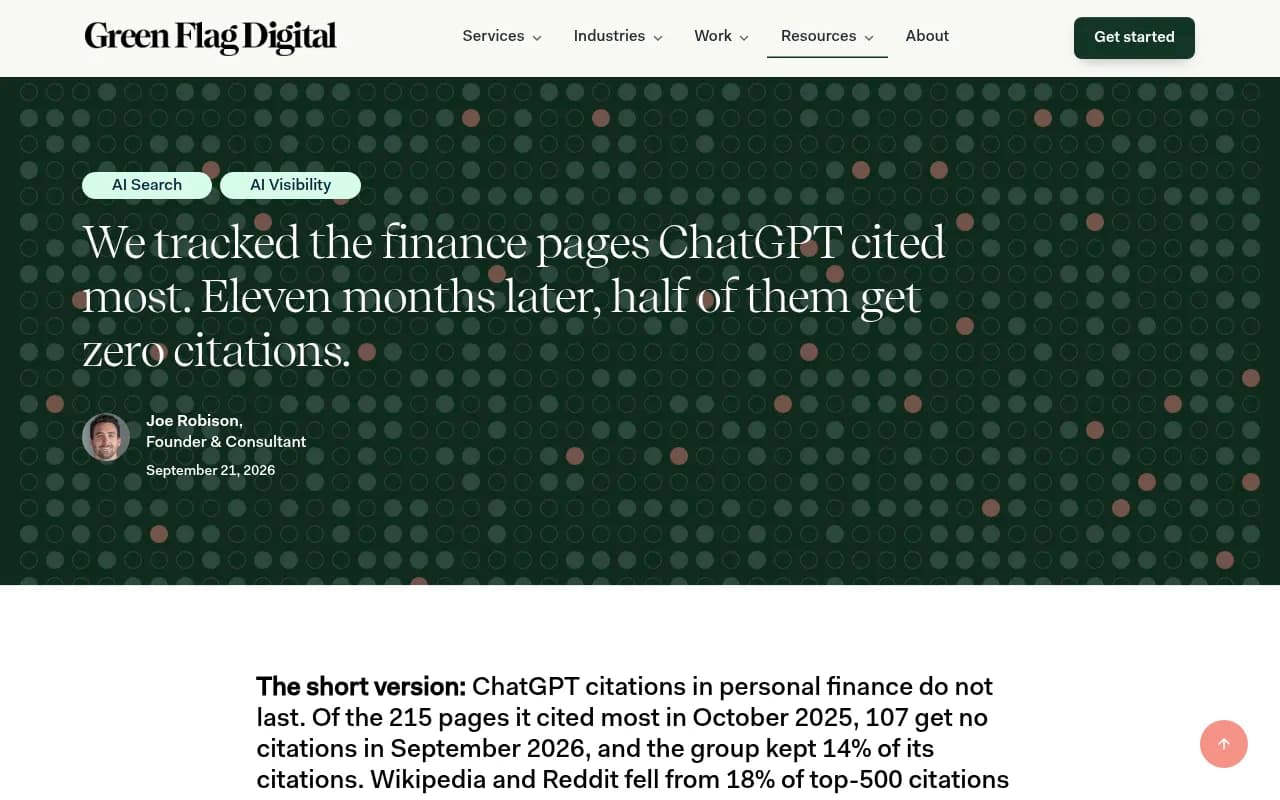
Their own phrasing is the best summary I have seen: DR works at the door. It helps a page get into the cited set. Past the door, it barely matters.
Why mid-authority sites do well
I think there are three plausible reasons. None is proven, so treat them as working theories.
- Query fan-outs reward specificity. ChatGPT runs several web searches per answer. Narrow, specific pages from niche sites can win individual sub-queries that a general giant never targets. Promptwatch's query fan-out data shows how many searches a single response triggers, and its unique domains report shows almost half of responses cite 10 or more domains. That is a lot of slots for non-giants.
- Content type beats site size. Product pages are the most cited type in ChatGPT at 22.4% of citations, followed by landing pages and listicles (content type data). A DR 55 vendor with a good product page competes fine.
- Giants were propped up by a few domains. When reddit.com dropped, the top tier fell with it.
Industry also shifts the picture. For healthcare prompts, government and public health sites earn almost half the citations (healthcare report). For travel, booking and search sites earn more than half (travel report). For software, GitHub, Microsoft docs, and G2 lead, and documentation earns the biggest share (software report). A DR benchmark is a starting point. Your vertical's source mix decides what matters.
Citations are rented, not owned
Green Flag found that of the 215 most-cited finance pages from October 2025, 107 (50%) get zero ChatGPT citations today. The group kept 14% of its citations. Only 8 pages grew. Wikipedia and Reddit went from 18% of top-500 citations to none, while bank, card issuer, and government pages rose from 2% to 28%.
Promptwatch's content half-life report tells a similar story by format: landing pages and docs stayed cited longest among pages cited on July 6, 2026, while news lost half its pages within 36 days.
This changes how you should value a link. A placement that raises citations this quarter may do nothing next quarter, because the platform changes its source mix on a timeline you do not control. That is also seoClarity's conclusion in its analysis of ChatGPT citation decline: the brands recommended by default are the ones embedded in the model's core knowledge through authoritative content, earned coverage, and a consistent presence.
What this means for your link strategy
Stop chasing only the biggest placements
Promptwatch's own recommendation is to put less weight on placements at the web's biggest sites and aim PR and guest content at DR 61-90 sites, which hold about 40% of ChatGPT and Perplexity citations. A feature on a respected industry publication at DR 65 may do more for ChatGPT visibility than a DR 95 mention that the model rarely cites.
This is not a case for abandoning big-name PR. Brand mentions at the top still feed Google rankings, brand search, and, probably, what models learn in training. The point is allocation.
Benchmark against DR 46-75, not DR 90
If your site sits in or near DR 31-75, you are where every engine does most of its citing. Use that as a baseline when you judge whether your domain is "strong enough". Do not hold off on AI search work until you reach a number.
Build coverage before links to single pages
Green Flag's advice is the one I would underline: authority shows up as more pages in the pool, so one page per distinct question beats one long guide. On a domain ChatGPT already trusts, building links to one page will not move its citations. Writing the next ten pages that answer ten different questions probably will.
Front-load answers and structure pages
KIME's analysis of ChatGPT sources points to front-loaded answers in the first 60 words of a section, FAQ-style structure, and presence in publications the model trusts. Their position data puts the middle 30-70% of a page at 31.1% of citations, so the answer does not have to be at the very top, but it has to be extractable.
Do not build one strategy for every engine
Only about 11% of domains are cited by both ChatGPT and Perplexity, according to a PR Newswire release on ChatGPT's source gatekeepers. Combine that with the Google-versus-ChatGPT split above: YouTube for AI Overviews, mid-authority publications for ChatGPT.
A practical 30-day plan
- Week 1: find your tier. Check your own DR and your top five competitors'. Then see which domains ChatGPT actually cites for your prompts. Mid-ranked sites in your list are your outreach targets.
- Week 2: audit coverage. List the distinct questions buyers ask. Count how many have a dedicated page on your site. The gaps are your content backlog.
- Week 3: re-aim outreach. Shift part of your guest post and digital PR budget to DR 61-90 publications that already show up in citations. Keep a few top-tier bets for brand reasons.
- Week 4: set a re-check habit. Citations decay, so track which pages are still cited and refresh or replace those that fall away.
Tools that help
You need to see which domains and pages get cited, how that shifts, and whether AI crawlers can read your site. Classic backlink tools tell you DR. They do not tell you who ChatGPT cites.
Promptwatch tracks citations by domain and page across ChatGPT, Google AI Overviews, Perplexity and others, shows where AI crawlers hit your site, and has a content gap analysis that maps your pages against the prompts AI answers. Its Citation Trends view classifies sources by type, which helps you pick realistic outreach targets.

For the DR side of the equation, backlink tools still do the job.

Some monitoring-focused alternatives are also worth a look if you want to compare.
| Tool | Strength | Gap for this use case |
|---|---|---|
| Promptwatch | Citation tracking, crawler logs, content gap analysis, content generation | Higher tiers needed for the Content Agent |
| Ahrefs | Backlink and DR data, Brand Radar | Fixed prompt sets, no crawler logs |
| Semrush | Broad SEO suite with AI toolkit | AI data is shallower |
| Majestic | Link intelligence | No AI citation data |
| Otterly.AI | Basic prompt monitoring | No crawler logs or content tools |
Otterly.AI

For wider browsing, the GEO software directory lists more options.
What I would not conclude
A few things this data does not say:
- It does not say links are dead. Links still go with modestly more citations in the Green Flag data.
- It does not say a low-DR site will win by default. DR 0-15 earned 6.3%, and ChatGPT cites domains with no rank at all more than other engines do (5.1%), but that is a thin slice.
- It does not prove mid-authority sites deserve their share. It describes where citations land, not why.
- It is a snapshot of ChatGPT in one stretch of 2026. The platform has changed its citation behavior before, including a drop in average citations per response around the GPT-5.3 rollout in March (citation drop report).
Bottom line
If your link plan assumes the biggest domains are the only ones that matter to ChatGPT, the data from August through November 2026 says otherwise. Roughly 60% of citations come from DR 31-75 sites and DR 91+ sits near 3%. Spend outreach where citations actually land, write more pages that each answer one question, and re-check what is still being cited every month.