Key takeaways
- Profound gated Google AI Mode behind its custom-priced Enterprise tier after it quietly removed its self-serve Starter ($99) and Growth ($399) plans in September 2026 — the free trial only covers ChatGPT, Gemini, and Google AI Overviews.
- Finseo includes Google AI Mode as a selectable model starting on its €84/mo Starter plan, alongside a wide roster that stretches into regional engines like Naver and Qwen.
- Promptwatch puts all 11 tracked platforms, including Google AI Mode, on every paid plan starting at $95/mo, with no model gating at all.
- Google's self-citation inside AI Mode is rising fast (google.com went from 4.24% to 7.31% share of citations between May and June 2026), which is a very different beast from ChatGPT, where Reddit tends to lead and google.com barely registers — a single-engine view misses this entirely.
- If you only track Google AI Mode, you're measuring maybe a third of where your buyers are actually forming opinions about your brand.
Why "does it cover Google AI Mode" is the wrong first question
I get why people ask it. Google AI Mode is the newest big surface, it rolled out to 120+ countries, and everyone wants to know if their monitoring tool keeps up. But asking "does Tool X track AI Mode" is like asking "does my rank tracker check page one" — sure, but what about the other nine engines your customers are quietly asking instead of Googling?
The honest answer, backed by Promptwatch's own citation data, is that AI Mode behaves nothing like ChatGPT or Perplexity. In June 2026, Google's own domain (google.com) captured 7.31% of all AI Mode citations — more than YouTube and Reddit combined — because AI Mode frequently resolves queries using Google Maps, Business Profiles, and its own support pages before it even looks at the open web (Promptwatch's Google AI Mode citation share data, June 2026). That self-preference jumped 72% in a single month, on top of a sixfold rise the month before. Compare that to ChatGPT, where Reddit leads the citation mix and google.com isn't even near the top. Different engine, different rules, different opportunity.
So the real question isn't whether a tool tracks AI Mode. It's whether a tool tracks AI Mode in addition to the other engines that behave completely differently, and whether it gates that coverage behind a sales call.
The three tools, head to head
Profound: strong coverage, but it got more expensive and less accessible
Profound has long been positioned as the enterprise-grade option, and on paper its coverage is impressive: up to 9 answer engines including ChatGPT, Perplexity, Google AI Mode, Gemini, Microsoft Copilot, DeepSeek, Claude, Google AI Overviews, and Exa Search. The catch is that this full roster is now Enterprise-only.
Profound

Around its $180M Series D (which pushed its valuation to $1.8B in September 2026), Profound quietly removed its self-serve $99 Starter and $399 Growth brand plans. What's left for brands that aren't ready for a custom quote is a free 7-day trial that covers only ChatGPT, Gemini, and Google AI Overviews — no AI Mode. If you want AI Mode tracking from Profound, you're talking to sales, and third-party estimates put Enterprise pricing somewhere between $2,000 and $5,000+ per month.
There's an agency option too: Agency Growth is $99/mo base plus $399/mo per client workspace, with each workspace limited to 100 prompts/day across ChatGPT, Perplexity, and AI Overviews — again, no AI Mode until you upgrade further.
Profound uses real-UI scraping rather than API calls, which is accurate but has drawn complaints on G2 about bugs, slow exports, and a steep learning curve. One Reddit thread in r/aeo called it "strongest on citation depth and multi-model coverage" but noted the steep learning curve — written before the pricing overhaul, so that multi-model claim now only applies once you're paying Enterprise rates.
Finseo: AI Mode from day one, European pricing, broad model list
Finseo takes a more generous approach to model access. Its Starter plan, priced at €84/mo (€70/mo billed yearly), lets you pick any 3 models from a roster that includes ChatGPT, Claude, Gemini, Google AI Overviews, Google AI Mode, Perplexity, Microsoft Copilot, Grok, Mistral, and DeepSeek — plus regional add-ons like Naver AI Briefing, Qwen, and Kimi for brands operating outside the US/EU bubble.
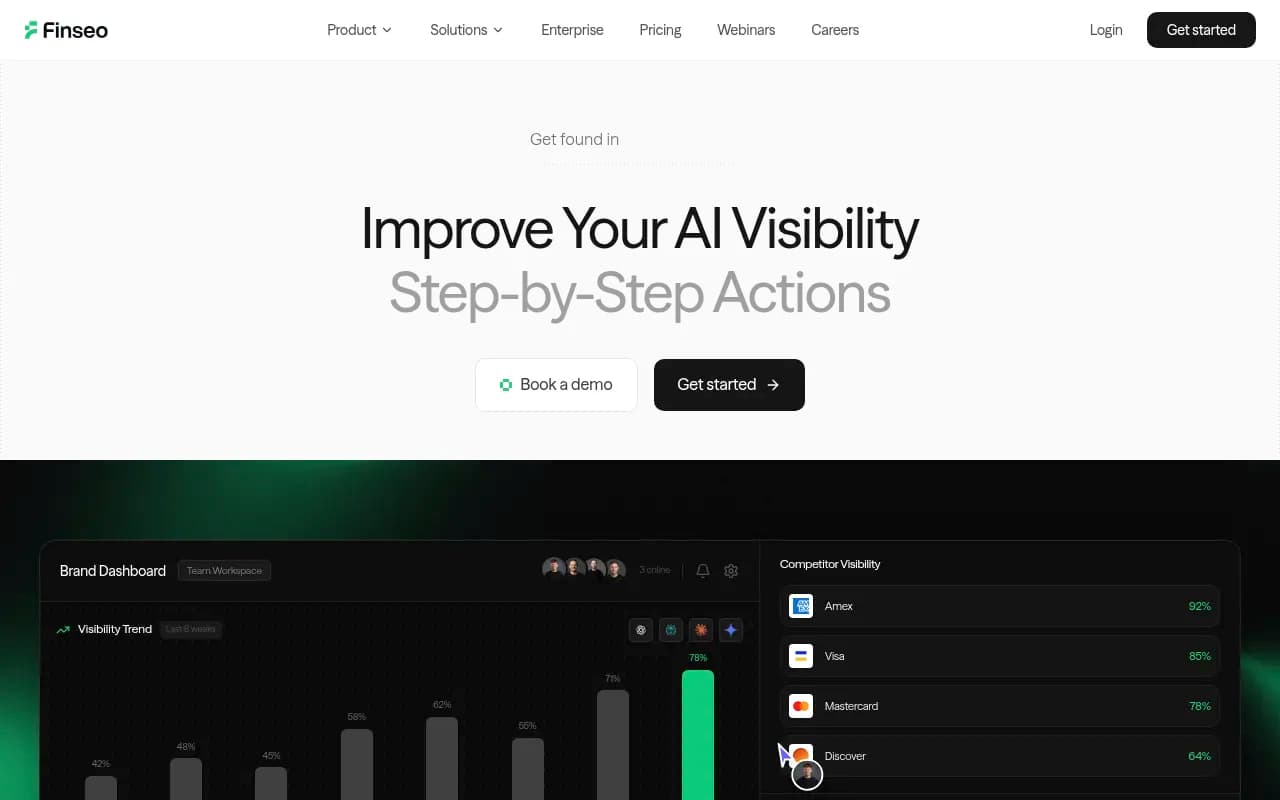
The catch here is smaller but real: you're picking 3 models at Starter, not getting all of them. Business (€210/mo) stays at 3 models but adds Attribution, Tasks, and bot traffic analytics. Growth (€479/mo) bumps you to 5 projects and adds API access. Only Enterprise unlocks the full 11-model roster and unlimited projects.
Finseo is bootstrapped, profitable, and based in Gaildorf, Germany, with GDPR-native data residency in Frankfurt. No VC money, which shows up in a more conservative but dependable feature set. Its customer list (Kellogg's, Lidl, Würth, Panasonic, Raiffeisen) is heavily DACH-concentrated, which makes sense for a tool built with EU compliance front and center.
Promptwatch: all 11 platforms unlocked at the entry tier
This is where the comparison gets lopsided. Promptwatch's paid plans, starting at Essential for $95/mo, include all 11 tracked platforms selectable from day one: ChatGPT, Claude, Gemini, Perplexity, Grok, DeepSeek, Meta Llama, Google AI Overviews, Google AI Mode, Claude Code, and OpenCode. You track 4 at a time per project, but nothing is locked behind an upsell or a sales call. The free Explore tier is ChatGPT-only, but the moment you pay anything, AI Mode is already in the mix.

That alone makes Promptwatch's own marketing against Profound pretty pointed: "Profound locks models, API, and MCP behind an Enterprise contract. Promptwatch puts every major model, full API access, and MCP on every paid plan." It's a fair hit, because it's literally true as of the current pricing pages for both.
What separates Promptwatch from being "just another tracker with more models," though, is what happens after you spot a visibility gap. It has AI crawler log analysis (via Cloudflare, AWS CloudFront, Fastly, Vercel, Netlify, Akamai, Google Cloud CDN integrations) that shows the elapsed time between a bot fetching a page and an engine actually citing it. It has native visitor and conversion analytics for AI-referred traffic, so you can see whether that AI Mode mention actually drove anyone to your site. And it has Content Agents that write and publish directly to Webflow or Framer, so once you've found the gap, something actually gets done about it, rather than just logged in a dashboard. Profound and Finseo are, at their core, monitoring tools. Promptwatch monitors and then acts.
Side-by-side pricing and coverage
| Platform | Entry price | Google AI Mode at entry? | Models at entry | API/MCP access | Content generation |
|---|---|---|---|---|---|
| Promptwatch | $95/mo (Essential) | Yes, all 11 platforms selectable | 4 tracked per project from day one | Included on every paid plan | 5 AEO articles/mo on Essential, up to 30 on Business |
| Finseo | €84/mo (Starter) | Yes, pick any 3 incl. AI Mode | 3 models of choice | Growth tier (€479/mo) and above | Limited; scales by tier |
| Profound | Free trial only; no self-serve paid plan since Sept 2026 | No, trial covers ChatGPT/Gemini/AI Overviews only | AI Mode is Enterprise-only (custom quote) | Enterprise only | Capped, per G2 reviews |
Pricing confirmed via each vendor's live pricing pages as of this writing; this category changes often, so double-check before you commit a budget.
What this actually means if you're choosing one
If your brand lives mostly in the US/global market and you want every engine unlocked without negotiating a contract, Promptwatch's $95/mo entry point with all 11 platforms is hard to beat on pure access. It's also the only one of the three that follows through past monitoring into crawler-log diagnostics and automated content publishing, which matters once you've found the gap and need to close it.
If you're EU-based, need GDPR-native hosting, or care about tracking regional engines like Naver or Qwen for a specific market, Finseo's roster and European pricing make a reasonable case, even with the "pick 3" limitation at the entry tier.
If you're a large enterprise with budget to spare and specifically need Exa Search or the deepest citation-depth tooling Profound built its reputation on, it still has a case — but understand you're now negotiating a custom contract to get Google AI Mode in the mix at all, which is a meaningfully different buying process than it was before September 2026.
One thing worth remembering regardless of which tool you pick: AI Mode's heavy self-citation (over 7% and climbing) means a lot of the visibility opportunity for independent brands actually sits in the long tail below Google's own properties, not at the top. Don't let AI Mode performance alone drive your tool choice — check how each platform handles ChatGPT and Perplexity citation patterns too, since those skew toward completely different sources like Reddit and Wikipedia.
For a broader look at other platforms in this space, the GEO software directory at bestgeosoftware.com is worth a scan before you commit to a 12-month contract on any of these three.