Key takeaways
- Google Search Console added dedicated Search Generative AI performance reports in June 2026 and rolled them out to every property worldwide by August 31, 2026, but the data is impressions-only, with no query dimension and no click data in the dedicated report.
- GSC only tells you about your own site's impressions inside Google's AI surfaces. It has no visibility into ChatGPT, Perplexity, Claude, Gemini, or Copilot, and it can't tell you whether a competitor is getting cited in your place.
- A brand can get recommended by AI without a single click or link back to the site, which GSC simply cannot register.
- Paid tools like Finseo close that gap by running your actual queries through multiple AI models daily and pairing the results with your Search Console data in one dashboard.
- DIY tracking (manually asking ChatGPT the same prompts and logging results) works for a handful of queries but falls apart once you need consistent, multi-model, multi-region coverage.
Why this question keeps coming up
Every few months Google ships something that makes marketers ask, "wait, do I even need a paid AI visibility tool anymore?" The June 2026 rollout of AI Mode and AI Overviews performance reports inside Search Console was one of those moments. For the first time, Google is handing site owners a native, free way to see how often their pages show up inside its generative search surfaces.
That's genuinely useful. It's also incomplete in ways that matter if you're trying to answer the actual business question: is my content showing up where people are getting their answers, and is it driving anything?
I want to walk through exactly what Search Console gives you now, what it still doesn't, and where a tool like Finseo (or, depending on your stack, something like Promptwatch) earns its monthly fee.
What Google Search Console's AI reporting actually shows you
Google's developer blog announced the dedicated Search Generative AI performance reports on June 3, 2026, and Google confirmed worldwide availability for all websites on August 31, 2026. You access it inside Performance > Search Results, then filter by Search Type: Web, AI Overviews, or AI Mode, alongside the usual Image, Video, and News filters.
Here's the catch. The dedicated report's available dimensions are limited to Pages, Countries, Dates, and Devices. There's no Queries dimension in that specific report, and no click data, only impressions. You get a search type filter that distinguishes "Web: text-based" queries from "Web: multimodal" ones (Lens, Circle to Search), and that's about it.
There's also an older, separate thread to this story. AI Mode first showed up in the standard Performance report around June 13, 2025, blended into the regular "Web" search type rather than isolated. In that older implementation, position tracking behaves strangely: the top block of links in AI Mode is treated as position 1, with everything visible in that block sharing the same position, unlike the staggered ranking pattern of a classic search results page.
A few other quirks worth knowing before you build a reporting habit around this:
- Data isn't retroactive. You only see AI Overview/AI Mode segmentation from the date Google started separating these search types for your specific property.
- A single impression can get counted in both the AI Overviews segment and the Web segment at the same time. They are not mutually exclusive, which makes totals hard to reconcile if you're trying to add things up cleanly.
- Follow-up queries inside a multi-turn AI Mode conversation are treated as brand new queries each time. There's no way to track a conversation as one session; metrics reset per prompt.
- The standard 1,000-row limit and the usual chart-versus-table aggregation mismatches in GSC still apply here too.
So yes, Google closed a real gap. CMSWire's June 2026 coverage called it exactly that, a fix for a "key visibility gap," while also flagging what it termed a persistent "attribution blind spot": referrer data from AI Mode is often hidden, and AI Mode traffic still blends into standard web reporting in some views.
What Search Console still can't see, no matter how good the rollout
This is the part that actually matters for deciding whether you need a paid tool. Search Console is, by design, a reporting surface for your own site's relationship with Google. It was never built to answer "what is AI saying about my brand" as a general question. It can only answer "did Google's AI surfaces show an impression of my page."
That means it has zero visibility into ChatGPT, Perplexity, Claude, Gemini, or Microsoft Copilot. If someone asks ChatGPT to recommend a project management tool and it names your three competitors but never you, Search Console will tell you nothing about that conversation. You won't know it happened.
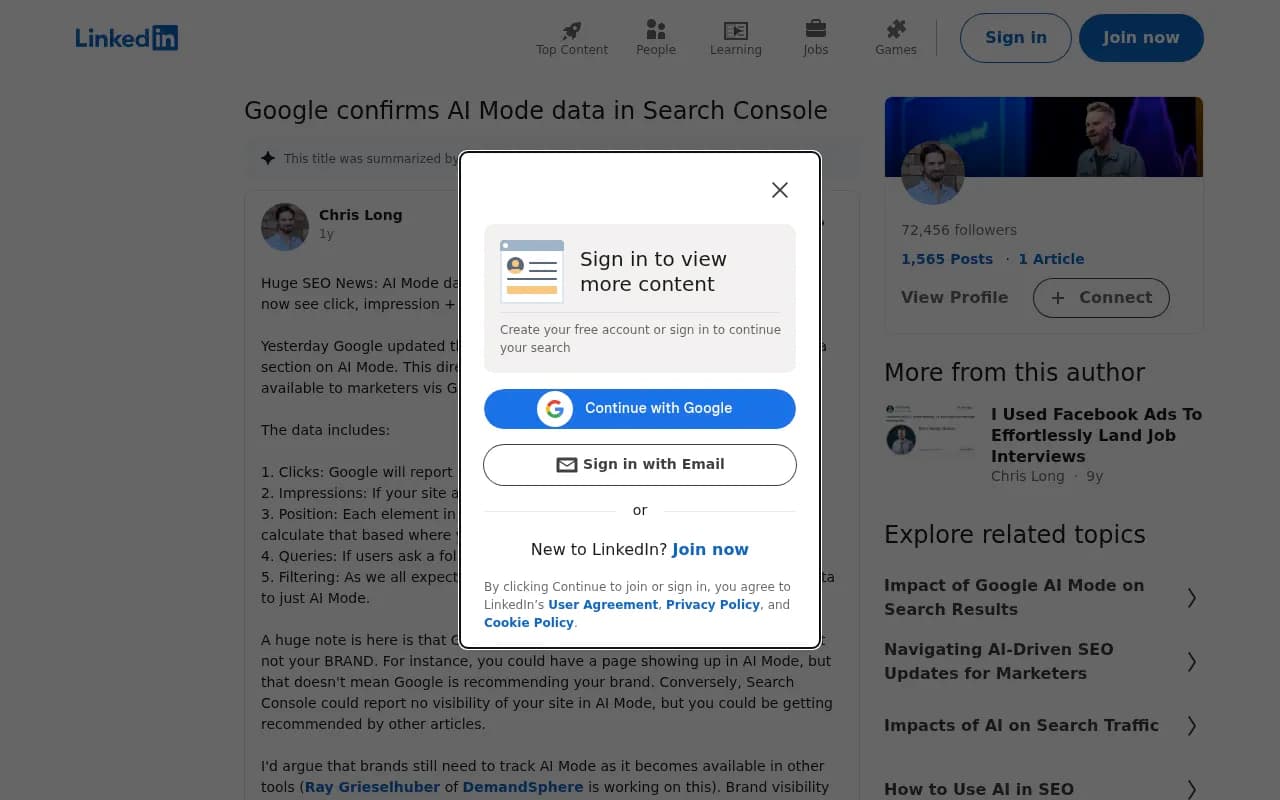
There's a sharper version of this problem even within Google's own surfaces. Marketing consultant Chris Long put it well in a LinkedIn post reacting to the AI Mode rollout: Search Console could report zero visibility of your site in AI Mode, while you're actually being recommended by other articles that AI is pulling from instead of linking to you directly. GSC only tracks direct impressions and clicks tied to your own URLs. It has no concept of a brand mention without a link, which is one of the most common ways AI answers actually cite businesses.
A Reddit thread in r/GEO_optimization summed up the honest state of the industry even after this update: nobody can track Google AI Overviews perfectly right now, and Search Console still doesn't provide a dedicated breakdown of which specific citations drove which impressions.
There's also a structural reason visibility in AI answers is scarcer and more contested than a traditional search results page. Promptwatch's data on average sources per response shows ChatGPT typically cites around 5 sources per web-search-enabled answer, while Google AI Overviews and Perplexity cite close to 10 each. Compare that to a traditional Google results page with ten blue links plus ads, images, and other modules, and you can see the problem: ChatGPT's answer format distributes visibility across roughly half as many winners, which makes every cited slot considerably more contested. Search Console's new reports don't tell you anything about that competitive landscape, only about your own impressions.
Where a tool like Finseo fills the gap
This is the actual use case for a paid AI visibility tool. Finseo runs your target queries through ChatGPT, Claude, Gemini, Perplexity, Microsoft Copilot, DeepSeek, Mistral, Grok, Google AI Overviews, and Google AI Mode on a recurring schedule, tracking brand mentions, competitor share of voice, and the sources cited in each answer.
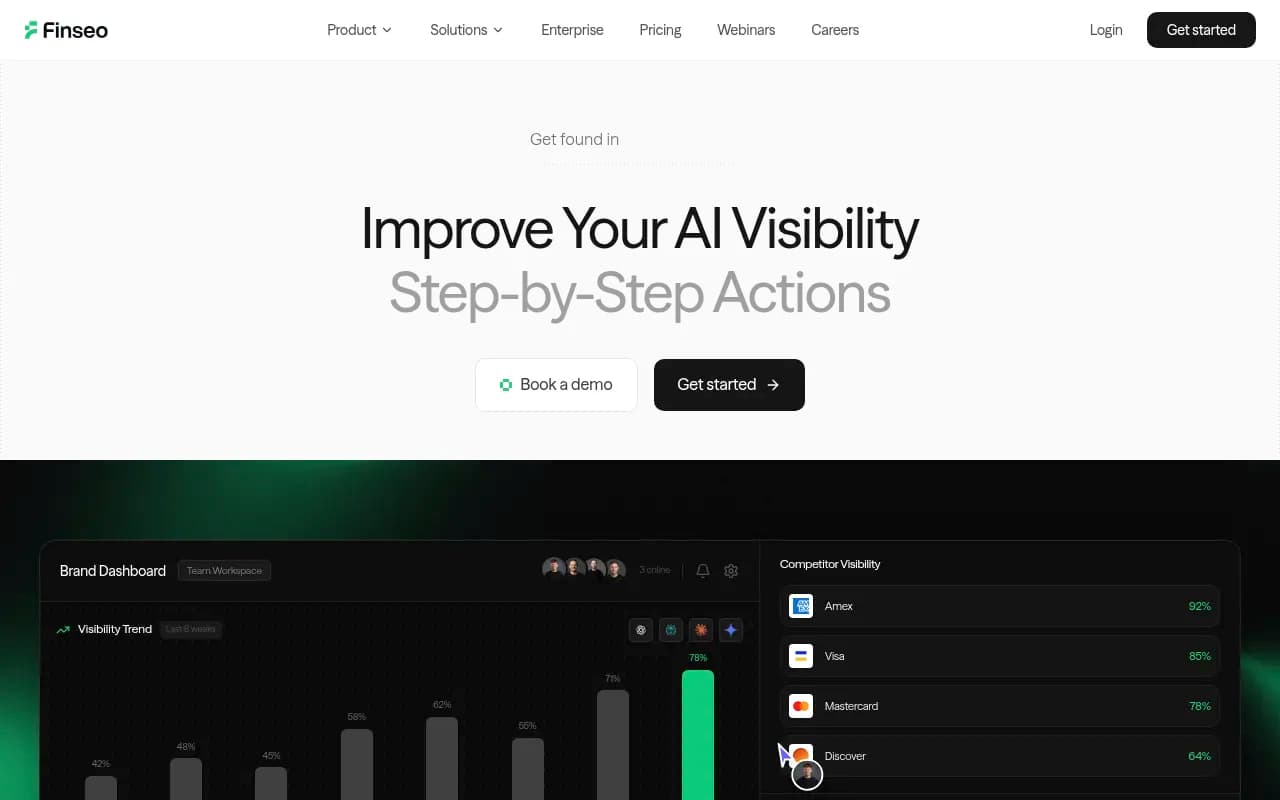
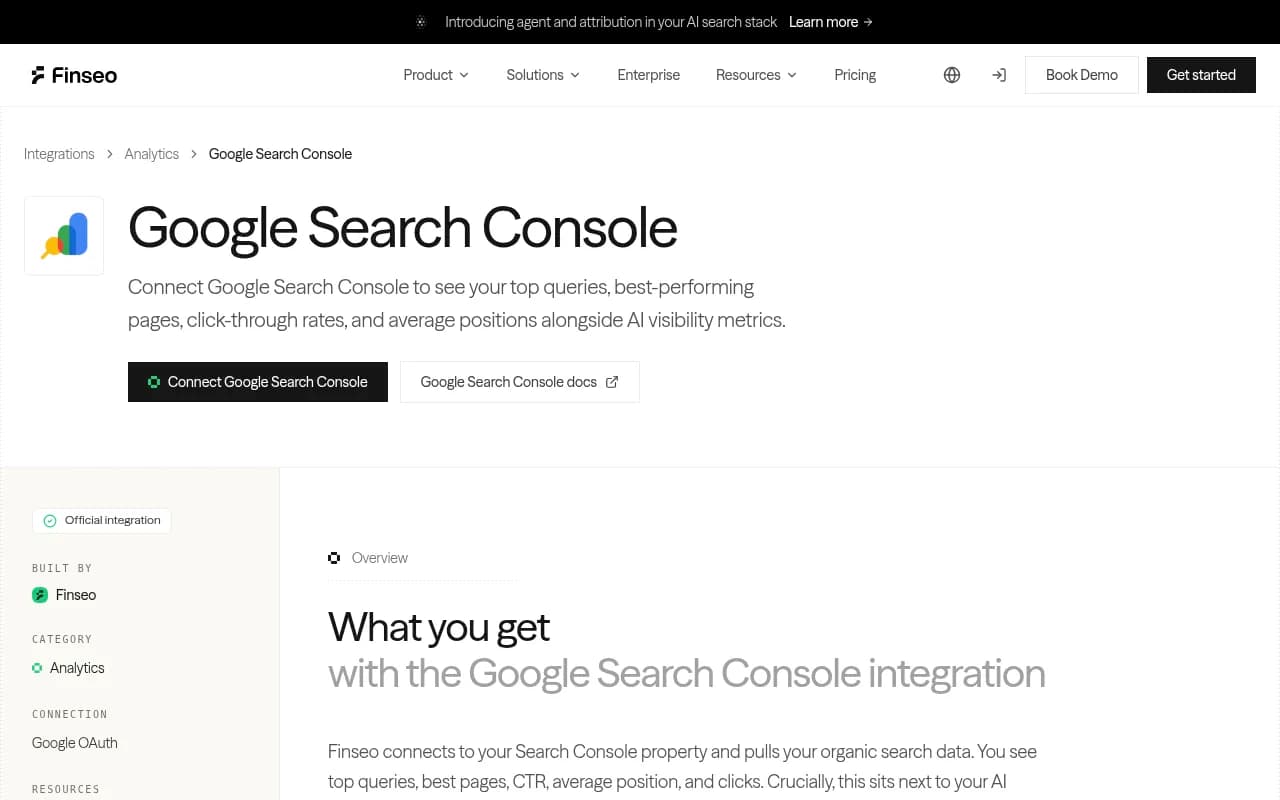
The genuinely useful part, for anyone who's already invested time in Search Console, is Finseo's native GSC integration. It connects through OAuth with read-only access and places your queries, pages, clicks, CTR, and average position next to AI visibility data from every model it tracks. That means you can finally see, in one view, where traditional SEO is working but AI visibility isn't, and vice versa. A page can rank #3 in Google and still never get mentioned when the same question is asked in ChatGPT. Without pairing the two data sets, you'd never notice that pattern.
Finseo's AI Mode tracker specifically addresses the fan-out problem: AI Mode often splits one user question into several sub-queries before generating an answer, and the tool maps which of those fan-out queries surface you and which leave you out entirely, something no Search Console report attempts to do.
Can you get away without paying for anything?
Honestly, sometimes yes, at small scale. If you're tracking five or ten queries and don't mind manual work, you can open ChatGPT, Perplexity, and Claude yourself, run the same prompts, and log the results in a spreadsheet. It's slow, it's inconsistent (the same prompt can return a different answer twice in a row, since these are generative systems, not deterministic search indexes), and it doesn't scale once you want coverage across categories, regions, or a competitor set. But for a quick gut check before you commit budget, it's a legitimate starting point.
Free, no-login spot-checks also exist. Finseo offers a free AI Visibility Check that gives you a 60-second read on how ChatGPT, Claude, Perplexity, and others describe your brand, without a login. That's useful for a one-time sanity check, not for ongoing tracking.
Comparing your options
| Approach | Cost | What you see | What you miss |
|---|---|---|---|
| Google Search Console alone | Free | Your own impressions in AI Overviews/AI Mode by page, country, device | No queries dimension, no clicks, no competitor data, nothing outside Google's AI surfaces |
| Manual DIY prompting | Free (your time) | Whatever you ask, across any model, in your own words | Inconsistent, not automated, impossible to scale past a handful of prompts |
| Finseo | Paid, from roughly €84/month | Daily tracking across 10 AI models including Google AI Mode, GSC data merged in, competitor share of voice, fan-out mapping | Still a sampled snapshot of generative answers, not literal user-level telemetry |
| Promptwatch | Paid, from $95/month | Prompt tracking with volumes and difficulty, AI crawler logs, citation trends, Reddit/YouTube citation tracking, visitor analytics, automated content generation | Paid tool, requires setup time to connect crawler logs and CMS |

If your goal is narrowly "did my page show an impression in Google's AI surfaces," the free Search Console reports now genuinely answer that. If your goal is "am I visible across the AI tools my customers actually use, and what do I do about the gaps," you need something that monitors beyond Google. Promptwatch goes a step further than most prompt trackers here: alongside multi-model monitoring, it logs AI crawler visits (ChatGPTBot, ClaudeBot, PerplexityBot, and 400+ others) so you can see whether AI systems are even reading your pages before they decide whether to cite them, something neither Search Console nor a basic prompt tracker shows you. Its Content Agents can also turn gap findings into published, on-brand articles rather than just a dashboard of problems.
Bottom line
Search Console's AI reporting is a real improvement, and if you only care about Google's own AI surfaces, it's a reasonable free starting point in 2026. But it was built to report on your relationship with Google, not on the broader AI search landscape. The moment you need to know whether ChatGPT or Perplexity mentions you, whether a competitor is winning citations you're missing, or whether your AI-driven traffic is actually converting, you're outside what any free Google tool was designed to do. For teams serious about AI search visibility, browsing a directory like bestgeosoftware.com's list of GEO platforms, or testing Finseo or Promptwatch directly, is a faster path than trying to stretch Search Console past its limits.