Key takeaways
- Finseo's AppSumo reviews average 2.75/5 from 4 verified buyers, with recurring complaints about system errors, a broken article-writer flow, and missing export options
- Finseo's pricing structure has changed at least twice in roughly a year (per ecom-tools.de's tracking), moving from $19/$49 tiers to the current Starter €84 / Business €210 / Growth €479 setup
- The most useful features, tasks, attribution, crawlability checks, and bot analytics, are locked behind the €210/mo Business plan; Starter only measures, it doesn't advise
- G2 has just 3 reviews for Finseo, too few for the platform to generate a reliable buying-insight score
- Dedicated AI-visibility specialists often undercut Finseo on price per tracked prompt while including features Finseo gates behind higher tiers
Why people are searching for Finseo complaints in the first place
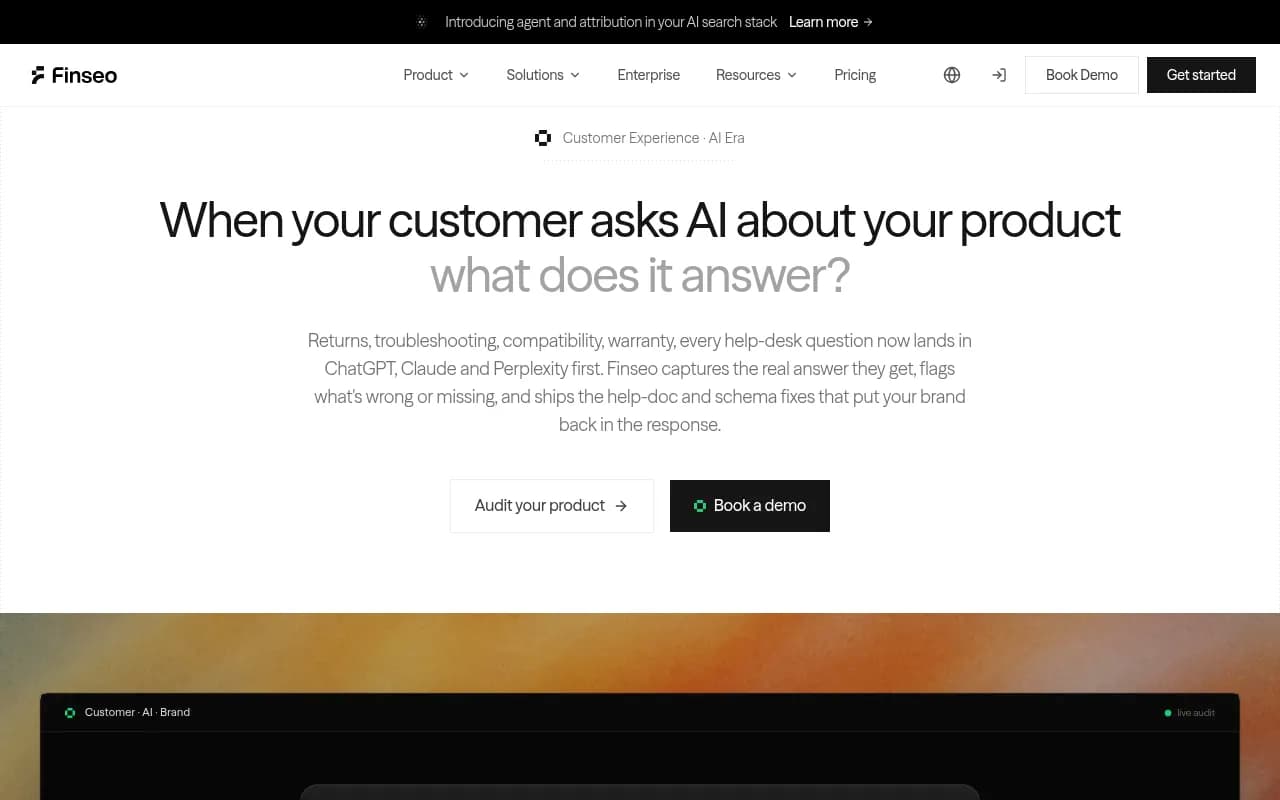
Finseo markets itself as a Generative Engine Optimization platform, tracking how brands show up in ChatGPT, Claude, Perplexity, Gemini, and Google AI answers, then suggesting fixes. Founded in 2025 by David Mühlenweg and Maurice Marinelli out of Gaildorf, Germany, the company says it's bootstrapped, profitable, and serves 500+ customers including Kellogg's, Panasonic, and Würth. Those are big names to drop, and I can't independently verify the claim, but it's worth noting upfront because it shapes expectations: a tool with that kind of client list should feel polished. A fair number of actual users say it doesn't, yet.
If you're evaluating Finseo for your own brand's AI visibility, you'll find the review landscape thin and a little contradictory. That's exactly why it's worth digging into what's actually been written, rather than taking the marketing page at face value.
What the reviews actually say
The AppSumo lifetime-deal reviews (the most detailed complaints)
Finseo ran an AppSumo lifetime deal in mid-2025, and the resulting reviews are the most specific, warts-and-all account of the product available. The overall score sits at 2.75 out of 5 from four verified buyers, which is not a flattering number for a tool asking for lifetime payment upfront.
One reviewer titled their post "They shouldn't have launched this yet" (2 stars, July 20, 2025). Their complaints were concrete: the SEO audit scanned admin pages like /wp-admin/plugins.php instead of public-facing content, the article writer got stuck at step two with no way to enter a topic, and keyword research had no export option at all. They also called customer support on AppSumo "next to non-existent."
Another reviewer (1 star, July 10, 2025) reported "frequent system errors and technical issues" and "repeated glitches" on a tier-4 lifetime purchase, despite liking the overall concept. A third (3 stars, June 30, 2025) couldn't save or input a custom keyword list, the tool only surfaced random keywords it guessed the site ranked for, and called the AI feature "ok" but needing more training.
To Finseo's credit, the founders replied directly to at least one review (5 stars, June 17, 2025) confirming they were working through remaining issues. That's a good sign for responsiveness, but it also confirms the product was shipped with known gaps.
The timing problem: a rebrand right after launch
One reviewer flagged something that's easy to miss but matters for trust: Finseo underwent a major rebrand that launched the day after its AppSumo deal went live. Then on July 24, 2025, the company posted a notice about "a major technical issue" affecting the platform. Stacking a rebrand, a paid launch, and a documented outage within roughly two weeks of each other isn't a great look, even if every SaaS company has rough patches.
G2 and Trustpilot: not enough data to trust
Finseo's G2 profile has exactly 3 reviews, all 5 stars, which G2 itself flags as too few to generate a reliable buying-insight score. Comments there mention "bugs and the interface isn't working well" alongside praise for the AI visibility search engine and easy setup. Finseo's Trustpilot profile is claimed but has zero reviews, despite Trustpilot's logo appearing on Finseo's own marketing page as a trust signal. That's a detail worth noticing: a trust badge attached to an empty review profile doesn't actually build trust.
The most thorough independent test (ecom-tools.de, 4.1/5)
The most rigorous third-party review I found ran a live Finseo project tracking 30 prompts across ChatGPT, Google AI Overviews, and Gemini starting September 17, 2026. In the first two weeks, Finseo analyzed 1,144 AI answers, which suggests the core tracking engine does work at a reasonable scale.
But the sub-scores tell a more mixed story: tracking and data quality scored 4.6/5, while actions and agent features scored only 3.8/5, value for money 3.5/5, and usability and documentation 3.7/5. The reviewer's specific gripes: task lists, attribution, and crawlability checks are all locked behind the €210/mo Business plan, so the Starter tier essentially just measures without telling you what to do about it. The interface is English-only. AI-generated task suggestions were described as "partly spot-on and partly off the mark." And pricing details sometimes contradicted each other across Finseo's own site and documentation.
On OMR Reviews, the picture flips
Interestingly, OMR Reviews shows Finseo at 4.97 out of 5 from 15 reviews, with praise for intuitive operation, fast support, and concrete recommendations. The sub-scores (ease of use 90%, customer support 89%, setup 90%) sit just below category average, though, and the same review set flags missing documentation, unexplained terminology, and a steep learning curve for anyone not already fluent in SEO jargon. Fifteen reviews is still a small sample, but it's a useful counterweight to the AppSumo horror stories, and it suggests Finseo's current product (post-rebrand) may be meaningfully better than the 2025 lifetime-deal version that generated most of the harsh reviews.
The pricing problem, in plain terms
Finseo's pricing has shifted at least twice in about a year. First it was $19/$49 tiers. Then, in summer 2026, it became Creator €99 / Business €189 / Enterprise from €499. As of late September 2026, the public pricing page lists:
| Plan | Price | Prompts tracked | AI answers/mo | What's included |
|---|---|---|---|---|
| Starter | €84/mo (€70 annual) | 50 | ~4,500 | 3 models, 1 project, no tasks/attribution/crawlability |
| Business | €210/mo (€175 annual) | 150 | ~13,500 | Adds tasks, attribution, bot analytics, 15 articles |
| Growth | €479/mo (€399 annual) | 350 | ~31,500 | API/webhooks, 5 projects, priority support |
| Enterprise | Custom | Unlimited projects | Up to 11 models | SSO, managed setup, dedicated Slack |
A third-party cost estimate pegs a realistic Finseo Business setup (100 prompts, 1 website, 8 models) at roughly $3,500 to $6,000 a year, and getting there historically required booking a demo rather than self-serve checkout. That friction, combined with the fact that the genuinely useful features sit behind the second tier, is the recurring theme across almost every complaint I found, whether it's an AppSumo reviewer annoyed about missing exports or a 2026 tester annoyed about gated attribution data.
What this means if you're evaluating Finseo right now
A few patterns worth internalizing before you sign up for any AI-visibility tool, Finseo or otherwise:
First, confirm exactly what's unlocked at the entry price, not what the marketing page implies. Several vendors in this space, not just Finseo, gate the modules that actually drive action (task lists, attribution, multi-engine tracking) behind a pricier tier. The "from €84" headline number is not the functional price for most buyers.
Second, be skeptical of any tool's raw visibility or citation numbers without context. Promptwatch's own data shows ChatGPT cites only about 5 sources per web-search response, a tight inventory, while Google AI Overviews cites roughly double that at around 10 sources, and Perplexity sits consistently near 10 as well. Microsoft Copilot's citation count has swung from under 2 to nearly 17 sources per response within a few weeks, which means any single tool's Copilot score should be read as noisy rather than definitive (https://promptwatch.com/data/average-sources-per-response). If a vendor's dashboard shows a dramatic swing in your "visibility score," it might just be the platform itself recalculating how many sources it shows, not a real change in your brand's performance.
Third, check whether export and API access are usable at the tier you're actually paying for. One AppSumo reviewer found keyword research had no export option whatsoever; Finseo's current API and webhook access only start at the €479/mo Growth plan.
Alternatives worth testing
If the gated features and pricing churn described above give you pause, here's how the field compares. I'd put Promptwatch, LLM Pulse, Otterly.AI, Profound, and Semrush's AI tracking among the names worth shortlisting, each for a different reason.
Promptwatch is the one I'd point to first if you want a platform built around actually fixing visibility gaps rather than just reporting them. It tracks ChatGPT, Claude, Gemini, Perplexity, Grok, DeepSeek, Mistral, Copilot, and both Google AI Overviews and AI Mode, and it goes further than most trackers by logging actual AI crawler visits to your site (ClaudeBot, PerplexityBot, GoogleOther, and 400+ others), showing you which pages get crawled, which get cited, and where the crawl-to-citation path breaks down. That's the kind of diagnostic data that explains why Finseo's gated "attribution" features matter so much, and Promptwatch includes citation trends, content gap analysis, and automated Content Agents that draft and publish GEO-optimized content to your CMS starting on its $95/mo Essential plan. It's rated 4.7/5 on G2 from a much larger review base than Finseo's three, and it's used by 1,840+ brands including Duolingo, Yelp, and Shutterstock.

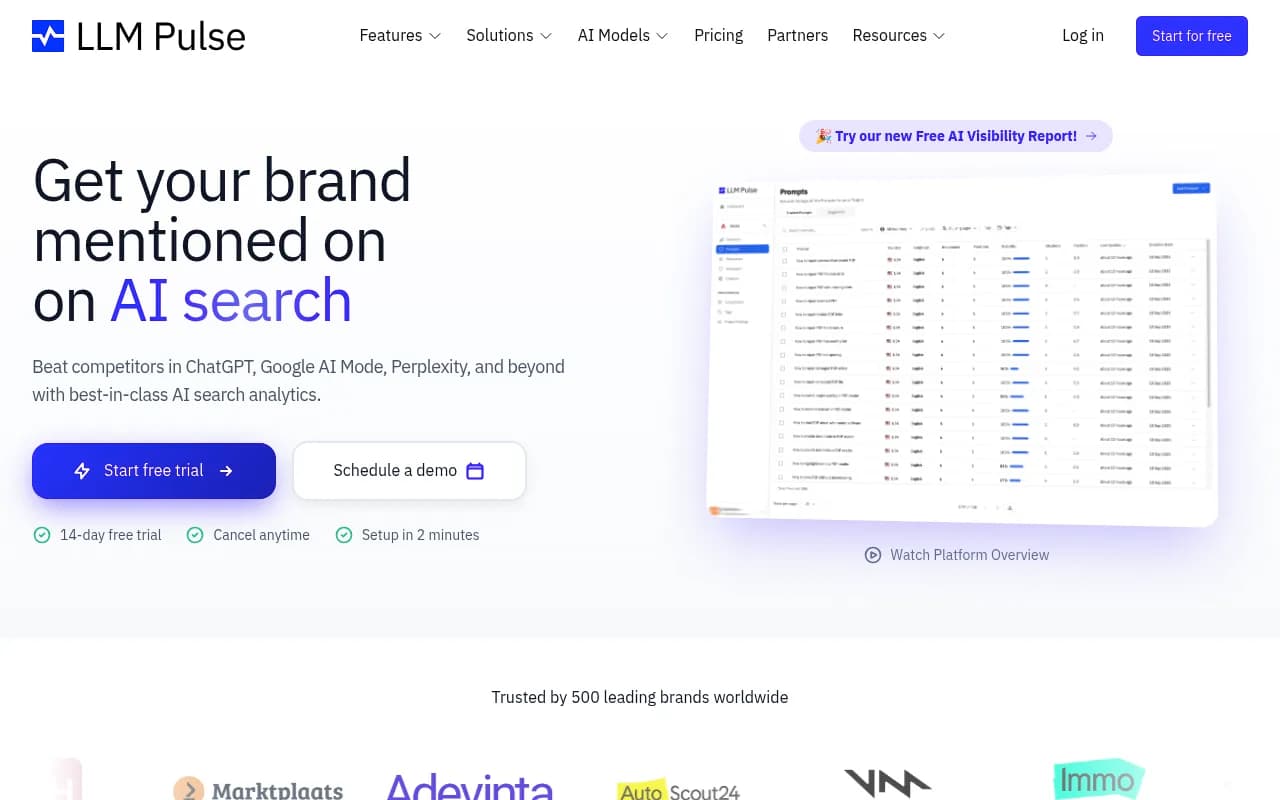
LLM Pulse is the more budget-friendly specialist: Starter at €49/mo for 50 prompts, Growth at €99/mo for 150 prompts, and Scale at €299/mo for 450 prompts, all working out to roughly €0.66-0.98 per tracked prompt. It covers five AI surfaces (ChatGPT, Perplexity, Gemini, AI Mode, AI Overviews), includes citations, share of voice, sentiment, an API, and self-serve signup with no demo requirement, which solves one of the biggest friction points reviewers flagged with Finseo.
Otterly.AI starts cheapest at $29/mo for 15 prompts across 4 core engines, with Standard at $189/mo and Premium at $489/mo. It's self-serve with a free trial, which again beats Finseo's historical demo-gating, though Google AI Mode and Gemini are paid add-ons rather than included by default, so check that before committing.
Otterly.AI

Profound targets a more enterprise audience. Its $99 Starter plan is genuinely limited (ChatGPT only, 50 prompts, no exports, no Opportunities panel) and reviewers commonly describe it as a funnel toward the $399 Growth plan, which adds three engines, 100 prompts, and an AI Agents content engine. Claude tracking is Enterprise-only. It's a reasonable option if budget isn't the constraint and you want deep enterprise reporting.
Profound

Semrush's AI Toolkit is worth a look if you already run traditional SEO through Semrush and want AI visibility bolted on rather than a standalone product, though like Finseo's core complaint, buyers who only want AI tracking will pay for a lot of unused keyword-research and technical-audit tooling.
Side-by-side comparison
| Tool | Entry price | Self-serve signup | Tasks/attribution included at entry? | Crawler log data |
|---|---|---|---|---|
| Finseo | €84/mo | Historically demo-gated | No, gated to Business tier | Limited |
| Promptwatch | $95/mo | Yes, 7-day trial | Yes | Yes, 400+ crawlers |
| LLM Pulse | €49/mo | Yes | Yes | No |
| Otterly.AI | $29/mo | Yes, free trial | Partial (AI Mode/Gemini extra) | No |
| Profound | $99/mo | Yes | No, gated to Growth | No |
How to decide
If you only need basic prompt tracking on a tight budget, LLM Pulse or Otterly.AI's entry tiers get you there without a demo call. If you want the crawler-log and content-generation depth that Finseo's own reviewers say is missing even at its paid tiers, Promptwatch is the more complete stack. And if Finseo's reported 2026 improvements (the better OMR scores, the founders actively replying to feedback) have you curious anyway, it's worth running a short trial on the Starter plan before committing to Business, specifically to test whether the gated attribution features are worth the jump in price for your use case.
Whichever direction you go, treat any AI-visibility score with a healthy dose of skepticism in isolation. Pair it with real traffic and conversion data from your analytics, not just the vendor's own dashboard, before deciding a tool is or isn't working for you. For a broader look at the category, the GEO software directory at bestgeosoftware.com is a useful place to keep comparing options as pricing and features keep shifting across this whole market.