Key takeaways
- Finseo tracks Google AI Mode and AI Overviews as two separate engines, running daily prompts per country and language, which matches how Google actually treats these as distinct surfaces with different citation behavior.
- Finseo's marketing pages lean heavily on headline metrics (visibility percentage, mentions per month, sentiment) without much explanation of methodology, prompt volume limits, or how "sentiment" is scored.
- The product doesn't appear to offer AI crawler log analysis, which means you can see whether Google mentions you but not whether Googlebot or Google-Extended actually fetched your pages.
- AI Mode is still rolling out market by market, and Google Search Console now surfaces some AI Mode click and impression data natively, which changes what a paid tool needs to add on top.
- If your priority is going beyond "are we mentioned" to "what do we do about it," tools with content generation and crawler-level diagnostics, like Promptwatch, cover more of the loop than tracking-only dashboards.
Why Google AI Mode tracking is a different problem than ChatGPT tracking
Most AI visibility tools started by tracking ChatGPT, because that's where the GEO conversation began in 2024 and 2025. Google AI Mode is a harder target for a few reasons that matter if you're evaluating a tool like Finseo.
First, AI Mode isn't a single global product. It rolled out market by market, and as of mid-2026 it's still expanding; France only got AI Overviews in July 2026, for instance. A tracker that claims "global coverage" for AI Mode needs to be honest about which countries it actually queries from, because Google's answer behavior (and whether AI Mode triggers at all) depends heavily on locale.
Second, Google has started exposing some of this data itself. Search Console now reports clicks and impressions tied to AI Mode as part of the regular Performance report, confirmed by Google's Martin Splitt and detailed by Glenn Gabe of GSQI. That's a meaningful shift: free, first-party data now covers part of what paid trackers charge for. The catch, as several SEOs have pointed out on LinkedIn, is that Search Console bundles AI Mode traffic into the same performance report as regular Search, with no dedicated filter. You can't cleanly separate "this click came from AI Mode" from "this click came from a regular blue link" without extra digging. That's exactly the gap third-party trackers like Finseo are trying to fill, by running controlled prompts and recording what the AI Mode answer actually says, rather than inferring it from aggregate Search Console rows.
Third, AI Mode uses a query fan-out approach: one user question triggers multiple underlying searches, and the results for those sub-queries can shift with every core algorithm update, since Google has said AI Mode is rooted in its core quality and ranking systems. That means a brand's AI Mode visibility isn't a static thing you check once a quarter. It moves with the same volatility as organic rankings, sometimes more.
What Finseo's Google AI Mode tracker actually shows
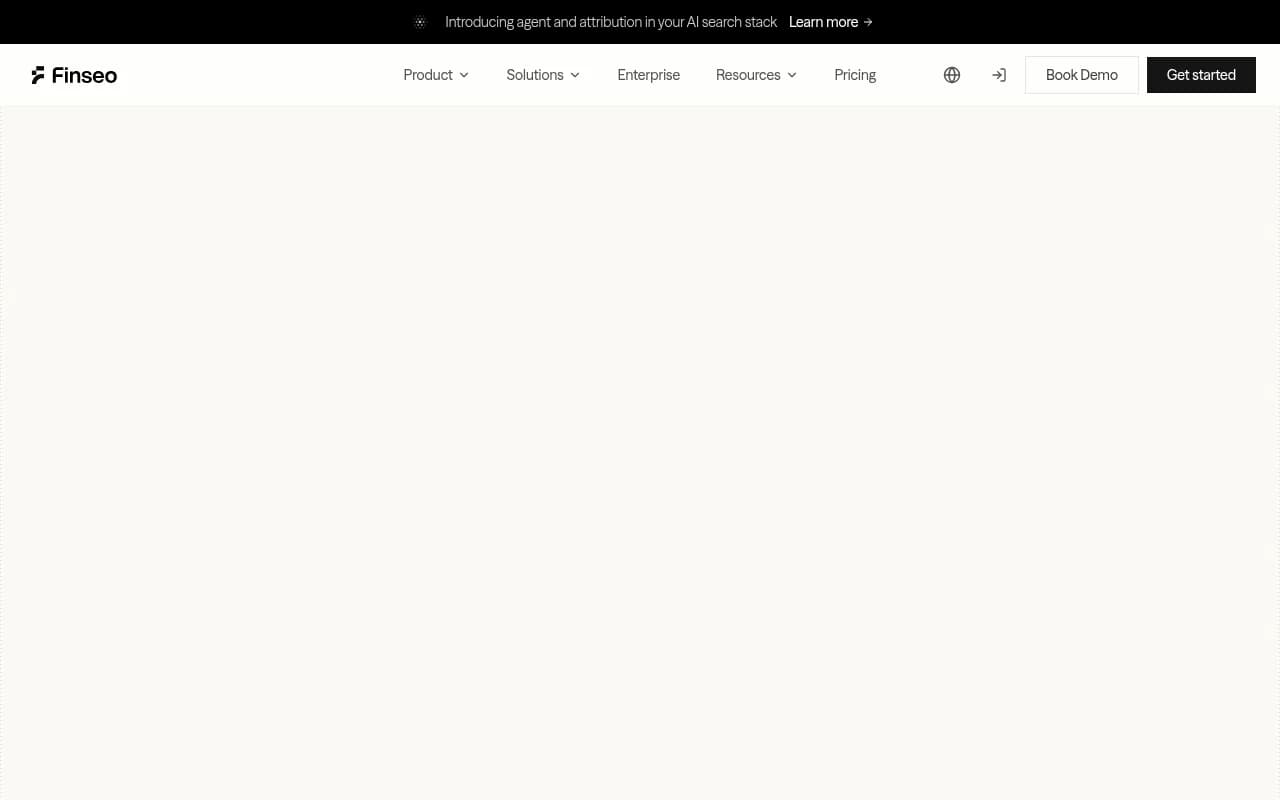
Finseo frames its AI Mode product simply: it runs your queries through Google AI Mode daily and records every answer that names your brand, turning that into a visibility trend over time. The page for AI Overviews does something similar but treats it as a separate engine from AI Mode, tracking per country and language whether an Overview names your brand, which pages it cites, and which competitors it ranks ahead of you.
A few things Finseo gets right here:
It treats AI Mode and AI Overviews as distinct products rather than lumping them together. Finseo's own FAQ states plainly that "they cite different sources, so Finseo tracks them as two engines." That's correct and it's a detail a lot of simpler trackers skip. AI Overviews sits on top of regular Google Search results and tends to pull from pages already ranking organically, YouTube, and forums. AI Mode is a more conversational, multi-turn experience with its own citation patterns. Conflating the two in a single "Google AI visibility" number would hide useful signal.
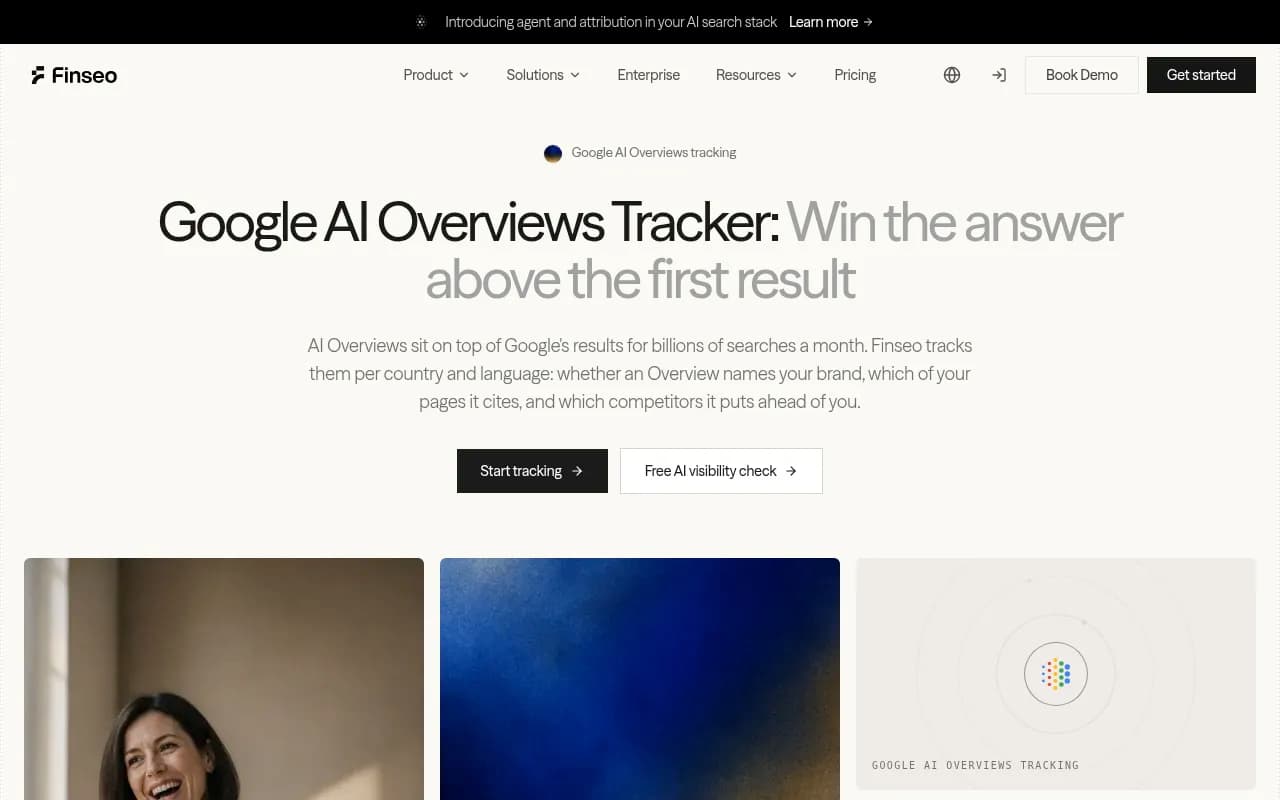
It runs daily prompts per country and language, which is the right cadence given how much AI Mode results shift around core updates. A weekly or monthly check would miss a lot of churn.
It positions AI Mode and AI Overviews inside a broader multi-model tracker that also covers Gemini, ChatGPT, Perplexity, and Claude using the same prompt set, so you're not running a separate tool just for Google's AI surfaces.
Where the marketing outpaces the detail
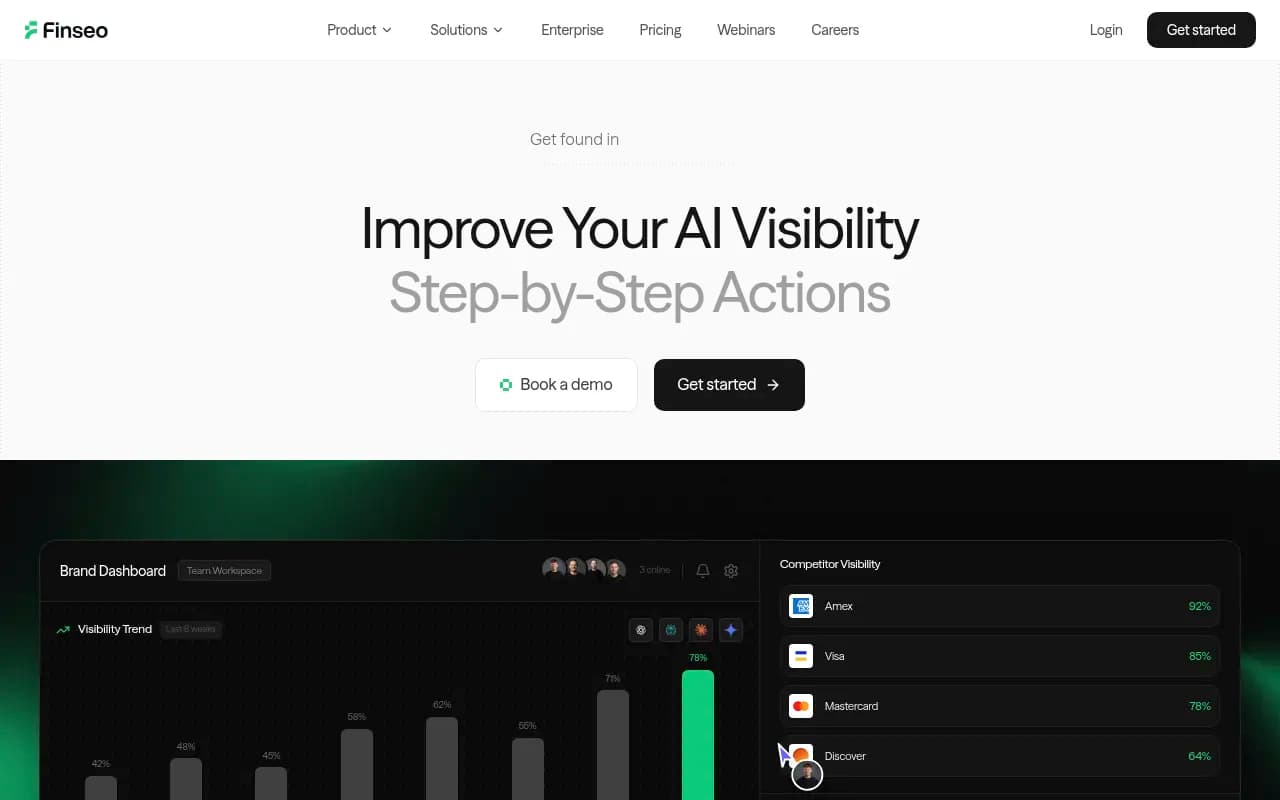
Here's where I get a little skeptical. The public-facing pages are full of headline numbers, a 68% to 72% "visibility" score, 1,284 mentions a month, 92% positive sentiment, without any visible explanation of what counts as a mention, how sentiment is scored, or what sample size produced those numbers. These look like demo placeholders rather than numbers tied to a specific brand, which is fine for marketing copy, but it makes it hard to judge the tool's actual accuracy from the outside.
There's also no mention, anywhere in the public pages, of AI crawler log analysis. That matters more than it sounds. Knowing that AI Mode or AI Overviews named your brand tells you the outcome. It doesn't tell you why, or whether Google-Extended and other crawlers are even reaching the pages you want cited, or where they're hitting errors. Without that diagnostic layer, you're stuck guessing at root causes when visibility drops.
And Finseo's own pricing and customer logos skew toward mid-market European brands (Würth, Lidl, Jägermeister, Raiffeisen), which suggests the tool is built and tuned for that segment rather than for teams that need enterprise-scale prompt volumes or agency-grade reporting.
What manual tracking looks like without a tool
It's worth noting that plenty of SEOs still track AI Mode and AI Overviews by hand, because results are so fragmented by query and location. One Reddit thread on r/seogrowth sums up the common workaround: pick a fixed set of prompts, check them weekly, and log whether your brand or pages show up, repeated per location if you serve multiple markets. That approach works, but it doesn't scale past a handful of prompts and it's easy to let slip when you're busy. Any tool, Finseo included, earns its subscription price mainly by removing that manual grind and making the trend visible without you remembering to check.
How Finseo compares to other AI visibility tools
| Tool | AI Mode / AI Overviews tracking | Crawler log analysis | Content generation tied to gaps | Multi-model coverage |
|---|---|---|---|---|
| Finseo | Yes, tracked as separate engines, daily prompts | Not advertised | Not advertised | Gemini, ChatGPT, Perplexity, Claude, Google AI |
| Promptwatch | Yes, plus real UI monitoring (not just API) | Yes, real-time crawler logs with citation rate per page | Yes, Content Agents publish to CMS | ChatGPT, Gemini, Claude, Perplexity, Grok, DeepSeek, Copilot, Mistral, Llama, Google AI Overviews and AI Mode |
| Semrush AI Toolkit | Partial, bundled into broader SEO suite | No | Limited | Fixed prompt sets |
| Otterly.AI | Yes, basic | No | No | ChatGPT, Perplexity, AI Overviews |
| Profound | Yes | No | No | ChatGPT, Perplexity, 9+ engines |

If you're comparing tools purely on "does it check Google AI Mode," several platforms can do that now. The real differentiator is what happens after the check. Promptwatch's crawler log analytics, for example, show exactly when AI crawlers like Google-Agent or ChatGPTBot visit your site, what they read, and whether they hit errors, which is the missing piece that explains why a visibility score moved. Most monitoring-only tools, Finseo included based on its current public feature set, stop at the mention-tracking layer.
Content types Google AI surfaces actually cite
It helps to know what Google's AI surfaces reward before you optimize anything. Promptwatch's data on AI Overviews citation types for July 2026 found that product pages overtook listicles as the most-cited format late in the month, a shift worth knowing if your content strategy still leans on roundup-style posts. Separately, Promptwatch's research on citation share by domain shows how much weight domain authority still carries in these surfaces, which is useful context when a tracker reports you're "invisible" for a prompt where a dominant competitor simply outranks everyone.
If you want to dig into these patterns further, the full catalog of first-party citation research is at Promptwatch's data hub.
Practical recommendations
If you're a mid-market European brand already comfortable with Finseo's broader AI visibility suite, its AI Mode and AI Overviews trackers are a reasonable add-on, especially given they're built on the same daily-prompt infrastructure as the rest of the platform. Just push the vendor for specifics on prompt volume limits, country coverage, and how sentiment scoring works before you commit budget.
If you need to understand not just whether you're visible but why, and want a path from insight to action (content gaps, crawler diagnostics, automated publishing), it's worth demoing a platform built around that full loop. Promptwatch is the one I'd point to, given its crawler log analytics, Content Agents, and coverage across both Google AI surfaces plus every major chatbot. For teams that want a wider shortlist before deciding, the GEO software directory at bestgeosoftware.com and the rank tracking comparisons at ai-rank-tools.com are good next stops.
And regardless of which tool you pick, don't throw out Search Console. It now gives you free, first-party AI Mode click and impression data bundled into the standard Performance report. It's not granular enough to replace a dedicated tracker, but it's a useful sanity check against whatever number your paid tool reports.