Key takeaways
- Bear AI has pivoted. Its website no longer describes the AI visibility and brand tracking product it originally marketed. It now focuses on enterprise workflow datasets for AI agents -- a completely different product category.
- Ahrefs Brand Radar is the clear winner for AI search monitoring between these two, with 210M+ search-backed prompts and coverage across 6 AI tools -- but it requires an existing Ahrefs subscription, pushing the real cost to $527+/mo minimum.
- Neither tool generates content or closes the optimization loop. Both are (or were) monitoring-focused. You can see where you're invisible, but neither helps you fix it.
- Ahrefs Brand Radar has no AI traffic attribution, no crawler logs, and no content generation -- significant gaps for teams that want to connect AI visibility to actual revenue.
- Bear AI's pivot makes it a non-starter for AI visibility use cases in 2026. If you came here comparing these two for brand tracking in ChatGPT or Perplexity, Ahrefs Brand Radar is the only one still doing that.
- The pricing gap is real but complicated. Bear AI was cheaper on paper ($199/mo vs $398/mo add-on), but Ahrefs Brand Radar actually delivers a working AI monitoring product.
Overview
Ahrefs Brand Radar
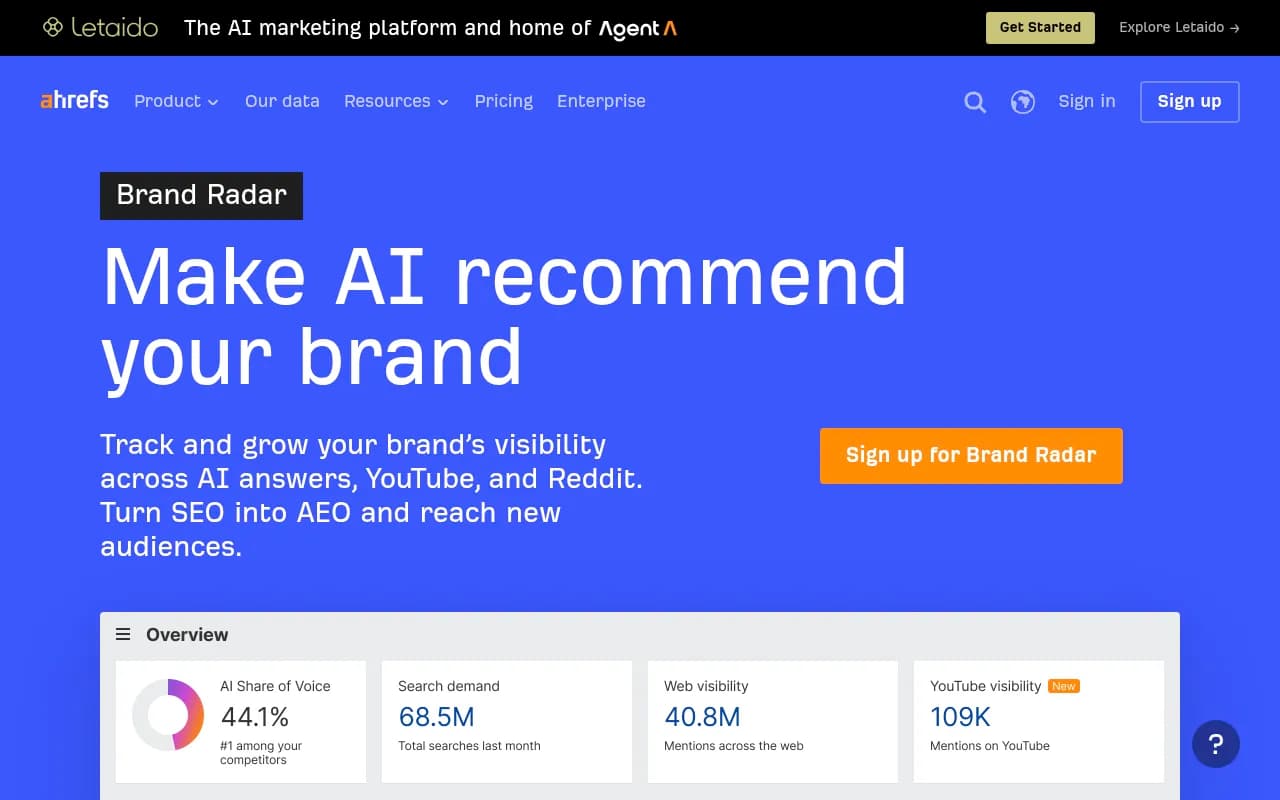
Ahrefs Brand Radar is the AI visibility module inside the Ahrefs platform -- one of the most established names in traditional SEO tooling. The pitch is straightforward: if you're already paying for Ahrefs, you can add Brand Radar to see how your brand appears across AI-generated search results from tools like ChatGPT, Perplexity, and Google AI Overviews.
The data scale is genuinely impressive. Ahrefs claims 210M+ search-backed prompts, which gives Brand Radar broad coverage without requiring you to manually define every prompt you want to track. You can also add custom prompts for more specific monitoring. Coverage spans 6 AI platforms, and the zero-setup promise is real -- it pulls from Ahrefs' existing web index rather than requiring you to configure a crawler.
The catch: Brand Radar is an add-on, not a standalone product. You need an active Ahrefs subscription first, then pay an additional $398-$699/mo on top. For teams already deep in the Ahrefs ecosystem, this is a natural extension. For teams that only want AI visibility tracking, it's an expensive way to get there.
Bear AI
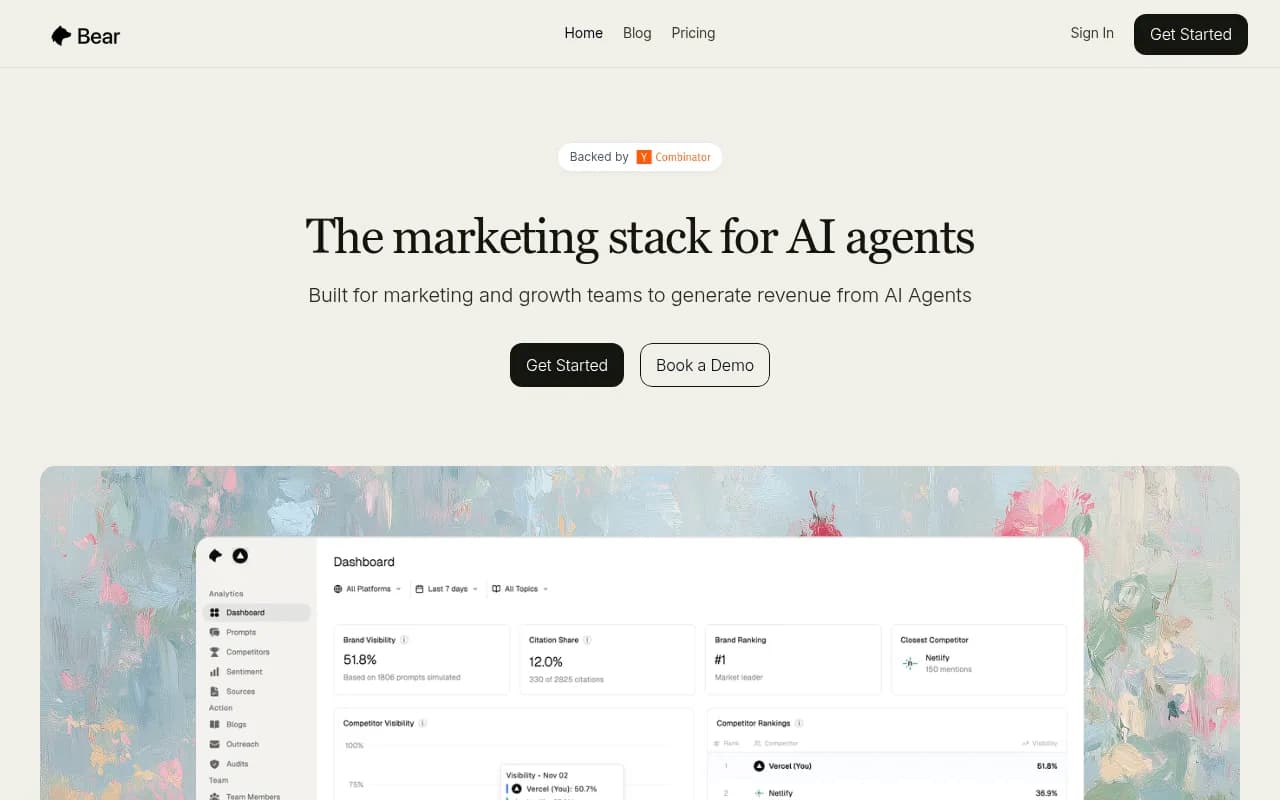
Bear AI's story is complicated by a significant product pivot. When it launched, Bear AI positioned itself as a marketing platform for AI agent traffic -- tracking how AI models like ChatGPT and Claude discover and recommend your brand, identifying high-intent visitors from AI sources, and providing tools to convert that traffic into leads. The original pricing started at $199/mo.
The current Bear AI website tells a different story. The product now describes itself as turning "real workflows into the foundation for dependable, domain-grounded agents" -- a dataset and AI agent infrastructure play, backed by Y Combinator. The lead generation features, AI model tracking, and brand visibility tools that were originally marketed are no longer the focus.
This makes a direct feature comparison difficult. What Bear AI was is not what Bear AI is now. For the purposes of this comparison, we'll cover what both products were designed to do in the AI visibility space, and be honest about where Bear AI currently stands.
Side-by-side comparison
| Feature | Ahrefs Brand Radar | Bear AI |
|---|---|---|
| Current product status | Active, maintained | Pivoted away from AI visibility |
| AI models tracked | 6 (ChatGPT, Perplexity, Gemini, etc.) | Was 2-6+; now unclear |
| Prompt database | 210M+ search-backed prompts | 75 custom prompts (Basic) |
| Custom prompts | Yes | Yes (was available) |
| Content generation | No | No |
| AI crawler logs | No | No |
| AI traffic attribution | No | Was advertised; now unclear |
| Lead generation tools | No | Was advertised; now unclear |
| Reddit/YouTube tracking | No | No |
| ChatGPT Shopping tracking | No | No |
| Competitor visibility | Yes | Limited |
| Standalone product | No (requires Ahrefs subscription) | Was standalone |
| Starting price | $398/mo add-on | $199/mo (historical) |
| Free trial | Yes (via Ahrefs) | Unclear |
| Best for | Existing Ahrefs users | N/A (pivoted) |
Head-to-head feature deep-dive
Prompt coverage and data scale
This is where Ahrefs Brand Radar has a genuine advantage -- and it's a big one. The 210M+ search-backed prompts means Brand Radar isn't just tracking the handful of queries you manually define. It pulls from Ahrefs' existing search data to surface prompts that real users are actually typing into AI tools, then checks whether your brand appears in the responses.
Bear AI's original approach was different: a smaller set of custom prompts (75 on the Basic plan) that you define yourself. This gives you more control over what you track, but you're limited by your own knowledge of what prompts matter. You can miss entire categories of queries where competitors are getting cited.
For prompt coverage, Ahrefs Brand Radar wins by a wide margin.
Verdict: Ahrefs Brand Radar
AI model coverage
Ahrefs Brand Radar covers 6 AI platforms. The exact list isn't fully public, but it includes the major ones: ChatGPT, Perplexity, Google AI Overviews, and Gemini. Bear AI originally tracked 2 models on its Basic plan and 6+ on Enterprise.
Six models is a reasonable number for most teams, though it's worth noting that tools like Promptwatch track 10+ models including DeepSeek, Grok, Meta AI, Mistral, and Copilot -- which matters if you're trying to understand your full AI search footprint.

Verdict: Ahrefs Brand Radar (active and verified)
Content optimization and the "what do I do now?" problem
Neither tool helps you fix the gaps they find. This is the core limitation of monitoring-only platforms: you get a dashboard showing where you're invisible, but no path to becoming visible.
Ahrefs Brand Radar shows you which prompts your brand appears in and which it doesn't. Bear AI (in its original form) showed you AI-sourced traffic and lead intent signals. Both stop there. There's no content gap analysis, no brief generation, no AI-optimized article creation.
If you want a tool that closes this loop -- finding gaps and then helping you create content to fill them -- you'd need to look elsewhere.
Verdict: Neither
AI traffic attribution and revenue connection
Bear AI's original differentiator was connecting AI visibility to actual revenue. It claimed to identify high-intent visitors arriving from AI sources and provide conversion tools to capture them as leads. This was a genuinely interesting angle that most AI visibility tools don't address.
Ahrefs Brand Radar doesn't do this. It's a visibility monitoring tool, not a traffic attribution tool. You can see that your brand appears in AI responses, but you can't see how many people clicked through or converted as a result.
Given Bear AI's pivot, it's unclear whether these features still exist in any form. The current website makes no mention of them.
Verdict: Bear AI (historically) -- but the feature may no longer exist
Setup and ease of use
Ahrefs Brand Radar delivers on its "zero setup" promise. If you have an Ahrefs account, you add Brand Radar and it starts working immediately, pulling from Ahrefs' existing data infrastructure. No crawler configuration, no prompt building from scratch.
Bear AI required more manual setup -- defining your brand, configuring prompts, connecting your website for traffic tracking. More control, but more work.
Verdict: Ahrefs Brand Radar
Integration with existing workflows
Ahrefs Brand Radar's biggest practical advantage is that it lives inside the Ahrefs platform. If your team already uses Ahrefs for keyword research, backlink analysis, and site audits, Brand Radar slots in naturally. You're not learning a new tool or managing another login.
Bear AI was a standalone platform with its own dashboard. For teams not already in the Ahrefs ecosystem, this might actually be preferable -- you're not locked into a larger subscription to access the feature you want.
Verdict: Depends on your stack -- Ahrefs Brand Radar for existing Ahrefs users, standalone tools for everyone else
Pricing comparison
| Plan | Ahrefs Brand Radar | Bear AI |
|---|---|---|
| Entry point | $398/mo (add-on only) | $199/mo (Basic, historical) |
| Required base subscription | Yes (~$129/mo minimum) | No |
| True minimum cost | ~$527/mo | $199/mo (historical) |
| Mid-tier | $699/mo (all platforms) | Custom (historical) |
| Enterprise | Custom | Custom |
| Free tier | No | No |
| Annual discount | Yes | Unknown |
The pricing picture for Ahrefs Brand Radar is more expensive than it looks at first glance. The $398/mo add-on price assumes you're already paying for an Ahrefs subscription. The Ahrefs Lite plan starts at $129/mo, so the realistic minimum to access Brand Radar is around $527/mo. If you need the full platform coverage (all 6 AI tools), you're at $699/mo for Brand Radar alone, plus your base Ahrefs subscription.
Bear AI's $199/mo starting price was more accessible, but the product has pivoted and current pricing isn't publicly listed.
Pros and cons
Ahrefs Brand Radar
Pros:
- Massive prompt database (210M+) means broad coverage without manual prompt building
- Zero setup for existing Ahrefs users
- Backed by Ahrefs' established web index and data infrastructure
- Competitor visibility tracking included
- Active, maintained product with a clear roadmap
Cons:
- Requires an existing Ahrefs subscription -- not a standalone tool
- True cost is $527+/mo minimum, which is steep for AI visibility alone
- No content generation or optimization features
- No AI crawler logs or traffic attribution
- Fixed prompt approach limits customization compared to some dedicated tools
- 6 AI models is decent but not comprehensive
Bear AI
Pros:
- Originally had an interesting angle on AI traffic attribution and lead conversion
- Lower entry price ($199/mo historically)
- Standalone product -- no required base subscription
- Y Combinator backing suggests credible founding team
Cons:
- Product has pivoted away from AI visibility entirely
- Current website describes a completely different product (enterprise workflow datasets)
- Feature availability for original AI marketing use cases is unclear
- No content generation or optimization
- Small prompt set (75 on Basic) limited coverage
- Only 2 AI models on the entry plan
Who should pick which tool
Choose Ahrefs Brand Radar if:
- You're already paying for Ahrefs and want to add AI visibility monitoring without switching platforms
- You want broad prompt coverage without manually building a prompt library
- Your team is primarily SEO-focused and AI visibility is a secondary concern
- You can absorb the $527+/mo combined cost
Don't choose Ahrefs Brand Radar if:
- You want a standalone AI visibility tool without the Ahrefs overhead
- You need content generation or optimization features
- You want AI crawler logs, traffic attribution, or revenue connection
- You need coverage beyond 6 AI models
Choose Bear AI if:
- You're building enterprise AI agents and need real workflow datasets (the current product)
- You were an existing customer and have a relationship with the team
Don't choose Bear AI if:
- You want AI brand visibility monitoring in 2026 -- the product no longer does this
- You need reliable, maintained AI search tracking features
Final verdict
This comparison has an unusual answer: for AI visibility tracking in 2026, Ahrefs Brand Radar wins by default, because Bear AI is no longer competing in this space.
Ahrefs Brand Radar is a solid monitoring tool with real data scale behind it. The 210M+ prompt database is a genuine differentiator, and the zero-setup experience for existing Ahrefs users is genuinely convenient. But it's expensive when you factor in the required base subscription, and it stops at monitoring -- there's no path from "here's where you're invisible" to "here's how to fix it."
Bear AI made an interesting bet on connecting AI visibility to revenue conversion, but that product no longer exists in its original form. If you came here trying to decide between these two for AI search tracking, the decision is already made for you.
If the cost of Ahrefs Brand Radar gives you pause, or if you want a tool that goes beyond monitoring to actually help you create content that ranks in AI search, it's worth looking at purpose-built GEO platforms before committing.