Key takeaways
- Google AI Overviews have no official eligibility list, but there are clear signals that make a site more or less likely to be cited
- New websites face a trust gap -- technical foundations, crawlability, and content quality all need to be in place before AI visibility is even possible
- Structured data, E-E-A-T signals, and direct question-answering content are the three biggest levers for new sites
- Ranking in traditional search still correlates with AI Overview inclusion, but it's not a guarantee
- Tracking whether you're actually appearing in AI Overviews requires dedicated tooling -- Google Search Console alone won't show you the full picture
Google AI Overviews are now the dominant feature on the search results page for millions of queries. They sit above organic results, summarize answers, and cite sources. For a new website, the question isn't just "how do I rank?" -- it's "am I even in the running to be cited?"
The honest answer is: maybe not yet. And that's not a bad thing to know early.
This guide walks through the actual eligibility signals for Google AI Overviews in 2026, what new sites are typically missing, and what you need to fix before any optimization effort will matter.
What "eligible" actually means for AI Overviews
Google hasn't published a formal eligibility checklist. There's no application, no minimum domain age requirement written in a help doc, and no guaranteed path. What Google has said -- through documentation, quality guidelines, and Search Central guidance -- is that AI Overviews pull from content that is "clearly structured, demonstrably authoritative, directly answers the query, and trustworthy."
That's vague on purpose. But in practice, the signals break down into four categories:
- Technical accessibility (can Google actually read your site?)
- Content quality and structure (does your content answer questions clearly?)
- Authority and trust signals (does Google have reason to trust you?)
- Query relevance (are you targeting the right types of prompts?)
A new website typically has gaps in all four. Let's go through each one.
Technical foundations checklist
This is where most new sites fail silently. Google's AI systems can't cite what they can't read.
Crawlability and indexation
Before anything else, confirm that Google can access your pages:
- Your
robots.txtfile isn't blocking Googlebot (or GPTBot, ClaudeBot, or other AI crawlers) - Your pages are indexed -- check via
site:yourdomain.comin Google or use Google Search Console - You have an XML sitemap submitted to Google Search Console
- No
noindextags are accidentally applied to key pages - Internal linking connects your pages so crawlers can discover them
One thing new sites often miss: AI crawlers like GPTBot and ClaudeBot follow separate rules from Googlebot. If you've blocked these in robots.txt, you may be invisible to AI systems even if Google indexes you fine. Check your robots.txt explicitly.
Page speed and Core Web Vitals
Slow pages get crawled less frequently and rank lower. Lower rankings correlate with lower AI Overview inclusion. Use Google PageSpeed Insights to check your Core Web Vitals -- specifically LCP (Largest Contentful Paint) and CLS (Cumulative Layout Shift).
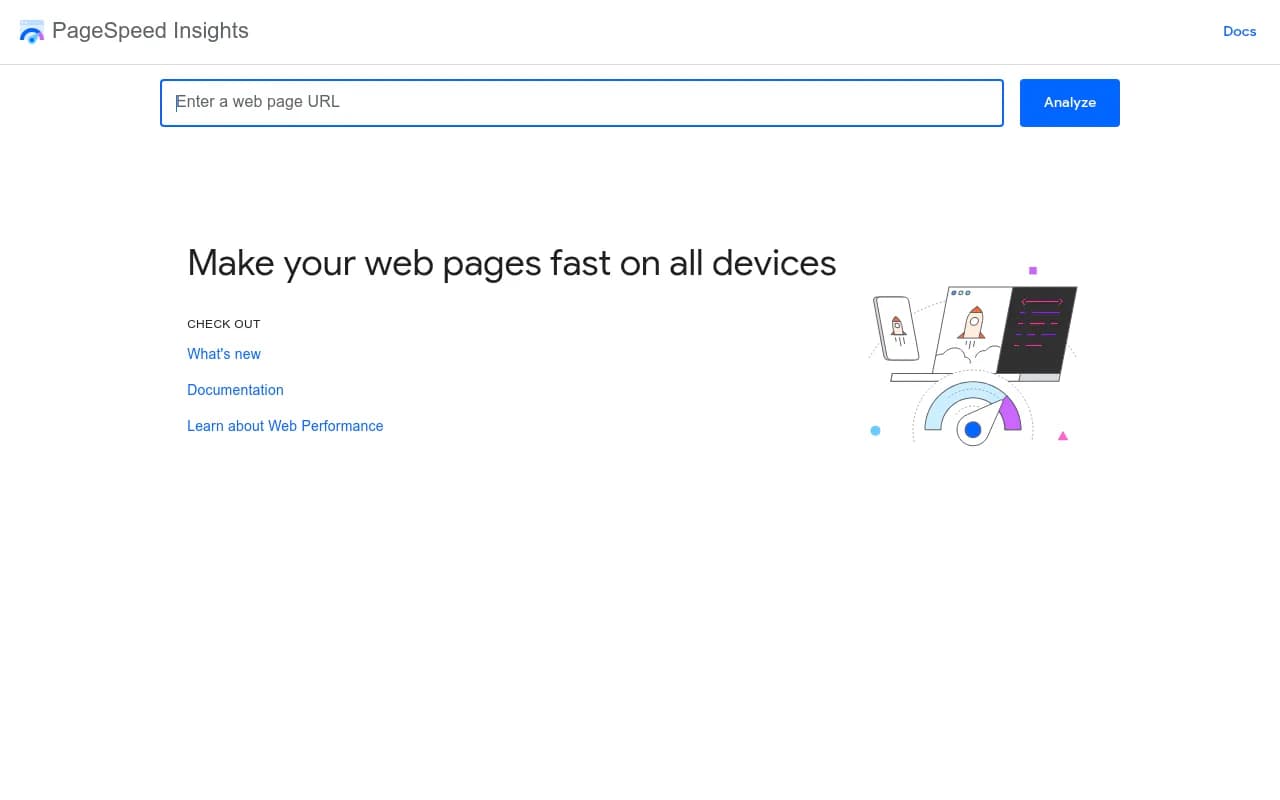
A score below 50 on mobile is a red flag. Fix it before worrying about content optimization.
HTTPS and security
Your site needs to be on HTTPS. This is table stakes in 2026 -- any new site without SSL is essentially invisible to trust signals.
JavaScript rendering
If your site is built on a JavaScript-heavy framework (React, Vue, Angular) without server-side rendering, Google may not be reading your content properly. AI systems in particular struggle with client-side rendered content. Use Google's URL Inspection tool in Search Console to see what Googlebot actually renders when it visits your pages.
Tools like Screaming Frog SEO Spider can help you audit what's actually crawlable.
Content quality checklist
Technical access is necessary but not sufficient. The content itself has to meet a higher bar for AI Overview inclusion than for traditional ranking.
Direct question answering
AI Overviews are built to answer questions. Content that wins citations tends to answer specific questions clearly and early -- not buried in paragraph five after three paragraphs of preamble.
For each page, ask: "What question does this page answer?" If you can't state it in one sentence, the page probably won't be cited. Structure your content so the answer appears in the first 100-150 words, then expand with supporting detail.
Clear structure and formatting
Google's AI systems parse structure. Use:
- H2 and H3 headings that reflect actual questions or topics
- Short paragraphs (2-4 sentences)
- Numbered lists for steps and processes
- Bullet lists for options and comparisons
- Tables for comparisons and data
Walls of text don't get cited. Structured content does.
Depth and completeness
There's a difference between a thin 400-word post and a genuinely comprehensive answer. AI Overviews tend to cite pages that cover a topic thoroughly -- not just the surface-level answer but the nuance, the caveats, the related questions.
For new sites, this means fewer pages done well beats many pages done poorly. Publish 10 genuinely useful, well-structured pieces before publishing 100 mediocre ones.
Long-tail and specific queries
Broad, competitive queries ("best CRM software") are dominated by established domains. New sites have a realistic shot at AI Overview inclusion for specific, long-tail queries where the competition is weaker and the question is precise.
Target questions like "how do I set up [specific thing] for [specific use case]" rather than generic category terms. The more specific the query, the more likely a clear, direct answer gets cited -- regardless of domain age.
Authority and trust signals checklist
This is the hardest part for new websites, and it's the most honest answer to "why am I not showing up."
E-E-A-T signals
Google's quality rater guidelines emphasize Experience, Expertise, Authoritativeness, and Trustworthiness (E-E-A-T). For AI Overviews, these signals matter because Google is staking its reputation on the answers it surfaces. It won't cite a source it doesn't trust.
For a new site, E-E-A-T signals to build include:
- Author bylines with real names and credentials
- About pages that explain who runs the site and why they're qualified
- Contact information (physical address, email, phone where relevant)
- Clear editorial standards or methodology pages for data-driven content
- Links from other credible sites in your niche
Backlink profile
A brand-new site with zero backlinks is a site Google has no external evidence to trust. You don't need hundreds of links -- but you need some. A handful of genuine mentions from relevant, established sites signals that real people in your industry have found your content worth referencing.
Guest posts, industry directories, podcast appearances, and PR coverage all contribute. The goal isn't volume -- it's relevance and credibility.
Brand mentions and entity recognition
Google increasingly understands entities -- brands, people, organizations -- not just keywords. If your brand is mentioned across the web (in forums, news articles, social media, other websites), Google builds a richer picture of who you are.
For new sites, this means getting your brand mentioned in places beyond your own domain. Contribute to Reddit threads in your niche. Get quoted in industry publications. Be active in communities where your target audience spends time.
Reviews and social proof
For commercial sites, reviews on third-party platforms (Google Business Profile, Trustpilot, G2, Capterra) contribute to trust signals. A site with zero external reviews looks unproven.
Structured data checklist
Structured data doesn't guarantee AI Overview inclusion, but it makes your content significantly easier for Google to parse and categorize.
Schema markup priorities for new sites
- Article schema: For blog posts and editorial content
- FAQPage schema: Directly maps to the question-answering format AI Overviews use
- HowTo schema: For step-by-step content
- Organization schema: Establishes your brand as an entity
- BreadcrumbList schema: Helps Google understand your site structure
FAQPage schema is particularly worth implementing. It explicitly tells Google "here are questions and answers" -- which is exactly what AI Overviews are looking for.
Use Google's Rich Results Test to verify your schema is valid before publishing.
Query type checklist
Not all queries trigger AI Overviews. Knowing which types do -- and targeting them -- is a practical shortcut for new sites.
Query types that commonly trigger AI Overviews
- "How to" and instructional queries
- "What is" definitional queries
- Comparison queries ("X vs Y")
- "Best [category] for [use case]" queries
- Multi-step process explanations
- Questions with clear, factual answers
Query types that rarely trigger AI Overviews
- Breaking news and time-sensitive queries
- Highly controversial or YMYL (Your Money Your Life) topics where Google is cautious
- Navigational queries (people searching for a specific brand or site)
- Very simple one-word queries
New sites should build their initial content calendar around the first category. Target questions your audience is actually asking, structure the answers clearly, and you're in the right lane.
The gap most new sites don't know about
Here's something that doesn't show up in most checklists: you can do everything right and still not know if you're appearing in AI Overviews, because standard analytics won't tell you.
Google Search Console shows impressions and clicks for traditional results. It doesn't give you a clean breakdown of AI Overview citations. Traffic from AI Overviews can look like direct traffic or organic traffic depending on how the user interacts with the result.
This is where dedicated AI visibility tracking becomes necessary. Tools like Promptwatch track exactly which queries trigger AI Overviews, whether your site is being cited, and how your visibility compares to competitors -- across Google AI Overviews and other AI search engines.

Without this kind of tracking, you're optimizing blind. You might be appearing in AI Overviews for some queries and missing entirely on others, with no way to know which content is working.
Comparison: what new sites typically have vs. what AI Overviews require
| Signal | Typical new site | What AI Overviews need |
|---|---|---|
| Crawlability | Often incomplete | Full access, no blocking |
| Indexed pages | Few or none | Core pages indexed |
| Structured data | Usually missing | FAQPage, Article, HowTo |
| Backlinks | Zero or near-zero | At least some credible links |
| E-E-A-T signals | Minimal | Author bios, about pages, credentials |
| Content depth | Variable | Comprehensive, question-focused |
| Page speed | Often slow | Core Web Vitals passing |
| Brand mentions | None | Mentions across web |
| AI crawler access | Unknown | GPTBot/ClaudeBot not blocked |
Most new sites have gaps in 5-7 of these. That's not a reason to panic -- it's a roadmap.
A realistic timeline for new sites
There's no shortcut here. A brand-new site targeting AI Overview inclusion should expect:
- Weeks 1-4: Technical foundations (crawlability, schema, speed, HTTPS)
- Months 1-3: Content foundation (10-20 well-structured, question-answering pieces)
- Months 2-4: Authority building (backlinks, brand mentions, author credibility)
- Months 3-6: First AI Overview appearances for long-tail, low-competition queries
- Months 6+: Broader visibility as trust accumulates
This is roughly the same timeline as traditional SEO, with the added requirement that content structure and question-answering quality matter more than keyword density ever did.
Tools to track and accelerate your progress
Beyond the checklist itself, a few tools make the process faster and more measurable.
For content research and optimization:

For technical SEO auditing:
For AI visibility tracking specifically:
Otterly.AI

For structured data and entity optimization:
The bottom line
New websites aren't automatically excluded from Google AI Overviews -- but they're starting from a significant deficit on most of the signals that matter. The good news is that the checklist is concrete: fix the technical foundations, build content that directly answers questions, establish credibility signals, and implement structured data.
The less comfortable truth is that domain age and accumulated trust are real factors. A site launched last month is competing against sites that have been building authority for years. The path forward is to target narrow, specific queries where that authority gap is smaller, execute the fundamentals well, and track your actual AI visibility rather than guessing.
Start with what you can control today -- crawlability, content structure, and schema markup -- and build from there.