AnswerThePublic Review 2026
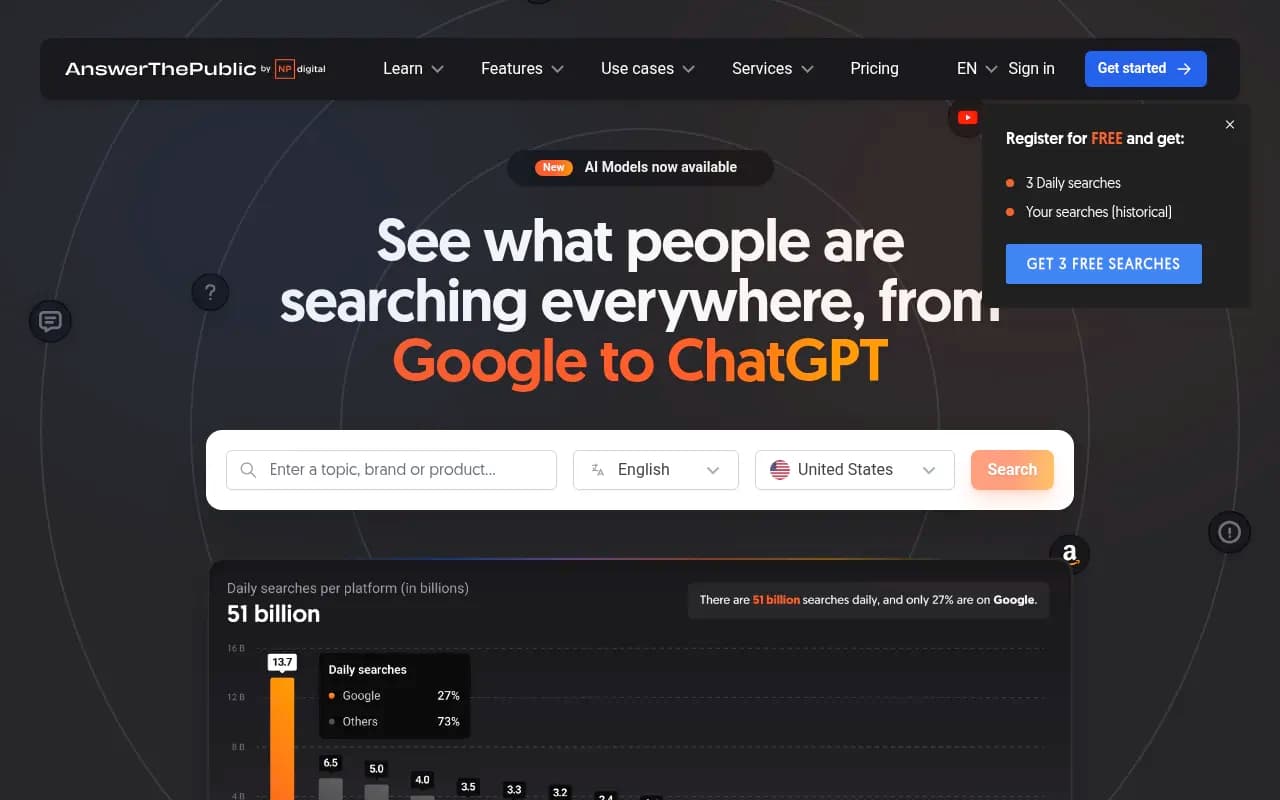
AnswerThePublic transforms autocomplete data from Google and other search engines into visual maps of questions, prepositions, and comparisons people actually search for. Used by 2.7M+ marketers, content creators, and SEO professionals to discover untapped content ideas, understand customer intent,
Key Takeaways:
• Best for content ideation and keyword research -- generates hundreds of real search queries visualized as interactive wheels and lists, perfect for filling content calendars and discovering long-tail opportunities • Covers multiple platforms -- pulls data from Google, Bing, YouTube, Amazon, TikTok, and now AI models like ChatGPT, giving a comprehensive view of search behavior across channels • Freemium model with limitations -- free users get 1 search per day; paid plans start at $99/mo for unlimited searches, CSV exports, and historical comparison features • Honest limitation -- doesn't provide search volume data in lower tiers, so you'll need to pair it with tools like Google Keyword Planner or Ahrefs for traffic estimates • Ideal for agencies, content teams, and solo creators who need fast inspiration and customer language insights without getting lost in spreadsheets
AnswerThePublic has been a staple in content marketers' toolkits since its launch in 2014 by UK-based startup Contently (later acquired by NP Digital in 2021). The tool's premise is simple but powerful: it scrapes autocomplete suggestions from search engines and organizes them into visual maps that show exactly what questions, comparisons, and phrases people type when searching for a topic. Instead of manually typing dozens of seed keywords into Google to see what autocompletes, AnswerThePublic does it automatically and presents the results in a format that's both comprehensive and easy to scan.
The tool has become particularly popular among content strategists, SEO specialists, digital agencies, and solo bloggers who need to generate content ideas quickly. It's also used by product teams and customer research departments to understand the language customers use when describing problems or searching for solutions. With over 2.7 million users (according to their homepage), AnswerThePublic has carved out a niche as the go-to tool for visualizing search intent -- even as competitors like AlsoAsked, Exploding Topics, and Semrush's Keyword Magic Tool have entered the space.
Search Data Sources & Platform Coverage
AnswerThePublic pulls autocomplete data from multiple sources, not just Google. You can run searches against Google, Bing, YouTube, Amazon, TikTok, and Instagram. As of 2026, they've added AI model data -- meaning you can now see what questions people are asking ChatGPT, Claude, and other LLMs. This multi-platform approach is a major differentiator. Most keyword tools focus exclusively on Google search, but AnswerThePublic recognizes that search behavior varies by platform. Someone searching YouTube for "how to fix a leaky faucet" might use different phrasing than someone Googling the same problem. The tool supports 16 languages and lets you filter by country, so you can tailor results to specific markets (e.g., "trainers" in the UK vs "sneakers" in the US).
Visualization Formats: Wheels, Lists, and Data Views
The signature feature is the search visualization wheel -- a radial diagram that places your keyword in the center and branches out into questions (who, what, where, when, why, how), prepositions (for, with, to, near, without), comparisons (vs, versus, or, and, like), and alphabetical variations. It's visually striking and makes it easy to spot patterns at a glance. For example, searching "protein powder" might reveal clusters around "protein powder for weight loss", "protein powder without artificial sweeteners", and "protein powder vs collagen" -- each representing a distinct content angle or customer concern.
Beyond the wheel, you can switch to a list view that organizes results by category, or a data view that shows all queries in a simple table. Paid users can export results as CSV files for further analysis or import into content management systems. The tool also highlights new or trending queries with a "New" badge, helping you spot emerging topics before competitors do.
Search Volume and Keyword Metrics (or Lack Thereof)
Here's where AnswerThePublic shows its limitations compared to full-featured SEO platforms. The free and Individual plans don't include search volume data -- you see the questions people ask, but not how many people are asking them. The Pro and Expert plans add search volume bars (visual indicators of relative popularity), but even then, you're not getting precise monthly search volume numbers like you would from Ahrefs, Semrush, or Google Keyword Planner. This means AnswerThePublic works best as a discovery tool, not a prioritization tool. You'll still need to cross-reference promising queries in a keyword research platform to estimate traffic potential and competition.
That said, the lack of volume data can actually be a feature for certain use cases. If you're brainstorming content ideas or trying to understand the full scope of customer questions around a topic, seeing every query (regardless of volume) helps you avoid tunnel vision. Some of the best content opportunities are low-volume, high-intent queries that bigger tools filter out.
Monitoring and Alerts for Ongoing Research
Paid plans include monitoring features that let you save searches and receive alerts when new questions or phrases appear. This is particularly useful for brand monitoring (e.g., tracking how people talk about your product over time) or staying on top of seasonal trends. You can compare search results from different time periods to see how language and intent shift -- for example, "best running shoes" might spike with "for winter" queries in November and "for marathon training" in March. The comparison view overlays two datasets so you can spot new queries, disappeared queries, and changes in question frequency.
Who Should Use AnswerThePublic
AnswerThePublic is ideal for content marketers at small-to-midsize companies (10-100 employees) who need to produce a steady stream of blog posts, videos, or social content. It's also popular with freelance writers and consultants who bill clients for content strategy and need a fast way to demonstrate customer research. Digital agencies use it during discovery phases to map out content pillars and identify gaps in a client's existing content. Product marketers and UX researchers use it to understand how customers describe pain points and compare solutions.
It's less suited for enterprise SEO teams that need granular keyword data, SERP analysis, and rank tracking. If you're managing a site with 10,000+ pages and need to prioritize keywords by traffic potential and difficulty, you'll outgrow AnswerThePublic quickly. It's also not ideal for local SEO (no "near me" or city-level filtering beyond country selection) or e-commerce teams that need product-specific keyword data with commercial intent signals.
Integrations and Workflow Fit
AnswerThePublic doesn't integrate directly with other tools via API or native connectors, which is a notable gap compared to platforms like Semrush or Ahrefs. You can export CSVs and manually import them into Google Sheets, Airtable, or your content management system, but there's no automated workflow. Some users build Zapier workarounds to trigger exports on a schedule, but this requires technical setup. The lack of integrations means AnswerThePublic works best as a standalone research tool rather than part of an automated SEO stack.
Pricing Breakdown
AnswerThePublic offers a freemium model with four tiers:
• Free: 1 search per day, no exports, no historical data, no search volume indicators. Good for occasional use or testing the tool. • Individual ($99/mo): Unlimited searches, CSV exports, comparison view, search volume bars, monitoring and alerts. Best for solo creators or small teams. • Pro ($199/mo): Everything in Individual, plus priority support, team collaboration features, and advanced filtering. Aimed at agencies and in-house teams. • Expert ($399/mo): Everything in Pro, plus API access (limited), white-label reports, and dedicated account management. For larger agencies or enterprises.
Annual billing discounts are available (roughly 20% off). Compared to Semrush ($129/mo starting) or Ahrefs ($129/mo starting), AnswerThePublic is cheaper at the entry level but offers far fewer features. It's a specialized tool, not an all-in-one SEO platform. The pricing is reasonable if you're specifically looking for question-based keyword research and don't need backlink analysis, rank tracking, or site audits.
Strengths
• Visual clarity: The wheel format makes it easy to spot content gaps and understand the full scope of a topic at a glance. It's more intuitive than scrolling through keyword lists. • Multi-platform coverage: Pulling data from YouTube, Amazon, TikTok, and AI models gives you a broader view of search behavior than Google-only tools. • Speed: You can generate hundreds of content ideas in under a minute. No need to manually explore autocomplete suggestions or build complex keyword lists. • Customer language insights: Seeing the exact phrasing people use helps you write content that matches search intent and resonates with your audience. • Monitoring and alerts: Track how search behavior evolves over time, which is valuable for trend spotting and brand monitoring.
Limitations
• No search volume in lower tiers: Without volume data, it's hard to prioritize which queries to target first. You'll need a second tool for traffic estimates. • Limited keyword metrics: No keyword difficulty scores, SERP analysis, or competitive data. It's purely a discovery tool. • No integrations: Exporting CSVs and manually importing them into other tools adds friction to your workflow. • Autocomplete dependency: The tool only shows queries that appear in autocomplete, which means it misses low-volume or brand-new queries that haven't been typed enough times to trigger suggestions. • Not ideal for local SEO: Country-level filtering is available, but you can't drill down to city or regional search behavior.
Bottom Line
AnswerThePublic excels at one thing: helping you understand what questions people ask about a topic and visualizing that data in a way that sparks content ideas. It's fast, intuitive, and covers more platforms than most keyword tools. If you're a content creator, blogger, or small agency that needs to fill a content calendar with topics that match real search intent, it's a solid investment at $99/mo. However, if you need search volume data, keyword difficulty scores, or rank tracking, you'll need to pair it with a more comprehensive SEO tool like Ahrefs, Semrush, or Promptwatch (for AI search visibility). AnswerThePublic is best used as a discovery layer in your research stack, not a replacement for full-featured SEO platforms.
Tags:
Similar and alternative tools to AnswerThePublic