Gracker AI Review 2026
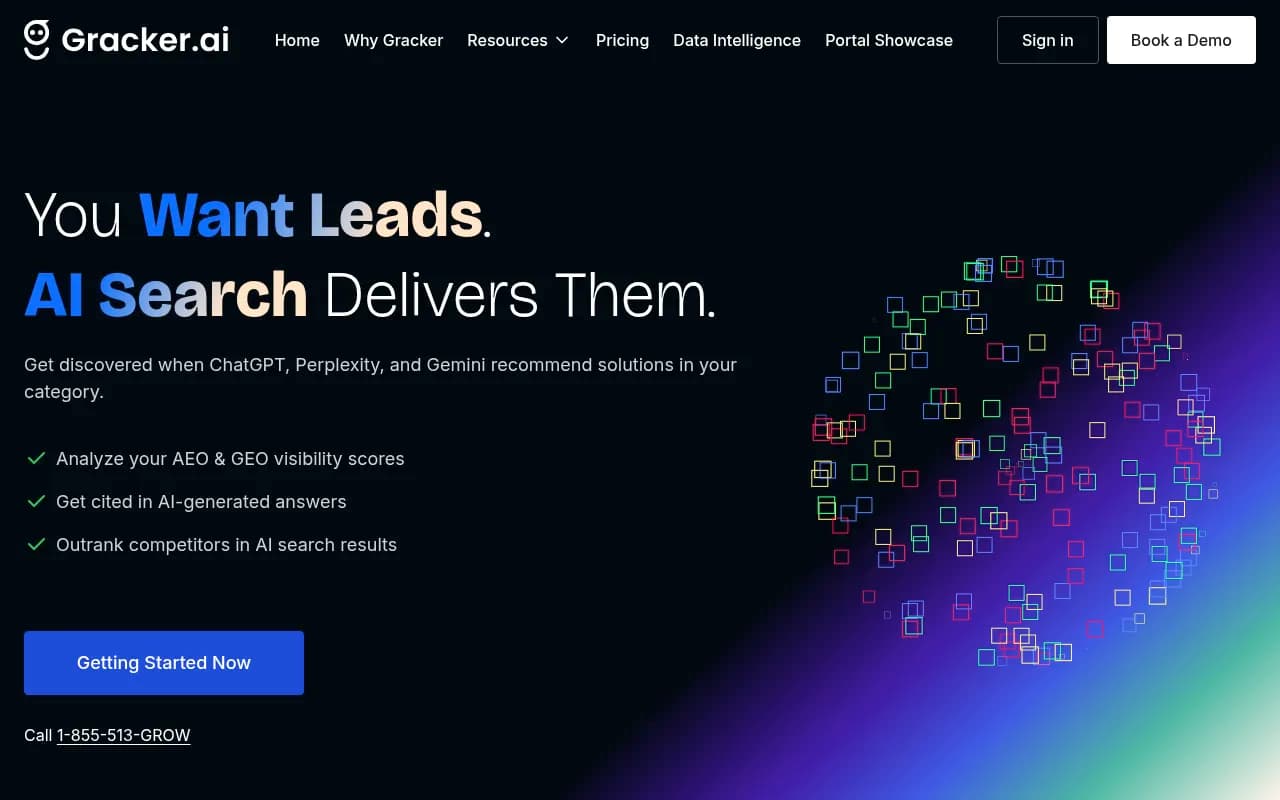
AEO tool that helps brands optimize their content for answer engines and track visibility in AI-generated responses.
Key Takeaways:
- Autopilot content engine: Automatically generates thought leadership articles, listicles, and comparison pages optimized for AI citation—no marketing team required
- Real-time AI visibility tracking: Monitors how often ChatGPT, Perplexity, Claude, Gemini, and Copilot mention your brand vs competitors with weekly visibility scores
- Fast results: Most customers see initial AI visibility improvements within 4-6 weeks, with 60% average increase in visibility scores within 90 days
- Built for lean teams: Designed specifically for startup founders and small B2B SaaS marketing teams who need AI search presence without hiring content writers
- Limitations: Focused exclusively on B2B SaaS (not suitable for e-commerce or local businesses), newer platform with smaller user base than established SEO tools
Gracker AI is a specialized Answer Engine Optimization (AEO) and Generative Engine Optimization (GEO) platform built specifically for B2B SaaS companies. Founded to address the shift from traditional Google search to AI-powered answer engines, Gracker AI helps software companies get discovered when potential buyers ask ChatGPT, Perplexity, Claude, or Gemini questions like "What's the best CRM for small businesses?" or "Top project management tools for remote teams." The platform combines AI visibility monitoring with automated content generation—tracking where your brand appears in AI responses while simultaneously creating optimized content designed to increase those citations.
The core insight behind Gracker AI is that AI search users have 3x higher purchase intent than traditional search traffic. When someone asks an AI assistant for product recommendations, they're typically in active buying mode, not just browsing. The problem: most B2B companies have zero AI search visibility because they're still optimizing exclusively for Google's traditional blue links. Gracker AI solves this by analyzing what makes AI engines cite certain brands, then automatically creating content that matches those patterns.
AI Visibility Monitoring & Competitive Analysis
Gracker AI tracks your brand's presence across ChatGPT, Perplexity, Claude, Gemini, and Microsoft Copilot. The platform generates weekly visibility scores showing how often these AI engines mention your brand when answering category-relevant queries. This isn't just vanity metrics—you see exactly which prompts trigger citations, how your visibility trends over time, and where you rank vs competitors. The competitive analysis feature shows precisely where competitors are getting cited and you're not, identifying content gaps and opportunities to capture AI search share in your category. For B2B SaaS founders tracking 5-10 direct competitors, this competitive intelligence is particularly valuable—you can see which content types (listicles, comparisons, thought leadership) are driving competitor citations and prioritize accordingly.
Autopilot Content Generation (Three Content Types)
The platform's standout feature is its autopilot content engine, which automatically creates three types of AI-optimized content:
Authoritative Thought Leadership Articles: The system generates expert-level articles on topics relevant to your category, designed to establish your brand as a trusted authority that AI engines reference. These aren't generic blog posts—they're structured to answer the specific questions AI models look for when building responses. For example, if you're a project management tool, Gracker AI might create articles on "How remote teams manage async workflows" or "The evolution of agile methodology in distributed teams." The content is written to demonstrate expertise and provide the kind of comprehensive, nuanced answers that AI engines prefer to cite.
Autopilot Listicles: Gracker AI automatically creates "Top 10" and "Best of" articles at scale—the exact content format that AI engines use to answer buyer queries. When someone asks ChatGPT "What are the best email marketing tools?", the AI often pulls from listicle-style content. Gracker AI generates these systematically, ensuring your product appears in the listicles that AI engines reference. The platform handles research, competitor analysis, feature comparisons, and positioning—you just review and approve.
Autopilot Alternatives & Comparisons: The system generates comparison pages ("Tool A vs Tool B") and alternative guides ("Top 5 Alternatives to [Competitor]") automatically. This captures high-intent traffic from buyers actively comparing solutions. When prospects ask AI assistants "What are alternatives to [your competitor]?", you want your brand in that response. Gracker AI creates the comparison content that makes that happen, complete with feature tables, pricing breakdowns, and use case recommendations.
All three content types run on autopilot—the platform handles strategy, creation, and can even publish directly to your site. For startup founders wearing multiple hats, this is the key value proposition: set it up once, review content weekly, and let the system handle the rest.
Programmatic SEO (pSEO) Portals
Gracker AI includes programmatic SEO capabilities for creating large-scale content portals. You can generate hundreds or thousands of pages targeting long-tail keywords and AI search queries—things like "[Tool Category] for [Industry]" or "[Use Case] software for [Company Size]". The platform offers static portals (pre-generated pages) and real-time portals (dynamic pages generated on-demand). This is particularly useful for SaaS companies targeting multiple verticals or use cases. For example, a CRM might create portals for "CRM for real estate agents," "CRM for insurance brokers," "CRM for nonprofits," etc. The pSEO engine handles page generation, internal linking, and optimization for both traditional SEO and AI citation.
Content Gap Identification
When you connect your domain, Gracker AI scans how AI search engines currently perceive your brand and identifies content gaps—topics, angles, and question patterns where competitors are visible but you're not. The platform shows you exactly what content is missing from your site that would improve AI visibility. This isn't guesswork; it's based on analysis of actual AI responses and competitor citations. For lean marketing teams, this gap analysis provides a clear content roadmap: here's what to create, in what order, to maximize AI visibility gains.
Weekly Reporting & Trend Analysis
The platform provides weekly AI visibility reports showing citation trends, new mentions, lost mentions, and visibility score changes. You can see which content pieces are driving citations, which AI engines are mentioning you most, and how your visibility compares to competitors over time. The reporting is designed for non-technical users—founders and marketers who need actionable insights, not data dumps. The trend analysis helps you understand what's working: if a particular listicle drove a spike in Perplexity citations, you know to create more content in that format.
Who Is Gracker AI For
Gracker AI is purpose-built for B2B SaaS companies, particularly startups and scale-ups with lean marketing teams. The ideal user is a founder or solo marketer at a software company with 10-100 employees who needs AI search visibility but doesn't have the resources to hire a content team. Specific personas include:
Startup Founders (Pre-Series A): Solo founders or founding teams wearing multiple hats who need marketing automation. They understand that AI search is where buyers are researching solutions but don't have time to manually create content. Gracker AI's autopilot handles content strategy and creation, requiring only weekly review and approval.
Growth-Stage SaaS Marketers (Series A-B): Marketing managers at 20-100 person SaaS companies who are responsible for inbound lead generation. They're already doing SEO and content marketing but recognize that AI search is a new channel they need to own. Gracker AI complements their existing efforts by specifically targeting AI visibility while they focus on traditional channels.
B2B SaaS in Competitive Categories: Companies in crowded markets (CRM, project management, marketing automation, dev tools) where traditional SEO is saturated. AI search offers a new way to get discovered, and Gracker AI helps them capture that opportunity before competitors do.
Who Should NOT Use Gracker AI: E-commerce brands, local businesses, B2C companies, and enterprise software with long sales cycles (12+ months) where AI search isn't a primary research channel. The platform is optimized for B2B SaaS with 1-6 month sales cycles where buyers actively use AI assistants to research and compare solutions. If your customers aren't asking ChatGPT or Perplexity for product recommendations, Gracker AI isn't the right fit.
Integrations & Technical Capabilities
Gracker AI integrates with your existing website/CMS for content publishing. The platform can publish directly to WordPress, Webflow, and other common CMS platforms, or you can export content and publish manually. The pSEO portal feature can be deployed as a subdomain or subdirectory on your main site. There's API access on higher-tier plans for custom integrations and programmatic content generation. The platform doesn't currently integrate with traditional SEO tools like Google Search Console or Ahrefs, which is a limitation—you'll need to track traditional SEO performance separately. GitHub presence suggests some developer tooling and open-source components (they maintain a "Cyber Pulse" project and security news intelligence repo), though these appear to be side projects rather than core product features.
Pricing & Value
Gracker AI offers a freemium model with four tiers:
Free Plan: Includes basic AI visibility analysis—you can see your current AEO/GEO scores, competitor benchmarks, and content opportunities. This is essentially a diagnostic tool to understand your starting point. No credit card required, good for evaluating whether AI search is relevant for your business.
Starter Plan (pricing not publicly listed, appears to be low three figures monthly based on market positioning): Includes AI visibility monitoring across major engines, limited autopilot content generation (likely 4-8 articles/month), and basic pSEO portal capabilities. Suitable for early-stage startups testing AI search as a channel.
Growth Plan (pricing not publicly listed, likely mid three figures monthly): Expanded content generation (15-25 articles/month), full autopilot across all three content types (thought leadership, listicles, comparisons), advanced competitive analysis, and enhanced pSEO portals. This is the sweet spot for growth-stage SaaS companies serious about AI visibility.
Scale Plan (enterprise pricing): Unlimited AI visibility tracking, high-volume content generation, real-time pSEO portals, API access, and custom integrations. For larger SaaS companies or agencies managing multiple brands.
Value proposition: Gracker AI is priced significantly lower than hiring a content writer ($4,000-8,000/month for a full-time writer) or content agency ($5,000-15,000/month retainer). For a startup that needs 15-20 AI-optimized articles per month, the Growth plan delivers that at a fraction of the cost of traditional content creation. The ROI case is straightforward: if AI search drives even 10-15 qualified leads per month at a $50-100 CAC reduction (vs paid ads), the platform pays for itself.
Compared to competitors like Promptwatch (which focuses on monitoring and optimization with built-in content generation) or Otterly.AI and Peec.ai (monitoring-only platforms), Gracker AI sits in the middle—more automated content generation than pure monitoring tools, but less comprehensive tracking and optimization features than full-stack platforms like Promptwatch. The trade-off: Gracker AI is simpler and more accessible for non-technical users who just want content automation, while platforms like Promptwatch offer deeper analytics, crawler logs, and citation-level tracking for teams that want to understand the mechanics of AI visibility.
Strengths
Autopilot Content at Scale: The ability to generate 15-30 AI-optimized articles per month without a content team is Gracker AI's core strength. For resource-constrained startups, this is transformative—you get consistent content output that would otherwise require hiring.
B2B SaaS Focus: Unlike general-purpose SEO tools trying to serve all markets, Gracker AI is laser-focused on B2B SaaS. The content templates, competitive analysis, and visibility tracking are all tuned for software companies, which means less configuration and faster time-to-value.
Fast Results: The claim of 4-6 weeks to initial visibility improvements is credible and faster than traditional SEO (which often takes 3-6 months). AI engines update their knowledge more frequently than Google's index, so well-optimized content can get cited quickly.
Programmatic SEO Capabilities: The pSEO portal feature is a bonus—most AEO platforms don't offer this. For SaaS companies targeting multiple verticals or use cases, being able to generate hundreds of landing pages automatically is valuable for both traditional SEO and AI visibility.
No Marketing Team Required: The platform genuinely delivers on this promise. A solo founder can set up Gracker AI, configure content topics, and let it run with minimal ongoing involvement (just weekly content review).
Limitations
Limited Tracking Depth: Compared to platforms like Promptwatch (which offers crawler logs, page-level citation tracking, and traffic attribution), Gracker AI's monitoring is more surface-level. You see visibility scores and citation counts, but less insight into why certain content gets cited or how AI engines are crawling your site.
No Traditional SEO Integration: The lack of Google Search Console, Ahrefs, or Semrush integration means you're managing AI visibility and traditional SEO in separate tools. For teams that want unified reporting, this is a gap.
Content Quality Variability: Automated content generation is inherently hit-or-miss. While Gracker AI's content is optimized for AI citation, it still requires human review to ensure accuracy, brand voice, and strategic alignment. Some users report needing to edit 30-40% of generated content before publishing, which reduces the "autopilot" benefit.
Newer Platform, Smaller User Base: Gracker AI is a relatively new entrant (launched within the last 1-2 years based on market presence). The customer base is smaller than established players, which means less community knowledge, fewer integrations, and potentially less robust data on what content patterns actually drive AI citations at scale.
B2B SaaS Only: If you're not B2B SaaS, this platform isn't for you. The content templates, competitive analysis, and visibility tracking are all built around software products. E-commerce, local businesses, and B2C brands won't find value here.
Bottom Line
Gracker AI is the right choice for B2B SaaS startups and growth-stage companies (10-100 employees) that need AI search visibility but lack the resources for a full content team. If you're a founder or solo marketer who understands that buyers are using ChatGPT and Perplexity to research solutions, and you need automated content generation to compete in AI search, Gracker AI delivers exactly that. The autopilot content engine, combined with competitive visibility tracking, gives you a systematic way to build AI search presence without hiring writers or agencies.
Best use case in one sentence: Early-stage B2B SaaS companies (pre-Series B) that want to automate AI-optimized content creation and track visibility in ChatGPT, Perplexity, and other answer engines without building an in-house content team.
For teams that need deeper analytics, crawler-level insights, or want to understand the mechanics of AI visibility (not just automate content), platforms like Promptwatch offer more comprehensive tracking and optimization tools. But if your primary need is "generate AI-optimized content at scale with minimal effort," Gracker AI is purpose-built for that job.

Frequently asked questions
What is Gracker AI and what does it do?
How much does Gracker AI cost?
Does Gracker AI have a free plan?
How long does it take to see results with Gracker AI?
Which AI platforms does Gracker AI track and optimize for?
Who is Gracker AI designed for?
What are the limitations of Gracker AI?
What is Answer Engine Optimization (AEO)?
Similar and alternative tools to Gracker AI