Geoptie Review 2026
Comprehensive generative engine optimization platform designed to help brands improve visibility across AI-powered search engines and track performance.
Key Takeaways:
• Geoptie is a specialized GEO platform focused exclusively on AI search visibility across ChatGPT, Claude, Perplexity, Gemini, Bing AI, and Google AI Overviews • Offers six free tools (audit, content checker, keyword finder, rank tracker, cannibalization checker, backlink finder) plus a paid dashboard starting at $41/mo • Best for agencies and SMEs managing multiple brands who need basic AI search monitoring without advanced optimization features • Lacks content generation, crawler logs, and deep competitive intelligence compared to platforms like Promptwatch • Transparent pricing with 14-day free trial, but limited prompt capacity on lower tiers may restrict larger operations
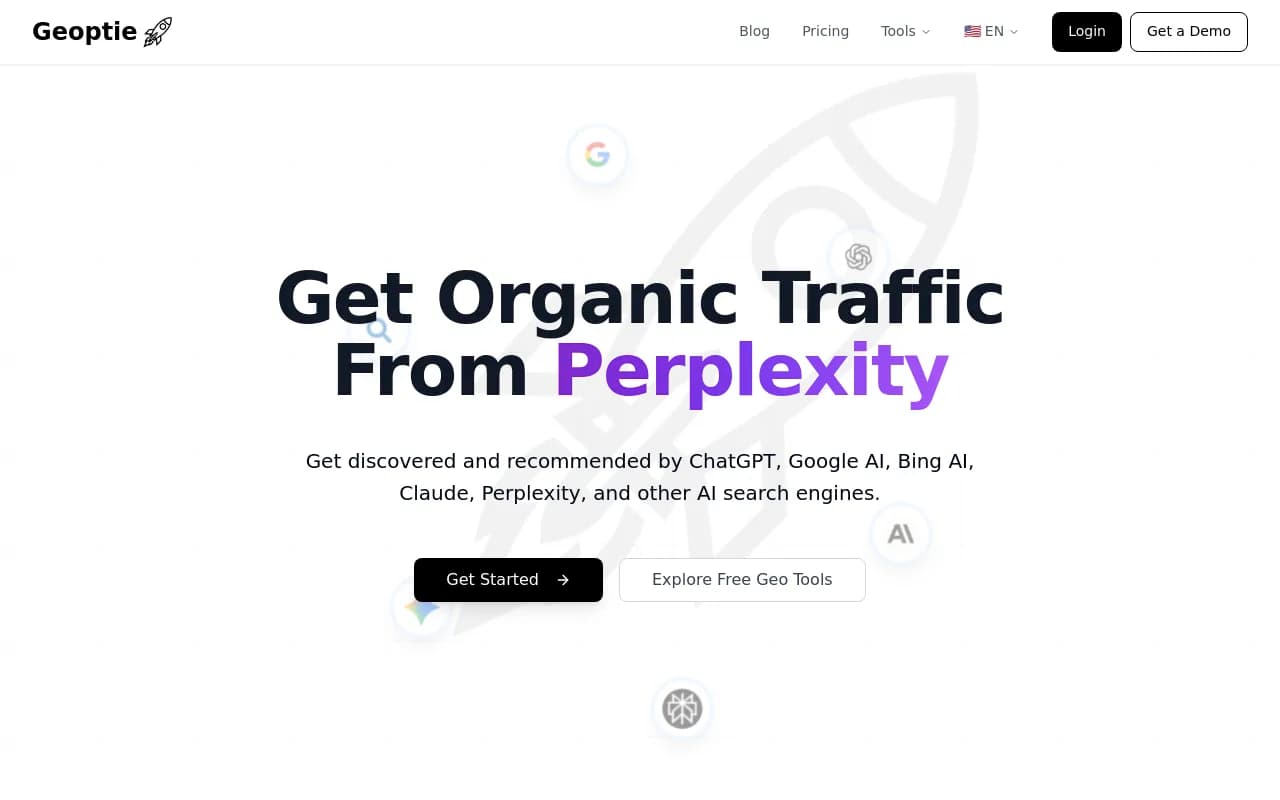
Geoptie positions itself as an "all-in-one GEO platform" built to help businesses track and optimize their visibility in AI-powered search engines. Launched as one of the early entrants in the GEO space, the platform targets marketing teams, digital agencies, and SMEs who want to understand how often their brand appears in responses from ChatGPT, Claude, Perplexity, Gemini, and other AI models. The core pitch: traditional SEO isn't enough anymore when 60%+ of searches are processed by AI engines, so you need specialized tools to monitor and improve your AI search presence.
The platform offers a suite of six free tools alongside a paid SaaS dashboard. The free tools provide entry-level functionality for businesses testing the GEO waters, while the paid plans unlock monitoring, analytics, and optimization features for ongoing campaigns.
Free Tools Suite
GEO Audit analyzes your website's readiness for AI search engines, checking factors like structured data, content clarity, and citation-worthiness. It generates a report with actionable recommendations for improving how AI models understand and reference your site. This is a one-time snapshot rather than continuous monitoring.
Content Checker evaluates individual pages or blog posts to determine if they're structured in a way AI engines can easily parse and cite. It looks at heading hierarchy, content depth, factual density, and formatting. The tool suggests specific improvements like adding FAQ sections, clarifying key points, or restructuring paragraphs for better AI comprehension.
Keyword Finder helps you discover phrases and questions AI engines use when generating responses in your industry. Unlike traditional keyword research tools that focus on search volume, this tool identifies conversational queries and topics that trigger AI citations. It's useful for content planning but doesn't provide prompt volume estimates or difficulty scores.
Rank Tracker monitors where your brand appears across multiple AI platforms. You input prompts relevant to your business, and the tool checks whether your brand gets mentioned in responses from ChatGPT, Claude, Perplexity, and others. The free version has limited tracking capacity.
Cannibalization Checker identifies situations where multiple pages on your site compete for the same keywords or topics, potentially confusing AI engines about which page to cite. It's a diagnostic tool borrowed from traditional SEO but applied to AI search context.
Backlink Finder shows which websites AI engines frequently cite when answering questions in your industry. This helps you identify authoritative sources to target for backlinks or partnerships, increasing the likelihood AI models will reference your content.
Paid Platform Features
The paid dashboard expands on the free tools with continuous monitoring, analytics, and optimization capabilities.
AI Content Optimization Tool provides real-time suggestions for improving existing content to be more citation-worthy. It analyzes your pages against AI engine preferences and recommends structural changes, content additions, and formatting improvements. However, unlike platforms like Promptwatch that include AI writing agents to generate optimized content from scratch, Geoptie focuses on editing what you already have.
Technical GEO Audit Dashboard runs automated technical analysis to identify schema markup opportunities, structured data gaps, and indexing issues that affect AI engine comprehension. It's similar to traditional technical SEO audits but tailored for AI crawlers. The platform doesn't provide real-time crawler logs showing when AI bots visit your site or what errors they encounter -- a capability that more advanced platforms offer.
AI-First Content Strategy Platform helps you plan content based on keyword opportunities and competitive gaps. It generates content outlines, FAQ sections, and topic clusters designed to capture AI citations. The tool suggests what to write about but doesn't create the actual content for you.
Competitive GEO Intelligence tracks how often competitors appear in AI search results compared to your brand. You can see which prompts they dominate and identify content gaps where you're underperforming. The competitive analysis is more limited than platforms that offer detailed citation breakdowns, Reddit/YouTube tracking, or query fan-out analysis showing how prompts branch into sub-queries.
GEO Performance Analytics provides dashboards showing your brand mention frequency across AI platforms, visibility trends over time, and ROI metrics. You can track which content pieces generate the most citations and which AI engines favor your brand. The analytics focus on brand mentions rather than page-level tracking or traffic attribution.
AI Training Data Optimization helps structure your knowledge base, documentation, and resources to increase the likelihood of being included in AI model training datasets. This is a longer-term play focused on becoming a reference source for future model updates.
Who Is It For
Geoptie is best suited for digital agencies managing 5-20 client brands who need basic AI search monitoring without the complexity or cost of enterprise platforms. The multi-brand support (2-50 brands depending on tier) and user seat add-ons make it practical for agency workflows. An agency running local SEO campaigns for restaurants, law firms, or home services businesses could use Geoptie to show clients how often their brand appears in AI search results and track improvements over time.
SME marketing teams with limited budgets will appreciate the free tools for initial audits and the relatively affordable paid plans starting at $41/mo. A SaaS startup with a small marketing team could use Geoptie to monitor brand visibility in AI responses and optimize their blog content for citations. However, teams that need to create large volumes of AI-optimized content from scratch will find the platform's lack of content generation limiting.
Freelance SEO consultants offering GEO services can use the free tools for client audits and the Starter plan ($41/mo) to monitor a handful of brands. The platform provides enough data to demonstrate value and justify ongoing optimization work.
Geoptie is NOT ideal for enterprise brands managing 50+ sites, companies needing deep competitive intelligence with Reddit/YouTube tracking, or teams that want to generate AI-optimized content at scale. The prompt limits (15-400 depending on tier) may feel restrictive for larger operations tracking hundreds of keywords. Brands that need real-time AI crawler logs, page-level citation tracking, or traffic attribution to connect AI visibility to revenue should look at more comprehensive platforms.
Integrations & Ecosystem
Geoptie's integration ecosystem is limited compared to more established platforms. The website mentions working "alongside" tools like SEMrush, Ahrefs, and Google, but these appear to be aspirational partnerships rather than actual API integrations. There's no mention of Google Search Console integration, Looker Studio connectors, Zapier support, or API access for custom workflows. The platform operates as a standalone dashboard without the ability to export data to other marketing tools or build automated reporting pipelines.
No browser extensions, mobile apps, or developer API are mentioned. For teams that need to integrate GEO data into existing marketing dashboards or automate reporting for clients, this lack of connectivity is a significant limitation.
Pricing & Value
Geoptie uses a three-tier pricing structure with annual discounts:
Starter: $41/mo ($490/yr) includes 15 monitoring prompts, 2 brands, unlimited audit reports, unlimited content analyses, and 2 user seats (add more at $20/mo each). This tier works for freelancers or very small agencies monitoring a couple of clients with limited keyword sets. The 15-prompt limit is restrictive -- most brands need to track 50+ prompts to get meaningful visibility data.
Professional: $83/mo ($990/yr) includes 100 monitoring prompts, 10 brands, unlimited audits/analyses, and 5 user seats (add more at $30/mo each). This is the "most popular" tier and makes sense for agencies managing 5-10 clients. The 100-prompt capacity allows for 10 prompts per brand, which is still fairly limited but workable for basic monitoring.
Enterprise: $166/mo ($1,990/yr) includes 400 monitoring prompts, 50 brands, unlimited audits/analyses, and 10 user seats (add more at $40/mo each). This tier targets larger agencies or enterprises with extensive brand portfolios. The 400-prompt limit works out to 8 prompts per brand if you're monitoring all 50 brands, which is tight for comprehensive coverage.
All plans include a 14-day free trial. Annual billing saves roughly 17% (equivalent to 2 months free).
Value Assessment: Geoptie's pricing is competitive for basic AI search monitoring. At $41-166/mo, it's significantly cheaper than enterprise GEO platforms that start at $500+/mo. However, the value proposition depends heavily on what you need. If you just want to track brand mentions across AI engines and run occasional audits, Geoptie delivers solid value. If you need content generation, deep competitive analysis, crawler logs, or traffic attribution, you're paying for a monitoring tool when you actually need an optimization platform.
Compared to Promptwatch ($99-579/mo), Geoptie is cheaper on the low end but lacks the action-oriented features that turn monitoring data into actual improvements. Promptwatch's Answer Gap Analysis, AI writing agent, and crawler logs help you fix visibility problems, not just observe them. For teams serious about improving AI search performance, the extra cost of a more comprehensive platform often pays for itself in faster results.
Strengths & Limitations
Strengths:
• Accessible entry point: The six free tools let you test GEO concepts without financial commitment, making it easy to demonstrate value to stakeholders before investing in paid plans.
• Multi-brand support: Unlike some competitors that charge per site, Geoptie's brand-based pricing works well for agencies managing multiple clients.
• Transparent pricing: Clear tier structure with no hidden fees or usage-based overages. You know exactly what you're paying upfront.
• AI engine coverage: Monitors major platforms including ChatGPT, Claude, Perplexity, Gemini, Bing AI, and Google AI Overviews on all plans.
Limitations:
• No content generation: The platform tells you what to optimize but doesn't help you create the actual content. You're on your own for writing AI-optimized articles, which is where most teams get stuck.
• Limited competitive intelligence: Basic competitor tracking without the depth of Reddit/YouTube citation analysis, query fan-outs, or detailed source breakdowns that show exactly why competitors are winning.
• No crawler logs or traffic attribution: You can't see when AI bots visit your site, what errors they encounter, or connect AI visibility to actual website traffic and revenue. This makes it harder to prove ROI.
• Restrictive prompt limits: Even the Enterprise plan's 400 prompts may not be enough for brands tracking comprehensive keyword sets across multiple products or services.
• No integrations: Operates as a standalone tool without API access, GSC integration, or export capabilities for custom reporting.
Bottom Line
Geoptie is a solid entry-level GEO platform for agencies and SMEs who want to start monitoring AI search visibility without a major financial commitment. The free tools provide a low-risk way to explore GEO concepts, and the paid plans offer basic tracking and optimization features at accessible price points. However, the platform's monitoring-focused approach means you'll still need to do the heavy lifting of creating optimized content and fixing technical issues yourself.
Best use case in one sentence: Digital agencies managing 5-15 client brands who need affordable AI search monitoring and basic optimization recommendations but don't require advanced features like content generation or crawler logs.
For teams that want to move beyond monitoring and actually improve their AI search performance with content gap analysis, AI-generated articles, and real-time crawler tracking, platforms like Promptwatch offer a more complete solution despite the higher price point. Geoptie works well as a starting point, but serious GEO practitioners will likely outgrow it as their needs become more sophisticated.
Similar and alternative tools to Geoptie