Artificial Societies Review 2026
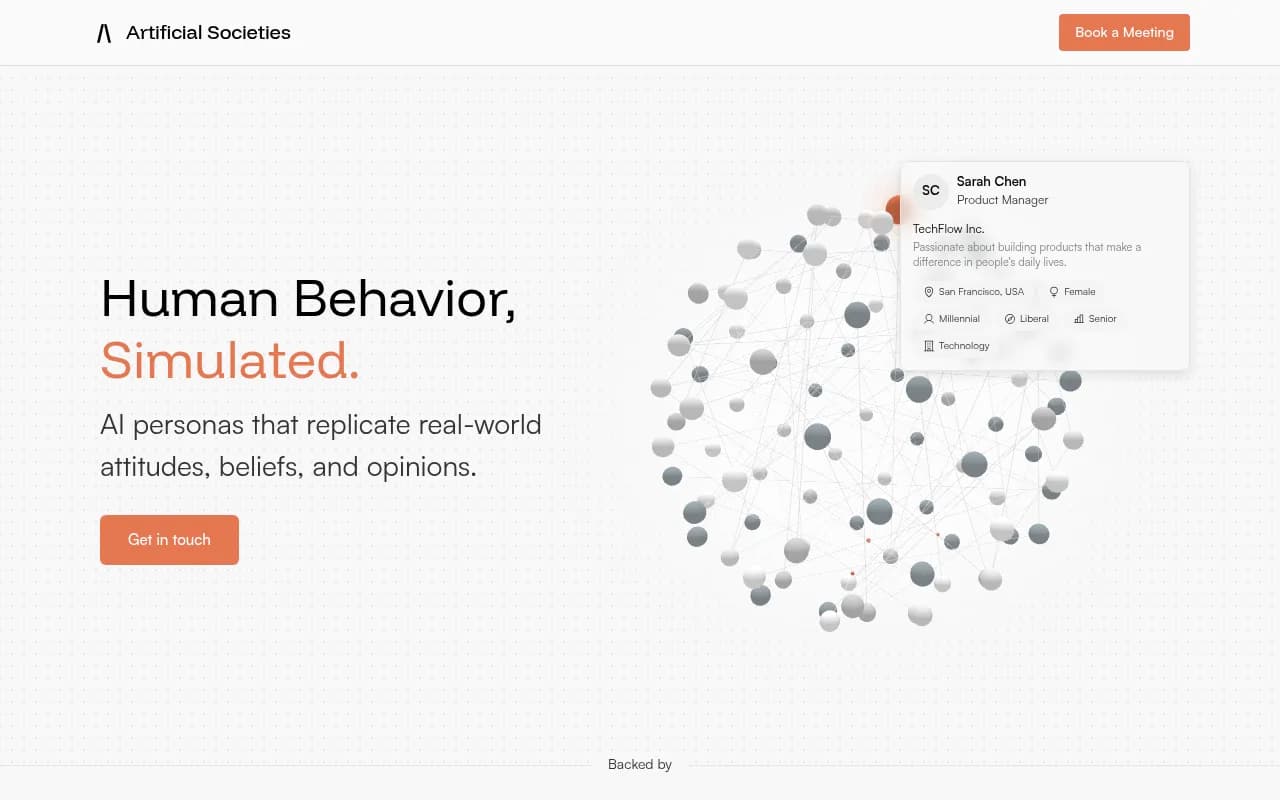
Artificial Societies uses AI to simulate human behavior with 86% accuracy, enabling instant access to Fortune 500 executives, rare specialists, and hyper-specific demographics. Replace weeks of traditional research with thousands of instant interviews across millions of calibrated personas that reas
Key Takeaways
- 86% accuracy in replicating human responses -- 19-25 points higher than standard AI models (GPT-4, Gemini) and just 5 points below the human replication ceiling. This isn't chatbot guessing, it's validated behavioral simulation.
- Instant access to unreachable audiences -- survey Fortune 500 executives, rare medical specialists, or niche demographics that traditional panels can't recruit. No waiting weeks for responses.
- Lacks real-world validation beyond surveys -- while survey accuracy is strong, the platform doesn't show how personas perform in longitudinal studies, A/B testing predictions, or actual purchase behavior tracking that would prove commercial value.
- Affordable entry point -- free trial with 3 credits, then $40/month for unlimited simulations. Dramatically cheaper than traditional market research panels.
- Best for rapid hypothesis testing and qualitative exploration -- not a replacement for all research, but a powerful tool for initial insights before committing to expensive fieldwork.
Artificial Societies is a Y Combinator W25 company building AI personas that replicate human attitudes, beliefs, and decision-making patterns. The core promise: research that used to take weeks and cost thousands of dollars now happens instantly. Instead of recruiting real humans through panels like Prolific or Qualtrics, you simulate their responses using AI models trained on demographic and psychographic data. The company is backed by Point72 Ventures, Kindred Capital, and investors from Sequoia, Google, DeepMind, and Prolific itself.
The target audience is market researchers, strategy consultants, product teams, and agencies who need fast insights into hard-to-reach populations. If you're trying to understand how C-suite executives at Fortune 500 companies think about AI adoption, or how rare disease patients make treatment decisions, traditional research hits a wall. Recruiting these people takes months and costs tens of thousands of dollars. Artificial Societies claims to solve this by simulating their perspectives in minutes.
The platform launched publicly in early 2025 and has already worked with Teneo (a global advisory firm) to simulate 180,000+ human perspectives for client research. Teneo's Global Head of Research called the results "impossible with traditional market research." The company also announced a strategic partnership with Pulsar, an audience intelligence platform, to combine real-world social data with live persona simulations.
How It Actually Works
You define your target audience using demographic filters (age, income, education, location) and psychographic attributes (political views, values, lifestyle). The platform generates AI personas calibrated to match those profiles. You then run surveys, conduct open-ended interviews, or test messaging against these personas. The AI doesn't just pick multiple choice answers -- it reasons through questions and provides explanations like a real respondent would.
The accuracy claim is backed by a January 2026 evaluation report (linked on their site) showing 86% proportional allocation accuracy across 1,000 survey replications. This means when you ask a simulated group of personas a question, their aggregate response distribution matches what you'd get from real humans 86% of the time. For context, standard AI models like GPT-4 and Gemini 2.0 plateau at 61-67% accuracy on the same benchmark. The human replication ceiling -- the theoretical maximum given noise in human responses -- is around 91%. So Artificial Societies is 5 points away from perfect replication.
What makes this different from just prompting ChatGPT to "act like a 45-year-old marketing director"? The personas are trained on real survey data, demographic distributions, and psychographic correlations. They don't hallucinate opinions -- they generate responses consistent with how real people in that demographic actually think. The platform also handles sample weighting, quota balancing, and statistical validation automatically.
Core Capabilities
Unreachable Audience Simulation: Survey Fortune 500 executives, rare medical specialists, or hyper-specific demographics (e.g. "female software engineers in Germany who use Notion"). Traditional panels struggle to recruit these groups because they're expensive, busy, or simply don't exist in panel databases. Artificial Societies generates personas matching these profiles instantly. You can run a 500-person survey of CEOs in under an hour instead of waiting 6 weeks for 50 responses.
Instant Survey Fielding: Upload your survey, define your audience, and get results in minutes. The platform handles quota sampling, response quality checks, and data export. You can iterate on questions and re-field surveys without burning through panel budgets. This is particularly useful for early-stage concept testing or message testing where you need directional insights fast.
Qualitative Interviews at Scale: Run open-ended interviews with personas. Ask follow-up questions, probe for reasoning, explore edge cases. The personas respond with the depth and nuance of real humans -- not canned answers. One use case: interviewing 100 simulated patients about a new medical device to identify concerns before recruiting real patients for clinical validation.
Millions of Calibrated Personas: Every persona is demographically and psychographically calibrated using real-world data distributions. This means the simulated population reflects actual diversity in attitudes, beliefs, and behaviors. You're not getting 1,000 copies of the same AI -- you're getting 1,000 distinct perspectives that map to real human variation.
Reasoning and Reflection: The personas don't just answer questions -- they explain their reasoning. If you ask a simulated executive why they'd choose one vendor over another, they'll cite specific factors (price, reputation, feature fit) and explain trade-offs. This qualitative depth is what separates Artificial Societies from basic survey bots.
Strategic Partnership with Pulsar: Pulsar provides real-world audience intelligence from social media, forums, and online communities. Artificial Societies uses this data to ground personas in actual human behavior patterns. The integration lets you simulate audiences based on real social listening insights, then validate findings with live simulations.
Who Should Use This
Artificial Societies is built for researchers and strategists who need fast, directional insights into hard-to-reach audiences. Specific personas:
Market researchers at agencies or consultancies running exploratory studies for clients. You need to test 5 different messaging angles with 200 people each before committing to a $50K quantitative study. Traditional panels would cost $10K+ and take 2 weeks. Artificial Societies does it in an afternoon for $40.
Product managers at B2B SaaS companies trying to understand enterprise buyer behavior. You want to know how IT directors at companies with 500-5,000 employees evaluate security tools. Recruiting real IT directors is expensive and slow. Simulating 500 of them gives you enough signal to prioritize features or refine positioning.
Strategy consultants building market entry plans or competitive analyses. You need to understand how decision-makers in a specific industry think about a new technology. Simulating 1,000 personas across different company sizes, roles, and geographies gives you a baseline before conducting expert interviews.
Academic researchers exploring hypotheses before applying for grants or recruiting real participants. You can test survey instruments, identify confounding variables, and refine research questions using simulated data. This doesn't replace real studies, but it makes them more efficient.
Who should NOT use this: Teams that need legally defensible data for regulatory submissions, clinical trials, or financial disclosures. Simulated data is not real data. It's also not ideal for final validation -- you still need real humans to confirm findings before making major decisions. And if your audience is easy to recruit (e.g. general consumers aged 18-65), traditional panels are cheaper and more credible.
Integrations and Workflow
The platform is web-based with no API mentioned publicly (as of early 2025). You upload surveys via CSV or build them in the interface. Results export to CSV for analysis in Excel, R, or Python. There's no mention of integrations with Qualtrics, SurveyMonkey, or other research tools, which limits workflow automation.
The Pulsar partnership suggests future integrations with social listening and audience intelligence platforms. No mobile app, browser extension, or developer tools are mentioned.
Pricing and Value
Artificial Societies offers a free trial with 3 simulation credits. After that, you get a two-week free trial. The Pro plan costs $40/month and includes unlimited simulations. This is remarkably cheap compared to traditional research:
- A 500-person survey on Prolific or Qualtrics costs $500-$2,000 depending on audience complexity and length.
- Recruiting 10 Fortune 500 executives for interviews costs $5,000-$20,000 through expert networks like GLG or AlphaSights.
- A full market research study with 1,000 respondents costs $20K-$100K+ depending on methodology.
At $40/month, Artificial Societies is 10-100x cheaper than traditional methods. The trade-off: you're getting simulated data, not real responses. For exploratory research, hypothesis generation, and rapid iteration, this is excellent value. For final validation or high-stakes decisions, you'll still need real humans.
Strengths
- Validated accuracy that beats standard AI models by 20+ points. The 86% benchmark is independently verifiable and significantly higher than what you'd get from prompting GPT-4 or Claude.
- Instant access to audiences that are impossible to recruit traditionally. Surveying 500 CEOs in an hour is not possible with any panel.
- Affordable pricing that democratizes market research. $40/month is accessible to startups, freelancers, and small teams who can't afford $50K studies.
- Qualitative depth that goes beyond multiple choice. The personas reason and explain, which is critical for understanding "why" not just "what."
- Strong early traction with credible clients. Teneo is a major advisory firm, and the Pulsar partnership signals enterprise adoption.
Limitations
- No evidence of predictive validity. The platform shows survey replication accuracy, but not whether simulated responses predict real-world behavior (purchases, clicks, conversions). This is the critical test for commercial value.
- Limited integrations and API access. You can't plug this into existing research workflows or automate simulations at scale. Everything is manual.
- Simulated data is not real data. For regulatory, legal, or high-stakes decisions, you need real human responses. Artificial Societies is a research accelerator, not a replacement.
- No transparency on training data sources. The personas are "calibrated" but the site doesn't explain what datasets were used or how biases are mitigated. This matters for academic and ethical scrutiny.
- Unclear how personas handle novel or rapidly changing topics. If you're researching a brand-new technology or a breaking news event, the personas may not have enough training data to replicate real human opinions accurately.
Bottom Line
Artificial Societies is best for researchers, strategists, and product teams who need fast, directional insights into hard-to-reach audiences before committing to expensive traditional research. If you're testing hypotheses, exploring messaging, or understanding niche demographics, this is a powerful tool that saves weeks and thousands of dollars. The 86% accuracy benchmark is credible and significantly better than generic AI prompting. But it's not a replacement for real human validation -- use it to accelerate research, not to skip it entirely. Best use case in one sentence: rapid exploratory research into audiences that are too expensive or slow to recruit through traditional panels.
Tags:
Frequently asked questions
What is Artificial Societies and what does it do?
How accurate is Artificial Societies compared to real human responses?
How much does Artificial Societies cost?
Who should use Artificial Societies?
What are the main benefits of using Artificial Societies over traditional market research?
What are the limitations of Artificial Societies?
Similar and alternative tools to Artificial Societies