Key takeaways
- AthenaHQ is a monitoring-focused platform -- it shows you where you're invisible in AI search but doesn't help you fix it, which is a real limitation for agencies trying to deliver results
- Most alternatives fall into two camps: pure trackers (cheaper, simpler) and full optimization platforms (more expensive, but close the loop from tracking to content to results)
- For agencies managing multiple clients, the non-negotiables are multi-workspace architecture, white-label reporting, and competitive benchmarking per client
- Promptwatch is the only platform in this comparison rated as a "Leader" across all GEO categories -- and the only one that combines tracking, content gap analysis, and AI content generation in one workflow
If you're running an agency and you've been using AthenaHQ, you already know the core problem: it tells you where your clients aren't showing up in ChatGPT or Perplexity, but then it leaves you to figure out what to do about it. That's fine for a brand manager with one website and time to think. It's not fine when you're managing 20 client accounts and need to show results in the next reporting cycle.
AthenaHQ does some things well. It monitors brand mentions across AI search engines, has decent competitive benchmarking, and the interface is clean. But agencies consistently run into the same walls: limited multi-client workspace support, no content optimization tools, and no way to connect visibility data to actual traffic or revenue.
This guide covers 9 alternatives worth considering in 2026, with honest notes on what each one is actually good for.
What agencies actually need from an AI visibility tool
Before getting into the list, it's worth being specific about what "agency-ready" means in this context. A tool that works for a solo brand manager often breaks down at agency scale.
The things that matter most:
- Multi-workspace or multi-client architecture (one login, separate client views)
- White-label reporting or at minimum exportable branded reports
- Competitive benchmarking per client, not just per account
- Coverage across the major AI models: ChatGPT, Perplexity, Google AI Overviews, Claude, Gemini, Copilot
- Some path from "here's the gap" to "here's how to fix it" -- otherwise you're just paying for bad news
With that in mind, here's how the main alternatives stack up.
The 9 best AthenaHQ alternatives for agencies in 2026
1. Promptwatch
Promptwatch is the most complete option on this list. Where AthenaHQ stops at monitoring, Promptwatch runs a full loop: find the gaps, generate content to fill them, then track whether that content actually gets cited.

The Answer Gap Analysis is the standout feature for agencies. It shows exactly which prompts your client's competitors are getting cited for but your client isn't -- not as a vague "you're missing coverage here" message, but as a specific list of prompts, the AI responses that mention competitors, and what content is missing from your client's site. From there, Content Agents generate articles, listicles, and briefs grounded in that prompt data.
For multi-client management, Promptwatch supports separate workspaces per client with page-level tracking, crawler logs (showing which AI crawlers hit which pages and when), and traffic attribution that connects AI citations to actual revenue. It monitors 10 AI models including ChatGPT, Perplexity, Google AI Overviews, Google AI Mode, Claude, Gemini, DeepSeek, Grok, Mistral, and Copilot.
Pricing starts at $99/month for one site, $249/month for the Professional plan (2 sites, crawler logs, 15 articles/month), and $579/month for Business (5 sites, 30 articles). Agency and enterprise pricing is available on request.
The honest caveat: it's more expensive than pure monitoring tools. If your clients just want a monthly "here's your AI visibility score" report and nothing else, simpler options exist. But if you're trying to actually move the needle, this is where the ROI is.
2. Profound
Profound is the other enterprise-grade option in this space. It covers 9+ AI search engines, has solid competitive benchmarking, and the data quality is generally reliable.
Profound

Where Profound shines is depth of monitoring -- it's one of the better tools for understanding how AI models are framing your client's brand, not just whether they're mentioning it. Sentiment analysis and share-of-voice tracking are more developed here than in most alternatives.
The limitation for agencies: Profound is expensive (pricing isn't publicly listed, but it's positioned at the enterprise end), and like AthenaHQ, it's primarily a monitoring platform. There's no content generation, no content gap analysis tied to specific prompts, and no crawler logs. You get excellent data but still need to figure out what to do with it yourself.
Best for: Large agencies or in-house enterprise teams with dedicated content resources who need premium monitoring data.
3. Otterly.AI
Otterly.AI is a straightforward AI visibility tracker. It monitors brand mentions across ChatGPT, Perplexity, and Google AI Overviews, has a clean interface, and is priced accessibly.
Otterly.AI

For agencies, Otterly works reasonably well if your clients are smaller brands with modest prompt sets. The multi-client setup is manageable, and the reporting is clear enough to share directly. It's also one of the faster tools to get up and running -- you can have a new client tracked within minutes.
What it doesn't do: no content optimization, no crawler logs, no traffic attribution, no ChatGPT Shopping tracking, no Reddit or YouTube insights. It's a monitoring dashboard, full stop. If a client asks "okay, so how do we improve this?" you'll need other tools to answer that question.
Best for: Agencies that need affordable, no-frills AI mention tracking for clients who aren't yet ready to invest in optimization.
4. Scrunch AI
Scrunch AI sits in the mid-tier of this market -- more capable than basic trackers like Otterly, but not as comprehensive as Promptwatch or Profound.
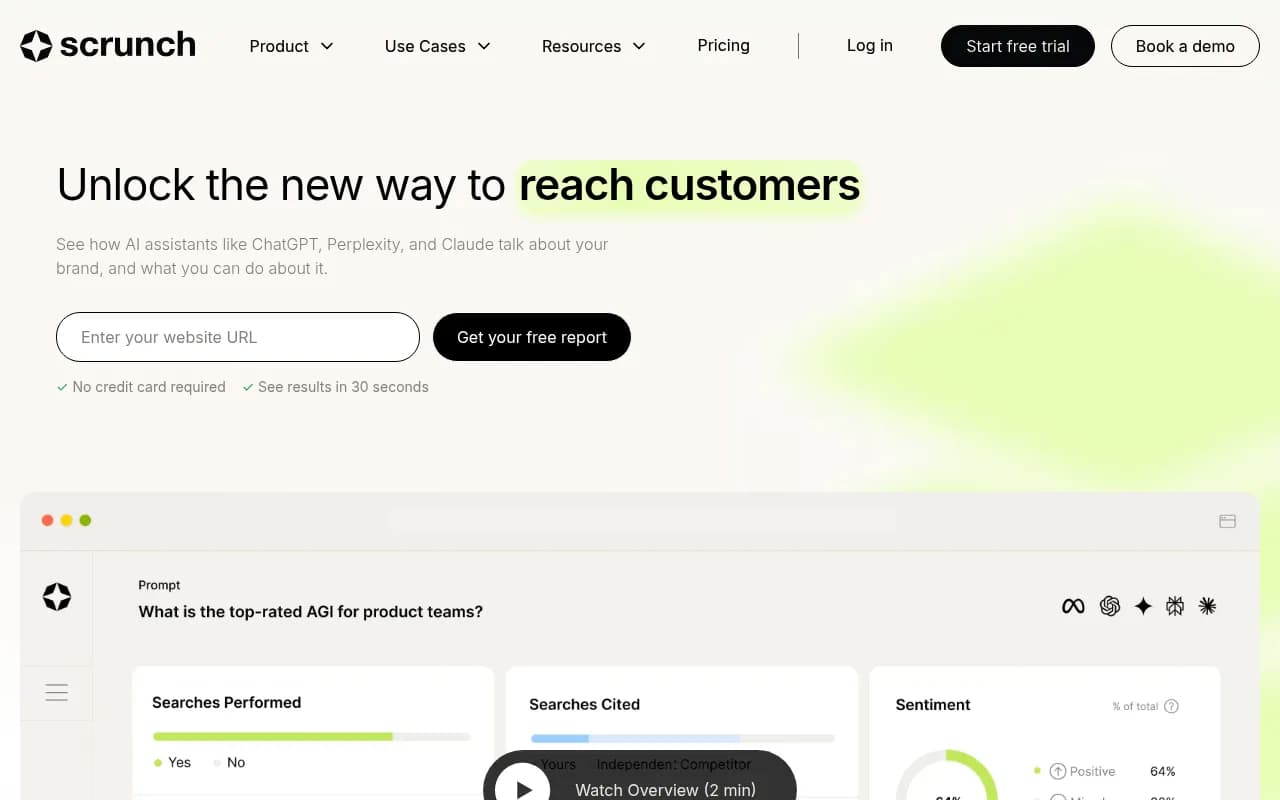
It covers the major AI models, has competitive analysis features, and the interface is built with agencies in mind. Multi-client management is cleaner here than in some alternatives. Scrunch also has some content recommendations, though they're more surface-level than the prompt-grounded gap analysis you get from Promptwatch.
The pricing is more accessible than enterprise platforms, which makes it a reasonable middle ground. The main gap is depth: prompt volume data, query fan-outs, and crawler logs aren't available, so you're working with less context when prioritizing what to fix.
Best for: Mid-size agencies that want more than basic monitoring but aren't ready to commit to enterprise-level pricing.
5. Rankscale
Rankscale is explicitly positioned for agencies, which shows in the product design. The workspace architecture handles multiple clients cleanly, and the reporting features are built around client deliverables rather than internal analysis.
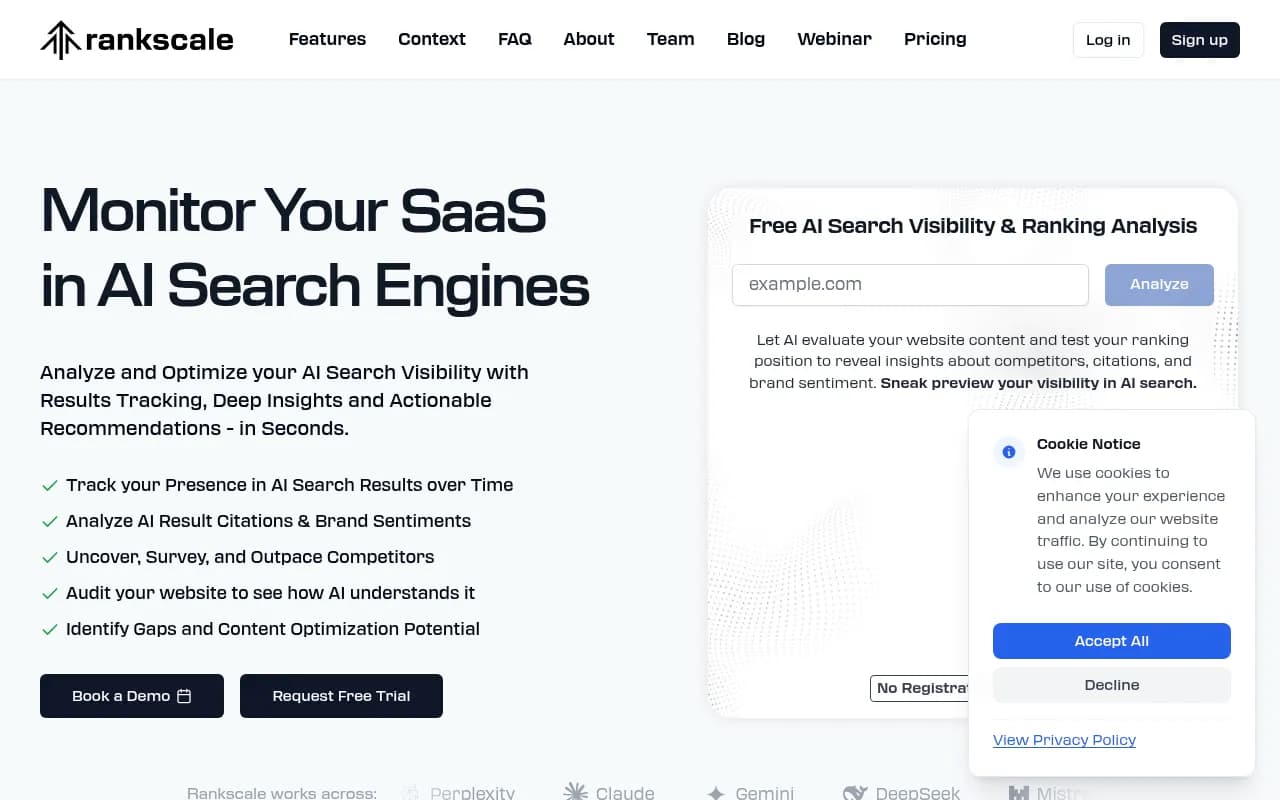
It tracks AI visibility across the main models, has competitive benchmarking, and the white-label reporting is one of the better implementations in this category. If your agency's primary deliverable is a monthly AI visibility report and you want something that looks polished without much manual work, Rankscale handles that well.
The limitation is the same as most monitoring-only tools: there's no path from the data to action. You can see that a competitor is getting cited more than your client, but the tool won't tell you why or what content to create.
Best for: Agencies where client reporting is the primary use case and optimization work happens separately.
6. SE Visible
SE Visible is SE Ranking's AI visibility product, which means it benefits from being part of a broader SEO platform that agencies already use.
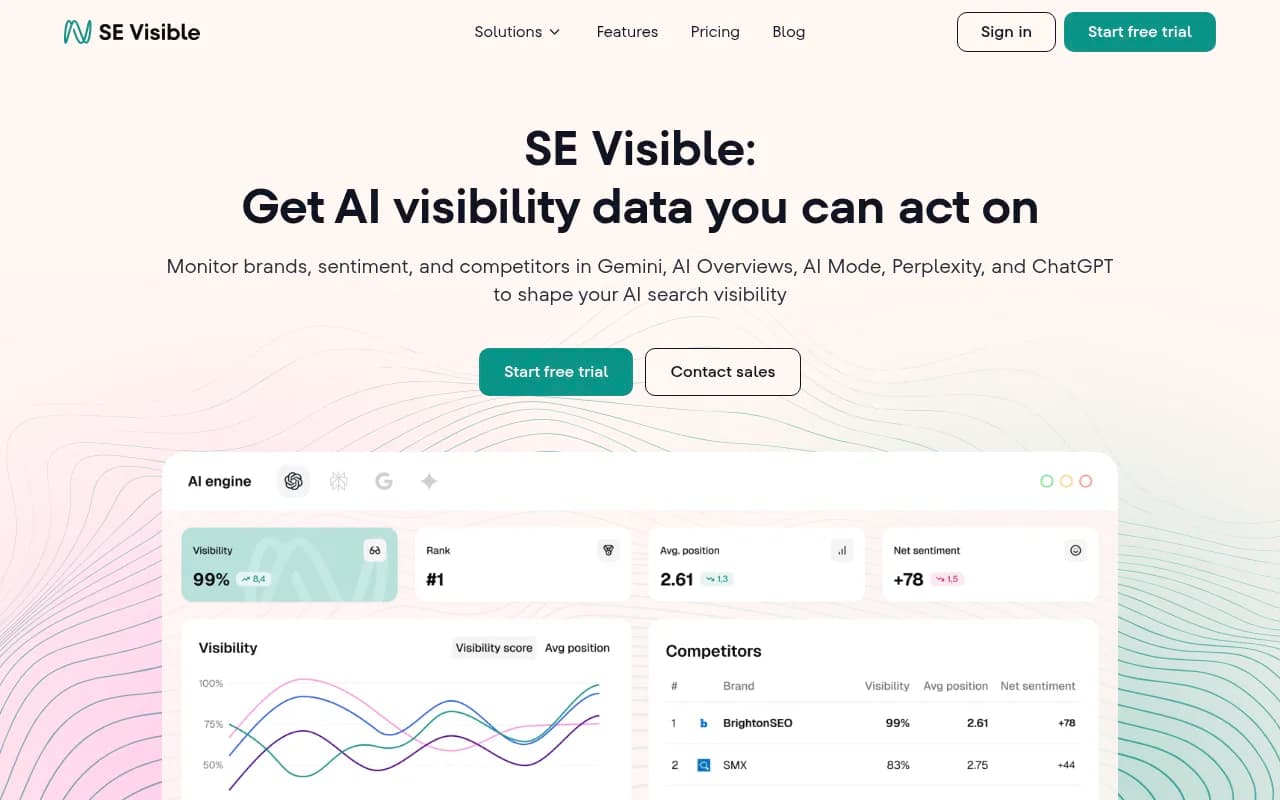
If your agency is already on SE Ranking for traditional rank tracking, adding SE Visible is a natural extension. The integration means you can look at a client's traditional SEO performance and AI visibility in the same platform, which simplifies reporting. Coverage includes the major AI models, and the competitive benchmarking is solid.
The downside: SE Visible is still primarily a monitoring layer. The content optimization tools in SE Ranking are for traditional SEO, not AI search. And if you're not already an SE Ranking customer, the value proposition is less clear -- you'd be buying into a larger platform for one feature.
Best for: Agencies already using SE Ranking that want to add AI visibility tracking without switching platforms.
7. Peec AI
Peec AI has gotten attention for connecting content recommendations to AI visibility outcomes more directly than most monitoring tools.
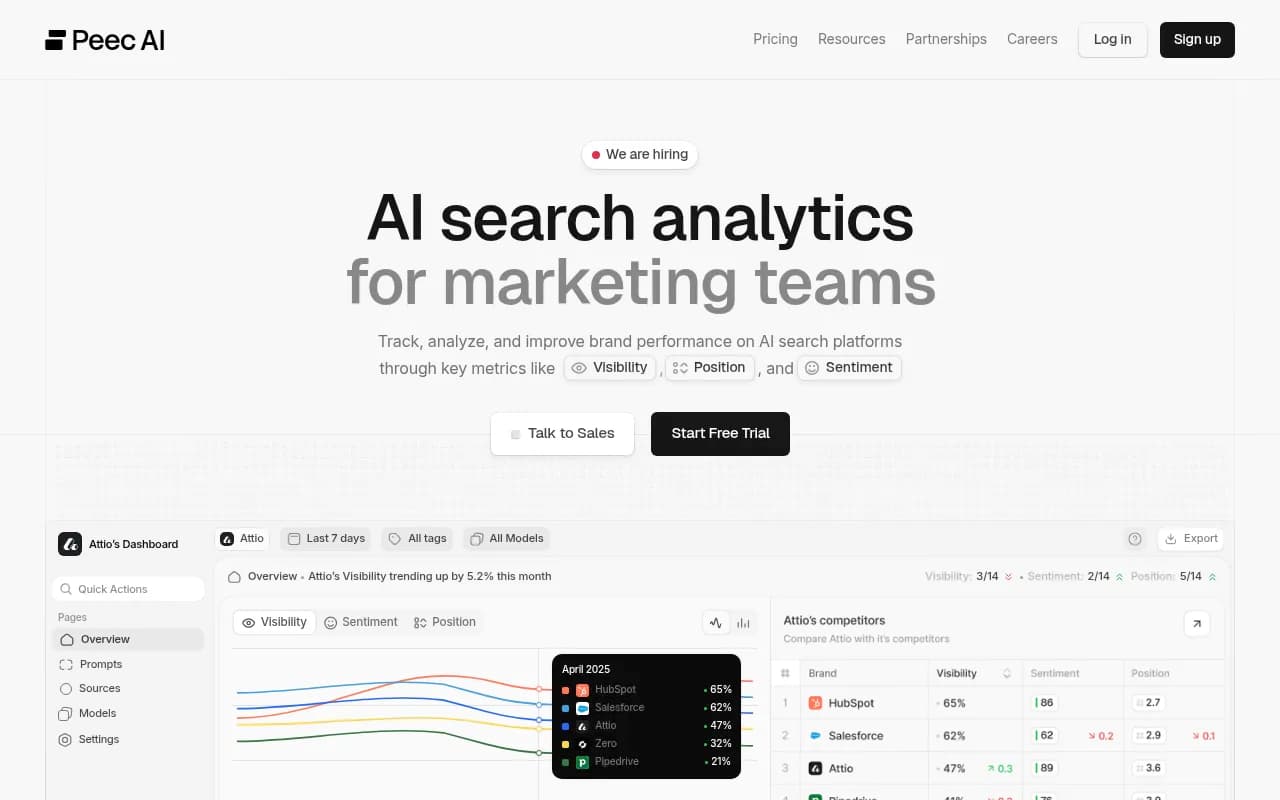
It tracks brand mentions across AI search engines and, importantly, tries to surface actionable recommendations rather than just data. The content optimization angle is more developed than in pure monitoring tools, though it's not as deep as Promptwatch's Content Agents and Answer Gap Analysis.
For agencies, Peec AI works best for clients in competitive verticals where content strategy is the primary lever. The prompt tracking is reliable, and the interface is clean. Multi-client management is functional but not as polished as tools built specifically for agencies.
Best for: Agencies with strong in-house content teams that want data-informed recommendations but will do the actual content work themselves.
8. Analyze AI
Analyze AI takes a different angle than most tools in this space: it focuses on connecting AI visibility to actual traffic and revenue, rather than just tracking mentions.
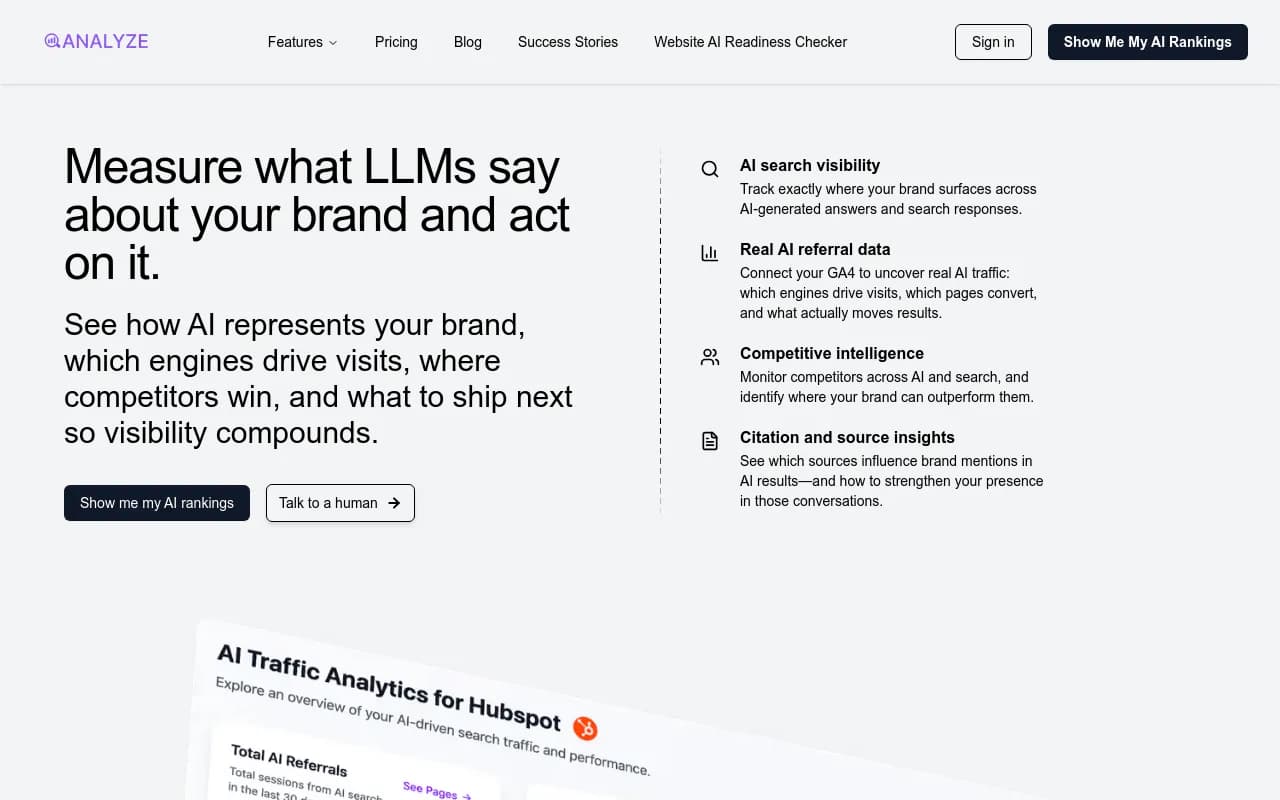
This matters for agencies because the hardest client conversation is often "yes, you're getting cited in Perplexity -- but is that actually driving anything?" Analyze AI is built to answer that question. The traffic attribution features are more developed here than in most alternatives.
The trade-off is that the monitoring breadth is narrower. It covers the main AI models but doesn't have the depth of competitive benchmarking or prompt-level data that enterprise platforms offer. And like most tools in this list, there's no content generation.
Best for: Agencies whose clients are skeptical about AI visibility ROI and need clear traffic attribution data to justify the investment.
9. Rankability
Rankability is an agency-focused SEO platform that has been expanding into AI search optimization. It's not a pure AI visibility tool -- it straddles traditional SEO and AI search, which is either a feature or a limitation depending on what you need.
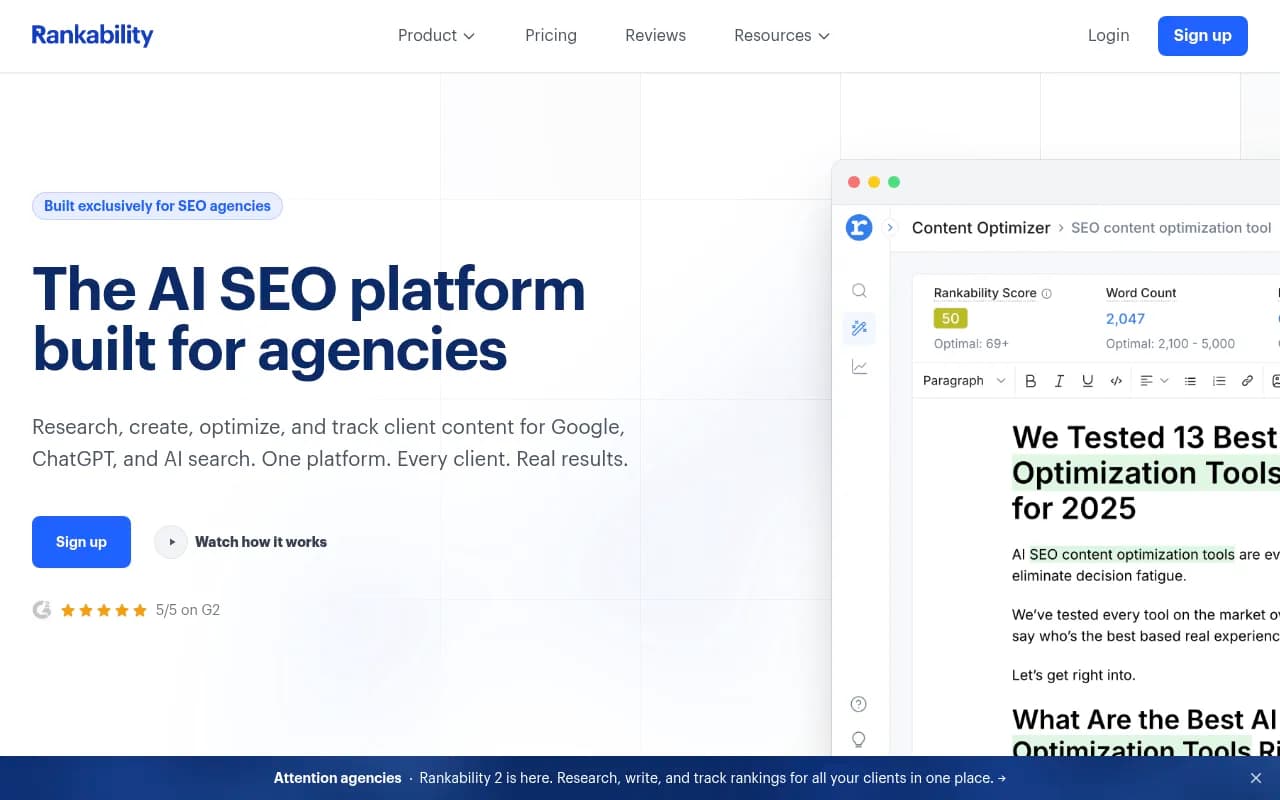
For agencies managing clients who still care about both Google rankings and AI visibility (which is most clients), having both in one platform reduces tool sprawl. The content optimization features are more developed than in pure monitoring tools, and the agency workflow features are solid.
The caveat: because it's trying to cover both traditional SEO and AI search, neither capability is as deep as a dedicated platform. If AI visibility is your primary focus, you'll feel the limitations.
Best for: Agencies that want a single platform covering both traditional SEO and AI search for clients who aren't ready to treat them as separate workstreams.
How these tools compare
| Tool | AI model coverage | Multi-client support | Content optimization | Crawler logs | Pricing |
|---|---|---|---|---|---|
| Promptwatch | 10 models | Yes (workspaces) | Yes (AI content agents) | Yes | From $99/mo |
| Profound | 9+ models | Limited | No | No | Enterprise |
| Otterly.AI | 3-4 models | Basic | No | No | Lower tier |
| Scrunch AI | Major models | Yes | Basic | No | Mid-tier |
| Rankscale | Major models | Yes (agency-focused) | No | No | Mid-tier |
| SE Visible | Major models | Via SE Ranking | No (SE Ranking only) | No | Bundled |
| Peec AI | Major models | Basic | Recommendations | No | Mid-tier |
| Analyze AI | Major models | Basic | No | No | Mid-tier |
| Rankability | Major models | Yes | Yes (SEO-focused) | No | Mid-tier |
| AthenaHQ | Major models | Limited | No | No | Mid-tier |
Which tool should you actually use?
It depends on what your agency is trying to deliver.
If you need to move client AI visibility scores and show measurable results, Promptwatch is the clearest choice. The combination of Answer Gap Analysis, Content Agents, and crawler logs means you're not just reporting on visibility -- you're building a workflow that improves it. The pricing is higher than basic trackers, but the alternative is paying for monitoring data and then spending agency hours figuring out what to do with it.
If your clients are early in their AI visibility journey and just need to understand where they stand, Otterly.AI or Scrunch AI are reasonable starting points. They're cheaper, easier to set up, and give you enough data to have the initial conversation.
If you're an enterprise-focused agency with clients who have dedicated content teams and need premium monitoring data, Profound is worth evaluating alongside Promptwatch.
And if your agency is already deep in SE Ranking, SE Visible is the path of least resistance for adding AI visibility tracking without changing your stack.
The honest summary: most of these tools are monitoring dashboards with varying levels of polish. The gap between monitoring-only tools and optimization platforms is real, and it shows up in client results. Agencies that can close that loop -- find the gap, create the content, track the citation -- are going to have a much easier time justifying AI visibility as a service line.
A note on what's changing fast
The AI search landscape in 2026 is moving quickly. Google AI Mode is expanding, ChatGPT's shopping and product recommendation features are growing, and the models themselves are updating their training data more frequently. A tool that had good coverage six months ago might have blind spots now.
When evaluating any platform, ask specifically about update frequency for prompt data, how quickly new AI model features get tracked (ChatGPT Shopping is a good test case), and whether the tool monitors actual user-facing AI responses or just API outputs. The latter matters because what users see in ChatGPT's interface can differ meaningfully from what the API returns.
Promptwatch, for instance, tracks how AI search engines behave in real user interfaces rather than just through APIs -- which is why its citation data tends to be more representative of what your clients' actual customers are experiencing.
Whatever tool you choose, the agencies winning in AI search right now are the ones treating it as an optimization discipline, not just a reporting metric.