Key takeaways
- Ahrefs Brand Radar is a solid AI visibility monitoring add-on for existing Ahrefs users, but it uses fixed prompts and doesn't help you act on what you find.
- Promptwatch is built around a full optimization loop: find gaps, generate content, track results — not just show you a score.
- Brand Radar has no crawler logs, no content generation, no Reddit/YouTube tracking, and no AI traffic attribution.
- If you're already deep in the Ahrefs ecosystem and just want a quick read on AI brand mentions, Brand Radar is convenient. If AI visibility is a strategic priority, you'll outgrow it fast.
- The two tools aren't really competing for the same job — one monitors, the other optimizes.
There's a version of this comparison that writes itself: Ahrefs is a legacy SEO tool that bolted on an AI feature, Promptwatch was built for AI search from the ground up, end of story. But that's too simple, and it ignores some real strengths Brand Radar has.
So let's actually dig into what each tool tells you, where each one stops, and which situations each is genuinely suited for.
What Ahrefs Brand Radar actually does
Brand Radar is Ahrefs' AI visibility module. According to Ahrefs' own documentation, it tracks how any brand shows up in AI search across 350+ million search-backed prompts. That's a legitimately large dataset — Ahrefs built it by mapping their existing keyword database to AI-style queries, which means the prompt coverage is broad.
Here's what you get with Brand Radar:
- A visibility score showing how often your brand appears in AI-generated answers
- Comparison against competitors across the same prompt set
- Custom prompt tracking (you can add your own prompts and monitor them daily or weekly)
- Breakdowns by topic area, so you can see which subjects your brand is associated with in AI responses
- Coverage across major AI engines including ChatGPT, Perplexity, and Google AI Overviews
For an Ahrefs subscriber, this is genuinely useful. If you're already paying for the platform and you want a quick read on whether ChatGPT mentions you when someone asks about your category, Brand Radar gives you that without switching tools.
The Profound blog published a review noting that Brand Radar "reveals how your AI visibility fares in the core topics you want associated with your brand" — and that's a fair summary. It's a topic-level visibility snapshot.
Where Brand Radar stops
The problem isn't what Brand Radar shows you. It's what it doesn't show you, and more importantly, what it doesn't help you do.
A few specific gaps worth knowing about:
Fixed prompt methodology. Ahrefs uses prompts derived from its keyword database. That's a reasonable approach, but it means the prompts are anchored to traditional search behavior. Real users prompt AI engines differently — they ask longer, more conversational questions, they ask for recommendations, they ask follow-ups. Brand Radar doesn't track query fan-outs (how one prompt branches into sub-queries) or prompt volume estimates that tell you which prompts are actually worth caring about.
No AI crawler logs. When ChatGPT's crawler visits your site, Brand Radar doesn't know about it. You can't see which pages AI engines are reading, how often they return, or whether they're hitting errors. This matters because a page can be crawled without being cited — and knowing the difference tells you where to focus.
No content gap analysis. Brand Radar can tell you that a competitor ranks for a topic you don't. It can't tell you what specific content you're missing, what angle the AI model wants, or what you should write to close the gap.
No content generation. You see the gap. You're on your own to fix it.
No Reddit or YouTube tracking. AI models cite Reddit threads and YouTube videos constantly. Brand Radar doesn't surface which of these external sources are influencing AI responses about your category.
No AI traffic attribution. You can't connect your Brand Radar visibility score to actual website traffic or revenue. It's a visibility number with no downstream connection.
None of this makes Brand Radar bad. It makes it a monitoring dashboard — useful for awareness, limited for action.
What Promptwatch actually does
Promptwatch approaches AI visibility as an optimization problem, not a reporting problem. The core workflow is a loop: find gaps, create content that fills them, track whether it works.

The monitoring side covers 10 AI models: ChatGPT, Perplexity, Google AI Overviews, Google AI Mode, Claude, Gemini, Meta/Llama, DeepSeek, Grok, Mistral, and Copilot. You can set custom prompts, track by region and language, and build persona-based monitoring that reflects how your actual customers search.
But the monitoring is table stakes. What makes Promptwatch different is everything that comes after:
Answer Gap Analysis shows you the specific prompts where competitors appear but you don't. Not just "you're behind in this topic" — the actual prompt, the actual response, and what's missing from your site that would make you citable.
Content Agents generate articles, listicles, comparisons, and briefs grounded in that gap data. The output is informed by real prompt volumes, citation patterns, competitor analysis, and brand guidelines. It's not generic AI content — it's content engineered to close specific visibility gaps.
AI Crawler Logs give you real-time visibility into when ChatGPT, Claude, Perplexity, and other crawlers visit your site. Which pages they read, errors they hit, how often they return, and when a crawled page moves to being cited. Most competitors don't have this at all.
Prompt Intelligence includes volume estimates and difficulty scores for each prompt, so you can prioritize the gaps that are actually worth closing rather than chasing every miss.
Traffic attribution connects AI visibility to actual website sessions and revenue. You can see which AI-cited pages are driving traffic, not just which ones are being mentioned.
Reddit and YouTube tracking surfaces the third-party content that's influencing AI responses in your category — which Reddit threads, which videos, which external domains are getting cited. This tells you where to publish and what to optimize beyond your own site.
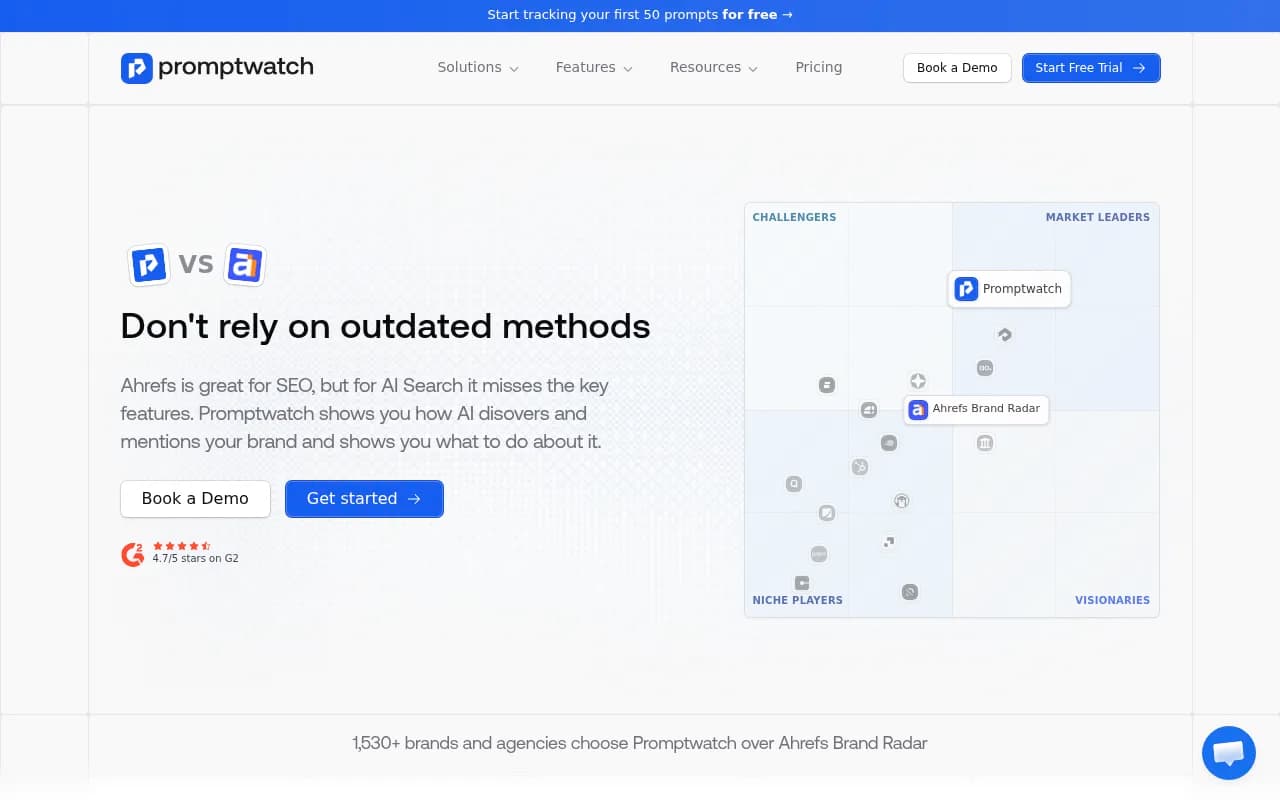
Head-to-head comparison
| Feature | Ahrefs Brand Radar | Promptwatch |
|---|---|---|
| AI model coverage | ChatGPT, Perplexity, Google AI Overviews | 10 models (ChatGPT, Claude, Gemini, Perplexity, Grok, DeepSeek, Copilot, Meta AI, Mistral, Google AI Mode) |
| Custom prompt tracking | Yes | Yes |
| Prompt volume & difficulty scores | No | Yes |
| Query fan-out tracking | No | Yes |
| Answer Gap Analysis | No | Yes |
| Content generation | No | Yes (Content Agents) |
| AI crawler logs | No | Yes |
| Traffic attribution | No | Yes |
| Reddit & YouTube tracking | No | Yes |
| ChatGPT Shopping tracking | No | Yes |
| Offsite citation analysis | No | Yes |
| Multi-language / multi-region | Limited | Yes |
| Pricing (entry) | Included in Ahrefs plans | $99/mo standalone |
| Best for | Ahrefs users wanting a quick AI visibility read | Teams making AI visibility a strategic priority |
The real difference: monitoring vs. optimization
This is the thing worth sitting with. Brand Radar and Promptwatch are solving different problems.
Brand Radar answers: "Are we visible in AI search?" That's a useful question. But it's a diagnostic question, not an action question. Once you know the answer is "not enough," Brand Radar doesn't have much more to offer.
Promptwatch answers: "Why aren't we visible, what should we do about it, and is it working?" That's an optimization loop. You find the gaps, you generate content to fill them, you watch the crawler logs to see when AI engines discover the new content, and you track whether citations and traffic follow.
The Profound blog review of Brand Radar put it well: it's good for SEO teams that already live in Ahrefs and want AI visibility as a secondary signal. It's not built for teams where AI search is a primary channel.
Who should use each tool
Ahrefs Brand Radar makes sense if:
- You're already an Ahrefs subscriber and want AI visibility data without adding another tool
- You need a quick competitive benchmark — "how do we compare to competitors in AI mentions?"
- AI search is a secondary concern and you mostly want to keep an eye on it
- You're an SEO-first team and AI visibility is one metric among many
Promptwatch makes sense if:
- AI search visibility is a strategic priority, not just a metric to monitor
- You want to know not just where you're invisible, but why — and what to write to fix it
- You need to connect AI visibility to actual traffic and revenue
- You're running content operations and want to generate briefs and articles grounded in real gap data
- You need crawler log data to understand how AI engines are discovering (or failing to discover) your content
- You're tracking multiple sites, languages, or regions
A note on the prompt methodology difference
This is worth a separate mention because it affects the data quality in ways that aren't obvious.
Ahrefs builds Brand Radar prompts from its keyword database. That means the prompts are derived from traditional search queries — keywords that people typed into Google. AI search behavior is different. People ask AI engines longer, more conversational questions. They ask for recommendations, comparisons, and follow-ups. They don't search the way they used to.
Promptwatch tracks how AI search engines behave in real user interfaces, not just through API calls. This matters because user-facing answers, citations, and shopping recommendations can differ from what you'd see through an API. You're seeing what real users see, not a synthetic approximation.
Neither approach is perfect, but the methodology difference means you might see different results between the two tools — and the Promptwatch data is closer to what your actual customers are experiencing.
Pricing context
Brand Radar is included in Ahrefs plans, which start around $129/month. If you're already paying for Ahrefs, you're not paying extra for Brand Radar. That's a real advantage for existing subscribers.
Promptwatch starts at $99/month for the Essential plan (1 site, 50 prompts, 5 articles/month). The Professional plan at $249/month adds crawler logs, more prompts, and city/state-level tracking. Business is $579/month for 5 sites. There's a free trial available.
So if you're comparing on pure cost, Brand Radar wins for Ahrefs users. But the comparison only makes sense if Brand Radar actually does what you need. If you need content gap analysis, crawler logs, or content generation, Brand Radar doesn't offer those at any price.
The bottom line
Ahrefs Brand Radar is a reasonable AI visibility add-on for a tool that was built for traditional SEO. It gives you a visibility score, some competitive context, and custom prompt tracking. For teams that live in Ahrefs and want to keep one eye on AI search, it's convenient.
Promptwatch is built around the idea that knowing you're invisible isn't enough — you need to know why, and you need tools to fix it. The crawler logs, gap analysis, content agents, and traffic attribution are all oriented toward closing the loop between "we're not getting cited" and "now we are."
If you're serious about AI search as a channel, you'll hit the ceiling of what Brand Radar can tell you pretty quickly. The data is there; the path forward isn't.