HeyGen Review 2026
Creates professional marketing videos using AI avatars and voice cloning. Supports multi-language dubbing and personalized video at scale.
Key takeaways
- HeyGen is one of the most capable AI video generation platforms available in 2026, covering everything from text-to-video and avatar creation to multilingual dubbing and personalized outreach videos.
- Over 124 million videos generated and trusted by companies like HubSpot, JPMorgan, Bosch, and Coursera -- this is not a niche experiment.
- The free plan exists but is limited; serious use requires a paid plan starting at $29/month for the Creator tier.
- The 175+ language dubbing with voice cloning and lip-sync is genuinely impressive and one of the strongest localization tools in this category.
- Video quality is high, but avatar realism can still feel slightly uncanny in close-up shots -- a limitation shared across the industry.
- Best suited for marketing teams, L&D departments, and sales teams that produce video content regularly and want to cut production time dramatically.
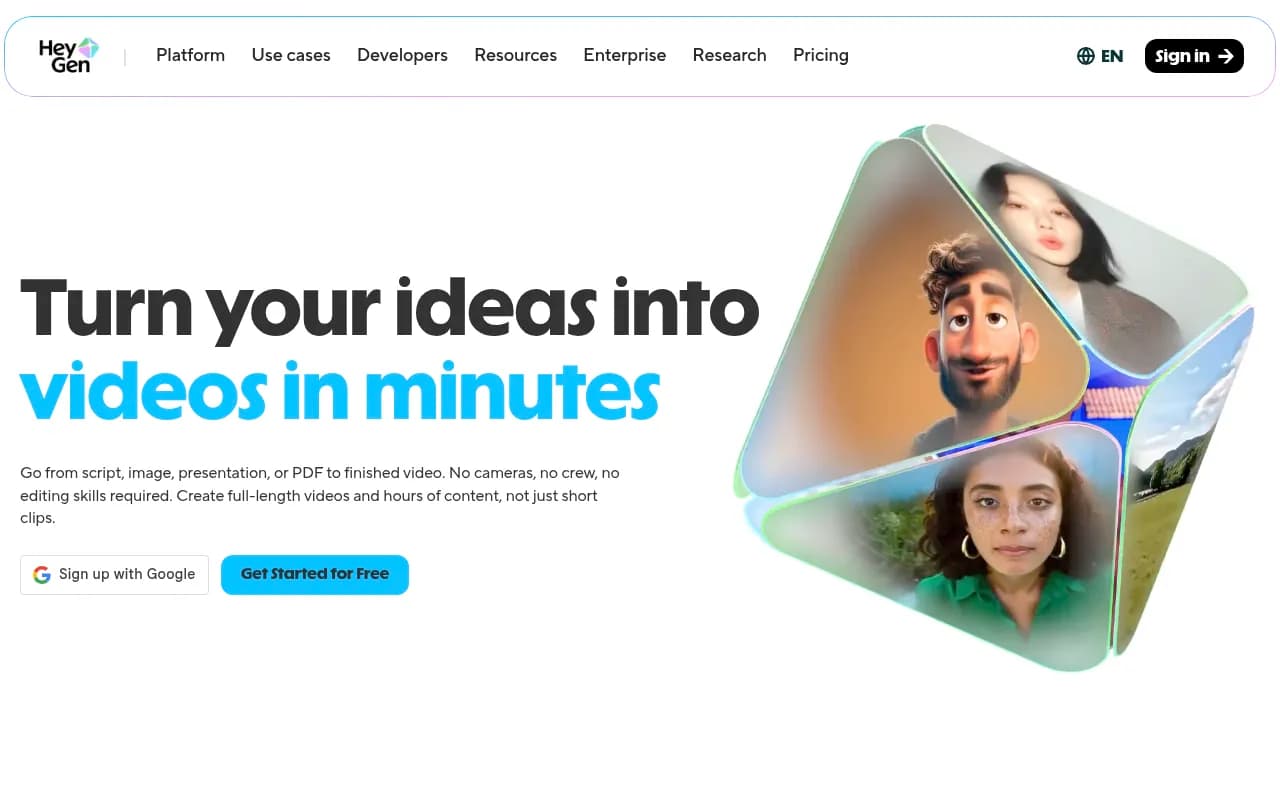
HeyGen is an AI video platform that lets you go from a script, PDF, image, or slide deck to a finished, share-ready video without touching a camera or editing timeline. The company has built a suite of tools around AI avatars, voice cloning, and multilingual dubbing -- and the numbers suggest it's working. Over 124 million videos generated, 98 million avatars created, and 17 million videos translated. Those aren't vanity metrics; they reflect a product that a lot of people are actually using in production.
The platform targets a wide audience: marketing teams that need video content at scale, L&D professionals building training libraries, sales reps doing personalized outreach, and content creators who want to run faceless YouTube or TikTok channels. It's also increasingly used by enterprise teams at companies like HP, DHL, and Autodesk for internal communications and localization. HeyGen positions itself as a full video production replacement for most business use cases -- not a supplement to traditional production, but a substitute for it.
HeyGen launched around 2022 and grew quickly as AI-generated video became a serious category. The company raised significant funding and has continued expanding its model integrations, adding support for third-party AI video models like Sora, Veo, and Kling alongside its own avatar and dubbing technology. By 2026, it's one of the most feature-complete platforms in the space, competing with tools like Synthesia, D-ID, and Runway -- each with different strengths.
Key features
Video Agent (one-shot text-to-video) Type a prompt or paste a script, click generate, and HeyGen produces a complete video with narration, visuals, captions, and an avatar. The Video Agent handles scene selection, pacing, and voiceover automatically. It's genuinely fast -- many videos finish in under a minute. The output quality is good enough for social media, internal comms, and explainer content without any manual editing. For longer or more complex videos, you can drop into the AI Studio editor to refine.
AI avatars (Photo, Public, and Digital Twin) This is HeyGen's core differentiator. There are three avatar modes:
- Photo Avatar: Upload a single headshot and it animates with lip-sync and facial expressions. Works surprisingly well for static portraits.
- Public Avatars: A library of pre-made, diverse AI presenters you can use immediately without any setup.
- Digital Twin: Film a short video of yourself and HeyGen generates a realistic clone that looks and sounds like you. This is the most impressive option for personal branding and scale -- you record once, then generate unlimited videos without being on camera again.
Avatar quality has improved significantly. Lip-sync is accurate, and expressions feel more natural than earlier versions. That said, close-up shots can still reveal the AI origin, particularly around eye movement and subtle facial micro-expressions.
Video translation and dubbing (175+ languages) Upload any video and HeyGen translates it into 175+ languages and dialects with voice cloning, lip-sync adjustment, and auto-generated subtitles. The voice cloning preserves the original speaker's tone and pacing, which is a meaningful improvement over generic text-to-speech dubbing. This feature alone is worth the subscription for any company doing international content -- the alternative is hiring voice actors and re-recording in each language, which is expensive and slow.
AI Studio (text-based editor) The AI Studio is HeyGen's main editing environment. It's text-based, meaning you edit the script and the video updates accordingly -- no timeline scrubbing or clip trimming required. You can control tone, delivery, gestures, and emotion through text commands. It's designed for people who know what they want to say but don't want to learn video editing software. The interface is clean and the learning curve is low.
Product placement and UGC ad creation Upload a product image and a script, and HeyGen places the product in an avatar's hand, adds music and captions, and produces a ready-to-publish ad. This is specifically designed for e-commerce brands running TikTok, Instagram, and Amazon content at scale. The UGC ad feature generates reaction-style videos and story-format content that mimics organic creator content -- useful for performance marketing teams that need volume without hiring influencers.
Third-party AI model integration HeyGen integrates Sora, Veo, and Kling for cinematic B-roll generation, Flux for high-fidelity images, and ElevenLabs for ultra-realistic speech. This is a smart move -- rather than trying to build every underlying model in-house, HeyGen acts as an orchestration layer that lets you access the best available models from a single interface. In practice, this means you can generate a cinematic background scene with Sora and pair it with a HeyGen avatar without leaving the platform.
Personalized video at scale HeyGen supports variable data video -- generating hundreds or thousands of personalized videos where the avatar says each recipient's name, company, or custom message. Sales teams use this for outreach campaigns. The API makes it possible to trigger video generation from CRM data, so a rep can send a personalized video to every prospect in a sequence without recording anything manually.
Enterprise security and compliance HeyGen is GDPR, SOC 2 Type II, CCPA, and AI Act compliant. For enterprise buyers, this matters a lot -- particularly for companies in regulated industries or those handling sensitive internal content. The platform includes admin controls, team collaboration features, and brand kit management to keep output consistent across large teams.
Who is it for
Marketing teams at mid-size to large companies are the clearest fit. If your team is producing explainer videos, product demos, social content, or campaign assets regularly, HeyGen can cut production time from days to minutes. A marketing team at a SaaS company, for example, can turn a blog post into a video explainer, translate it into five languages, and publish it across channels -- all without a video editor or production agency. The 10x increase in video production speed that Miro reported is plausible for teams that were previously bottlenecked by traditional production workflows.
L&D professionals building training content are another strong fit. Compliance training, onboarding videos, and product education content are exactly the kind of material that benefits from HeyGen's avatar-based approach -- you need professional-looking video, but the content changes frequently and doesn't justify a full production shoot every time. HeyGen lets L&D teams update and republish training videos quickly without re-recording.
Sales teams doing personalized video outreach are a growing use case. Reps can generate a personalized video for each prospect using the Digital Twin feature, making outreach feel more human without the time cost of recording individual videos. This works best for teams with a defined outreach sequence and enough volume to justify the setup.
Who should probably look elsewhere: individual creators or hobbyists who only need occasional videos and don't want to pay a monthly subscription. The free plan is limited enough that casual users will hit its ceiling quickly. Also, teams that need highly cinematic, narrative-driven video production -- HeyGen is excellent for business and informational content, but it's not a replacement for a film production team working on brand storytelling or documentary-style content.
Integrations and ecosystem
HeyGen has a REST API that covers the main platform capabilities: Video Agent, Video Translation, Text-to-Speech, avatar creation, Studio video generation, and template management. The API is pay-as-you-go, which makes it practical for teams that want to integrate video generation into existing workflows without committing to a fixed volume. Developers can trigger video generation from CRM data, content management systems, or marketing automation platforms.
The platform integrates with third-party AI models including Sora (OpenAI), Veo (Google), Kling, Flux, and ElevenLabs -- all accessible from within the HeyGen interface. This is a meaningful ecosystem advantage over competitors that are more closed.
HeyGen has a GitHub presence (github.com/heygen-com) with developer resources. There's also a Discord community and a Discord bot for the Talking Photo feature. The platform is web-based with no desktop app, but there is a mobile app with its own pricing and plan structure.
Import/export is straightforward: you can upload scripts, PDFs, presentations, images, and audio files as inputs, and export finished videos in standard formats. The platform supports 1080p and 4K output.
Pricing and value
HeyGen's pricing structure in 2026:
- Free plan: Available, supports basic text-to-video and AI video creation. Limited in video length, credits, and features. Enough to evaluate the platform but not for production use.
- Creator plan: $29/month (or approximately $24/month billed annually). Aimed at individuals creating short-form videos. Includes unlimited video creation with some feature restrictions.
- Team/Business plans: Higher tiers exist for teams needing more seats, longer videos, advanced avatar features, and priority rendering. Specific pricing for these tiers requires checking the current pricing page, as HeyGen adjusts these periodically.
- Enterprise: Custom pricing with dedicated support, advanced security, SSO, and SLA guarantees.
- API: Pay-as-you-go pricing separate from the main subscription tiers.
Compared to Synthesia, which starts at around $22/month for a basic plan but charges more for advanced avatar features, HeyGen's Creator plan is competitive. D-ID is cheaper at the entry level but has fewer features. For teams that need the full suite -- dubbing, Digital Twin, product ads, API access -- HeyGen's mid-tier plans represent reasonable value given what traditional video production costs.
The free plan is genuinely useful for evaluation but not for ongoing production. Most serious users will need at least the Creator plan.
Strengths and limitations
What HeyGen does well:
- The 175+ language dubbing with voice cloning and lip-sync is one of the best in the market. For global content teams, this alone justifies the subscription.
- The Digital Twin feature is impressive. Recording once and generating unlimited personalized videos from that clone is a real workflow change for sales and content teams.
- Third-party model integration (Sora, Veo, ElevenLabs) means HeyGen benefits from the best underlying AI without users having to manage multiple subscriptions.
- The text-based editor makes video creation genuinely accessible to non-technical users. The learning curve is low compared to traditional video editing tools.
- Enterprise compliance (SOC 2 Type II, GDPR, AI Act) makes it viable for regulated industries and large organizations with strict data requirements.
Honest limitations:
- Avatar realism still has an uncanny valley problem in close-up shots. Eye movement and micro-expressions can give away the AI origin, which matters for high-stakes external communications.
- The free plan is quite limited. Users who want to seriously evaluate the platform before committing will hit the ceiling quickly and need to upgrade.
- Creative control has limits. For highly customized, brand-specific visual styles or complex narrative video, HeyGen's templates and avatar-based approach can feel constraining. It's optimized for efficiency, not creative flexibility.
- Pricing transparency for mid-tier and team plans requires visiting the pricing page directly -- the public-facing information is somewhat fragmented between creator, mobile, and API pricing.
Bottom line
HeyGen is the right tool for any team that produces business video content regularly and wants to cut the time and cost of production without sacrificing quality. Marketing teams, L&D departments, and sales organizations at companies with 50 to 5,000 employees will get the most out of it -- particularly if they have multilingual content needs or want to scale personalized video outreach.
The best single use case: a global marketing team that needs to produce product explainers, translate them into 10+ languages, and publish them across channels every month -- HeyGen turns that from a multi-week production project into a same-day workflow.
Tags:
Frequently asked questions
What is HeyGen?
Is HeyGen free to use?
How many languages does HeyGen support for video dubbing?
What is the Digital Twin feature in HeyGen?
How does HeyGen compare to Synthesia?
What AI models does HeyGen integrate with?
Similar and alternative tools to HeyGen