Key takeaways
- Tibly is built for small businesses and fixes things on your site. Promptwatch is the deepest tracking and optimization platform of the three. Birdeye is built for 100 to 10,000+ locations and says so itself.
- For a single location, Birdeye is usually the wrong shape. Its own blog concedes it may be more comprehensive than a small single-location business needs, and it publishes no list price.
- Promptwatch starts at $95/month and supports country, language and city tracking on every plan. Tibly's homepage says plans from $149/month.
- No independent head-to-head test of these three exists yet. Treat vendor claims, including customer results, as vendor claims.
- Whatever you pick, track 10 to 20 real buyer prompts that include your city or service area.
What single-location businesses actually need
A dentist in Boise, a food truck, a photographer, a plumber with one van. Nobody asks an assistant "good dentist." They ask "dentist near me who takes new patients," and the answer changes by city. That one fact decides most of what matters in a tool.
Here is the checklist I would run against any of these products:
- Can I put my city or service area into the prompts, and does the tool check from that location?
- Does it show which sources the AI cites, so I know where to fix things?
- Does it help me fix the problem, or only report it?
- Does the price make sense for one location?
- Can I verify the claims independently?
Promptwatch's own guidance is that local businesses should measure Google's AI surfaces city by city, because Google AI Overviews and AI Mode answer "near me" questions and the answer shifts by location. A lightweight starting point, suggested in a r/localseo thread, is to pick 10 to 20 buyer-intent prompts and check them regularly. That is good advice regardless of which tool you buy.
The three tools at a glance
| Tibly | Promptwatch | Birdeye | |
|---|---|---|---|
| Built for | Small businesses, many verticals | Brands, agencies, local to enterprise | Multi-location and enterprise brands |
| Starting price | Plans from $149/month (homepage); Plus annual $1,490/year | Free Explore tier; paid from $95/month | No public list price; third-party estimates of roughly $299 to $449 per location (unverified) |
| Local tracking | Tracks ChatGPT, Gemini and Google AI recommendations | Country, language and optional city or US state, on live interfaces | Per-location visibility across 100 to 10,000+ locations |
| Fixes things | Applies fixes to your site, offers AI website builder | Content Agent, Action Board, CMS publishing | Agents update listings, reviews, citations, local pages |
| Crawler and traffic data | Shows AI-referred orders and bookings in demo | IP-verified crawler logs, visitor analytics | Not a focus per available research |
| Best fit for one location | Yes, by design | Yes, if you want depth and measurement | Rarely |
Tibly: made for the small shop
Tibly positions itself as an AI search visibility platform for small businesses. It tracks how often ChatGPT, Gemini and Google AI recommend you, which competitors they name instead, and which sources they cite. Then it applies fixes to your site, and it also sells an AI website builder.
The site has vertical pages for contractors, restaurants, photographers and food trucks, plus an e-commerce angle with on-site checkout and booking. That tells you who it is talking to: owners who do not have an SEO person and want someone to just change the website.
What I like: the scope matches the buyer. A single-location owner does not want a 40-widget dashboard.
What gives me pause:
- Customer results on the site ("0% to 36% of AI answers name them", "+62% AI-driven visits", "+$12,000 online orders in 90 days") are self-reported testimonials. They are not independently verified.
- Reports for a business may be cached and shown to other visitors for up to 7 days, per the site. Worth knowing if freshness matters to you.
- I found no independent reviews, and I could not confirm plan tiers, prompt limits or the exact list of engines beyond ChatGPT, Gemini and Google AI.
If your site is a weak point and you want the tool to touch it directly, Tibly is a reasonable thing to trial. Just ask for prompt limits and engine coverage in writing before paying.
Promptwatch: the measurement and optimization option
Promptwatch is not a local-only product, but its local features are real and included on every plan. Monitors can be set per country, language and optional city or US state, collected from live interfaces through a residential proxy with a matched locale and timezone. That matters because what a user in your city sees can differ from what an API returns.

For a single location, the parts that tend to matter most:
- Real interface tracking across 12 AI platforms. Brands plans let you pick 4 per project, and for a local business the sensible starting set is Google AI Overviews, Google AI Mode, ChatGPT and Gemini, with Perplexity added later.
- Citation data showing which of your pages, and which third-party pages, get cited. For local businesses that is how you find the directories and review sites AI is actually reading.
- IP-verified AI crawler logs. If GPTBot or another bot gets a 403 on your site, no amount of content work helps. Most tools in this category lack this.
- Visitor analytics that separate AI-referred human visits by source, so you can see whether any of this brings customers.
- The Content Agent and Action Board, which turn gaps into a prioritized to-do list and publish to WordPress, Webflow or Framer.
Pricing, to confirm at promptwatch.com/pricing: Explore is free (1 project, 10 prompts, ChatGPT only), Essential is $95/month (1 project, 50 prompts, all models, country tracking, site audit, content gap analysis), and Professional is $245/month (150 prompts, 2 projects). Annual billing gives 12 months for the price of 10, and monthly Essential has a 7-day free trial. A single location will almost always sit at Essential or the free tier.
The honest downside: it is a full platform. If you want a one-click fix and have never opened a dashboard, there is more here than you will use in month one. The free tier is a fair way to find out.
Birdeye: powerful, but pointed at a different customer
Birdeye AI Search is aimed at multi-location and enterprise brands with 100 to 10,000+ locations. It sends customer-configured queries to selected LLMs and measures visibility per location, then pairs that with agents that fix listings, reviews, citations and local pages.
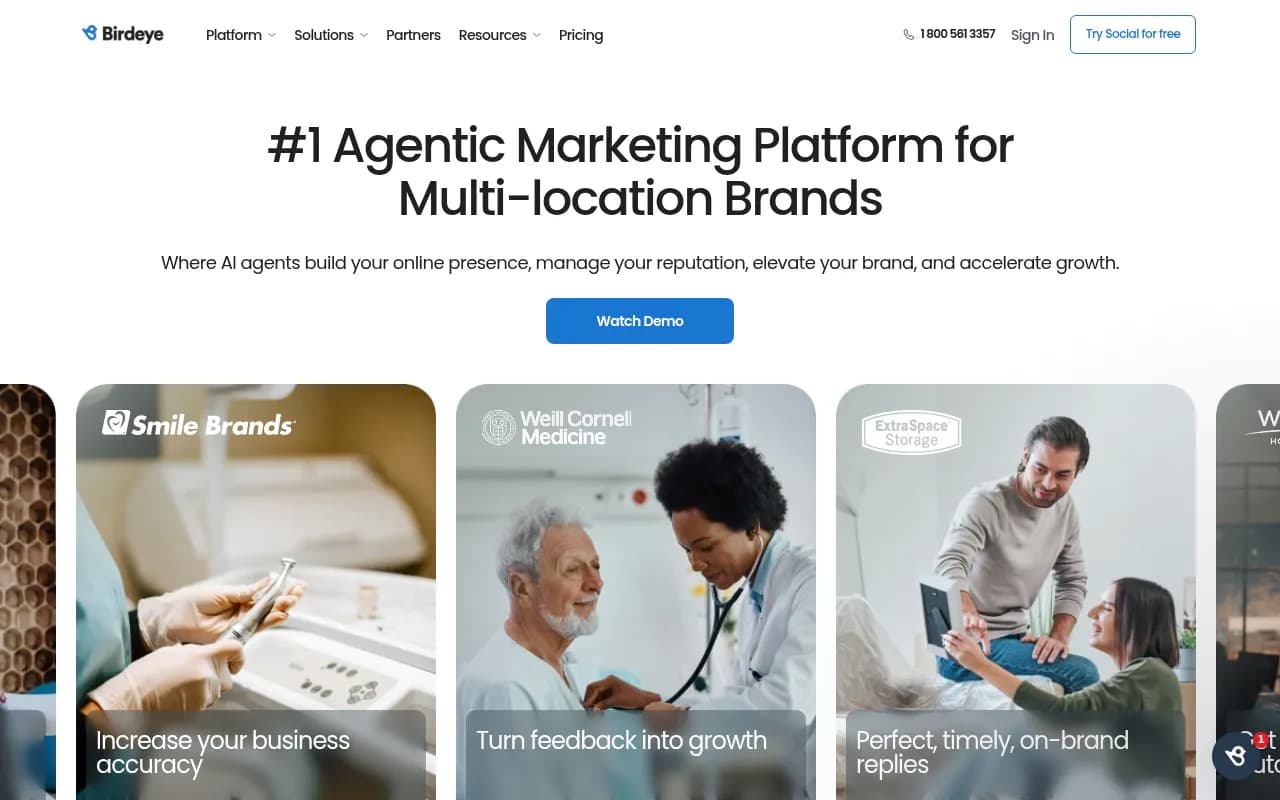
That is a strong pitch for a franchise or a regional chain. Birdeye's own comparison article says the platform is best suited to multi-location and enterprise brands and may be more comprehensive than a small single-location business needs. I appreciate the candor. Note, though, that the article is vendor-written, and it names Birdeye the winner of its own listicle.
Other details worth knowing:
- Birdeye's pricing page says pricing is "built around outcomes, not seat counts" and shows no list price. Emitrr, a Birdeye competitor, estimates roughly $299 to $449 per month per location. That figure is unverified and may be dated.
- Birdeye claims multi-location brands boost AI visibility by 61% in 2 months with Search AI. That is a vendor claim.
- Cheers, another vendor, rates Birdeye's AI prompt tracking and review generation as core, and its cited-source capture as partial or add-on.
- A local SEO roundup from GrowthPro AI, also a vendor, says Birdeye handles reviews well but needs separate tools for GBP management and AI visibility.
Where Birdeye could still make sense for one location: you already use it for reviews, you want review generation and AI visibility under one login, and a sales conversation gets you a price that fits. Otherwise, you are paying for scale you will not use.
Side-by-side on what single-location owners care about
| Question | Tibly | Promptwatch | Birdeye |
|---|---|---|---|
| Public price for one location | Yes, from $149/month | Yes, free tier and from $95/month | No public list price |
| Location-aware prompts | Tracks local recommendations; details unconfirmed | City and state tracking, country and language | Per-location, designed for it |
| See which sources AI cites | Yes, per its description | Yes, deep citation analytics | Partial or add-on per Cheers |
| Crawler visibility | Not confirmed | IP-verified AI crawler logs | Not confirmed |
| Measures AI traffic and conversions | Demo shows AI-referred orders and bookings | Visitor analytics by AI source | Not confirmed |
| Review generation | Not a stated focus | Not a focus; tracks review sites as citations | Core capability |
| Hands-on fixing | Applies site fixes | Content Agent and CMS publishing | Agents for listings, reviews, local pages |
| Independent proof available | None found | G2 4.7/5 | Vendor claims only in our research |
What the citation data says about where to put effort
Whichever tool you use, it helps to know what AI engines tend to cite. Promptwatch Data's report on ChatGPT citations by content type (Sep 28 to Oct 4, 2026) found product pages are 22.4% of classified ChatGPT citations and landing pages 16.8%. For branded prompts, reviews rise to 5.6%, more than three times their overall share, and FAQ pages reach 4.8%. The practical reading for a local shop: keep your service and landing pages complete and factual, collect reviews on trusted sites, and add an FAQ page answering the questions customers ask.
There is also a platform difference worth planning around. In Promptwatch's social media citations report for Sep 28 to Oct 4, 2026, ChatGPT got 0.46% of its citations from social platforms while Google AI Overviews got 12.2%. So a strong social presence matters more for Google's surfaces than for ChatGPT. The same week, Promptwatch's data on unique domains per response shows almost half of ChatGPT responses cite 10 or more domains, so being named on third-party pages counts as much as your own site.
Cheaper alternatives to know about
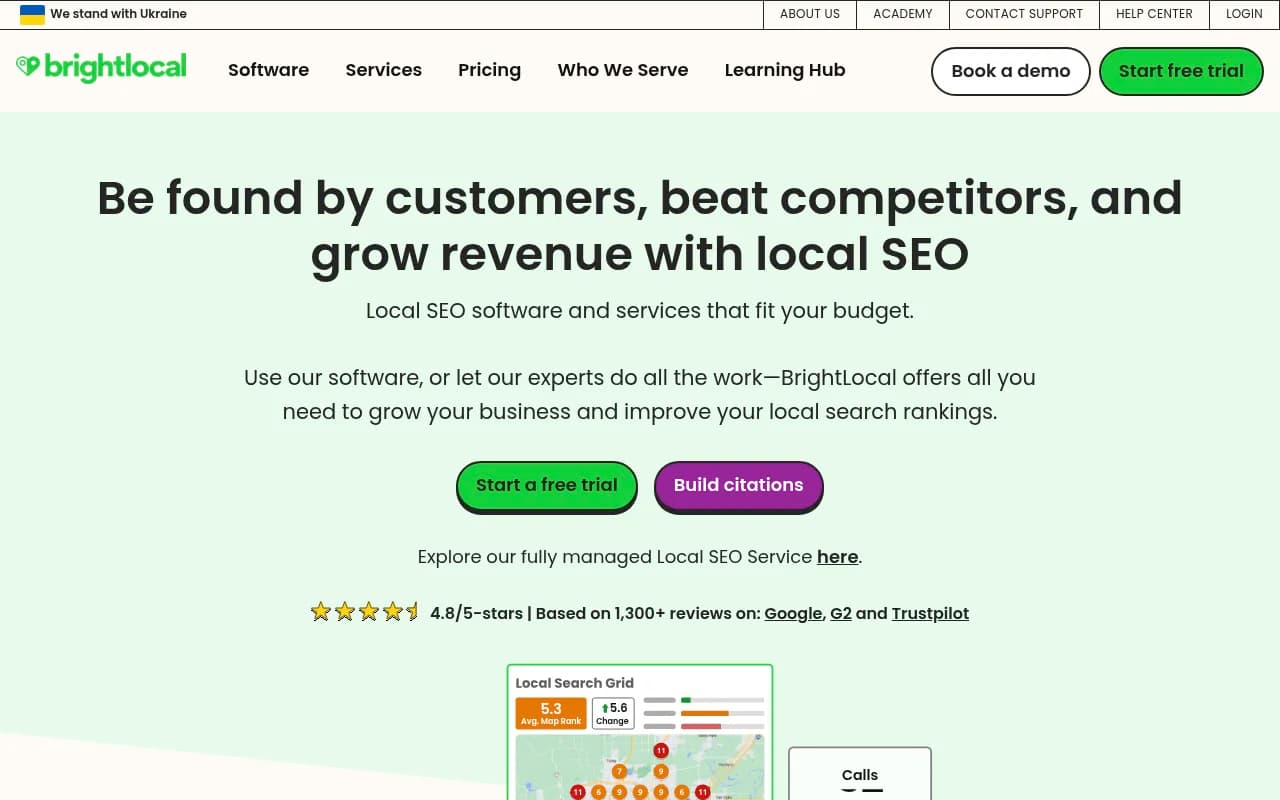
If none of the three fits, the single-location budget range has options. Otterly.AI lists $29/month for 15 prompts, though the research did not find city-level targeting on that plan. Ayzeo lists paid plans from $39/month. Semrush's AI Visibility Toolkit is $99/month for 25 prompts. BrightLocal puts AI visibility beside local rankings, citations and Google Business Profile tools, though it covers only two AI platforms and prices per location.
Otterly.AI

For more options, the GEO software directory at bestgeosoftware.com lists a wider set of trackers.
Which should you pick
| If you are... | Start with |
|---|---|
| An owner who wants the tool to change the website for you and has little time | Tibly, after confirming prompt limits and engines |
| Someone who wants to measure real AI traffic, crawler access and citations, and act on them | Promptwatch, starting free or at Essential |
| Already a Birdeye reviews customer, or opening a second and third location soon | Birdeye, after getting a written quote |
| Strictly budget-limited and only need a basic check | A $29 to $39 tracker, or Promptwatch's free tier |
My own lean: for one location, I would start with Promptwatch's free tier or Essential to find out whether there is a problem and where, since crawler logs and citation data tell you why you are missing. Tibly is the more hands-off option if you value convenience over measurement. Birdeye only enters the picture if scale is coming.
How to run a fair test before paying
Because no independent comparison exists, run your own:
- Write 15 prompts the way customers ask, including your city and service ("emergency plumber in Tulsa", "best pediatric dentist near downtown Boise").
- Run them by hand in ChatGPT, Gemini and Google AI Overviews and record whether you are named, who beats you, and which sources are cited.
- Start each tool's trial or free tier with the same prompts and compare the results against your manual log. Does the tool match what you see?
- Ask each vendor three questions: which engines are tracked from the real interface, how is location handled, and what does a month of fixes actually include.
- Recheck in 30 days. AI answers shift from run to run, so one snapshot proves little.
Prices and plan tiers change often. Confirm everything on each vendor's pricing page before buying.
FAQ
Is Birdeye too big for a single-location business?
Its own published comparison says it is best for multi-location and enterprise brands and may be more than a single location needs. There is also no public list price, so you will need a quote.
Does Promptwatch work for local businesses?
Yes. City and US state tracking, plus country and language, is included on every plan, and tracking runs on live interfaces rather than APIs. It is a broader platform than a pure local tool, so expect more features than you will use at first.
Can I trust the results Tibly shows on its site?
Treat them as self-reported testimonials. We found no independent verification, so test with your own prompts during a trial.
How many prompts should a single location track?
10 to 20 buyer-intent prompts with your location in them is a workable start. Add more only once you are acting on what the first set shows.