Birdeye Review 2026
Monitor how often your brand appears in ChatGPT, Gemini, Perplexity, and other AI platforms with actionable visibility insights.
Key Takeaways:
- Best for: Multi-location brands (healthcare systems, restaurant chains, real estate groups, retail franchises) managing 10+ locations who need centralized reputation and marketing automation
- Standout strength: AI agents that handle review responses, social publishing, and listings management at scale while maintaining brand voice consistency across all locations
- Unique capability: Search AI feature monitors brand visibility in ChatGPT, Gemini, Perplexity, and other AI platforms—similar to tools like Promptwatch but integrated into a broader marketing suite
- Pricing: Starts at $299/month (Standard), $399/month (Professional), custom pricing for Premium—significantly higher than single-location tools but competitive for enterprise needs
- Limitation: Overkill for single-location businesses or solopreneurs; pricing and feature complexity target mid-market to enterprise only
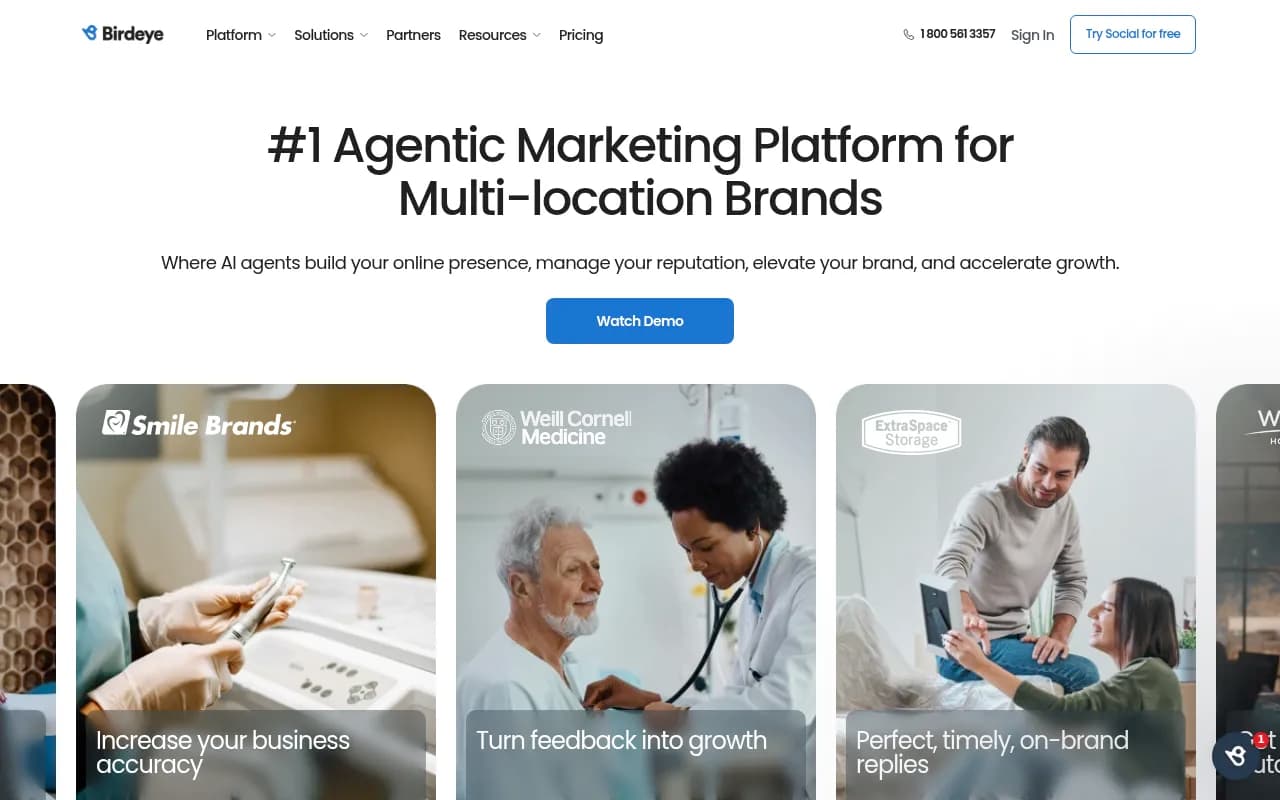
Birdeye positions itself as the "#1 Agentic Marketing Platform for Multi-location Brands," and that positioning is precise. This isn't a tool for freelancers or single-location businesses—it's built for healthcare systems with 50 clinics, restaurant chains with 200 locations, or real estate groups managing dozens of properties. The platform replaces what would typically require 5-8 separate tools: review management software, social media schedulers, local SEO platforms, business listing services, and now AI search monitoring.
Founded as a reputation management platform, Birdeye has evolved into a comprehensive marketing automation system powered by what they call "AI agents"—specialized AI modules trained on your brand voice, industry context, and business data. These agents don't just assist; they execute tasks autonomously, from drafting review responses to publishing social content to optimizing local listings.
Who This Platform Serves
Birdeye's customer roster reads like a who's who of multi-location brands: Wyndham Hotels, Smile Brands (dental), Black Bear Diner, Sono Bello (medical aesthetics), and thousands of healthcare practices, auto dealerships, senior living facilities, and self-storage operators. The common thread? These are businesses where maintaining consistent brand presence, reputation, and customer engagement across dozens or hundreds of locations is operationally complex and labor-intensive.
The platform is specifically designed for marketing directors, regional managers, and corporate teams who need centralized control with local flexibility. A dental group with 40 practices can set brand guidelines and content templates at the corporate level, while individual office managers can still customize messaging for their specific community. A restaurant chain can automate review requests after every transaction while ensuring responses feel personal and location-specific.
This is NOT for: Solo practitioners, single-location businesses, or small teams with under 5 locations. The pricing, feature depth, and learning curve are all calibrated for organizations with dedicated marketing staff and multi-location complexity. If you're a single restaurant or one dental office, you'll pay enterprise prices for capabilities you don't need.
Core AI Agents and What They Actually Do
Review Generation Agent: Automatically triggers review requests via SMS and email after customer interactions (appointments, purchases, service completions). The system integrates with your CRM, POS, or scheduling software to know when to ask. It's smart about timing—waiting until after service delivery, not immediately at checkout. Birdeye claims clients generate an average of 10x more reviews after implementation. American Pacific Mortgage, for example, has accumulated 131,000 reviews with a 4.9-star average using the platform.
Review Response Agent: This is where the AI gets impressive. The agent analyzes incoming reviews across Google, Facebook, Yelp, Healthgrades, and 200+ other sites, then drafts responses in your brand voice. It's trained on your previous responses, brand guidelines, and industry best practices. For positive reviews, it thanks customers and reinforces key brand messages. For negative reviews, it acknowledges concerns, offers solutions, and escalates to human managers when needed. Fairlawn Real Estate reports that AI-generated responses saved "so much time while ensuring we maintain a professional and personal connection."
Social Publishing Agent: Creates and schedules social media content across Facebook, Instagram, Twitter, and LinkedIn for all your locations. The AI analyzes trending topics in your industry, pulls from your content library, and generates posts optimized for each platform. You can publish in bulk to all locations or customize per location. Valley Veterinary Care saw a 400% increase in social publishing after implementation, posting consistently across multiple clinic accounts without the manual tedium.
Social Engagement Agent: Monitors and responds to comments, messages, and mentions across all social platforms. The AI can handle routine inquiries (hours, services, pricing) automatically while flagging complex questions for human follow-up. It maintains conversation threads and ensures no customer message goes unanswered.
Listings Optimization Agent: Manages your business information (NAP—name, address, phone—plus hours, services, photos, descriptions) across Google Business Profile, Apple Maps, Bing, Facebook, and 100+ directories. When you update information in Birdeye, it syncs everywhere automatically. The agent also monitors for incorrect listings and suppresses duplicates. Superior Storage saw an 86% increase in direction requests after optimizing their listings through Birdeye.
Search AI: This is Birdeye's newest capability and directly relevant to the AI search visibility space. The Search AI module monitors how often your brand appears in responses from ChatGPT, Google Gemini, Perplexity, and other AI platforms. It tracks brand mentions, analyzes context (positive, neutral, negative), and provides recommendations for improving AI visibility. This puts Birdeye in competition with specialized AI visibility platforms like Promptwatch, though Birdeye's approach is integrated into their broader marketing suite rather than being a standalone deep-dive tool.
Lead Generation Agent: Manages two-way texting, webchat, and messaging across platforms. Customers can text your business number, and the AI handles initial qualification, appointment scheduling, and FAQs before routing to human staff. The system maintains conversation history across channels so your team has full context.
Reporting Agent: Generates automated reports on reputation metrics (review volume, star ratings, sentiment trends), social performance (engagement, reach, follower growth), listing accuracy, and competitive benchmarking. The AI can answer natural language questions like "How did our star rating change last quarter?" or "Which locations have the most negative reviews?"
Marketing Automation: Builds and executes email and SMS campaigns personalized for each location. You can create templates at the corporate level, and the system customizes messaging with location-specific details, offers, and contact information.
Insights AI: Analyzes customer feedback across reviews, surveys, and messages to identify sentiment trends, common complaints, service gaps, and churn risks. It surfaces actionable insights like "30% of negative reviews at Location X mention wait times" or "Locations with photos get 2x more engagement."
The Birdeye Score: A proprietary metric that aggregates your online presence, reputation, engagement, and visibility into a single score (0-100) for each location. This gives executives a quick benchmark for comparing location performance and identifying underperformers.
Integrations and Ecosystem
Birdeye integrates with 3,000+ business systems including major CRMs (Salesforce, HubSpot), scheduling platforms (Calendly, Acuity), POS systems (Square, Toast, Clover), healthcare EMRs (Epic, Cerner, Athenahealth), and communication tools (Slack, Microsoft Teams). The depth of integrations is critical for automation—review requests trigger based on actual customer interactions logged in your existing systems.
The platform offers a mobile app for iOS and Android, allowing location managers to respond to reviews, approve social posts, and monitor performance on the go. There's also a Chrome extension for quick access to customer data and review management.
API access is available for enterprise clients who want to build custom integrations or pull Birdeye data into their own dashboards and reporting systems.
Pricing and What You Actually Get
Birdeye uses tiered pricing based on features and number of locations:
- Standard Plan: $299/month—includes review generation, review monitoring, basic listings management, and reporting. Good for businesses just starting with reputation management.
- Professional Plan: $399/month—adds AI review responses, social media publishing, advanced listings optimization, and competitive benchmarking. This is the most popular tier for growing multi-location brands.
- Premium Plan: Custom pricing (typically $500-$1,000+/month depending on location count)—includes everything plus Search AI, Marketing Automation, Insights AI, dedicated account management, and custom integrations.
Pricing scales with the number of locations. A 10-location business might pay $399/month on Professional, while a 100-location enterprise could pay $2,000+/month on Premium. There's no free trial advertised publicly, but Birdeye offers demos and typically includes an onboarding period with training and setup support.
Compared to competitors like Podium ($289-$449/month), Reputation.com (custom enterprise pricing), or Yext ($199-$499/month for listings only), Birdeye is competitively priced for the breadth of features. However, single-location businesses will find better value in tools like BirdEye's simpler competitors or standalone review platforms like Trustpilot or G2.
What Birdeye Does Exceptionally Well
Multi-location scalability: The platform is architected for managing hundreds of locations from one dashboard. Corporate teams can set global policies while empowering local managers with appropriate permissions. This is harder than it sounds—most tools either give you full centralization (no local flexibility) or full decentralization (no brand control).
AI that actually sounds human: Customer testimonials consistently praise how natural the AI-generated responses feel. The system learns your brand voice and adapts tone based on context (enthusiastic for 5-star reviews, empathetic for complaints). This is critical because generic AI responses damage brand perception.
Unified data model: Because Birdeye handles reviews, social, listings, and messaging in one platform, it can connect dots that separate tools can't. For example, it can correlate review sentiment with social engagement or identify that locations with complete listings get more direction requests.
Industry-specific training: BirdAI is trained on industry-specific language and compliance requirements. Healthcare clients get HIPAA-compliant messaging, financial services get regulatory-appropriate responses, and restaurants get food-service-specific content.
Honest Limitations and Where Competitors Win
Pricing is opaque: The lack of transparent pricing on the website is frustrating. You have to book a demo to get a quote, which adds friction for businesses doing initial research. Competitors like Podium and Yext publish pricing tiers openly.
Overkill for small businesses: If you have 1-5 locations, you're paying for enterprise features you don't need. Single-location businesses should look at Podium, Grade.us, or even just Google Business Profile's native tools.
Search AI is new and less mature: While Birdeye has added AI search visibility monitoring, it's a newer feature compared to their core reputation management capabilities. Specialized platforms like Promptwatch offer deeper AI visibility analytics, real prompt tracking, and more granular citation analysis. Birdeye's Search AI is more of a "nice to have" add-on rather than a best-in-class standalone tool.
Learning curve: The platform is feature-rich, which means there's a learning curve. Smaller teams without dedicated marketing staff may struggle to leverage all capabilities. Onboarding and training are critical.
Limited social listening: While Birdeye monitors brand mentions and engagement, it's not a full social listening platform like Sprout Social or Hootsuite. If you need deep social analytics, competitive social intelligence, or influencer tracking, you'll need a supplementary tool.
Bottom Line: Who Should Buy Birdeye
Birdeye is the right choice for multi-location brands (10+ locations) in healthcare, real estate, automotive, restaurants, senior living, self-storage, or retail who need to centralize reputation management, social media, and local search optimization. It's particularly strong for businesses where online reputation directly drives revenue (healthcare practices, service businesses, hospitality) and where maintaining brand consistency across locations is operationally challenging.
The platform delivers the most value when you're replacing multiple tools—if you're currently paying for separate review management, social scheduling, listings management, and messaging platforms, Birdeye's all-in-one approach can actually save money while reducing operational complexity.
Skip Birdeye if you're a single-location business, solopreneur, or small team without dedicated marketing resources. The pricing and feature depth target mid-market to enterprise, and you'll get better ROI from simpler, cheaper alternatives. Also skip it if AI search visibility is your primary need—specialized tools like Promptwatch offer more comprehensive AI monitoring and optimization capabilities.
Tags:
Similar and alternative tools to Birdeye