Atomic AGI Review 2026
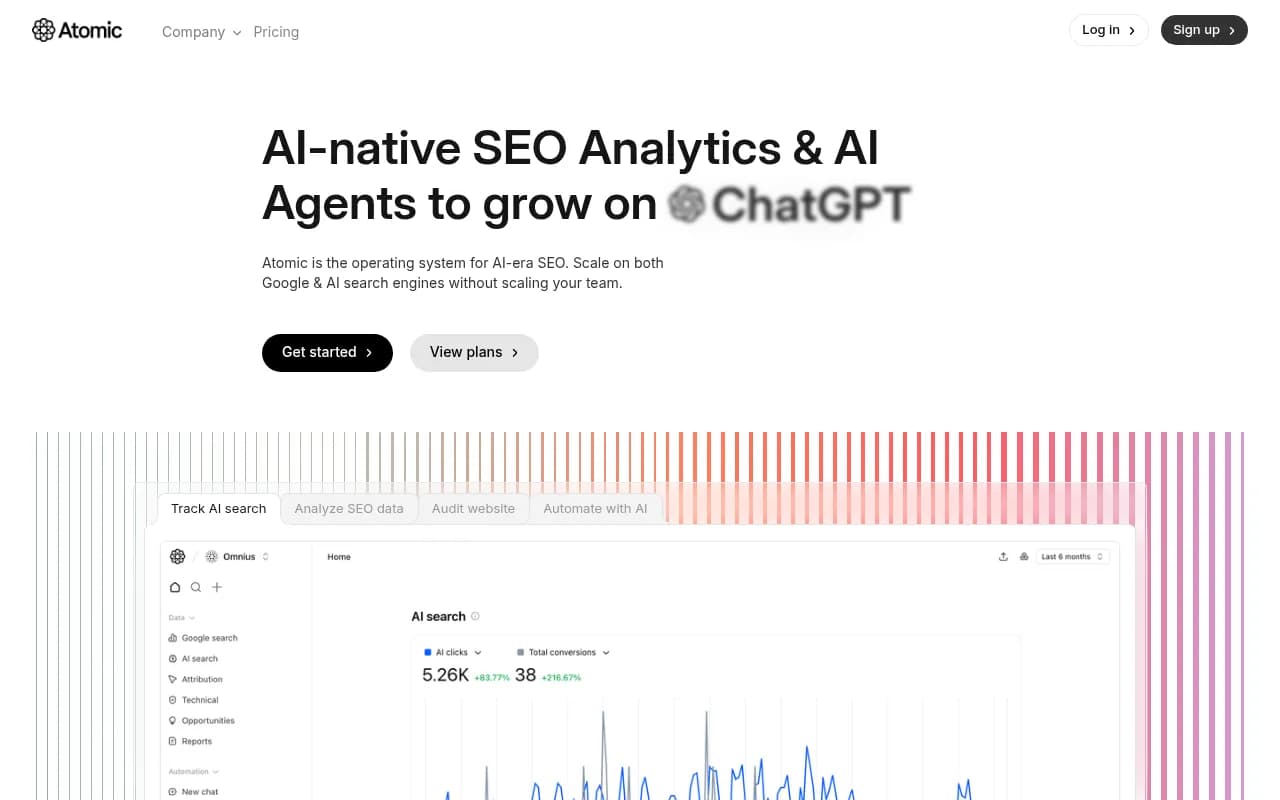
Atomic AGI is an all-in-one SEO analytics and automation platform that tracks both traditional Google search and AI search engines (ChatGPT, Perplexity, Gemini, Claude). Built for marketing teams who want to scale organic growth without scaling headcount, it combines deep analytics, technical audits, and AI agents to automate repetitive SEO tasks and optimize for both Google and LLM visibility.
Key Takeaways:
- Dual-engine tracking: Monitors both Google Search Console data and AI search engines (ChatGPT, Perplexity, Gemini, Claude, DeepSeek, Copilot, Grok, Meta Llama, Qwen, Mistral) in one platform
- AI workflow automation: Deploy specialized AI agents to analyze data, refresh content, audit pages, and execute optimization tasks continuously
- Technical depth: Comprehensive SEO audits plus LLM-specific crawlability analysis to ensure your site is discoverable by both Google and AI engines
- Limitations: AI agent features are still in development ("Coming soon" status), and the platform lacks some advanced GEO capabilities like citation gap analysis and content generation found in competitors like Promptwatch
- Best for: Marketing teams at SaaS companies, digital agencies, and content-driven businesses managing 1-5 websites who want unified analytics and automation without juggling multiple tools
Atomic AGI positions itself as the "operating system for AI-era SEO" -- a platform designed to help marketing teams scale organic growth across both traditional search and AI search engines without scaling headcount. The company targets teams frustrated by fragmented tooling and manual workflows, promising to consolidate analytics, technical audits, and automation into a single interface.
What Atomic AGI Actually Does
At its core, Atomic AGI is a dual-tracking analytics platform. On one side, it pulls data from Google Search Console, Google Analytics 4, and other traditional SEO sources to show keyword rankings, landing page performance, conversions, geographic distribution, and device breakdowns. On the other side, it monitors how AI search engines like ChatGPT, Perplexity, Gemini, and Claude present your brand in their responses -- tracking prompts that mention you, visibility percentages, citation share, and sentiment analysis.
The platform's value proposition centers on three pillars: Analytics (understand what's happening), Attribution (connect search to conversions), and Automation (use AI agents to execute tasks). A fourth pillar, AI Agents, is prominently featured but marked "Coming soon" -- suggesting the automation layer is still under development.
AI Search Tracking: The Core Differentiator
Atomic's AI search tracking covers 10 generative engines: ChatGPT, Perplexity, Google Gemini, Claude, DeepSeek, Copilot, xAI Grok, Meta Llama, Qwen, and Mistral. The system tracks which AI platforms send traffic to your website, measures visitor volume and conversions by engine, and shows average session time to reveal which platforms deliver high-quality traffic.
Prompt Tracking monitors the specific queries users enter into AI search engines that trigger mentions of your brand. You see your visibility percentage across prompts, average position in AI responses, mention frequency, and which engines return your brand for each query. Prompts are categorized by intent stage (Awareness, Consideration, Decision), helping you identify optimization opportunities.
Visibility Overview aggregates performance across all AI platforms, tracking total AI clicks, click-through rate, and visibility percentage. The system breaks down performance by individual platform, analyzes position distribution in AI responses, calculates citation share, and captures recent chat examples showing how AI engines discuss your brand in real conversations.
Pages Analysis reveals which pages on your website receive traffic from AI-generated responses, distinguishing between pages that convert clicks and "zero-click" pages where users don't proceed to your site. The system calculates your site's "AI indexability percentage" -- measuring how much of your content successfully drives engagement from AI search.
Competitor Tracking compares your brand's AI search visibility to competitors, tracking each company's visibility percentage, average position in AI responses, and citation frequency across all tracked prompts and platforms. Trend analysis shows competitive shifts over time.
Citation Analysis shows which specific pages and domains AI engines cite as sources when responding to your tracked prompts. Citations are categorized by type (You, Competitor, UGC, Corporate, Reference), with citation share percentages, ranking positions, and trends across different platforms over time.
Sentiment Analysis evaluates how your brand is described inside AI search engines, classifying mentions as positive or negative and grouping them into recurring themes. Each signal is linked to the source the AI model relies on, allowing you to track how AI perception changes over time.
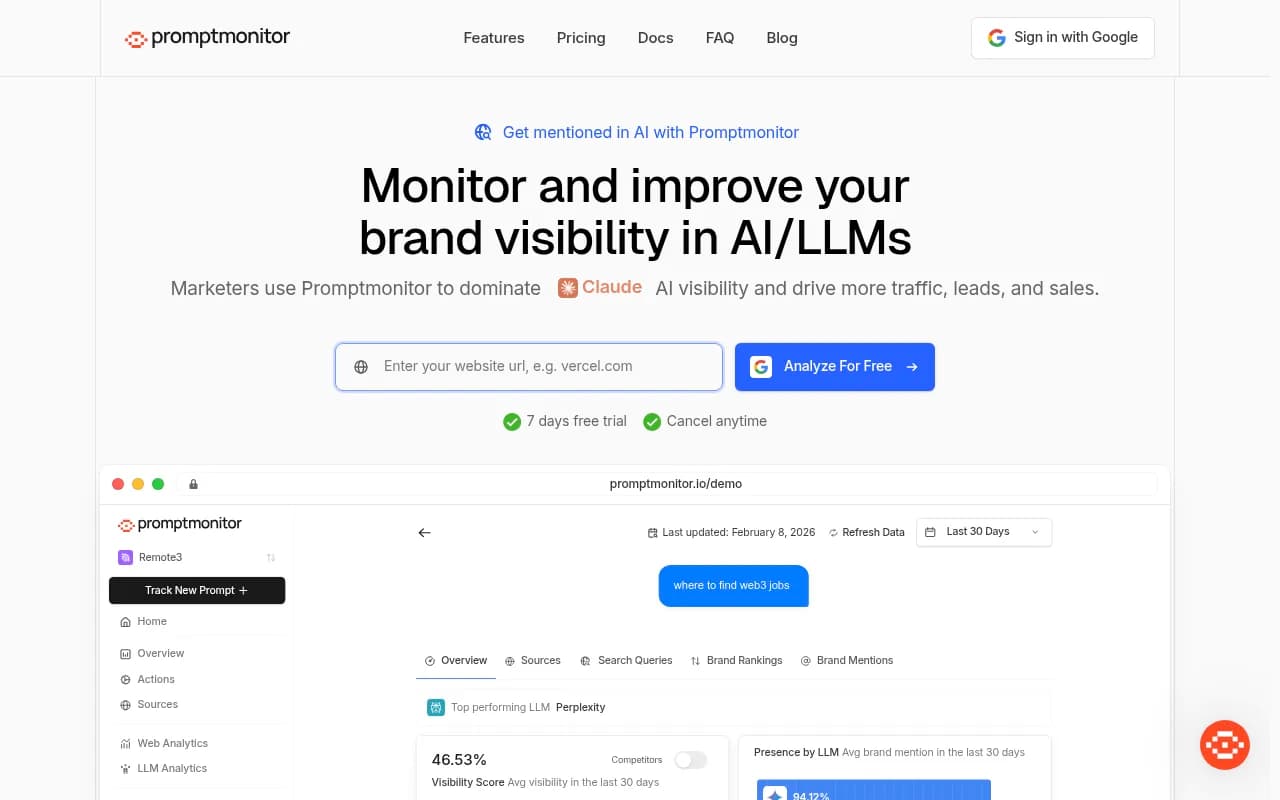
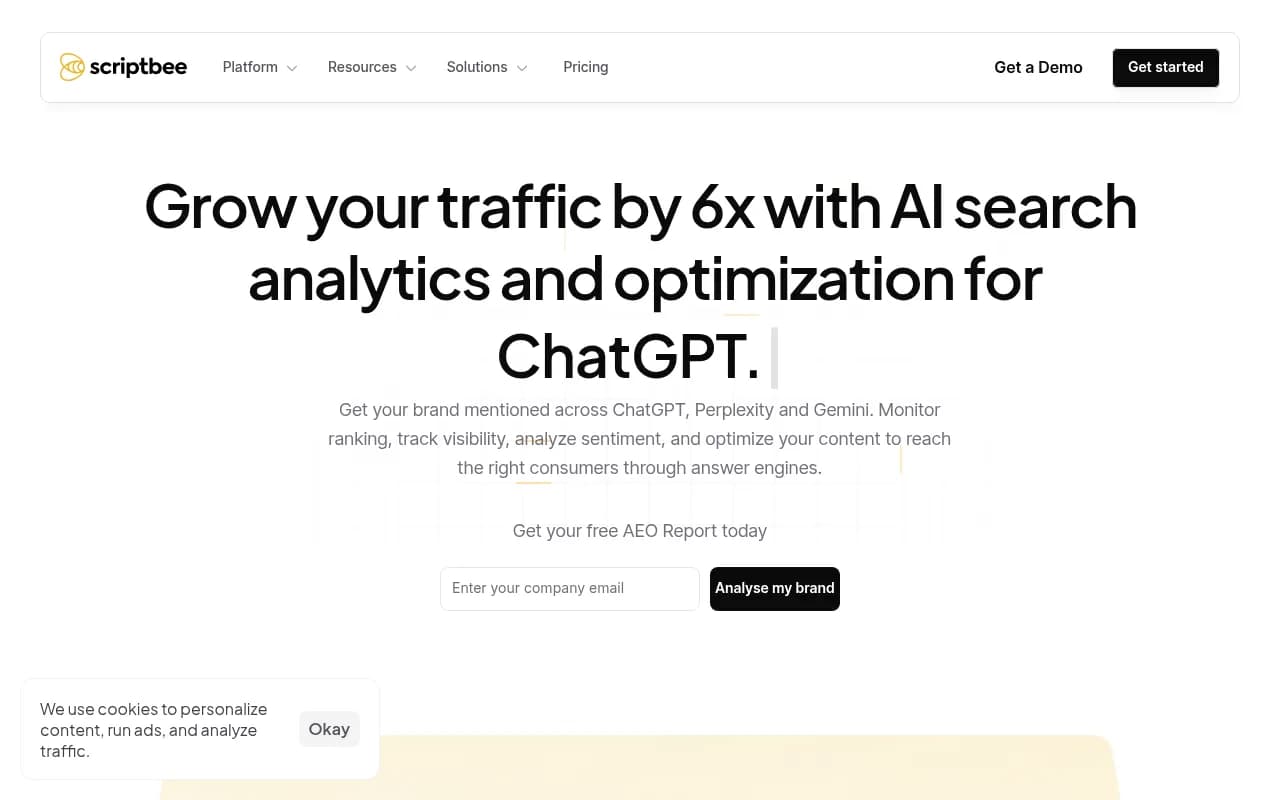
This AI search tracking is more comprehensive than basic monitoring tools like Otterly.AI or Peec.ai, which only show visibility data without deeper analysis. However, it lacks the action-oriented features found in platforms like Promptwatch -- specifically, Answer Gap Analysis (showing which prompts competitors rank for but you don't) and AI content generation grounded in citation data. Atomic shows you where you're visible in AI search, but doesn't directly help you create content to improve that visibility.
Google Search Analytics: Traditional SEO Tracking
Atomic's Google Search tracking pulls data from Google Search Console and Google Analytics 4, presenting it through several views:
Keywords shows which keywords drive organic traffic, tracking total keyword count, position distribution (top 3, 4-10, 11-50), clicks, impressions, average position, and CTR. Keywords are segmented into individual terms, branded keywords, and questions, with trend visualization to identify ranking changes.
Landing Pages tracks which pages receive organic traffic from Google, measuring clicks, impressions, average position, and CTR for each page. Performance trends show how individual pages gain or lose visibility over time.
Attribution connects traffic sources to conversions, tracking total sessions and conversions by source (direct, Google, ChatGPT, LinkedIn, etc.). The system measures conversion counts, conversion rates, and average time spent per source, revealing which channels drive the highest-intent traffic.
Referring Domains shows which external domains refer traffic through Google Search, tracking total referring domains and session volume from each source. This helps identify which backlinks and referral partnerships are working.
Geography maps click volume by country, measuring impressions, average position, and conversions for each region. Heat mapping visualizes geographic distribution to identify high-value markets.
Devices segments traffic by device type (desktop, mobile, tablet), tracking clicks, impressions, and conversions for each platform to identify optimization priorities.
This Google Search tracking is solid but not groundbreaking -- it's essentially a cleaner interface for GSC data with better visualization. Tools like Semrush, Ahrefs, and even Google's own Looker Studio dashboards offer similar or deeper analysis. The value here is consolidation: having Google and AI search data in one place rather than switching between tools.
Technical SEO Audits: Google and LLM Crawlability
Atomic's technical auditing includes two distinct audit types:
SEO Audit crawls your website automatically, scanning pages for technical SEO issues across indexability, content optimization, social tags, images, and sitemaps. Issues are categorized by severity (errors, warnings, notices), with an overall site health percentage and audit history tracking improvements or regressions. Each issue includes specific page-level details with recommendations.
LLM Audit evaluates your site from an AI search engine perspective, scoring performance, accessibility, best practices, SEO, and content structure. The system analyzes crawlability factors, trust and safety signals, content chunking and indexing readiness, HTML structure, organic backlinks, and diagnostics issues that impact AI engine visibility and citation potential.
This dual-audit approach is valuable -- most traditional SEO tools don't consider LLM crawlability at all. However, the LLM audit appears to be a scoring system rather than actionable crawler log analysis. Platforms like Promptwatch offer real-time AI crawler logs showing exactly which pages ChatGPT, Claude, and Perplexity are reading, errors they encounter, and how often they return. Atomic's LLM audit is more of a health check than a diagnostic tool.
Additional Technical Features:
- Interlinking Analysis: Maps internal linking structure, calculating a score for each page based on incoming and outgoing links. Identifies pages with weak internal linking that could benefit from additional connections.
- URL Indexing: Tracks indexing status of all URLs (indexed, discovered, unknown, indexing requested, errored), with the ability to bulk load URLs from your sitemap and request indexing for specific pages directly through the interface.
Content Optimization: Analysis, Editing, Clustering
Atomic includes three content-focused features:
Content Analysis identifies reasons behind decreasing content performance, using NLP-driven insights to surface optimization opportunities.
Content Editor provides an interface for optimizing articles based on analysis insights.
Content Clustering organizes content into effective clusters, presumably for topical authority and internal linking.
These features are mentioned but not deeply explained on the website, suggesting they may be less developed than the analytics and auditing capabilities. The lack of detail here is notable -- competitors like Surfer SEO, Clearscope, and Frase offer robust content optimization with specific keyword targeting, competitor analysis, and content briefs. Atomic's content features appear to be secondary to its analytics focus.
AI Agents and Workflow Automation: The Promised Future
Atomic heavily promotes its "4A" framework: Analytics, Attribution, Automation, and AI Agents. The first two are clearly delivered through the tracking and conversion features. The second two are less clear.
Automation is described as the ability to "automate repetitive SEO tasks" and "save more time for what matters." The website lists potential automations like schema markup validation, LLM bot permission checking, URL indexing monitoring, JavaScript & CSS optimization, internal link structure analysis, meta tag auditing, Core Web Vitals tracking, robots.txt compliance scanning, and sitemap error detection. However, it's unclear which of these are actually automated versus simply monitored.
AI Agents are prominently featured with a "Coming soon" label. The vision is to "use AI to analyze data, predict trends, automate complex tasks, or build your own AI agents within Atomic Playground." Potential agent use cases include search data analysis & alerting, AI search visibility optimization, content refreshment, content writing, backlink opportunity discovery, page value analysis, keyword decay monitoring, and site crawlability diagnostics.
The website shows screenshots of an agent interface where you can "Build & fine-tune" agents, "Run" them, and "Execute" tasks. There's also a "Workflows" section showing multi-step automation with agent orchestration -- pulling data, executing tasks, publishing updates to your website, and sending notifications via email or Slack.
This is where Atomic's positioning gets murky. The platform is marketed as an AI-native SEO operating system with agents and workflows, but the agent functionality is explicitly marked as "Coming soon." The screenshots suggest the infrastructure exists, but it's unclear whether any agents are actually deployable today or if this is entirely a roadmap promise.
For teams evaluating Atomic based on its automation capabilities, this is a critical gap. The platform's current value is in unified analytics and technical auditing -- not in AI-driven workflow automation. That may change as the agent features launch, but as of early 2026, the automation story is more vision than reality.
Who Is Atomic AGI For?
Atomic targets marketing teams at SaaS companies, digital agencies, and content-driven businesses managing 1-5 websites who want to track both Google and AI search performance without juggling multiple tools. The ideal user is a Head of Marketing, SEO Manager, or Growth Lead at a company with 10-100 employees who currently uses Google Search Console, Google Analytics, and maybe one AI search monitoring tool, but finds the fragmentation frustrating.
Specific personas:
- SaaS marketing teams tracking 50-200 keywords across Google and AI search, needing to prove ROI on organic efforts and identify which content drives conversions
- Digital agencies managing multiple client sites, needing a single dashboard to report on both traditional SEO and AI visibility without switching between tools
- Content-driven businesses (blogs, media sites, affiliate sites) with 100-1000 pages, needing to understand which content performs in AI search and where technical issues block crawlers
- In-house SEO teams at mid-market companies (50-500 employees) who want to scale organic growth without hiring additional headcount
Who should NOT use Atomic:
- Enterprise teams managing 10+ websites or complex multi-brand portfolios -- the platform is priced and scoped for smaller operations
- Teams prioritizing AI content generation -- if your primary need is creating content optimized for AI search, tools like Promptwatch (with built-in AI writing agents grounded in citation data) or traditional content optimization tools like Surfer SEO are better fits
- Agencies needing white-label reporting -- there's no mention of white-label capabilities, suggesting this is a direct-use platform rather than an agency reseller product
- Teams requiring deep backlink analysis -- Atomic tracks referring domains but doesn't appear to offer the depth of backlink analysis found in Ahrefs, Majestic, or Semrush
Integrations & Ecosystem
Atomic integrates with:
- Google Search Console (primary data source for keyword and page performance)
- Google Analytics 4 (traffic attribution and conversion tracking)
- Google AI Overviews and AI Mode (tracking Google's own AI search features)
- 10 AI search engines (ChatGPT, Perplexity, Gemini, Claude, DeepSeek, Copilot, Grok, Meta Llama, Qwen, Mistral)
The platform is hosted in Germany on European-owned cloud infrastructure, with GDPR compliance and end-to-end encryption. The website emphasizes that Atomic "does not collect your cookies or store data" and that "your data is visible only to you."
There's no mention of API access, Zapier integration, or connections to other marketing tools (Slack, HubSpot, Salesforce, etc.). The workflow automation screenshots suggest email and Slack notifications are possible, but it's unclear whether these are live features or roadmap items.
Pricing & Value
Atomic offers a free plan (details not specified) and paid plans starting from $99/mo per domain. The pricing page mentions "$10/mo" in one search result snippet, but this appears to be a typo or outdated information -- the main pricing reference is $99/mo.
Based on the feature descriptions, the pricing tiers likely break down as:
- Free Plan: Basic Google Search tracking (keywords, pages, devices, referring domains) and AI search tracking (generative engines overview, pages analysis)
- Paid Plans ($99/mo+): Full AI search tracking (prompt tracking, visibility, competitors, citations, sentiment), attribution analysis, technical audits (SEO + LLM), interlinking analysis, URL indexing, geography tracking, content features, and (eventually) AI agents and workflows
At $99/mo per domain, Atomic is positioned as a mid-market tool -- more expensive than basic monitoring tools like Otterly.AI ($49/mo) or Peec.ai ($79/mo), but cheaper than comprehensive GEO platforms like Promptwatch ($249/mo for Professional) or enterprise SEO suites like Semrush ($229/mo+) and Ahrefs ($199/mo+).
The value proposition depends on what you're comparing:
- vs monitoring-only tools (Otterly.AI, Peec.ai, AthenaHQ): Atomic offers deeper technical auditing and (eventually) automation, justifying the higher price
- vs action-oriented GEO platforms (Promptwatch): Atomic is cheaper but lacks Answer Gap Analysis, AI content generation, and real-time crawler logs -- you get visibility tracking but not optimization tools
- vs traditional SEO suites (Semrush, Ahrefs): Atomic adds AI search tracking but lacks the depth of keyword research, backlink analysis, and rank tracking found in mature SEO platforms
For teams that want unified Google + AI search analytics without paying for a full SEO suite or a premium GEO platform, Atomic hits a sweet spot. For teams that need deep optimization capabilities or AI content generation, it's not enough on its own.
Strengths & Limitations
Strengths:
- Dual-engine tracking: The only platform that consolidates Google Search Console data and AI search engine tracking (10 LLMs) in one interface, eliminating tool fragmentation
- LLM-specific auditing: The LLM Audit feature evaluates crawlability, trust signals, and content structure from an AI engine perspective -- something traditional SEO tools completely ignore
- Clean, modern interface: The platform is visually polished with clear data visualization, making it easy to understand performance patterns without digging through spreadsheets
- European data hosting: GDPR compliance and EU-based infrastructure appeal to privacy-conscious teams and European companies
- Competitive pricing: At $99/mo per domain, it's more affordable than comprehensive GEO platforms while offering more depth than basic monitoring tools
Limitations:
- AI agents are vaporware: The platform is heavily marketed around AI agents and workflow automation, but these features are explicitly marked "Coming soon" -- the current product is analytics and auditing, not automation
- No content generation: Unlike Promptwatch (which includes an AI writing agent grounded in citation data) or traditional content tools (Surfer SEO, Clearscope), Atomic doesn't help you create content optimized for AI search -- it only shows you where you're visible
- Shallow content optimization: The Content Analysis, Content Editor, and Content Clustering features are mentioned but not explained in depth, suggesting they're underdeveloped compared to dedicated content optimization tools
- No Answer Gap Analysis: Atomic shows your AI visibility but doesn't reveal which prompts competitors rank for that you don't -- a critical feature for identifying content opportunities (available in Promptwatch)
- Limited backlink analysis: Referring domains are tracked, but there's no deep backlink analysis, anchor text tracking, or link quality scoring found in Ahrefs or Majestic
- Unclear automation status: The website lists many potential automations (schema validation, URL indexing monitoring, etc.) but doesn't clarify which are actually automated versus simply monitored
Bottom Line
Atomic AGI is best for marketing teams at SaaS companies and digital agencies managing 1-5 websites who want to track both Google and AI search performance in one platform without paying for a full SEO suite or a premium GEO platform. If your primary need is unified analytics and technical auditing across traditional and AI search, Atomic delivers solid value at $99/mo per domain.
However, if you need AI content generation, Answer Gap Analysis, or real-time crawler logs, tools like Promptwatch offer deeper optimization capabilities. And if you need comprehensive keyword research, backlink analysis, or rank tracking, traditional SEO platforms like Semrush and Ahrefs remain stronger choices.
The platform's biggest question mark is its AI agent and workflow automation features, which are prominently marketed but explicitly marked "Coming soon." If those features launch as promised, Atomic could become a true AI-native SEO operating system. Until then, it's a well-designed analytics dashboard with a compelling vision but incomplete execution.
Best use case in one sentence: Marketing teams at SaaS companies managing 1-3 websites who want to track Google and AI search performance in one dashboard without paying for a full SEO suite or premium GEO platform.
Tags:
Similar and alternative tools to Atomic AGI