Rankpilot Review 2026
Tool that helps generate content faster and build backlinks to improve rankings in AI search engines like ChatGPT.
Key Takeaways:
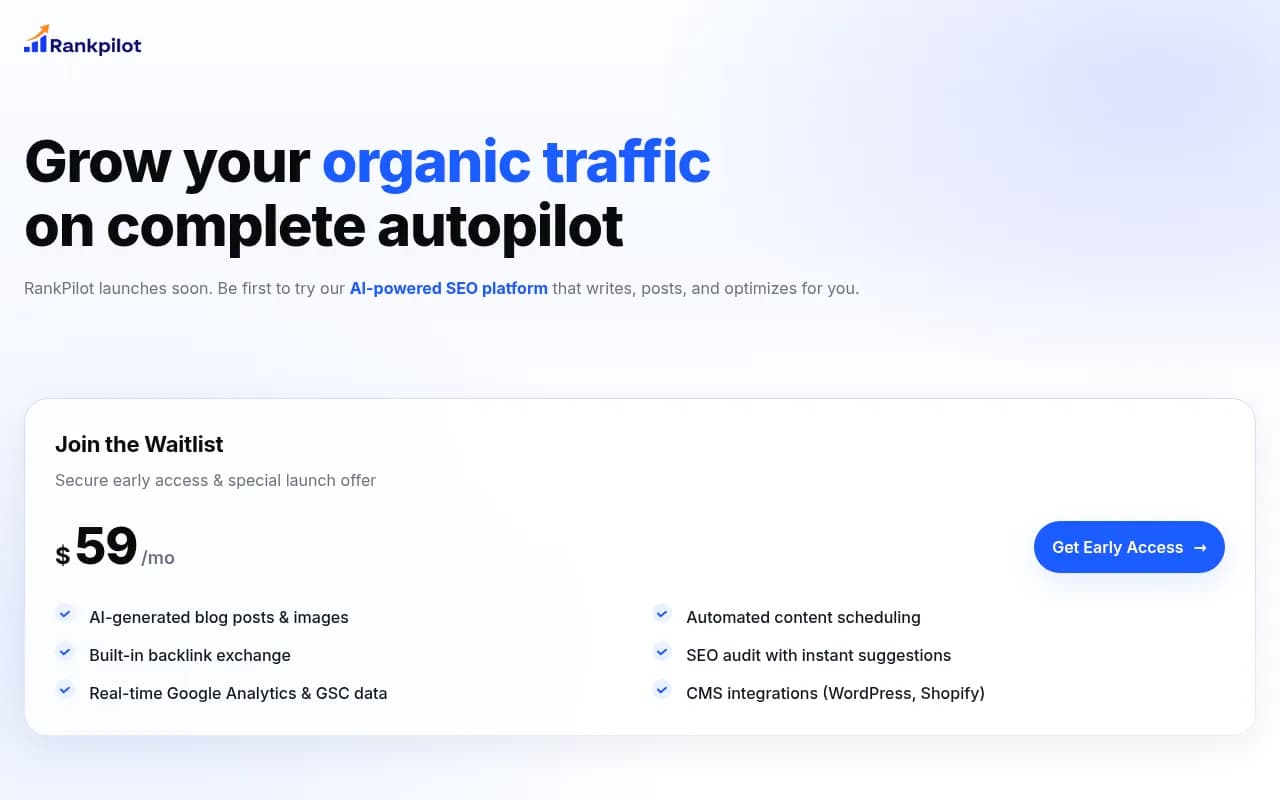
• Full automation focus: Rankpilot handles content creation, publishing, backlink building, and SEO audits without manual intervention -- ideal for founders and small teams stretched thin • Built-in backlink exchange: Unlike most content tools, includes a network for trading backlinks with other users to accelerate domain authority growth • Affordable entry point: Starting at $59/mo during early access makes it accessible for bootstrapped startups and side projects • Pre-launch status: Tool is not yet live (launching 2026), so real-world performance and feature completeness remain unproven • Best for: Solopreneurs, indie hackers, and small businesses who prioritize speed and automation over editorial control and brand voice precision
Rankpilot is positioning itself as a complete SEO autopilot system for founders and small teams who want organic traffic but lack the time or resources to manage content creation, publishing workflows, and link building manually. The platform promises to handle everything from generating blog posts and images to scheduling publication and building backlinks through an integrated exchange network. It's targeting the growing market of solopreneurs and bootstrapped startups who need SEO results without hiring writers or agencies.
The tool is currently in pre-launch (waitlist open as of early 2026), with early access pricing starting at $59/mo. The pitch is simple: set it up once, let AI handle the rest, and watch organic traffic grow while you focus on product and customers. For founders juggling a dozen priorities, that's a compelling promise -- but the real question is whether automated content can actually rank and convert in 2026's increasingly competitive search landscape.
AI Content Generation & Scheduling Rankpilot's core feature is automated blog post creation powered by AI. The platform generates full articles based on keyword targets or topic inputs, then schedules them for publication directly to your CMS (WordPress and Shopify integrations confirmed). It also creates accompanying images, eliminating the need for stock photo hunting or design tools. The goal is to maintain a consistent publishing cadence without manual writing or editing.
This is similar to tools like Jasper, Copy.ai, or Writesonic, but with tighter integration into the publishing workflow. Instead of generating content in a separate tool and manually posting it, Rankpilot aims to be a one-stop system. The trade-off: less editorial control and brand voice customization compared to tools where you review and refine every draft. For founders who prioritize speed over perfection, that's acceptable. For brands with strict tone guidelines or technical accuracy requirements, it's a risk.
The scheduling component handles publication timing automatically, presumably optimizing for when your audience is most active or when search engines are most likely to crawl new content. This removes another manual task from the workflow, though details on scheduling logic (timezone handling, frequency caps, etc.) aren't yet public.
Built-in Backlink Exchange Network This is where Rankpilot differentiates itself from pure content generation tools. The platform includes a backlink exchange system that connects users who want to trade links to boost domain authority. You publish a post linking to another user's site, they link back to yours, and both sites benefit from the SEO signal.
Backlink exchanges have been around for years (think MyBlogGuest, LinkLifting, or manual outreach), but integrating it directly into a content automation platform is relatively novel. The advantage: you don't need to spend hours prospecting for link partners or negotiating placements. The risk: Google has historically penalized link schemes that exist purely for SEO manipulation rather than genuine editorial value. Rankpilot will need to ensure exchanges are contextually relevant and not spammy to avoid triggering algorithmic penalties.
For new sites with low domain authority, this feature could accelerate early growth. For established brands, the risk/reward calculus is less clear -- a few bad links from low-quality exchange partners could hurt more than help. The platform's success here depends entirely on the quality of its user network and how well it vets participants.
SEO Audit & Instant Suggestions Rankpilot includes an SEO audit tool that scans your site and provides actionable recommendations. This likely covers standard technical SEO issues: broken links, missing meta descriptions, slow page speed, mobile usability problems, etc. The "instant suggestions" framing implies automated fixes or one-click implementations, though specifics aren't detailed.
This puts it in competition with tools like Screaming Frog, Sitebulb, or the audit features in Semrush and Ahrefs. The difference: Rankpilot is targeting users who don't want to learn SEO terminology or manually implement fixes. If it can truly automate common optimizations (e.g. auto-generating meta descriptions, compressing images, fixing internal link structures), it's a major time-saver. If it just flags issues and leaves implementation to the user, it's less differentiated.
For technical SEO professionals, this feature is likely too basic. For non-technical founders, it could be the difference between ignoring SEO entirely and actually fixing critical issues.
Real-time Google Analytics & GSC Integration The platform pulls data from Google Analytics and Google Search Console to show traffic trends, keyword rankings, and click-through rates in real time. This is table stakes for any SEO tool in 2026, but the value is in consolidation -- seeing content performance, backlink status, and audit results in one dashboard instead of toggling between multiple tools.
The real-time aspect suggests live data syncing rather than daily or weekly updates, which is useful for quickly identifying traffic spikes or drops and correlating them with recent content or backlink activity. However, most small sites don't need real-time monitoring -- weekly check-ins are sufficient. This feature is more valuable for agencies or larger sites publishing multiple posts per day.
CMS Integrations: WordPress & Shopify Rankpilot integrates directly with WordPress and Shopify, allowing it to publish content without manual copy-pasting. For WordPress, this likely uses the REST API or a custom plugin. For Shopify, it's probably publishing blog posts via the Shopify API.
This is critical for the "autopilot" promise -- if you had to manually publish AI-generated drafts, the time savings would evaporate. The integration also enables automated image uploads, meta tag setting, and potentially internal linking between posts.
Notably absent: integrations with other popular CMSs like Webflow, Ghost, or custom-built sites. If you're not on WordPress or Shopify, you're stuck with manual publishing or waiting for future integrations. For the target audience (small businesses and solopreneurs), WordPress and Shopify cover the majority, but it's a limitation for agencies managing diverse client stacks.
Who Is Rankpilot For? Rankpilot is explicitly designed for founders, solopreneurs, and small teams who want SEO results without becoming SEO experts. If you're a bootstrapped SaaS founder, an indie hacker launching a side project, or a small e-commerce store owner, and you don't have time to write blog posts or build backlinks manually, this tool is built for you. It's also appealing to agencies managing multiple low-budget clients who can't afford custom content but still need organic visibility.
It's NOT for brands that prioritize editorial quality, unique brand voice, or technical accuracy. AI-generated content in 2026 is good, but it's not indistinguishable from expert human writing. If your audience expects deep expertise, original research, or a distinct tone, automated posts will feel generic. It's also not ideal for highly regulated industries (finance, healthcare, legal) where factual errors or compliance issues could have serious consequences.
Team size: Best for solo founders or teams of 2-5 people. Larger marketing teams with dedicated writers and SEO specialists won't need this level of automation -- they'll want more control and customization.
Pricing & Value Early access pricing starts at $59/mo, with additional tiers at $99/mo (Essentials), $197/mo (Growth), and $297/mo (PRO) based on third-party pricing data. The $59/mo entry point is competitive with standalone AI writing tools (Jasper starts at $49/mo, Copy.ai at $36/mo) but includes publishing automation, backlink exchange, and SEO audits -- features that would normally require separate subscriptions.
The Growth and PRO tiers likely add more content volume, additional user seats, white-label options for agencies, and priority support. Without official pricing details, it's hard to assess exact value, but the bundled approach (content + backlinks + audits + analytics) is more cost-effective than piecing together separate tools.
For a bootstrapped founder spending 10+ hours per week on content and SEO, $59-99/mo to automate that work is a no-brainer. For established businesses with existing content teams, the ROI is less clear -- you're trading cost savings for less control and potentially lower content quality.
Strengths • True end-to-end automation: Most tools stop at content generation or link building -- Rankpilot handles the full workflow from ideation to publication to backlink acquisition • Backlink exchange network: Unique feature that addresses one of the hardest parts of SEO (link building) without manual outreach • Affordable entry point: $59/mo makes it accessible for early-stage startups and side projects with tight budgets • CMS integrations: Direct publishing to WordPress and Shopify eliminates manual copy-pasting and saves hours per week • Consolidated dashboard: Seeing content, backlinks, audits, and analytics in one place reduces tool sprawl and context switching
Limitations • Pre-launch uncertainty: Tool isn't live yet, so real-world performance, content quality, and backlink network effectiveness are unproven • AI content quality risks: Automated posts may lack depth, originality, or brand voice -- fine for basic SEO traffic but not for building authority or trust • Backlink exchange risks: Google penalizes manipulative link schemes -- success depends entirely on network quality and relevance matching • Limited CMS support: Only WordPress and Shopify at launch -- excludes Webflow, Ghost, custom sites, and other platforms • Not for editorial brands: If your content strategy relies on expert insights, original research, or a distinct voice, automation won't deliver
Bottom Line Rankpilot is best for time-strapped founders and small teams who need organic traffic but can't afford to hire writers or spend hours on SEO. If you're launching a SaaS, building a side project, or running a small e-commerce store, and you're willing to trade some editorial control for speed and automation, this tool could be a game-changer. The backlink exchange network is a bold differentiator, though its long-term viability depends on execution and Google's tolerance.
For established brands, content-focused businesses, or anyone who views content as a core differentiator, Rankpilot's automation-first approach is too risky. You'll get volume, but not necessarily quality or brand alignment. Wait for real-world case studies and user reviews before committing.
Best use case in one sentence: Bootstrapped SaaS founders and indie hackers who need consistent blog traffic without hiring a content team or learning SEO.
Tags:
Frequently asked questions
What is Rankpilot?
How much does Rankpilot cost?
Is Rankpilot free to use?
Who is Rankpilot best for?
What are the key features of Rankpilot?
Does Rankpilot have a backlink building feature?
When is Rankpilot launching?
Can Rankpilot help with AI search engine rankings?
Similar and alternative tools to Rankpilot