Key takeaways
- Local AI search tracking fails most often because teams copy their local SEO setup: one rank grid, one location, one model. AI answers do not work that way.
- Prompts, not keywords, are the unit of measurement. Many of the biggest budget leaks come from tracking the wrong prompts, in the wrong place, on the wrong platforms.
- Mentions are not the goal. If you cannot connect AI visibility to crawls, citations and visits, you are paying for a vanity chart.
- ChatGPT changed its search behavior overnight in August 2026, so one-off audits go stale fast. Continuous monitoring beats quarterly snapshots.
- Fix the basics first (listings, location pages, crawlability) before buying a tracker.
Why local GEO tracking wastes so much money
Local SEO had a clean measurement model. You picked a keyword, you picked a zip code, you looked at a map pack, and you got a rank. Tools like Local Falcon and BrightLocal are good at exactly that.
Local AI search breaks the model. An answer from ChatGPT or Google AI Mode is assembled from several searches, a handful of cited sources, and whatever the model already believes about your brand. There is no single position 3. There is a probability that you get named, in a given place, for a given phrasing.
Marketers who treat it like rank tracking tend to make the same ten mistakes. I have seen most of them, and a few I have made myself. Here they are, roughly in order of how much money they cost.
The classic local SEO mistakes in articles like Bizzyweb's list (inconsistent listings, a neglected Google Business Profile) have not gone away. They just now sit underneath a second layer of problems.
Mistake 1: Tracking national prompts for a local business
A plumber in Leeds does not need to appear for "best plumber." They need to appear when someone in Leeds asks for a plumber, in whatever words that person uses.
If your prompt set has no city, neighborhood or "near me" phrasing, you are measuring a game you are not playing. Worse, the results look fine. Big national directories show up, your brand shows up occasionally, and everyone nods.
Build prompts from real local intent: service plus city, service plus neighborhood, and the conversational versions ("who can fix a boiler tonight in Headingley"). Then group them by location so you can compare markets.
Mistake 2: Tracking from one location
AI answers vary by country, and for local queries they can vary by state or city. If your tracker runs every prompt from a single server location, a multi-location brand gets one data point and calls it coverage.
Check two things before you buy any tool. Can it run the same prompt from different cities? And does it use the real interface of the AI product rather than only the API? User-facing answers and API answers can differ, and the interface is what your customers see. Tools like Promptwatch track the real UIs of ChatGPT, Google AI Overviews and AI Mode by country, with state and city tracking on higher plans.

If you run more than a few locations, budget for that granularity up front. Retrofitting it later means throwing away your baseline.
Mistake 3: Watching only ChatGPT
It is tempting to pick the biggest name and stop there. But local discovery is split. Google AI Overviews and AI Mode sit on top of the map and search results your customers already use. Gemini, Perplexity, Copilot and voice assistants like Alexa each answer differently.
Sources differ too. In Promptwatch Data's social media citations by AI model report (Sep 28 to Oct 4, 2026), ChatGPT drew just 0.46% of its citations from social platforms, while Google AI Overviews drew 12.2%. A local business that leans on community posts and video might be nearly invisible in one and well represented in the other. If you only track one model you will draw the wrong conclusion about your whole social strategy.
Mistake 4: Counting mentions and calling it success
A mention is not a customer. For local businesses the question is whether the answer sends someone to your door, your phone or your booking page.
This is where most monitoring-only tools fall short. They tell you that you were named, and stop. You also want to know:
- Did the AI cite your own site, or a third-party listing?
- Did an AI crawler actually read the page you care about?
- Did any visit or call follow?
Read together, the metrics diagnose the problem. Low share of voice means a coverage problem. Late position in the answer means a prominence problem. Mentions without citations to your own domain usually mean a content or crawlability problem. Without that breakdown you cannot tell what to fix, so you fix nothing, or everything.
Mistake 5: Ignoring that location pages are now retrieval targets
This one is new, and it matters. According to Promptwatch Data's report on ChatGPT's site: operator shift, on August 8, 2026 site:-scoped fanout queries jumped from about 0.4% to roughly 17% of all fanouts in a single day. Average fanouts per response rose from about 1.08 to about 1.83.
In plain terms, ChatGPT now searches inside specific domains far more often. Your own website has become a retrieval surface. The report's advice is to keep key pages crawlable and indexed, and it notes that thin location pages and broken internal search now cost you answers.
I would add a caveat the report itself makes: this was a platform-wide change, so do not tear up your content strategy over it. But if your location pages are 120 words with a swapped city name, this is a good time to fix them. Give each one real content: services offered there, staff, local specifics, parking, reviews, and unique answers to local questions.
Mistake 6: Using keyword-era headings and never re-auditing
Promptwatch's ChatGPT query fanouts report shows average query length falling from roughly 117 characters in early December 2025 to about 53 characters from April 2026. The searches AI runs behind the scenes got shorter and more keyword-like, not longer and more conversational.
The report's suggestion is to write headings that read like keyword queries and put the entity and category up front. My reading for local (the report does not say this directly) is that city and service terms belong in short headings: "Emergency plumber in Leeds," not "When the unexpected happens, we are here."
The bigger mistake is mapping keywords to headings once and never looking again. Fanout behavior shifts after model updates. Schedule a re-check after each notable one.
Mistake 7: Building citations for the wrong directories
Old-school citation building meant submitting to the same 50 directories as everyone else. For AI search, which sources matter depends on the industry, and the differences are large.
Promptwatch Data's travel report (Sep 28 to Oct 4, 2026) shows Skyscanner, Going and Tripadvisor leading ChatGPT citations, with booking and search sites earning more than half of what the report charts. For healthcare prompts, government and public health sites earn almost half. For software, documentation and help centers lead. You can read each in the travel, healthcare and software reports.
Two lessons. First, find out which sources AI actually cites for your category and city before spending on listings. Second, notice how fragmented it is: in the travel report, the 17 charted domains together earn only 4.18% of all travel citations. The long tail is enormous, so a tracker that watches a short fixed list of domains misses most of the picture.
For listing management at scale, platforms such as Yext, Uberall, Moz Local and Whitespark are built for it. Just point them at the sources that AI cites, not the ones that were popular in 2018.
Mistake 8: Skipping reviews and reputation signals
Reviews feed both the map pack and the AI answers that summarize local options. Chasing a higher star average is less useful than making sure the sentiment is accurate and recent, and that the platforms AI trusts for your category have fresh reviews.
In practice that means collecting reviews where your category is cited (Tripadvisor for hospitality, for example, per the travel data above), responding to negative ones, and monitoring how AI describes you. Trustpilot, Birdeye, Reputation and Podium handle the collection side. A sentiment score on AI answers, which a GEO platform can provide, tells you whether what the model says matches the reviews.
Mistake 9: Trusting round statistics without checking them
Local marketing content is full of confident numbers. One widely shared 2026 guide from Big Eye Agency says 98% of consumers search online for local businesses, that complete Google Business Profiles convert 3.2 times more often, and that schema markup lifts AI visibility by 30 to 40%.

I cannot trace those figures to a primary source, and I would not build a business case on them. Complete your Google Business Profile and add schema because they are good practice, not because a blog post promised a multiplier. When a claim is about AI behavior, check it against measured data. Promptwatch Data publishes its measurement periods alongside the numbers, which is the standard to hold everyone to.
Mistake 10: One-off audits and no feedback loop
The August 8 change is the clearest argument against the annual or quarterly GEO audit. Overnight, any keyword mapping built before that date went stale. If you only look every quarter, you spend two months optimizing against rules that no longer apply.
The second half of the mistake is monitoring with no action attached. A dashboard that says you are invisible in Manchester is only useful if it points to a content gap, a crawl error or a missing source, and then tells you whether your fix worked.
This is the real difference between tool types. Prompt trackers answer "was I mentioned?" Platforms that close the loop also show crawler logs, cited pages and traffic, and queue up the next piece of work.
What the right tool mix looks like
No single product covers local SEO and local GEO well. A sensible setup combines three layers.
| Layer | Job | Example tools |
|---|---|---|
| Local SEO rank and listings | Map pack grids, citations, GBP | Local Falcon, BrightLocal, Whitespark, Synup |
| Multi-location presence | Listings and reviews across many sites | Yext, Uberall, SOCi, Chatmeter |
| AI visibility and GEO | Prompts by location, citations, crawlers, traffic | Promptwatch, Peec AI, Otterly.AI, Profound |
| Technical baseline | Crawlability, indexation, performance | Google Search Console, Screaming Frog, Sitebulb |
A few of these deserve a quick look.
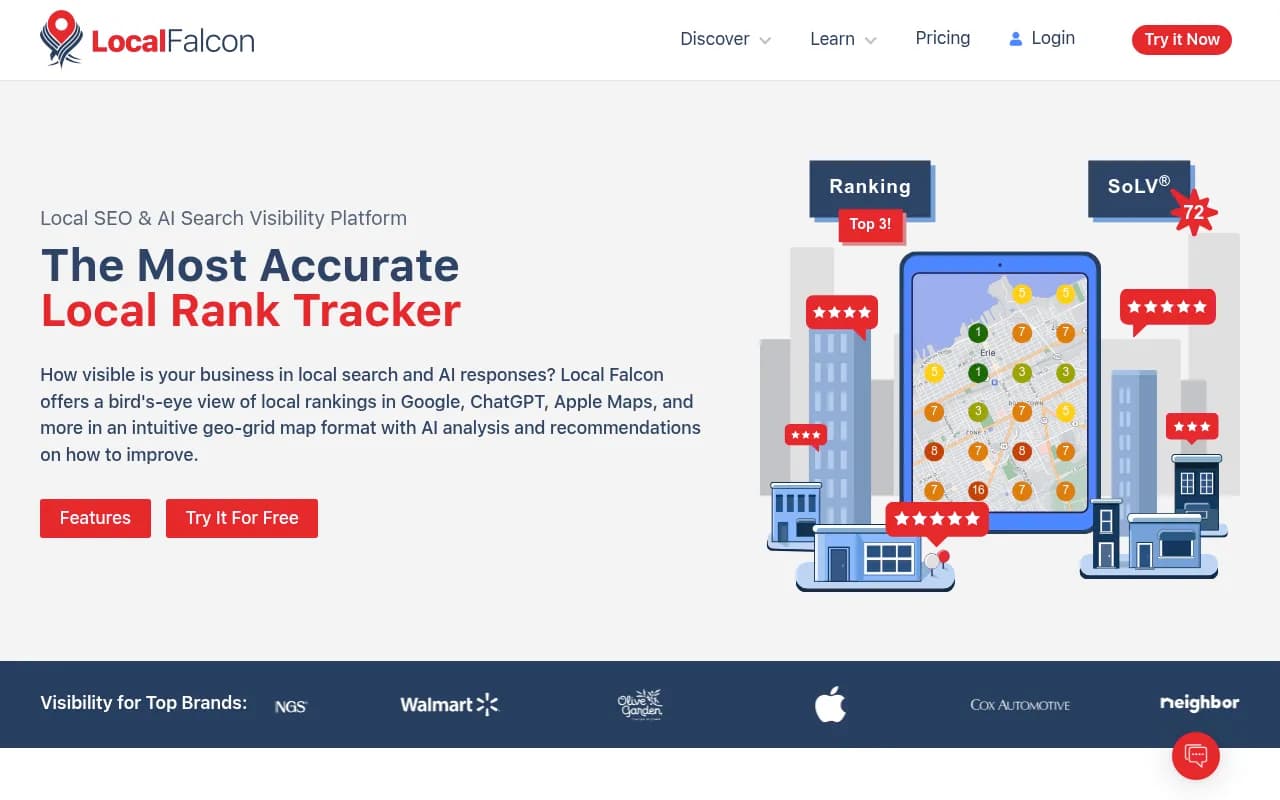
Local Falcon is still the quickest way to see how the map pack looks block by block. It does not tell you what ChatGPT says, so do not expect it to.
BrightLocal covers audits, citations and reviews for agencies and multi-location brands, which still feed the sources AI draws on.
Yext suits brands with many locations that need listing data synced everywhere at once.

Peec AI and similar prompt trackers are fine for basic monitoring, but check whether they support city-level prompts, crawler logs and traffic attribution before you commit.
For a wider view of options, the GEO software directory and the AI rank tracking tools directory are good places to compare.
A practical order of operations
If your budget is tight, spend in this order:
- Fix the basics: a complete Google Business Profile, consistent listings, and real location pages with unique content.
- Check crawlability. Make sure AI crawlers can reach your location pages and that nothing important is blocked or orphaned.
- Build a prompt set per location, with real local phrasing, and track it from the right places.
- Look at which sources AI cites in your category and city, and invest in those.
- Connect visibility to visits, calls or bookings so you can tell what worked.
- Re-check after each major model change instead of on a calendar.
Steps 1 and 2 are cheap and cost nothing in software. Skipping straight to a tracker to confirm you are invisible, when a thin location page explains it, is the most expensive way to learn the same lesson.
Do you need an agency for this?
Sometimes. Multi-location brands with dozens of markets often find the coordination, not the tools, is the hard part. If you want a team that handles technical SEO, content and AI search together, 1001 SEO Media covers local SEO and GEO as part of its service mix. For a single location with a decent site, you can usually get most of the way on your own with the order above.
Quick checklist
- Prompts include city, neighborhood and conversational phrasing
- Tracking runs from the locations you actually serve
- More than one AI platform is monitored, including Google AI Overviews and AI Mode
- Success is measured in citations and visits, not mentions
- Location pages are substantial, crawlable and indexed
- Headings lead with the service and city
- Listing and review effort goes to sources AI actually cites
- Third-party statistics are verified before they drive budget
- Monitoring is continuous, with a clear action attached to each finding
If you do only one thing this week, open your location pages and read them as a stranger would. If they say nothing a competitor's page doesn't, no tracker will fix that.