Key takeaways
- Google ranks pages. ChatGPT picks a handful of businesses to name, and it pulls from many sources at once. Almost half of ChatGPT responses cite 10 or more domains, so your own website is just one voice in a crowded answer.
- The usual culprits are boring ones: a blocked crawler, thin service pages, inconsistent business details, and too few third-party mentions.
- Test with a fixed set of questions and save the results. One missing mention proves nothing.
- Fix in order: access first, then facts, then page clarity, then off-site proof, then measurement.
- Treat the popular "50 businesses tested, 6 appeared" Reddit experiment as a hint, not a study.
Why Google and ChatGPT disagree about your business
A Reddit user in r/smallbusiness ran a small test: 50 local businesses, searched across ChatGPT, Gemini and Perplexity. Only 6 showed up. Several of the invisible ones ranked on page one of Google and spent real money on ads. The poster noted that the visible businesses tended to have schema markup, consistent mentions across authoritative sources, and a fully built Google Business Profile.
Take that with salt. It is one person's anecdote, the sample is tiny, and those three traits are correlations, not proven causes. But the thread produced a framing worth keeping. One commenter put it as: you don't have a ranking problem, you have a selection problem.
That matches how these systems work. Google gives you a list and lets the searcher choose. ChatGPT writes an answer and names a few businesses inside it. If it can't tell clearly what you do, where you do it, and whether anyone else vouches for you, you don't make the shortlist, no matter where you sit in the blue links.
One more thing before the fixes. Another commenter pointed out that results depend heavily on which assistant you test. Perplexity does live retrieval and picks up changes fast. ChatGPT only searches the web when it decides to, so a plain answer from memory tells you nothing about whether your pages can surface. Test more than one tool.
How to test properly before you fix anything
The worst way to diagnose this is to type your business name once and shrug. Do this instead.
- Write 5 to 10 questions a real customer would ask, naming the service, the city, and one constraint. For example: "Which HVAC companies offer same-day AC repair in Mesa, Arizona?"
- Ask ChatGPT to search the web, so you know retrieval actually happened.
- Save the exact wording, date, answer, businesses named, and the citations.
- Open each citation next to the claim it supports. Note which facts the competitors' pages establish that yours doesn't.
- Don't reword the question between runs. "Same-day AC repair" and "emergency HVAC service" ask for different facts.
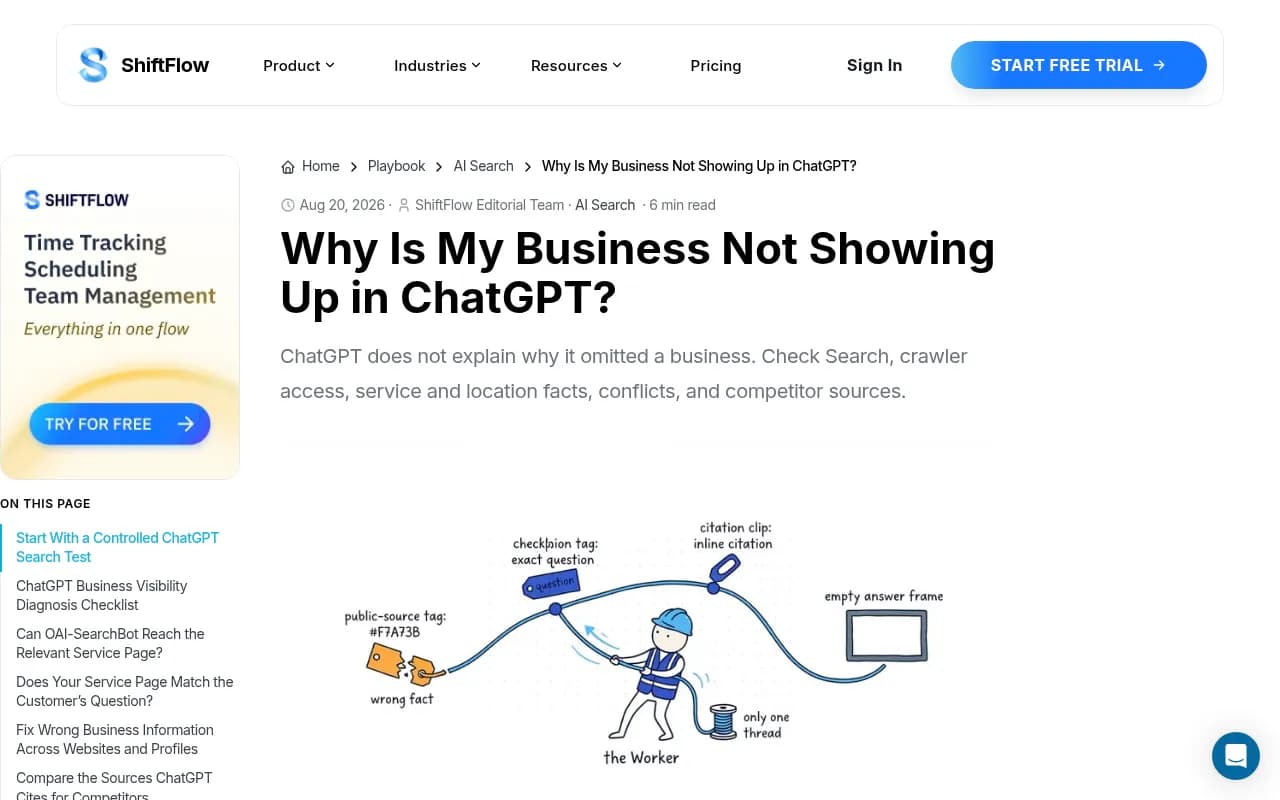
ShiftFlow's diagnosis checklist uses the same logic: start with what you observed, check the matching thing first, and make the smallest fix.
Doing this by hand for a dozen prompts is fine. Past that, a tracker saves time. Tools like Promptwatch can run your prompts across ChatGPT, Gemini, Perplexity and AI Overviews on a schedule and show which pages get cited.

Quick diagnosis table
| What you see | Most likely cause | First fix |
|---|---|---|
| ChatGPT never shows sources | It didn't search the web | Ask it to search, repeat the question |
| Your site never appears in search-enabled tests | Crawler blocked or page unreachable | Check robots.txt and firewall |
| You show for broad but not specific questions | Service or city page is vague | Add the missing real facts |
| Old phone, hours or services quoted | Conflicting listings | Fix the source that owns the fact |
| Competitors named, you aren't | Fewer third-party mentions or reviews | Build presence on sites AI cites |
| Named in Gemini but not ChatGPT | Different retrieval systems | Test each platform separately |
Cause 1: ChatGPT never searched the web for your question
This is the most overlooked one. If the response has no citations, it answered from training data. That says nothing about whether your pages can be found by ChatGPT Search.
Fix: Ask ChatGPT explicitly to search the web, then rerun the identical question. Only count results from search-enabled answers.
Cause 2: AI crawlers can't reach your site
OpenAI documents OAI-SearchBot as the crawler that surfaces sites in ChatGPT Search. Its separate GPTBot is tied to model training, and you can allow one and block the other. A lot of sites block both by accident, through an old robots.txt rule, a security plugin, a CDN firewall setting, or a noindex tag on important pages.
Fix:
- Open yourdomain.com/robots.txt and look for blanket disallows.
- Confirm OAI-SearchBot is allowed.
- Check that service pages return a clean 200 status and aren't behind scripts or logins.
- Make sure the content exists in the HTML, not only after JavaScript renders.
To see which bots actually visit, you need server or CDN logs. Some AI visibility platforms surface verified crawler activity, which beats guessing. For the technical audit side, Screaming Frog is the standard crawler.
If your site is built with a JavaScript framework and bots see an empty shell, pre-rendering tools such as Prerender.io exist for exactly that.
Cause 3: Your business details conflict across the web
If your phone number, hours, address or service list differ between your website, Google Business Profile, Yelp and a few old directories, the system has to guess. When ChatGPT quotes a wrong detail, open the citation beside it. That is the source to correct.
The rule from ShiftFlow's guide is sensible: update the source that owns the wrong fact instead of publishing yet another version elsewhere. Wording can vary. Phone numbers, hours, and service areas can't.
Fix:
- Confirm the real operating facts.
- Correct your website and Google Business Profile.
- Update the main customer-facing listings.
- Ask third-party pages repeating the old fact to correct it.
Listing management tools help once you have many locations or many directories. BrightLocal, Whitespark and Moz Local all do citation cleanup, and Yext is the heavier option for multi-location brands.
Cause 4: Your service and location pages are vague
A homepage that says "quality service for all your needs" gives an AI system nothing to quote. ChatGPT is answering a specific question: who does this job, in this place, under this condition. Promptwatch Data found that product pages and landing pages together account for about 39% of ChatGPT citations (Sep 28 to Oct 4, 2026), so pages that plainly describe what you sell are the pages that get used. See the ChatGPT citation share by content type report.
Fix: For each core service, have a page that states:
- what the service is and what's included
- which cities or neighborhoods you serve
- limits such as cutoff times, property types or minimum job sizes
- price ranges or how pricing works, if you can share it
- proof: completed-work examples, certifications, real reviews
Don't respond by spinning out dozens of near-identical city pages. That's the opposite of clarity. Add a real FAQ page too. The same Promptwatch report notes FAQ pages make up 4.8% of citations for branded prompts, and recommends one that covers common questions about your brand.
If you want a second opinion on page content, Surfer SEO and Clearscope help check coverage, though neither is a local-specific tool.
Cause 5: Too few trusted third parties mention you
This is the big one for local businesses. A claim on your own site is one signal. The same claim repeated by directories, news mentions, review platforms and industry sites is a different picture entirely.
Promptwatch Data shows how crowded these answers are: 47.6% of ChatGPT responses with citations cite 10 or more domains, and 52.5% for unbranded prompts (Sep 28 to Oct 4, 2026). The unique domains report suggests third-party listicles, reviews and comparison pages are often how a brand gets into a crowded answer. If you're only on your own website, you're competing against ten other sources with one.
A commenter in the Reddit thread, who sells a directory-submission service, claimed that many HVAC, plumbing and pool businesses aren't in Yelp, BBB, Angi or any directory the models draw from, and said results take 60 to 90 days. That's a vendor's claim and I'd treat the timeline as a rough guess. The underlying point, though, is credible: if you're absent from the places models cite, you're easy to skip.
Fix:
- Claim and complete profiles on the directories relevant to your trade and city.
- Get listed in local "best of" roundups and chamber or association pages.
- Pitch local press when you have something real to say.
- Collect reviews on platforms trusted in your category. Trustpilot matters in some verticals; Google and Yelp matter in most local ones.
For brand mentions you haven't found yet, monitoring tools such as Awario or Brand24 can surface them.
Cause 6: Your Google Business Profile is thin or neglected
In the Reddit test, the businesses that appeared tended to have a fully built, regularly updated profile. Plausible, and consistent with how local data flows, though still correlation. An unverified profile, wrong categories, missing services, no photos, and few reviews all weaken the picture of who you are.
Fix:
- Verify the profile and pick accurate primary and secondary categories.
- Fill in services, hours, service area, attributes and a real description.
- Post updates and add current photos.
- Ask happy customers for reviews steadily rather than in bursts.
- Reply to reviews, good and bad.
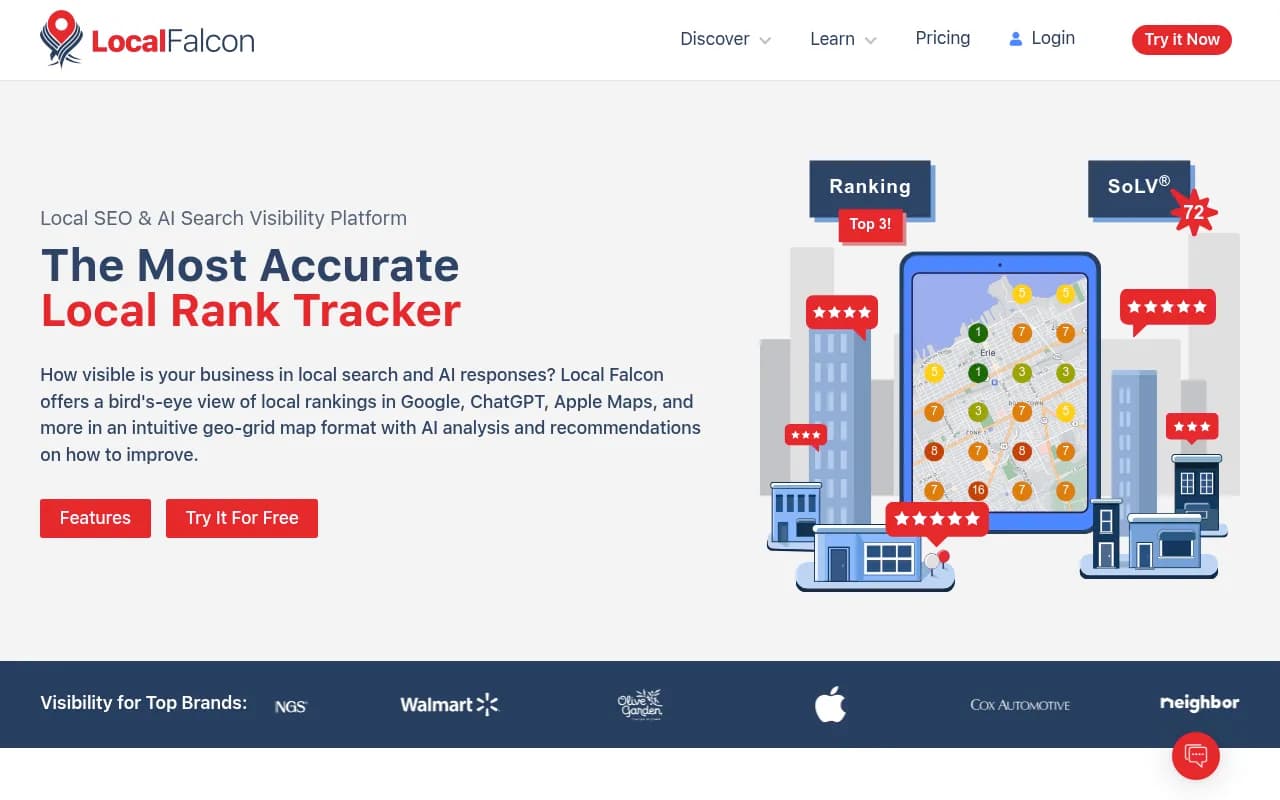
This is also the best lever for Google's own AI features, since they sit inside Google's ecosystem. If you track map rankings, Local Falcon shows a geo grid view.
SeoProfy's Google Maps checklist covers the verification, NAP and review basics in more depth.
Cause 7: You lack the right platforms for each AI engine
Different assistants lean on different sources. Promptwatch Data for Sep 28 to Oct 4, 2026 shows ChatGPT drew only 0.46% of its citations from social platforms, while Google AI Overviews drew 12.2%, led by YouTube (4.28%), Facebook (2.38%), Reddit (2.15%) and Instagram (1.61%). Details are in the social media citations report.
The practical read for a local business: an active Facebook page, Instagram account and a few YouTube videos matter more for Google's AI answers than for ChatGPT. And don't plan around Reddit threads to reach ChatGPT. Promptwatch's Reddit citation data shows reddit.com's share of ChatGPT citations fell from about 4% to 0.5% on August 14, 2026.
Fix: Spend effort on your own pages and the listicles, guides and comparisons ChatGPT does cite. Keep social profiles accurate and active for Google's surfaces.
Cause 8: You aren't measuring AI visibility at all
Most local businesses watch rankings and calls. Neither tells you whether you were named in an AI answer. There are three separate things to track: mentions (your brand named), citations (your site linked as a source), and referral traffic (people who clicked through). They don't move together, and a mention with no click can still send someone to search your name.
Fix:
- Keep your fixed prompt set and rerun it monthly.
- Tag AI referrals in Google Analytics so you can see ChatGPT and Perplexity visits.
- Use Google Search Console and Bing Webmaster Tools to confirm your key pages are indexed. Bing's index matters because other tools lean on it.
If you want a tracker, here's how the field breaks down for a small business.
| Tool | What it does | Fit for local business |
|---|---|---|
| Promptwatch | Tracks prompts across major AI engines, shows cited pages and crawler activity, and suggests content actions | Best when you want to fix gaps, not just watch them |
| Otterly.AI | Basic brand mention tracking | Cheap monitoring for a single location |
| Peec AI | Prompt-level visibility tracking | Marketing teams that only need reporting |
| TrackMyBusiness | Shows what ChatGPT, Gemini and Perplexity say about a brand | Quick checks |
| Birdeye | Reviews plus AI appearance tracking | Review-heavy local brands |
Otterly.AI


For a broader view of the category, the GEO software directory lists far more options. Plenty of trackers stop at telling you that you're invisible. The useful ones also show which pages and sources to fix. Promptwatch, for instance, pairs tracking with an action list and content tools, which matters more than another dashboard.
What to do in the first 30 days
- Week 1: run your test prompts with web search on, and save everything.
- Week 1: check robots.txt, firewall rules and noindex tags for OAI-SearchBot access.
- Week 2: reconcile business facts across your site, Google Business Profile and top listings.
- Week 3: rewrite or add service and location pages, plus an FAQ page, using real facts only.
- Week 4: claim missing directory profiles, request reviews, and pitch two or three local mentions.
- Then rerun the same prompts and compare. Expect this to take weeks or months, not days.
What not to do
- Don't buy an unofficial "ChatGPT listing." There's no secret registry to join.
- Don't mass-produce city pages with swapped place names.
- Don't script keywords into reviews.
- Don't add schema that repeats vague copy. Schema helps when it describes real facts clearly, not as decoration.
- Don't conclude anything from a single answer. Responses vary run to run.
Do you need an agency for this?
Many owners can handle the first three fixes alone: access, consistent facts and clearer pages. Off-site presence and measurement take longer. If you'd rather hand it off, an SEO and GEO agency such as 1001 SEO Media covers technical SEO, content, digital PR and AI search work together, which is the combination this problem usually needs.
The short version
ChatGPT doesn't rank you, it chooses whether to name you. Make sure it can crawl you, that your facts agree everywhere, that your pages answer specific service-and-city questions, and that credible third parties say the same things about you. Then measure with a fixed prompt set so you know whether it worked.