Key takeaways
- In a third-party study of 9,434 ChatGPT home-services answers (US and Canada, Aug 31 to Sep 20, 2026), 84% of answers that cited anything cited at least one directory, review platform or "best of" list.
- Expertise.com appeared in 32.1% of answers and Angi or HomeAdvisor in 29.4%. Yelp appeared in only 0.6%, and Google pages in 0.1%.
- Contractor websites still matter: at least 44.2% of answers cited a business's own site, though the pattern varies sharply by trade.
- Promptwatch's broader citation data points the same way. Marketplaces, review sites and landing or product pages carry a large share of what ChatGPT cites.
- The practical plan: get listed and reviewed on the platforms ChatGPT actually pulls from in your vertical, then make your own service and location pages easy to cite.
Why local queries behave differently
Ask ChatGPT for "best plumber in Denver" and you do not get a neat map pack. You get a written answer, a handful of named businesses, and a list of sources underneath. Those sources decide who gets named.
Two things feed that answer. One is what the model learned in training. The other is a live web search ChatGPT runs when the question needs current facts. For a local business, the live search is the part you can see, measure and influence, because it leaves a list of cited URLs.
This guide pulls together what the data says about which sources show up in that list. A caveat first: most of the local-specific numbers here come from a third-party study of home-services prompts, not from Promptwatch Data. I flag which is which, because the two datasets also measure different things (more on that below).
What the home-services study found
The most detailed local dataset I found is the Cheers Market Baseline, published by the AI visibility company Cheers. It asked 32 home-services questions weekly across 100 US and Canadian metros, and collected 9,434 usable ChatGPT answers between August 31 and September 20, 2026. It is a single vertical, so treat it as a strong signal for contractors and a rougher guide for restaurants or dentists.
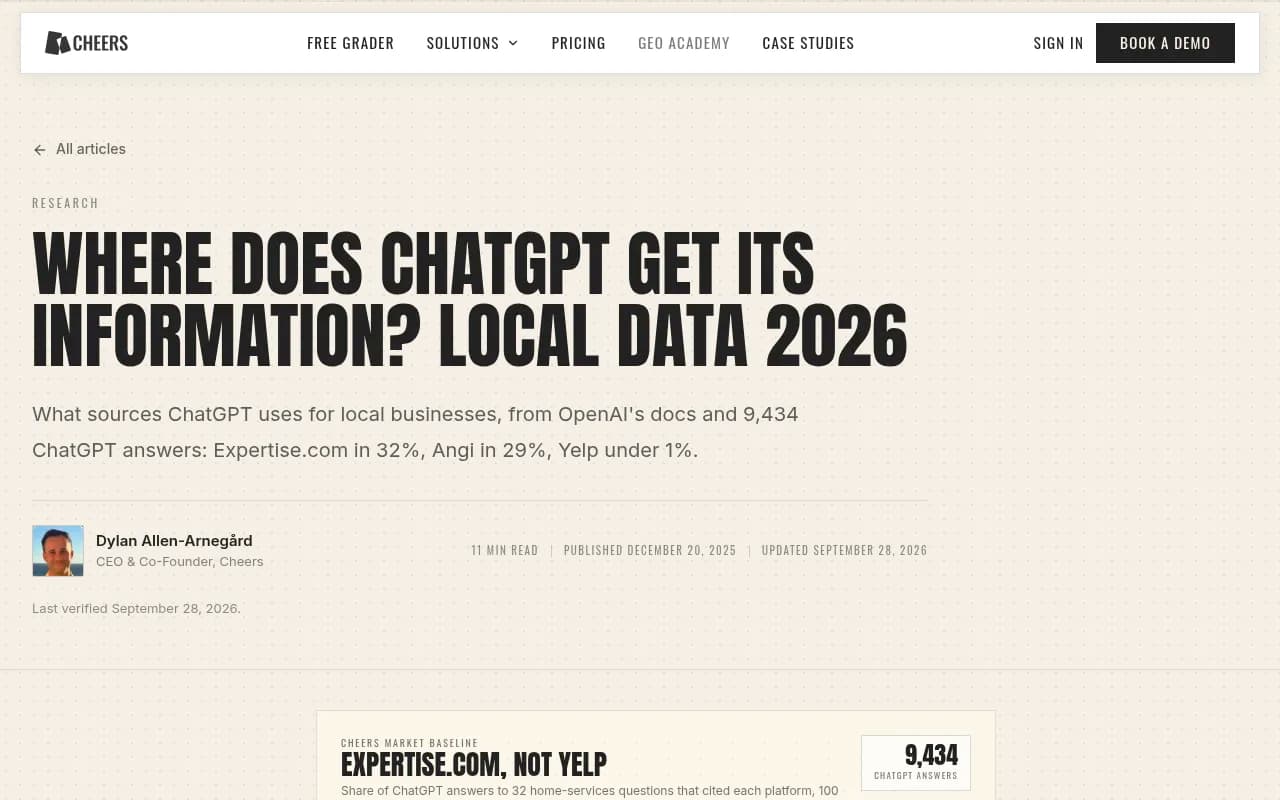
Share of ChatGPT answers citing each platform
| Platform | Share of answers | Notes |
|---|---|---|
| Expertise.com | 32.1% | US answers only |
| Angi or HomeAdvisor | 29.4% | US answers only, bar one |
| HomeStars | 16% | Canadian answers only |
| BBB | 14.5% | Cited more than twice as often in Canada (21.5%) than the US (9.8%) |
| Yelp | 0.6% | 52 of 9,434 answers |
| Any Google page | 0.1% | Versus 95.5% of Google AI Mode answers |
The headline is the gap between what local marketers obsess over and what ChatGPT cites. Yelp is the platform many owners spend the most time on, and it barely registers as a citation. Expertise.com, which many owners have never heard of, shows up in almost a third of answers.
There is a wrinkle. In a five-day capture from September 18 to 22, 2026, when the study recorded ChatGPT's map view in full, 34% of the rated business cards linked to a Yelp business page. And 98% of the answers showing a business under 4.0 stars involved one of those Yelp cards. So Yelp does not drive the written citations, but it appears to feed the ratings shown on the map. Those are two separate surfaces, and you need to watch both.
Lists beat everything else
Sites that rank local companies, the "best of" format, appeared in 64.2% of the answers that cited anything. That is the single biggest finding. If your business is not on the lists these sites publish, ChatGPT has far less reason to name you.
Your own website still counts
Contractor sites were the other big source. At least 44.2% of answers cited a website belonging to a business in the dataset, and those sites took 26.8% of all citation links, roughly the same share as the long tail of directories.
It depends heavily on the trade:
- In plumbing, 53.7% of answers cited a plumber's own site.
- In roofing, only 17.8% of 600 answers cited a roofer's site, while 40.0% cited Expertise.com.
Which page gets cited matters too. When ChatGPT cited a contractor's site, it picked the homepage 37.4% of the time, a service page 24.1%, a page naming both a service and a city 17.4%, and a location page 10.7%. Blog posts got 1.2%. That last number surprised me. Most local content calendars are blog-heavy, and almost none of that effort shows up in citations.
How other engines compare
The same study ran identical questions through other engines, and the source mix is very different. Business websites were cited in 44.2% of ChatGPT answers, against 92.5% for Google AI Mode, 89.0% for Perplexity and 88.3% for Gemini answers that had citations. In other words, ChatGPT leans on intermediaries far more than the others do. A local business that is visible in AI Mode through its own site can still be invisible in ChatGPT if no list or directory names it.
What the older BrightLocal study says
BrightLocal ran an earlier replication of its local search study on ChatGPT Search. It reported business websites at 58% of local search sources, business mentions at 27%, and directories at 15%. It also found ChatGPT ignored forums entirely for local business searches, while still drawing on review information from Google and Google Maps for ratings and snippets.
That is a different picture from the home-services data, with websites much more prominent and directories much less. I would not read that as a contradiction. The query sets differ (coffee shops and salons versus plumbers and roofers), the method differs, and ChatGPT's search behavior has shifted since. Check the publication date before leaning on the 58% figure. The consistent thread is that third-party mentions carry real weight and forums do not.
What Promptwatch Data adds
Promptwatch Data has no dedicated home-services or local report, so I will not invent one. What it does have are citation reports for local-adjacent verticals and for ChatGPT overall. Note that these measure percentages of all citations, not percentages of answers, so do not compare them directly with the Cheers numbers above.
Automotive: marketplaces beat brands
In Promptwatch's automotive citation data for August 2026, marketplaces like Autotrader (5%) and Cars.com (4.6%) outrank every car brand. Chevrolet.com is the only manufacturer in the top eight, at 2.62%. Marketplaces and listings made up 14.65% of citations and reviews and research sites 12.62%, while manufacturer sites held 7.92%. Dealerships, service and finance sites and community and news sources combined were just 2.12%. The report's advice: keep complete profiles on review platforms such as DealerRater, Birdeye and BBB. It also notes one individual dealer group reaching the top 31, so a specific local page can appear alongside the national players.
Travel: a long tail
In the travel report for September 28 to October 4, 2026, Skyscanner (0.78%), Going (0.52%) and Tripadvisor (0.49%) lead. Booking and search sites hold 2.42% of citations, and the 17 domains shown together hold only 4.18%. Travel is a heavily fragmented citation space, so a hotel or tour operator has a better chance of landing somewhere in the long tail than in a concentrated category.
Which page types get cited
Across all prompts, Promptwatch's content-type data (Sep 28 to Oct 4, 2026) shows product pages at 22.4% of ChatGPT citations and landing pages at 16.8%, so 39% of citations go to a page describing what a company sells. Listicles are 13.6%, and reviews are 1.7% overall but rise to 5.6% on branded prompts, more than three times their overall share. That last point is useful for local owners, since people often ask about a named business directly.
This lines up with the Cheers finding that homepages and service pages get cited far more than blog posts. Pages that describe a service clearly beat pages that talk around it.
Social and forum sources are fading
On social media citations, Promptwatch Data shows ChatGPT drawing just 0.46% of its citations from social platforms between Sep 28 and Oct 4, 2026, while Google AI Overviews drew 12.2%. And reddit.com's share of ChatGPT citations fell from about 4% to 0.5% on August 14, 2026. If your local strategy leaned on Reddit threads or Facebook posts to earn ChatGPT visibility, the data says that bet got weaker this year. It may matter more for AI Overviews.
Citations decay
On freshness, Promptwatch's content half-life report tracked every page ChatGPT cited on July 6, 2026 for 90 days. Landing pages and docs stayed cited longest, while news lost half its pages within 36 days. A durable service page is a better long-term bet than a timely news-style post.
Putting it together
The two datasets agree on the big picture even though they measure different things. Cheers finds 84% of cited answers include a directory, review platform or list. Promptwatch finds marketplaces and review sites taking roughly a quarter of automotive citations. Intermediaries are the gatekeepers for local queries in ChatGPT.
| Source type | What the data says | What to do |
|---|---|---|
| "Best of" lists and ranking sites | Cited in 64.2% of answers that cited anything (home services) | Find out which ones cover your trade and city, and get listed |
| Industry directories (Expertise.com, Angi, HomeStars) | Each cited in roughly 15% to 32% of home-services answers, depending on country | Claim and complete profiles |
| Review platforms (BBB, Yelp, Trustpilot, Tripadvisor) | BBB 14.5%; Yelp 0.6% as a citation but powers many map ratings | Keep ratings healthy and reviews recent |
| Your own site | At least 44.2% of answers; homepage and service pages favored | Clear service and service-plus-city pages |
| Blog posts | 1.2% of contractor-site citations | Don't expect them to carry local visibility |
| Forums and social | Near zero in ChatGPT | Low priority for ChatGPT, maybe more for AI Overviews |
A practical plan
1. Find out which sources matter in your vertical
Don't assume. Ask ChatGPT the exact questions your customers ask, in your city, and open the sources list. Do it for ten or twenty queries and tally the domains. Roofing and plumbing already look different in the Cheers data, so your answer might not match the averages. A rough way to do this by hand is to ask the question, scroll to the bottom and open the sources panel.
2. Claim and complete the profiles that keep showing up
Complete means every field: categories, service areas, hours, photos, a consistent name, address and phone number, and a link to your site. Listing platforms like Yext and Moz Local distribute that data across many directories at once, which helps with the long tail. For ongoing local monitoring, BrightLocal is a common choice, and BrightLocal's own research is where some of the data above came from.
3. Earn reviews where AI looks
Reviews rise to 5.6% of citations on branded prompts, and the Cheers data shows low star ratings on the map link back to Yelp cards. Keep a steady flow of recent reviews on Google, Yelp and whichever industry platform dominates your trade. Review tools such as Birdeye, Trustpilot and Podium help with the request workflow.
4. Fix your own pages
Given that homepages (37.4%) and service pages (24.1%) get cited most often, make those pages unambiguous. State what you do, where you do it and how to contact you in plain text. Build service-plus-city pages only where you really operate, and give each location its own page with a unique address and details. Skip thin doorway pages. If you have a blog, I would not spend the next quarter on it expecting local citations.
5. Make sure AI crawlers can read the site
A page cannot be cited if the crawler is blocked or the content only appears after heavy JavaScript. Check robots.txt, server errors and rendering. A crawler like Screaming Frog will surface the obvious technical problems.
6. Track it over time
Citation patterns change monthly. ChatGPT's reddit.com share dropped by roughly 8x overnight in August 2026, and nobody saw it coming. You need ongoing measurement, not a one-off check. Tools like Promptwatch can track which pages and third-party sources ChatGPT cites for your prompts over time, and show where AI crawlers are hitting your site.

For a broader field of options, the GEO software directory at bestgeosoftware.com lists more trackers, and multi-location brands will find local-specific platforms in the tools above.
What I would be careful about
A few honest limits on all of this:
- The best local numbers come from one vertical (home services), one company's methodology and a three-week window. Treat the percentages as directional.
- The two datasets use different denominators. Cheers counts the share of answers that cite a source. Promptwatch counts the share of all citations. Both are valid, but 32% of answers is not 32% of citations.
- ChatGPT changes often. The site: operator shift on August 8, 2026 nearly doubled searches per response, and Promptwatch Data on that change shows how fast retrieval behavior can move. Re-check your own queries every month or two.
- ChatGPT is only one engine. The same home-services study found Google AI Mode citing Google pages in 95.5% of answers, so a strategy tuned only to ChatGPT will miss other surfaces.
Bottom line
For local queries, ChatGPT mostly names businesses that other sites have already vetted. In home services that means ranking lists and a few industry directories first, contractor websites second, and Yelp and Google pages almost never as written citations. Work out which three or four platforms dominate your own vertical, get a complete and well-reviewed presence on them, and put your effort into clear service and location pages on your own site rather than more blog posts.