Key takeaways
- AI assistants return a handful of names for local queries, not a page of links, so every slot a competitor holds is one you don't.
- A manual test works as a starting point: fresh sessions, logged-out browsing, several phrasings, several personas, and notes on the reasons each answer gives.
- The reasons AI states (a specialty, a neighborhood, a price band) tell you what signals it read. Specialists get named and generalists get skipped.
- Manual checks don't scale. A tracker that runs a fixed prompt set per city and logs competitors, position and cited sources does.
- Finding the competitor is half the job. The other half is working out which sources AI cited and fixing your own gaps there.
Why local AI recommendations are different
When someone types "best dentist near me" into Google, they get ten blue links, a map pack and a lot of room for a second-best business to pick up traffic. When they ask ChatGPT, Gemini or Perplexity, they get a short list. Sometimes three names. Sometimes five. The rest don't exist as far as that user is concerned.
That changes how you should think about competitors. The businesses you compete with in Google's local pack might not be the ones AI recommends. A competitor with fewer reviews but a sharper website and consistent directory listings can beat you in AI answers while ranking below you in Maps.
So the first job is boring and practical: find out who AI actually names in your city, for the questions your customers actually ask. The second job is more interesting: work out why.
Step 1: Run the manual test properly
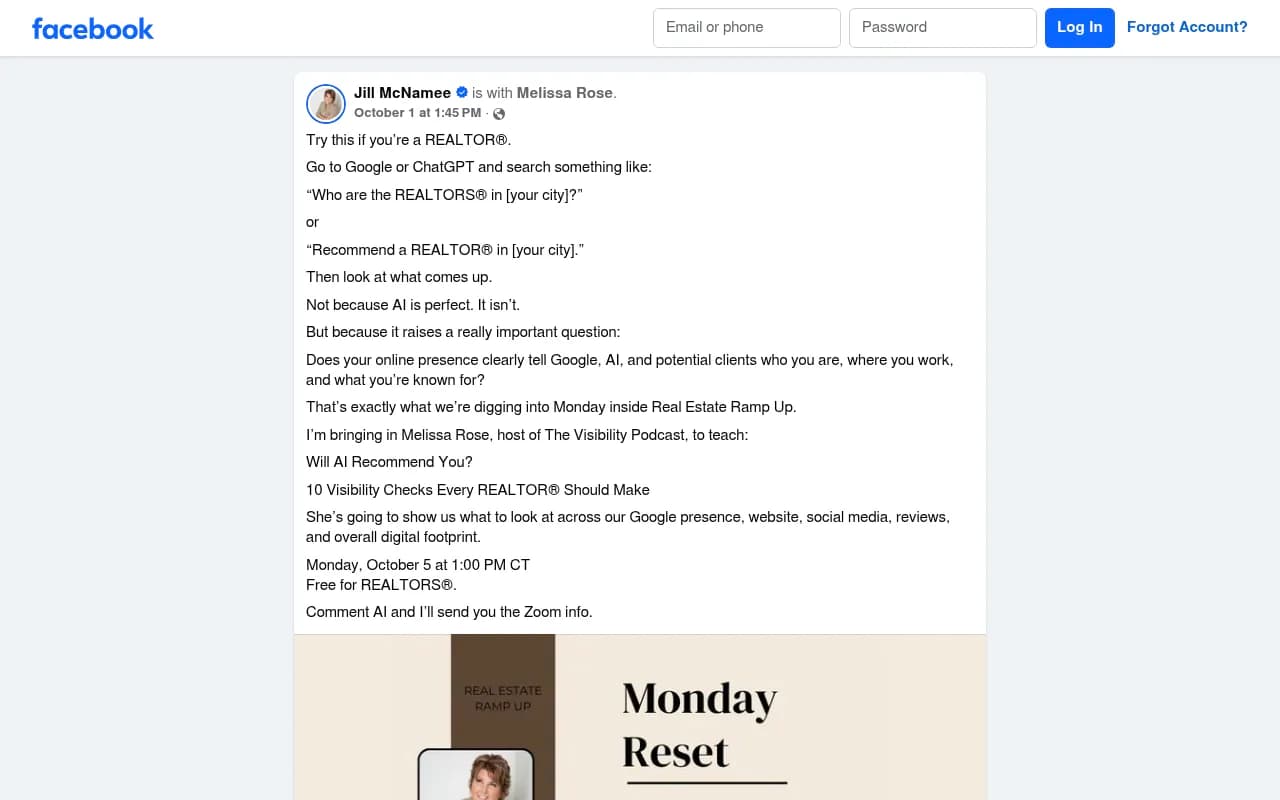
The simplest version of this is what a lot of realtors have started doing. Open ChatGPT or Google and ask something like "Who are the REALTORS in [your city]?" or "Recommend a REALTOR in [your city]." You'll learn something in two minutes. But a single query is an anecdote, not data. Do it properly.
Control the environment
A few rules from people who do this regularly:
- Use a fresh chat for every query. Mentioning your own brand early in a thread skews everything that follows.
- Use a logged-out or incognito session where you can, so your history and cookies don't shape the answer.
- Turn on web search for ChatGPT, or use Perplexity, so you can see citations and not just names.
- Set your location deliberately. If you're testing a city you aren't in, name the city and neighborhood in the prompt rather than relying on "near me".
Test several phrasings and personas
Answers are context-dependent. Asking as a first-time buyer produces a different list than asking as someone selling a $3 million home. Build a small prompt set that covers the ways your customers really ask:
| Prompt type | Example | What it reveals |
|---|---|---|
| Generic category | "Best [service] in [city]" | Who owns the default recommendation |
| Neighborhood-level | "Best [service] in [neighborhood]" | Who has hyperlocal authority |
| Specialty | "[Service] for [situation] in [city]" | Who has a clear "best for" signal |
| Price or segment | "Affordable [service] in [city]" vs. "luxury [service] in [city]" | Which competitors win by market tier |
| Comparison | "[Competitor A] vs [Competitor B] in [city]" | How AI describes rivals side by side |
| Branded | "Is [your business] any good?" | What AI believes about you specifically |
Run each prompt on at least ChatGPT, Gemini, Perplexity and Google AI Overviews. They don't agree with each other, and the differences are useful.
Log what you see
Keep a simple spreadsheet. For every prompt and engine record the names mentioned, their order, the reason given, and any sources cited. Ten minutes of discipline here saves you from relying on memory later. It's also the data you'll compare against when you start fixing things.
Step 2: Read the reasons, not just the names
The names are the least interesting part of an AI answer. The reasons are where the strategy lives.
A real estate agency, To Be Agency, ran this test for agents in Park City, Utah and published what came back. A few patterns stand out, and they apply well beyond real estate:
- ChatGPT opened like a local search result, with a map and star ratings, then a short list of agents.
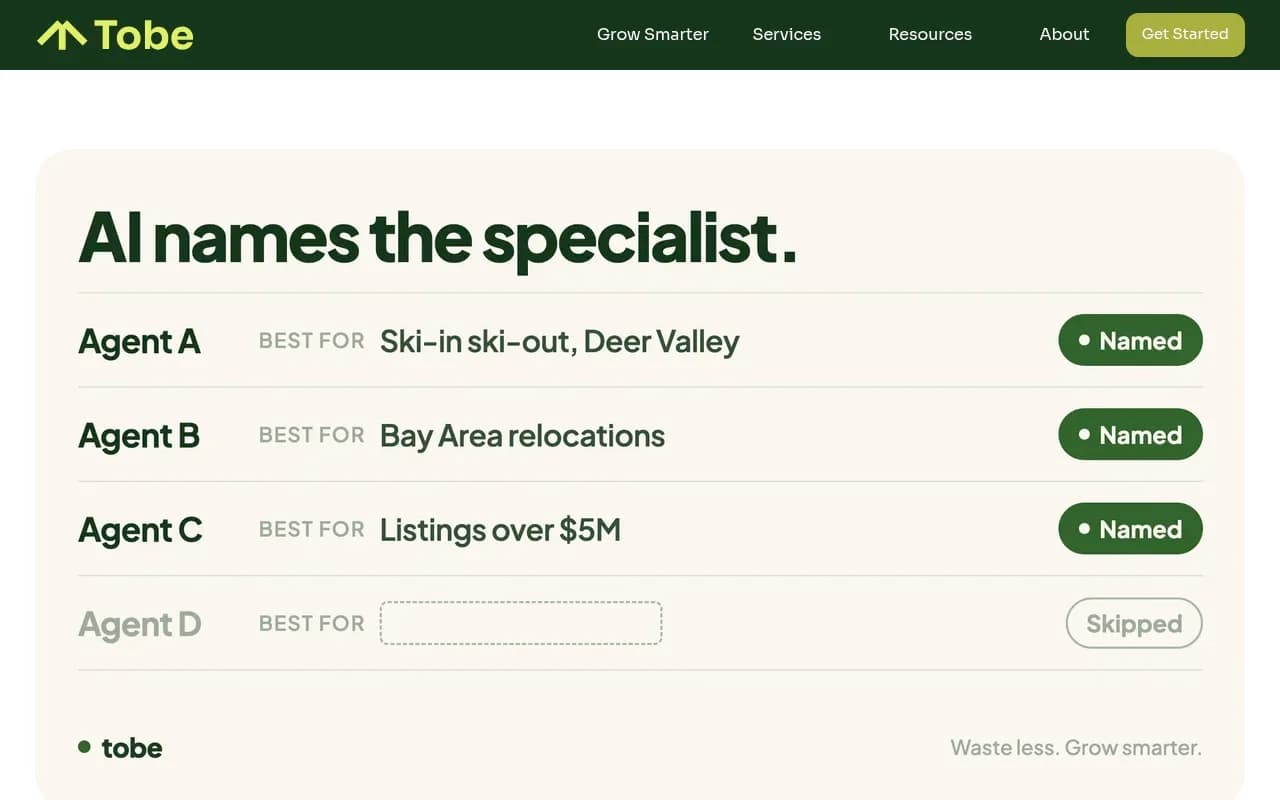
- Every name came with a specific reason: a community (Deer Valley, Empire Pass), a price band ($3 million and up), off-market access.
- Nearly every pick had a stated specialty. Sales volume came up only sometimes.
- A team whose entire identity was built around Deer Valley, from the team name to the neighborhood pages on its site, got named for the ski-in ski-out question.
- When asked about that team by name, ChatGPT described its neighborhoods, tenure and reviews. The franchise brokerage behind it barely came up. For that question, the team's own brand carried more weight.
That last point is worth sitting with. Plenty of businesses assume the parent brand does the work. In that test it didn't.
The agency's framing is useful: picture a table with a "best for" column. If AI can't fill in that cell for you, you don't make the table. "Hardworking" and "20 years in the market" don't fill it. A named neighborhood, a named client type or a named price band does.
What to extract from each answer
For every competitor that appears, write down:
- The stated specialty or "best for".
- The proof AI cites (reviews, years, volume, awards).
- The source it pulled from (their site, a directory, a review platform, a roundup article).
- Whether it names them for buyers, sellers, or both.
After 20 or 30 prompts you'll see the same competitors repeating and the same reasons attached to them. That is your real competitive set for AI.
Step 3: Trace the sources behind the answers
Names come from somewhere. If your engine shows citations, those are the pages feeding the answer. For local queries they tend to be some mix of the business's own site, Google Business Profile data, review platforms, industry directories and "best of" roundups.
Promptwatch Data gives a rough guide to which page types ChatGPT leans on. In its report covering Sep 28 to Oct 4, 2026, product pages were the most cited content type at 22.4% of classified citations, and landing pages followed at 16.8%. For commercial prompts, the closest match to "best X in [city]", product pages hit 26.0%, landing pages 20.6% and listicles 15.0%, with comparisons at 7.9%. Those four types made up almost 70% of commercial citations.
Translate that into local terms: a clear service page for each service and each city you cover matters, and so does appearing in the roundups AI already cites for your category. If a competitor keeps showing up because a local "best of" article names them, getting into that article is a concrete task.
Branded prompts look different. In the same data, reviews rise to 5.6% of citations on prompts that name a company, more than three times their overall share, and FAQ pages reach 4.8%. So when someone asks AI about you or a rival by name, review sites and a plain FAQ page carry real weight.
One more note on expectations. Almost half of ChatGPT responses cite 10 or more unique domains in Promptwatch's Sep 28 to Oct 4, 2026 data, so the recommendation you see is usually stitched together from many pages, not one. And the source mix changes by industry. For example, marketplaces like Autotrader and Cars.com outrank every car brand in ChatGPT automotive citations (August 2026), and booking and search sites earn more than half of travel citations (Sep 28 to Oct 4, 2026). If you're a local business in one of those verticals, you may be competing with platforms, not just other local firms.
Don't expect social proof from Reddit anymore
A lot of older advice says to get mentioned on Reddit. That's weaker than it was for ChatGPT: reddit.com's share of ChatGPT citations fell from roughly 4% to 0.5% on August 14, 2026. Google's AI surfaces behave differently. In the week of Sep 28 to Oct 4, 2026, ChatGPT drew 0.46% of its citations from social platforms while Google AI Overviews drew 12.2%. So test each engine separately before you decide where to spend effort.
Step 4: Move from manual checks to tracking
Manual testing is good for building intuition. It's bad for monitoring. AI answers shift, and a list you recorded in March may be wrong by June. Also, you can only run so many prompts by hand across four engines and several neighborhoods.
A tracker runs a fixed prompt set on a schedule and records who gets named, where, and with what sources. For local work, what to look for is:
- Location control. Can you set the country, and ideally the city or state, for each prompt?
- Competitor visibility. Does it show which competitors appear next to you and how early?
- Source and citation data. Can you see which pages and domains were cited?
- Real interface data. Answers from the actual ChatGPT or AI Overviews interface can differ from API outputs.
- Action, not only reporting. Does it help you fix what it finds?
Tools worth knowing
Promptwatch is the one I'd start with when the goal is to find the competitors and then do something about it. It tracks the real interfaces of ChatGPT, Google AI Overviews, AI Mode, Gemini, Perplexity and Copilot, supports country tracking on every paid plan and state/city tracking from the Business plan, and shows competitor heatmaps, citation sources and Share of Voice. Its Action Board and content tools turn gaps into tasks. Check promptwatch.com/pricing for current plans.

For a monitoring-first view, these are in the same space:
Otterly.AI


Profound

Otterly.AI and Peec AI are simpler prompt trackers. Profound is a stronger monitoring product but sits at a higher price point. None of the three is built around the fix-it loop the way Promptwatch is.
Some tools in the catalog speak directly to local businesses:
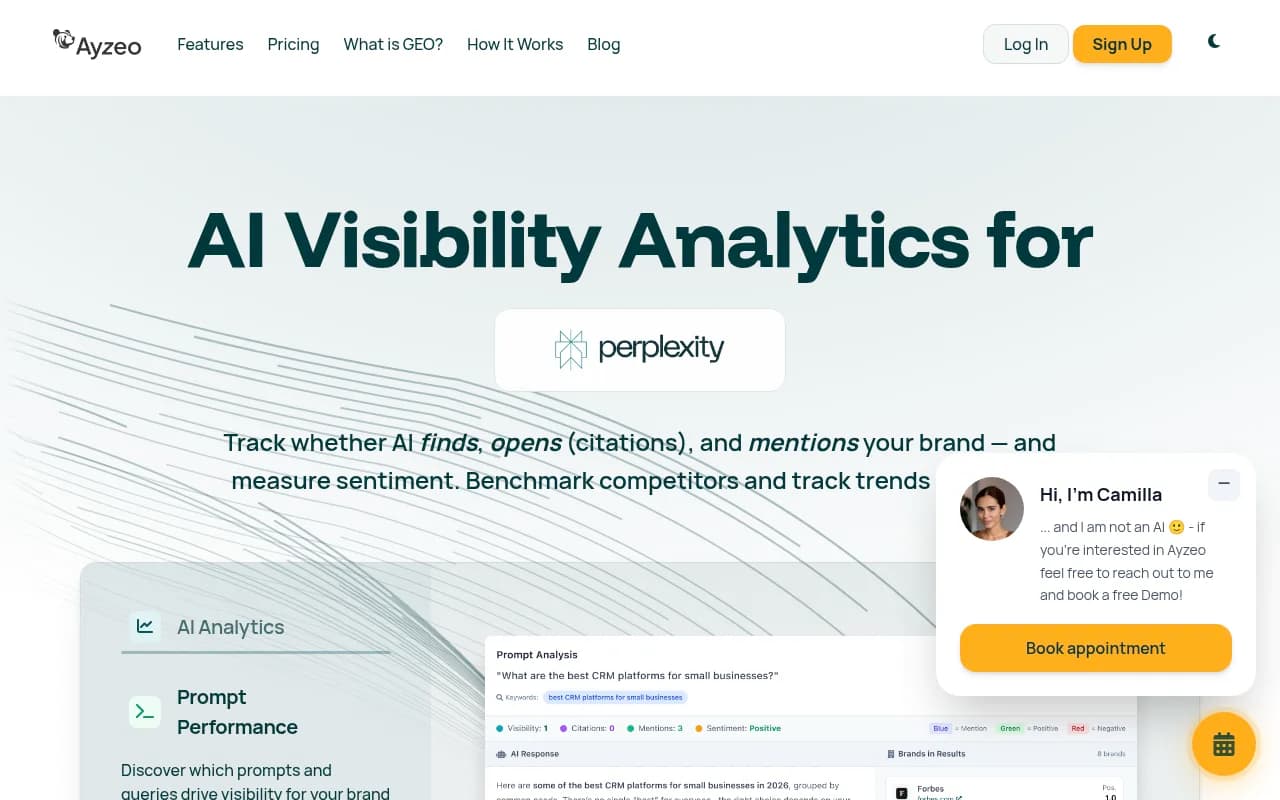
Ayzeo focuses on local prompt monitoring across engines, showing whether you're named, how early, and which competitors take the other slots.
For multi-location brands, listing and reputation platforms matter because AI reads the same directories and reviews that local SEO has always cared about:
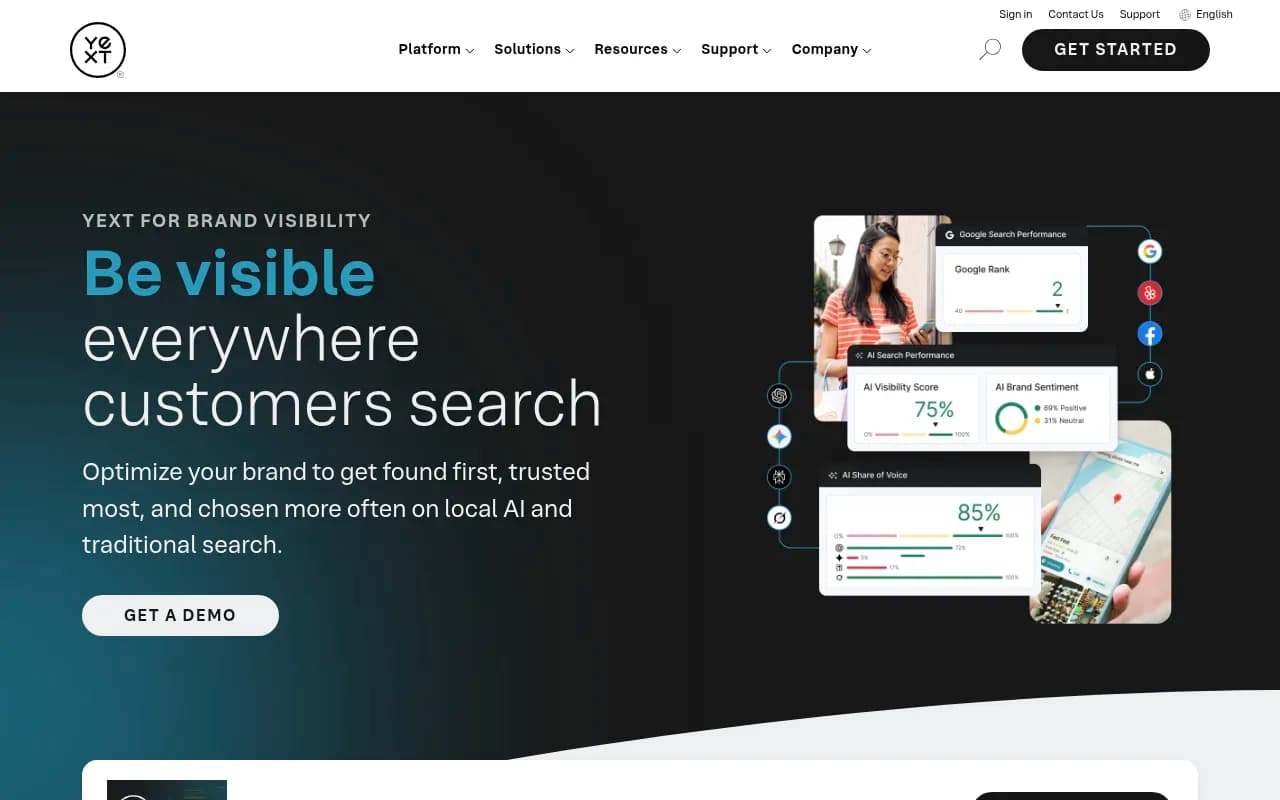
Yext and BrightLocal handle listing consistency and local SEO reporting. Whitespark is strong on citations. They don't track AI answers on their own, but they fix the data AI reads.
| Tool | Best for | Local/city tracking | Fixes what it finds |
|---|---|---|---|
| Promptwatch | Finding competitors and closing gaps | Country on all paid plans, state/city on Business | Yes, via Action Board and Content Agent |
| Otterly.AI | Basic brand mention monitoring | Limited | No |
| Peec AI | Marketing team tracking | Limited | No |
| Profound | Enterprise monitoring | Yes | Limited |
| Ayzeo | Local business prompt monitoring | Local focus | Some GEO guidance |
| BrightLocal | Local SEO and listings | Yes (traditional local) | Listing and review work |
| Yext | Multi-location listing sync | Yes | Listing data |
For wider browsing, the GEO software directory at bestgeosoftware.com lists more options, and ai-rank-tools.com focuses on AI rank trackers.
Step 5: Turn what you find into fixes
Once you know who AI names and why, the work is fairly mechanical.
Write your specialty down in plain words
If your site, Google Business Profile and directory profiles never say what you're best for, AI has nothing to match you to. Name the neighborhood, the customer type, the price tier. Put it in the page title, the headline, the profile description. Repeat it consistently across platforms.
Build pages that match the queries
Promptwatch's query fanout data shows ChatGPT often runs short keyword-style searches behind the scenes. Average query length fell from about 117 characters in December 2025 to about 53 characters in April 2026 (query fanout report). So headings and titles that read like "best [service] [city]" or "[service] in [neighborhood]" tend to match better than clever copy. One page per service per area beats a single generic page.
Collect reviews where your category is read
Since branded prompts lean on review content, make sure you have recent reviews on the platforms trusted in your industry, not only Google. Trustpilot is relevant for some categories, while others depend on niche directories.
Get into the roundups AI already cites
If the sources you logged in Step 3 include local "best of" articles or directory lists that name your competitors, contact the publishers. This is old-fashioned outreach, and it now feeds AI answers too.
Keep pages fresh
Not all content lasts. News pages lost half their cited pages within 36 days, while landing pages and docs stayed cited longest in Promptwatch's analysis of pages ChatGPT cited on July 6, 2026. Your evergreen service pages are your durable assets, so keep them accurate and updated.
Make sure AI can actually read your site
A page can't be cited if the crawler can't fetch it. Check robots.txt, rendering and errors. Tools like Screaming Frog help with basic crawl checks, and Promptwatch's crawler logs show which AI bots actually visit and where they hit errors.
A simple monthly routine
- Keep a fixed set of 20 to 40 prompts covering generic, neighborhood, specialty and comparison queries.
- Run them (manually or via a tracker) across at least four AI engines.
- Log competitors, order, stated reasons and cited sources.
- Flag any competitor who gains a slot, and read the page that earned it.
- Pick two or three fixes: a specialty rewrite, a new local page, a review push, a roundup pitch.
- Re-run the same prompts next month and compare.
The repeat is what matters. Without the same prompts each time, you can't tell whether a change worked or the answer just wobbled.
Common mistakes
- Testing once and drawing conclusions. AI answers vary between runs and engines.
- Testing while logged in with a long chat history, then wondering why your brand shows up.
- Only checking "near me" prompts, which depend on device location and miss the neighborhood and specialty queries that decide a lot of choices.
- Assuming the competitor in Google's local pack is the one AI picks.
- Treating a referral as safe. A client may refer you, then check AI and find a different name, so your own track record needs to be written down somewhere AI can read.
Where an agency fits
If you'd rather hand off the prompt design, tracking and content fixes, agencies that specialize in AI search can run this for you. 1001 SEO Media does GEO and local SEO work and uses Promptwatch for AI visibility tracking, though the routine above is something a small team can run alone.
Bottom line
Finding which competitors AI recommends in your city takes an afternoon of disciplined testing. Understanding why takes reading the stated reasons and tracing the cited sources. Staying ahead takes repetition and a tracker that covers your cities and engines. Start with 20 prompts, log everything, and look first at the one competitor who keeps showing up. Their "best for" cell is the one you need to fill in.