Key takeaways
- AEO (Answer Engine Optimization) is the practice of structuring content so AI-powered engines like ChatGPT, Perplexity, and Google AI Mode cite it in their responses.
- It's different from traditional SEO: the goal isn't a ranking position, it's being the source an AI quotes.
- AI-referred traffic to websites grew 527% year-over-year through mid-2025, and ChatGPT now handles over 2 billion queries daily -- this channel is real and growing fast.
- The core tactics: answer questions directly and early, build topical depth, use structured data, establish entity authority, and track which AI engines are actually citing you.
- Monitoring alone isn't enough -- you need to identify gaps and create content that fills them.
What AEO actually is (and what it isn't)
Answer Engine Optimization is the practice of structuring and enhancing your content so that AI-powered search platforms select it as a cited source when generating answers.
That's it. No mystery.
When someone asks Perplexity "what's the best project management tool for remote teams?" or asks ChatGPT "how do I reduce churn for a SaaS product?", those systems pull from the web, synthesize an answer, and cite sources. AEO is the work you do to make your content one of those sources.
What AEO is not: it's not about gaming prompts, stuffing keywords into FAQ sections, or writing content that sounds like it was written for a robot. The AI engines doing the citing are sophisticated enough to recognize thin, low-value content -- and they skip it.
It's also not a replacement for SEO. Google's own May 2026 AI guidance confirmed that AEO is still SEO at its core: authoritative, well-structured, genuinely useful content. The difference is in what "success" looks like. In traditional SEO, success is a ranking position. In AEO, success is a citation.
The difference between AEO and GEO
You'll see these terms used interchangeably, but there's a meaningful distinction worth knowing.
AEO focuses specifically on getting cited by answer engines -- the AI systems that respond to direct questions. Think Perplexity, ChatGPT search, Google AI Mode.
GEO (Generative Engine Optimization) is the broader discipline: optimizing your brand's presence across all generative AI surfaces, including AI-generated summaries, shopping recommendations, entity mentions, and conversational responses. GEO includes AEO, plus things like brand entity optimization, offsite citation building, and AI crawler management.
In practice, most people use "AEO" and "GEO" interchangeably, and that's fine. The underlying work is largely the same.
Why this matters right now
The numbers tell the story. ChatGPT handles over 2 billion queries daily. AI-referred sessions to websites grew 527% year-over-year through mid-2025. Google AI Overviews now appear on a significant portion of searches, often pushing organic results further down the page.
This isn't a future trend to prepare for. It's happening now, and brands that aren't showing up in AI answers are already losing trust-building moments -- the moments where someone is actively researching a decision and an AI system either mentions your brand or doesn't.
The old model: user searches → sees your result → clicks → converts.
The new model: user asks AI → AI synthesizes an answer → user either sees your brand cited or doesn't → user may or may not visit your site.
That middle step -- the AI synthesis -- is where AEO operates.
How answer engines decide what to cite
Understanding this is the foundation of everything else. AI answer engines don't just pull the top-ranking Google result. They evaluate sources based on several signals:
Clarity and directness. Pages that answer the question clearly in the first few sentences get cited more often than pages that bury the answer in background context. AI engines are looking for extractable answers -- text they can pull and present cleanly.
Topical authority. A site that has covered a topic deeply and consistently -- multiple related articles, internal linking, comprehensive coverage of subtopics -- signals expertise. A single page on a topic, with no surrounding content, gets less trust.
Freshness. AI engines weight recency, especially for fast-moving topics. Outdated content gets deprioritized.
Entity signals. Does the AI "know" who you are? Is your brand mentioned on other credible sites? Do you have a Wikipedia page, a Wikidata entry, consistent NAP data? These entity signals help AI engines resolve your brand as a trusted, real-world entity.
Structured data. Schema markup (FAQ, HowTo, Article, Organization) helps AI engines parse your content more reliably. It doesn't guarantee citation, but it removes friction.
Source reputation. Backlinks, brand mentions, and citations from authoritative sources still matter -- they're part of how AI engines assess trustworthiness.
The seven core AEO tactics for 2026
1. Lead with the answer
The most common AEO mistake is burying the answer. If someone asks "what is answer engine optimization?", your page should answer that in the first paragraph -- not after three paragraphs of context-setting.
Think of it like an inverted pyramid: answer first, then explain, then provide supporting detail. This structure makes it easy for AI engines to extract a clean, citable response.
A practical test: read your first 100 words. If someone asked the question your page targets, would those 100 words answer it? If not, rewrite the opening.
2. Build topical depth, not just individual pages
A single page on a topic rarely gets cited as often as a site that has covered the topic from multiple angles. AI engines look for topical authority -- evidence that a source understands a subject comprehensively.
This means building content clusters: a main pillar page on a topic, supported by related articles covering subtopics, use cases, comparisons, and FAQs. Internal linking between these pages signals to AI engines that your site is a reliable, deep resource.
If you're in B2B SaaS, for example, and you want to be cited when people ask about customer onboarding, you shouldn't just have one "customer onboarding guide." You should have articles on onboarding checklists, onboarding email sequences, onboarding metrics, common onboarding mistakes, and so on.
3. Use structured data (but do it right)
Schema markup helps AI engines parse your content. The most useful schema types for AEO:
- FAQPage: Mark up Q&A content so AI engines can extract individual answers
- HowTo: Structure step-by-step guides in a machine-readable format
- Article: Signal authorship, publish date, and content type
- Organization: Establish your brand's entity data (name, URL, logo, social profiles)
- Person: For individual authors, signal expertise and credentials
One important caveat: schema only works when it reflects visible content. Don't add FAQ schema to questions that aren't actually answered on the page. AI engines are good at detecting mismatches, and it can hurt trust rather than help it.
4. Write for questions, not just keywords
Traditional SEO optimizes for keywords. AEO optimizes for questions -- the actual prompts people type into ChatGPT or Perplexity.
These are often longer, more conversational, and more specific than traditional search queries. "best CRM" is a keyword. "What's the best CRM for a 10-person B2B sales team that already uses HubSpot?" is a prompt.
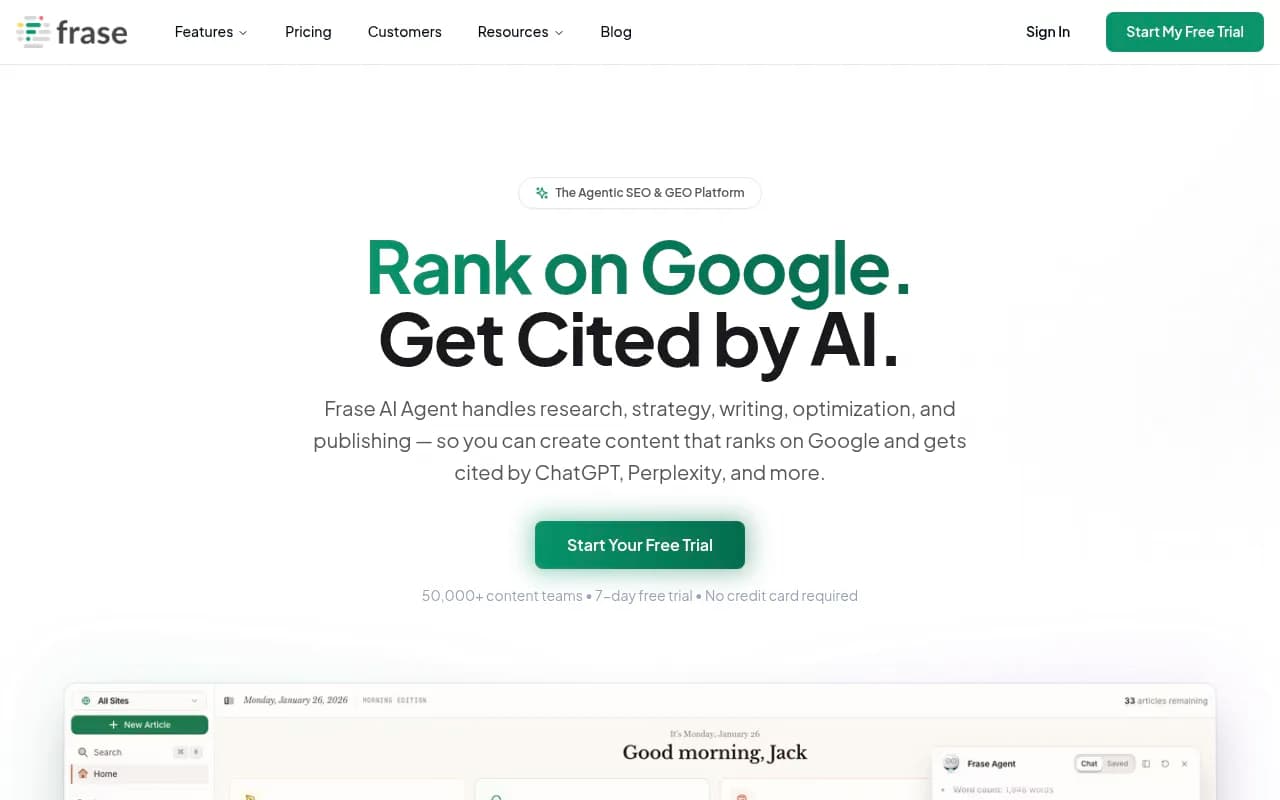
Tools like Frase are useful here -- they help you research the questions your target audience is actually asking and structure content to answer them.
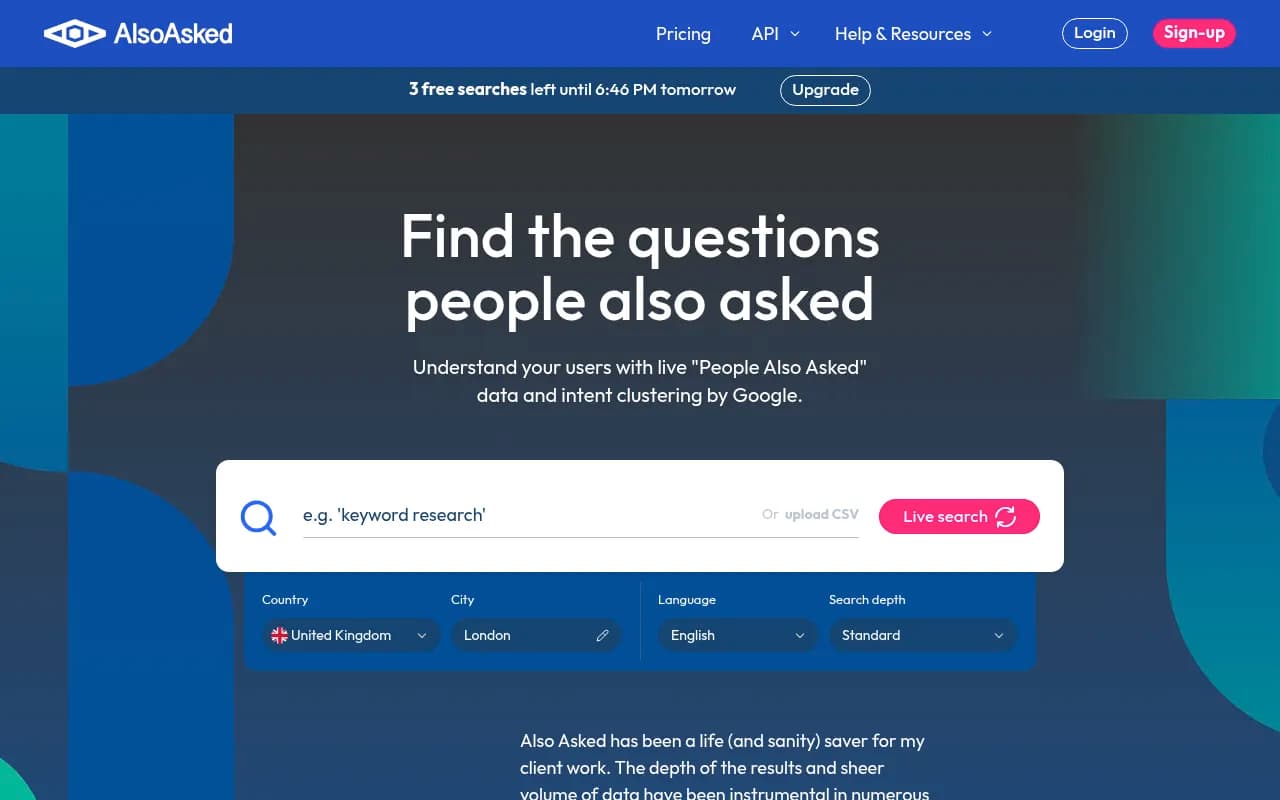
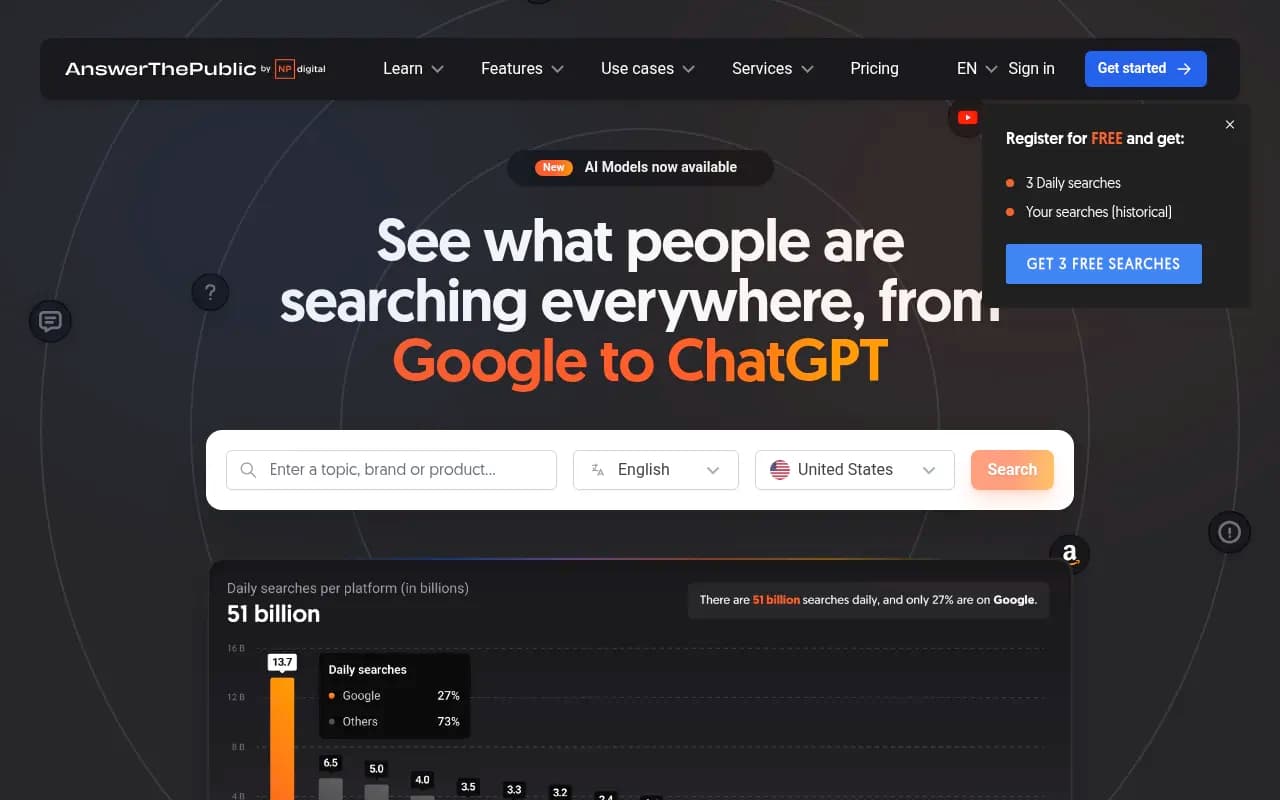
You can also use tools like AlsoAsked or AnswerThePublic to surface related questions, then build content that addresses the full question space around your topic.
5. Establish entity authority
AI engines don't just cite pages -- they cite sources they trust. And trust, in this context, is partly about whether the AI "knows" your brand as a real, legitimate entity.
Entity optimization means:
- Consistent brand name, description, and contact details across your site and third-party directories
- A Wikipedia or Wikidata entry if you're large enough to qualify
- Brand mentions on authoritative sites (press coverage, industry publications, partner pages)
- Consistent authorship signals -- named authors with credentials, author bio pages, links to author profiles on LinkedIn or other credible platforms
This is slower work than on-page optimization, but it compounds. A brand that AI engines recognize as an established entity gets cited more reliably across more queries.
6. Optimize for AI crawlers, not just Google
AI engines have their own crawlers -- GPTBot (OpenAI), ClaudeBot (Anthropic), PerplexityBot, and others. These crawlers behave differently from Googlebot, and your site may be inadvertently blocking them.
Check your robots.txt file. If you've blocked AI crawlers (some security tools do this automatically), you're invisible to those engines regardless of how good your content is. Unless you have a specific reason to block them, allow access.
Also check for JavaScript rendering issues. Many AI crawlers don't execute JavaScript the way browsers do, which means content that loads dynamically may not be visible to them. Server-side rendering or pre-rendering can fix this.
7. Track what's actually happening
You can't optimize what you don't measure. The challenge with AEO is that traditional analytics tools weren't built for it -- Google Analytics doesn't tell you which AI engine cited your page or which prompt triggered the citation.
Dedicated AI visibility tools have emerged to fill this gap. They track which prompts your brand appears in, which AI engines are citing you, which pages are getting cited, and how your visibility compares to competitors.
Promptwatch goes further than most -- it not only tracks citations across 10+ AI engines but also shows you exactly which prompts competitors are visible for that you're not, then helps you create content to close those gaps. The AI crawler logs show which pages GPTBot, ClaudeBot, and PerplexityBot are actually reading, which is data most tools don't surface at all.

For teams that want simpler monitoring without the full optimization workflow, tools like Otterly.AI and Profound track brand mentions across AI engines.
Otterly.AI

Profound

AEO vs traditional SEO: a direct comparison
| Dimension | Traditional SEO | AEO |
|---|---|---|
| Goal | Rank in search results | Get cited in AI answers |
| Success metric | Ranking position, organic clicks | Citations, brand mentions in AI responses |
| Content format | Keyword-optimized pages | Question-answering, structured, extractable |
| Key signals | Backlinks, on-page keywords, Core Web Vitals | Entity authority, topical depth, structured data, freshness |
| Measurement tools | Google Search Console, rank trackers | AI visibility platforms, crawler logs |
| Timeline | Weeks to months | Weeks to months (similar) |
| Relationship | Complementary | Builds on SEO foundation |
The most important thing in this table: AEO builds on your SEO foundation. You don't abandon one for the other. Strong technical SEO, good content, and authoritative backlinks all contribute to AEO performance. The difference is in what you optimize toward.
Common mistakes that kill AEO performance
Burying answers in preamble. Long introductions before the actual answer are the single most common issue. AI engines want extractable content. If your answer is on paragraph six, it might not get extracted at all.
Thin topical coverage. One page on a topic signals a passing interest. Ten well-linked pages signal expertise. AI engines favor depth.
Blocking AI crawlers. Check your robots.txt. Some security plugins and CDN configurations block GPTBot and similar crawlers by default.
No structured data. Not using schema markup is a missed opportunity. It doesn't guarantee citation, but it makes your content significantly easier for AI engines to parse.
Ignoring offsite signals. Your own website is only part of the picture. AI engines also pull from Reddit, YouTube, review sites, and third-party publications. If your brand isn't mentioned positively in those places, you're missing citation opportunities that don't live on your domain.
Treating AEO as a one-time project. AI engines update frequently. New competitors enter your topic space. Your visibility scores will drift without ongoing monitoring and content updates. AEO is a continuous practice, not a launch.
Tools worth knowing for AEO in 2026
The tooling category has grown quickly. Here's a practical breakdown:
For content research and optimization:

These help you identify what questions to answer, how comprehensively to cover a topic, and how your content compares to what's already being cited.
For AI visibility tracking:
Otterly.AI
Profound
These track your brand's presence across AI engines, show which prompts you appear in, and surface gaps where competitors are visible but you're not.
For question and prompt research:
Useful for building out the question space around your topic -- the raw material for AEO content.
For structured data:
WordLift specializes in structured data and entity optimization, which is particularly relevant for AEO.
How to measure AEO success
The metrics are different from traditional SEO, and that trips people up. Here's what to track:
Citation rate: How often does your brand or content appear when AI engines answer prompts in your topic area? This is the core AEO metric.
Share of voice: Of all the sources cited for a given set of prompts, what percentage are yours vs. competitors? This is more useful than raw citation counts.
Prompt coverage: How many of the prompts relevant to your business do you appear in? Tracking this over time shows whether your content strategy is working.
AI-referred traffic: Some of this shows up in analytics as direct or referral traffic from AI platforms. It's incomplete data, but it's a useful directional signal.
Page-level citation data: Which specific pages are being cited, and by which AI engines? This tells you what's working and what to replicate.
Crawler activity: Are AI crawlers actually visiting your site? How often? Which pages? This is operational data that helps you catch indexing issues before they affect citations.
Most of these metrics require a dedicated AI visibility tool. Google Search Console doesn't capture them, and standard analytics tools only partially reflect AI-referred traffic.
Where to start if you're new to this
If you're starting from zero, here's a practical sequence:
- Audit your robots.txt to make sure you're not blocking AI crawlers.
- Pick 10-15 prompts that represent how your target customers ask about your product category. These are your baseline.
- Manually check a few of those prompts in ChatGPT, Perplexity, and Google AI Mode. Are you cited? Are competitors? What sources are being used?
- Identify one or two topics where you have strong existing content but aren't being cited. Rewrite the opening to lead with a direct answer. Add FAQ schema.
- Set up monitoring so you can track changes over time.
The manual audit in step 3 is genuinely useful -- it gives you a concrete picture of where you stand before you invest in tooling or content. Once you have that picture, the gaps become obvious, and you can prioritize accordingly.
AEO isn't complicated. It's mostly about writing clearly, covering topics thoroughly, and making sure AI engines can actually read and trust your content. The brands winning in AI search in 2026 aren't doing anything exotic -- they're doing the fundamentals well, consistently, and tracking the results.