Key takeaways
- Trakkr.ai monitors brand mentions across 8 AI models (ChatGPT, Claude, Gemini, Perplexity, Grok, DeepSeek, Meta AI, Copilot) with daily refresh
- Plans start at $79/month for 1 brand and 50 prompts, with a 14-day free trial
- The platform includes article generation (25/month on Growth), citation tracking, and site optimization suggestions
- Trakkr is a solid monitoring-first tool, but it lacks AI crawler logs, prompt volume data, and traffic attribution -- features that matter if you want to close the loop between visibility and revenue
- For teams that need to act on what they find, not just watch the numbers, there are more complete platforms worth comparing
AI search visibility has gone from a niche concern to something marketing teams are actively budgeting for. Branded queries with AI Overviews present saw an 18% CTR increase in Q1 2026 -- that stat alone has pushed a lot of brands to start asking: "Are we even showing up in these AI answers?"
Trakkr.ai is one of the tools that's stepped into this gap. It's clean, it's focused, and it covers a decent spread of AI models. But "tracking your brand across ChatGPT, Claude, and Perplexity" can mean a lot of different things depending on how deep the tool actually goes. Let's find out.
What Trakkr.ai actually does
Trakkr monitors how AI models mention and recommend your brand when users ask relevant questions. You set up a brand, define a set of prompts (up to 50 per brand on the entry plan), and Trakkr runs those prompts daily across all 8 supported models, logging whether your brand appears, how it's framed, and what sources get cited.
The core output is a visibility score over time -- you can see trends, compare models, and get a sense of whether your brand is gaining or losing ground in AI-generated answers.
On top of the monitoring layer, Trakkr includes:
- Citation and perception tracking (what sources AI models pull from, how your brand is described)
- Competitor tracking (see how rivals perform across the same prompts)
- Article generation (25 articles/month on Growth, 100/month on Scale)
- Site optimization suggestions
- Executive reports and exports
- MCP access (for integrating with AI workflows)
The Scale plan adds white-label client portals and REST API access, which makes it more viable for agencies managing multiple brands.
Pricing breakdown
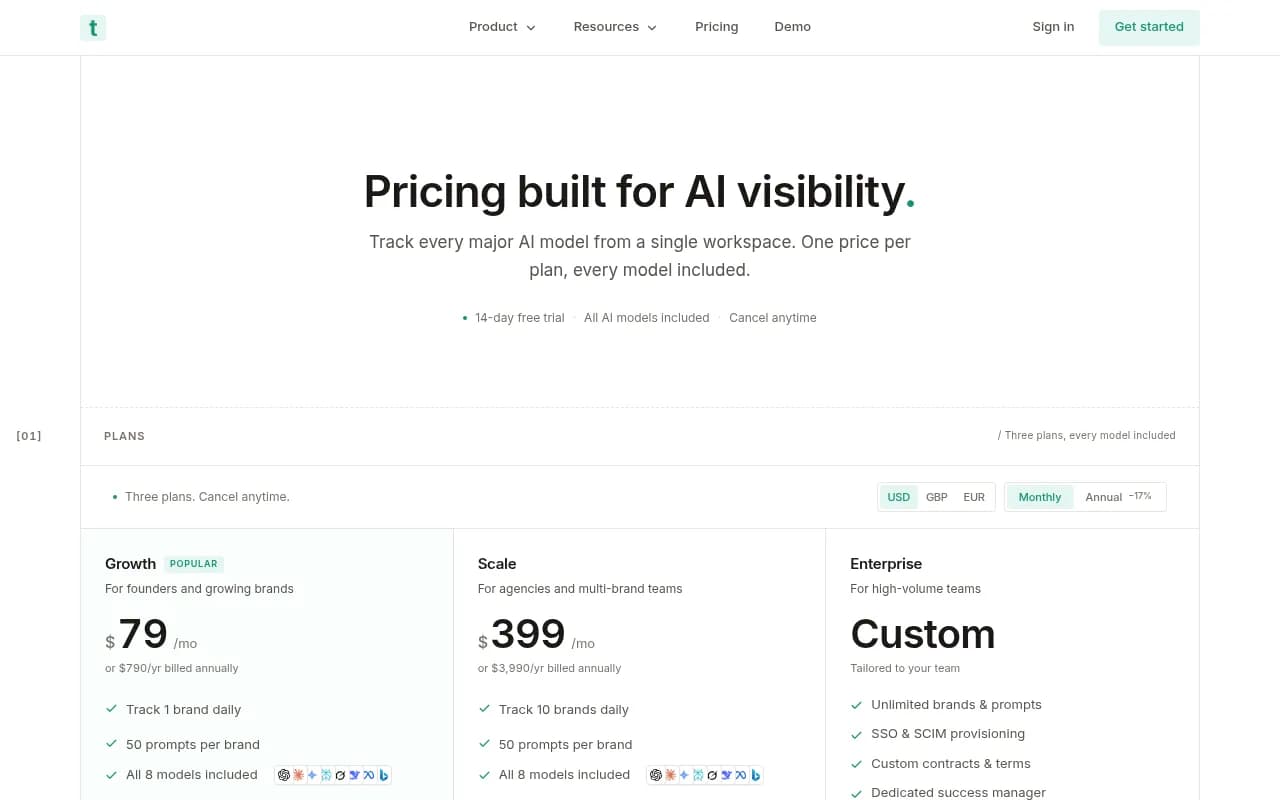
Trakkr has three tiers, and the structure is fairly transparent:
| Plan | Price | Brands | Prompts/brand | Articles/mo | API access |
|---|---|---|---|---|---|
| Growth | $79/mo ($790/yr) | 1 | 50 | 25 | No |
| Scale | $399/mo ($3,990/yr) | 10 | 50 | 100 | Yes (REST) |
| Enterprise | Custom | Unlimited | Unlimited | Custom | Custom |
All plans include all 8 AI models, daily refresh, and 1 year of historical data on Growth (unlimited on Scale). There's a 14-day free trial on both paid tiers, and annual billing saves about 17%.
The Growth plan at $79/month is genuinely competitive for a solo brand or founder who wants to get started. The jump to Scale at $399/month is steep if you only need 2-3 brands -- there's no middle tier, which is a real gap for small agencies.
The 8 models: what's covered and what's not
Trakkr covers ChatGPT, Claude, Gemini, Perplexity, Grok, DeepSeek, Meta AI, and Copilot. That's a solid lineup. For most brands, the models that actually drive meaningful traffic are ChatGPT and Perplexity, with Gemini and Claude growing fast -- so this coverage is practically useful, not just impressive on a spec sheet.
What's missing: Google AI Overviews and Google AI Mode. These are increasingly important for brands with strong organic search presence, and their absence is worth noting. If your audience is primarily finding you through Google, Trakkr's model coverage has a real blind spot.
Where Trakkr does well
Clean, focused interface
Trakkr doesn't try to do everything. The dashboard is organized around brands and prompts, and the daily data is easy to read. If you're a founder or a small marketing team that just wants to know "are we showing up in AI answers?", Trakkr gives you that answer without overwhelming you with options.
Competitor tracking
Being able to run the same prompts against competitor brands and see how you compare is genuinely useful. It's not just about your own visibility -- it's about understanding the competitive landscape in AI search. Trakkr includes this across all plans.
Article generation
The built-in article generation is a nice addition for a tool at this price point. 25 articles per month on Growth is enough to start building content that targets the prompts where you're not showing up. The quality and whether those articles are grounded in real citation data (rather than generic AI output) is harder to verify without hands-on testing, but the feature existing at all puts Trakkr ahead of pure monitoring tools.
White-label portals on Scale
For agencies, the white-label client portal on the Scale plan is a meaningful differentiator. Most tools at this price range don't offer this.
Where Trakkr falls short
No AI crawler logs
One of the most actionable things you can do with an AI visibility platform is understand how AI crawlers are actually accessing your site -- which pages they read, how often, what errors they hit. Trakkr doesn't offer this. You're seeing the output (whether your brand appears in answers) but not the input (whether AI models can even properly crawl and index your content).
No prompt volume or difficulty data
Trakkr lets you define 50 prompts per brand, but it doesn't tell you which prompts are worth targeting. There's no volume data, no difficulty scoring, no query fan-out analysis showing how one prompt branches into related sub-queries. You're essentially guessing which prompts matter most.
No traffic attribution
Knowing your brand appears in AI answers is step one. Knowing whether that visibility actually drives traffic and revenue is step two. Trakkr doesn't connect AI visibility to actual site traffic -- there's no code snippet, no Google Search Console integration, no server log analysis. You can see your visibility score go up, but you can't tie it to a conversion.
Google AI Overviews not covered
As mentioned above, the absence of Google AI Overviews and Google AI Mode is a real limitation for brands where Google is the primary discovery channel.
50 prompts per brand is limiting
50 prompts sounds like a lot until you start mapping out the actual question space around your brand, your product category, your competitors, and your use cases. For any brand with meaningful market presence, 50 prompts will feel tight quickly. There's no way to add more prompts without jumping to Scale and paying for 10 brands you might not need.
How Trakkr compares to alternatives
The AI visibility space has expanded fast. Here's how Trakkr sits relative to some of the other tools worth knowing about:
| Tool | Models tracked | Crawler logs | Prompt volume data | Traffic attribution | Content generation | Starting price |
|---|---|---|---|---|---|---|
| Trakkr.ai | 8 | No | No | No | Yes (25/mo) | $79/mo |
| Promptwatch | 10+ | Yes | Yes | Yes | Yes (5/mo) | $99/mo |
| Otterly.AI | ~5 | No | No | No | No | ~$49/mo |
| Profound | 9+ | No | Limited | No | No | Higher |
| Peec AI | ~5 | No | No | No | No | Lower |
| LLM Pulse | ~5 | No | No | No | No | Lower |
Promptwatch is the most direct comparison worth making here. It costs $20/month more at the entry level but adds AI crawler logs, prompt volume and difficulty scoring, query fan-outs, and traffic attribution through GSC integration or server log analysis. If you're trying to close the loop between AI visibility and actual business outcomes, that gap matters.

For teams that just want basic monitoring without the complexity, tools like Otterly.AI or Peec AI are cheaper but give you even less to work with.
Otterly.AI


Who Trakkr is actually a good fit for
Trakkr works well for:
- Founders and small teams who want a simple, clean dashboard to track AI brand mentions without a steep learning curve
- Agencies with 10+ clients who need white-label reporting (Scale plan)
- Brands just starting to think about AI visibility who want to establish a baseline before investing in more sophisticated tooling
It's less suited for:
- Marketing teams who need to understand why they're not showing up (not just that they're not)
- SEO teams who want to connect AI visibility to organic traffic and revenue
- Brands where Google AI Overviews is a primary discovery channel
- Teams who want to prioritize which prompts to target based on volume and competition data
The honest verdict
Trakkr.ai is a well-designed monitoring tool. The interface is clean, the model coverage is solid, the pricing is accessible, and the inclusion of article generation at $79/month is genuinely useful. For a brand that's never tracked AI visibility before, it's a reasonable place to start.
The limitation is that monitoring is where it stops. You can watch your visibility score, but Trakkr doesn't tell you why you're invisible, which prompts are worth winning, whether AI crawlers can even reach your content, or whether your visibility improvements are driving any actual traffic. Those are the questions that turn AI visibility from a vanity metric into a business lever.
If you're at the stage where you just want to know "are we showing up?", Trakkr does that job. If you're at the stage where you want to actually improve your position and measure the impact, you'll hit the ceiling fairly quickly and start looking for something that goes further.