Hugging Face Inference API Review 2026
Hugging Face Inference Providers gives developers serverless access to hundreds of AI models across 18+ world-class providers through a single API. Run LLMs, image generation, embeddings, and more without vendor lock-in. Free tier included, OpenAI-compatible endpoints, and automatic provider failove
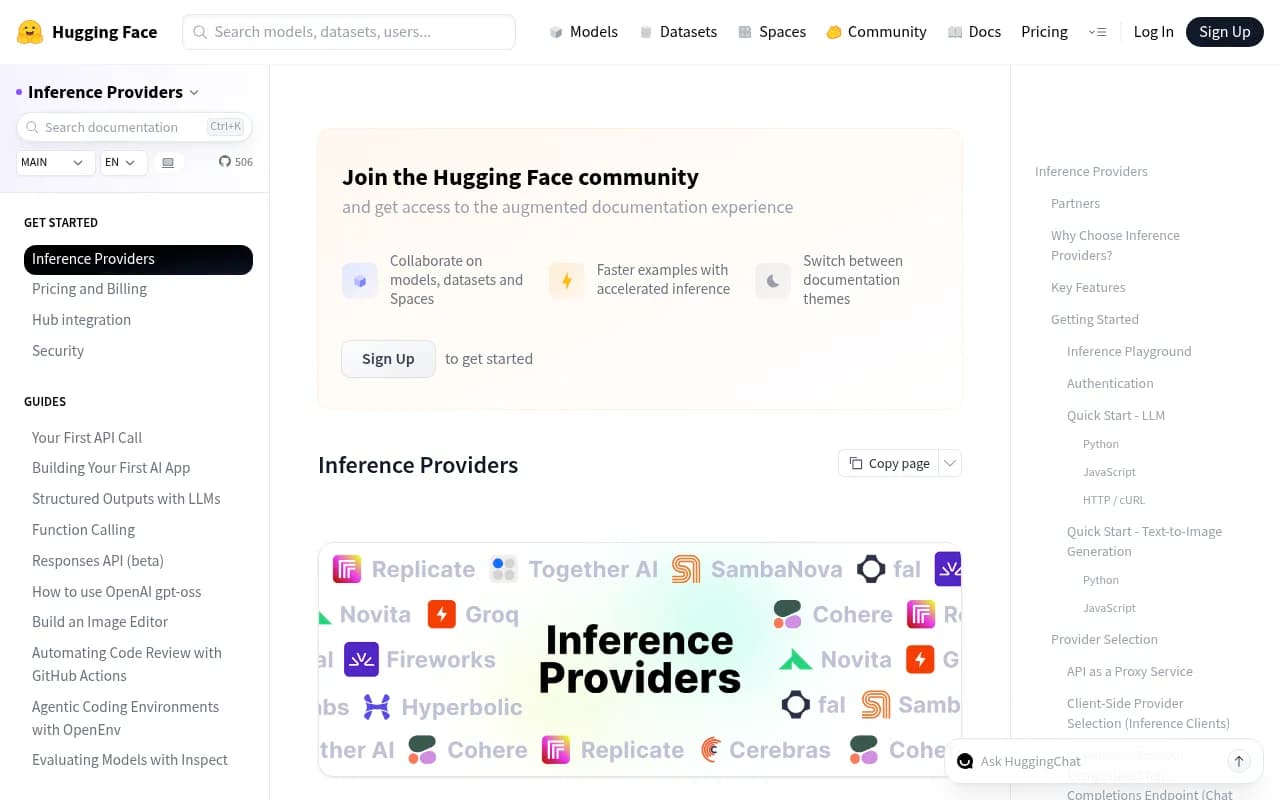
Summary
- Unified access to 1000+ models: Single API for LLMs, image/video generation, embeddings, and speech across 18+ providers (Cerebras, Groq, Together AI, Replicate, Fal AI, SambaNova, etc.)
- Zero vendor lock-in: Switch between providers instantly without rewriting code -- same interface works across all partners
- OpenAI-compatible chat endpoint: Drop-in replacement for OpenAI's chat completions API with automatic provider selection
- Free tier + PRO credits: Generous free usage included, with additional credits for PRO subscribers ($9/mo) and Enterprise teams
- Limitations: OpenAI compatibility is chat-only (other tasks require Hugging Face clients), provider-specific features may not be exposed, and you're dependent on Hugging Face's proxy layer for all requests
Hugging Face Inference Providers is a proxy API that sits between your application and 18+ AI infrastructure providers, giving you serverless access to over 1000 models through a single authentication token and consistent interface. Instead of managing separate accounts, API keys, and billing relationships with Cerebras, Groq, Together AI, Replicate, Fal AI, and others, you get one unified endpoint that handles provider selection, failover, and routing automatically.
The core value proposition: you can run state-of-the-art models like DeepSeek V3, FLUX.1, Llama 3.3, or Qwen without committing to a single provider's ecosystem. If one provider is down or slow, the system automatically routes to an alternative. If a better model becomes available on a different provider, you can switch with a single parameter change.
Hugging Face launched this in early 2025 as part of their broader mission to democratize AI. The company already hosts 1M+ models and datasets used by 6M+ developers, and Inference Providers extends that ecosystem by making those models actually runnable in production without managing infrastructure.
Key Features
Multi-Provider Model Access: The platform integrates 18+ inference providers as of February 2026. Each provider specializes in different capabilities -- Cerebras for ultra-fast LLM inference, Groq for low-latency chat, Fal AI and Replicate for image/video generation, SambaNova for embeddings. You get access to their full model catalogs through Hugging Face's unified API. The provider table shows exactly which tasks each partner supports: chat completions (text and vision), embeddings, text-to-image, text-to-video, and speech-to-text. Current partners include Cerebras, Cohere, Fal AI, Featherless AI, Fireworks, Groq, Hyperbolic, Novita, Nscale, OVHcloud, Public AI, Replicate, SambaNova, Scaleway, Together AI, WaveSpeedAI, and Z.ai. Hugging Face's own inference infrastructure (HF Inference) is also available as a provider option.
Automatic Provider Selection: You can let the system choose the best provider automatically or specify one explicitly. Three selection policies are available: :fastest (default, highest tokens/second throughput), :cheapest (lowest price per output token), and :preferred (follows your custom ranking in account settings). For example, openai/gpt-oss-120b:fastest routes to the fastest available provider for that model, while openai/gpt-oss-120b:sambanova forces SambaNova. The client libraries handle this with a provider parameter -- set it to "auto" for automatic selection or specify a provider name. If your chosen provider is unavailable, the system automatically fails over to alternatives when using auto mode.
OpenAI-Compatible Chat Endpoint: For chat completions specifically, Hugging Face offers a drop-in replacement for OpenAI's API at https://router.huggingface.co/v1/chat/completions. You can use the official OpenAI Python or JavaScript SDK by just changing the base URL and API key. This makes migration trivial if you're already using OpenAI's client libraries. The endpoint supports streaming, function calling, and all standard chat completion parameters. Model listing is available at GET /v1/models. The catch: this compatibility layer only works for chat tasks. For image generation, embeddings, or speech, you need to use Hugging Face's native clients.
Native Client Libraries: The huggingface_hub Python library and @huggingface/inference JavaScript package provide first-class support for all task types. These clients handle provider-specific API differences automatically -- you write the same code whether you're using Groq, Together AI, or Replicate. The Python client includes InferenceClient with methods like chat.completions.create(), text_to_image(), and feature_extraction(). The JavaScript client mirrors this API with TypeScript support. Both libraries support streaming responses, custom parameters, and provider selection.
Inference Playground: Before writing code, you can test models interactively in the web-based playground at huggingface.co/playground. Select any chat model, enter prompts, adjust parameters like temperature and max tokens, and compare responses across providers. This is useful for evaluating which model and provider combination works best for your use case before committing to an integration.
Unified Authentication & Billing: One Hugging Face token authenticates you across all 18+ providers. You create a fine-grained token with "Make calls to Inference Providers" permission, and that's it -- no need to sign up for separate accounts with Cerebras, Groq, Replicate, etc. Billing is consolidated on your Hugging Face invoice. The platform doesn't add markup on provider rates, so you pay the same price you'd pay going direct (though you do pay for the convenience of the unified interface).
Free Tier & PRO Credits: Every Hugging Face account includes a generous free tier for Inference Providers. PRO subscribers ($9/mo) get additional monthly credits, and Team/Enterprise organizations get custom allocations. The free tier is enough for prototyping and small-scale production use. Exact credit amounts aren't publicly listed but are visible in your account dashboard.
Task Coverage: The API supports chat completions (text and vision models), feature extraction (embeddings), text-to-image generation, text-to-video generation, and speech-to-text transcription. Each provider supports a subset of these tasks. For example, Fal AI and Replicate specialize in image/video generation, while Cerebras and SambaNova focus on LLM inference. The provider table in the docs shows exactly which tasks each partner handles.
Production Reliability: The proxy layer includes automatic failover when using provider="auto". If a provider is flagged as unavailable by Hugging Face's validation system, requests are automatically routed to alternative providers. This happens transparently -- your code doesn't need to handle retries or fallback logic. The system monitors provider health continuously.
Direct HTTP Access: If you're not using Python or JavaScript, you can call the API directly via HTTP. The chat completions endpoint uses standard REST conventions with JSON payloads. For other tasks, the Hugging Face Hub API provides endpoints for each model. This works with any HTTP client (curl, Postman, custom implementations in Go/Rust/etc.).
Who Is It For
Inference Providers targets developers and teams who want to use cutting-edge AI models without managing infrastructure or committing to a single provider. The primary personas:
Startup founders and indie developers building AI-powered products need fast iteration and low upfront costs. Inference Providers lets them prototype with free credits, test multiple models across providers, and scale up without rewriting code. A solo developer building a chatbot can start with the free tier, try DeepSeek on SambaNova and Llama on Groq, and switch providers based on performance without touching application code.
Engineering teams at mid-size companies (10-100 engineers) who are integrating AI features into existing products. These teams value reliability and want to avoid vendor lock-in. If they build on OpenAI's API and OpenAI has an outage or raises prices, they're stuck. With Inference Providers, they can switch to Groq or Together AI in minutes. The OpenAI-compatible endpoint makes migration from existing OpenAI integrations trivial.
AI/ML engineers and researchers who need access to the latest models as soon as they're released. Hugging Face hosts 1M+ models, and Inference Providers makes hundreds of them instantly runnable. If a new SOTA model drops on Hugging Face, you can often run it through Inference Providers within hours, without waiting for OpenAI or Anthropic to add it to their catalogs.
Agencies and consultancies building AI solutions for multiple clients. They need flexibility to match different models and providers to different client requirements and budgets. One client might need the cheapest possible embeddings (use :cheapest policy), another needs the fastest LLM inference (use :fastest), and a third needs specific image generation capabilities (use Fal AI or Replicate directly).
Who should NOT use this: Teams that need maximum control over infrastructure, custom model fine-tuning on their own hardware, or guaranteed SLAs for mission-critical applications should look at dedicated inference solutions like Hugging Face Inference Endpoints (dedicated instances) or self-hosted deployments. Inference Providers is serverless and multi-tenant, so you're sharing resources and relying on Hugging Face's proxy layer. If you need guaranteed capacity or sub-50ms latency, dedicated infrastructure is a better fit.
Integrations & Ecosystem
Inference Providers integrates with the broader Hugging Face ecosystem and external tools:
Hugging Face Hub: Every model on the Hub that's supported by a partner provider can be run through Inference Providers. Model cards show which providers support each model, and you can filter models by provider in the Hub's model search.
OpenAI SDK: The chat completions endpoint works with the official OpenAI Python and JavaScript SDKs. Just change base_url to https://router.huggingface.co/v1 and use your Hugging Face token as the API key.
Hugging Face Spaces: You can call Inference Providers from Gradio or Streamlit apps hosted on Spaces. This lets you build interactive demos that use multiple models across providers without managing API keys for each provider.
LangChain and LlamaIndex: Both frameworks support Hugging Face as a provider. You can use Inference Providers as the LLM backend in RAG pipelines, agent frameworks, and other LLM orchestration workflows.
Vercel AI SDK: The Vercel AI SDK has native support for Hugging Face, making it easy to build AI-powered web apps with Next.js and stream responses from Inference Providers.
No native integrations with monitoring tools like LangSmith or Helicone yet, but you can log requests and responses in your application code. The API returns standard HTTP responses, so any HTTP logging/monitoring tool works.
Pricing & Value
Inference Providers uses a credit-based system. Every Hugging Face account includes free credits, PRO subscribers ($9/mo) get additional monthly credits, and Team/Enterprise organizations get custom allocations. Exact credit amounts aren't publicly listed -- you see your balance in the account dashboard.
Credits are consumed based on provider pricing. Hugging Face doesn't add markup, so you pay the same per-token or per-image rate you'd pay going direct to the provider. The value is in the unified interface, automatic failover, and consolidated billing.
Free tier: Enough for prototyping and small-scale production use. Good for indie developers and early-stage startups.
PRO ($9/mo): Additional monthly credits plus other PRO benefits like 8x higher rate limits on Hugging Face Spaces, access to H200 GPU compute, and priority support. Worth it if you're using Inference Providers regularly or want the other PRO perks.
Team/Enterprise: Custom credit allocations, dedicated support, and volume discounts. Contact Hugging Face sales for pricing.
Compared to going direct to providers: you get convenience and flexibility at the same per-unit cost. If you only use one provider (e.g. only Groq), going direct might be simpler. But if you use multiple providers or want the ability to switch, Inference Providers is a better deal because you avoid managing multiple billing relationships and API integrations.
Compared to OpenAI: OpenAI's pricing is generally higher than open-source models on Inference Providers. For example, GPT-4 costs $10 per 1M input tokens, while DeepSeek V3 on SambaNova costs under $1 per 1M tokens. If you're using OpenAI primarily for chat completions and don't need their specific models, Inference Providers can save 80-90% on inference costs.
Strengths & Limitations
Strengths:
- Zero vendor lock-in: Switch providers or models with a single parameter change. No code rewrite required.
- Massive model selection: Access to 1000+ models across 18+ providers, including the latest open-source releases.
- OpenAI compatibility: Drop-in replacement for OpenAI's chat API makes migration trivial for existing applications.
- Automatic failover: Provider outages are handled transparently when using auto mode.
- Consolidated billing: One invoice, one token, one API for all providers.
Limitations:
- OpenAI compatibility is chat-only: The
/v1/chat/completionsendpoint only works for chat tasks. For image generation, embeddings, or speech, you must use Hugging Face's native clients. This means you can't fully replace OpenAI's API if you're using multiple task types. - Proxy layer dependency: All requests go through Hugging Face's infrastructure. If Hugging Face has an outage, you can't reach any provider. This is a single point of failure, though Hugging Face's uptime is generally strong.
- Provider-specific features may not be exposed: Some providers offer unique parameters or capabilities that aren't standardized across the Inference Providers API. You might lose access to advanced features when going through the proxy.
- No guaranteed SLAs: This is a serverless, multi-tenant service. If you need guaranteed capacity or sub-50ms latency, you need dedicated infrastructure (Hugging Face Inference Endpoints or self-hosted).
- Limited monitoring and observability: No built-in integrations with tools like LangSmith, Helicone, or Datadog. You have to build your own logging and monitoring.
Bottom Line
Inference Providers is the best choice for developers who want access to cutting-edge AI models without vendor lock-in. If you're building an AI-powered product and don't want to bet your entire stack on OpenAI or Anthropic, this gives you the flexibility to switch providers and models as the landscape evolves. The OpenAI-compatible endpoint makes migration from existing OpenAI code trivial, and the unified API means you can experiment with dozens of models without rewriting integration code.
Best use case in one sentence: Startups and mid-size engineering teams building AI features who want the flexibility to use the best model for each task without committing to a single provider's ecosystem.
Frequently asked questions
What is Hugging Face Inference API?
Is Hugging Face Inference API free?
How much does Hugging Face Inference API cost?
Is Hugging Face Inference API compatible with OpenAI?
What AI models are available on Hugging Face Inference API?
What providers does Hugging Face Inference API support?
Does Hugging Face Inference API have vendor lock-in?
Who should use Hugging Face Inference API?
Similar and alternative tools to Hugging Face Inference API