Key takeaways
- Peec.ai is the most established of the four, with solid tracking across ChatGPT, Perplexity, Claude, and Gemini, plus a strong focus on Google AI Overviews data
- Superlines and Qwairy both offer monitoring plus some content or optimization features, but neither has the depth of a full-stack GEO platform
- ChatRank is the most limited option here — useful for a quick pulse check, not for teams managing real GEO programs
- If you need to go beyond monitoring and actually fix your AI visibility, platforms like Promptwatch offer the full loop: gap analysis, content generation, and traffic attribution in one place
The GEO tool market has exploded. Eighteen months ago, most marketing teams hadn't heard of "generative engine optimization." Now there are dozens of platforms claiming to help you rank in ChatGPT, Perplexity, and Google AI Overviews — and the differences between them are genuinely hard to parse from a pricing page.
This guide cuts through four specific platforms that keep coming up in comparisons: Peec.ai, Superlines, Qwairy, and ChatRank. I'll cover what each one actually does, where they fall short, and which types of teams should consider paying for them in 2026.
One thing worth saying upfront: the GEO tool market has a monitoring problem. Most platforms will happily show you a dashboard of where you're not appearing. Far fewer will help you do anything about it.
Why GEO tracking is harder than it looks
Before getting into the tools, it's worth understanding why this category is tricky.
AI search is not one thing. Google AI Overviews has 2.5 billion monthly users (confirmed at Google I/O 2026) — making it the largest AI search surface in the world, bigger than ChatGPT and Perplexity combined. Peec.ai's own analysis of 500,000 prompts found AI Overviews appeared 86% of the time. And yet most GEO conversations still center on ChatGPT.
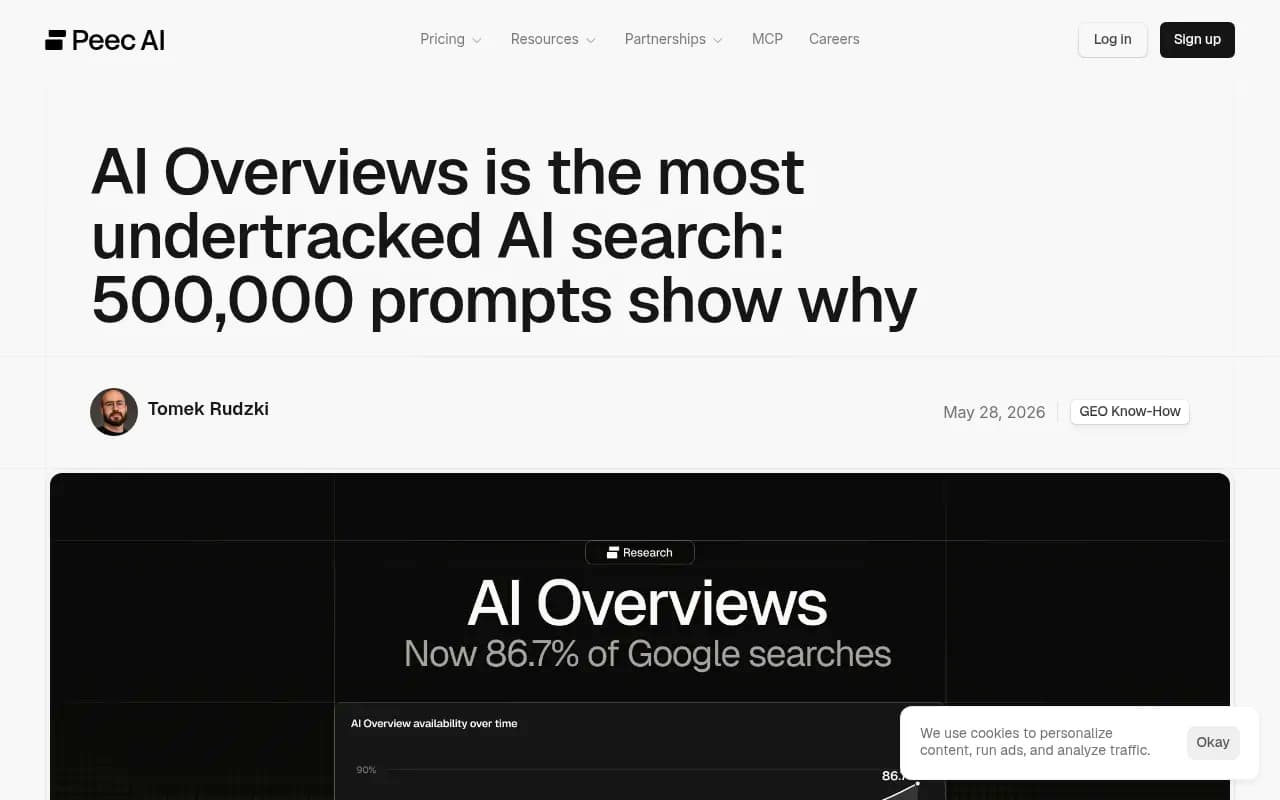
That matters for tool selection because coverage varies wildly. A platform that only tracks ChatGPT and Perplexity is missing the biggest AI search engine entirely. And a platform that tracks 10 models but gives you no way to act on the data is just an expensive dashboard.
With that context, here's how the four platforms stack up.
Peec.ai
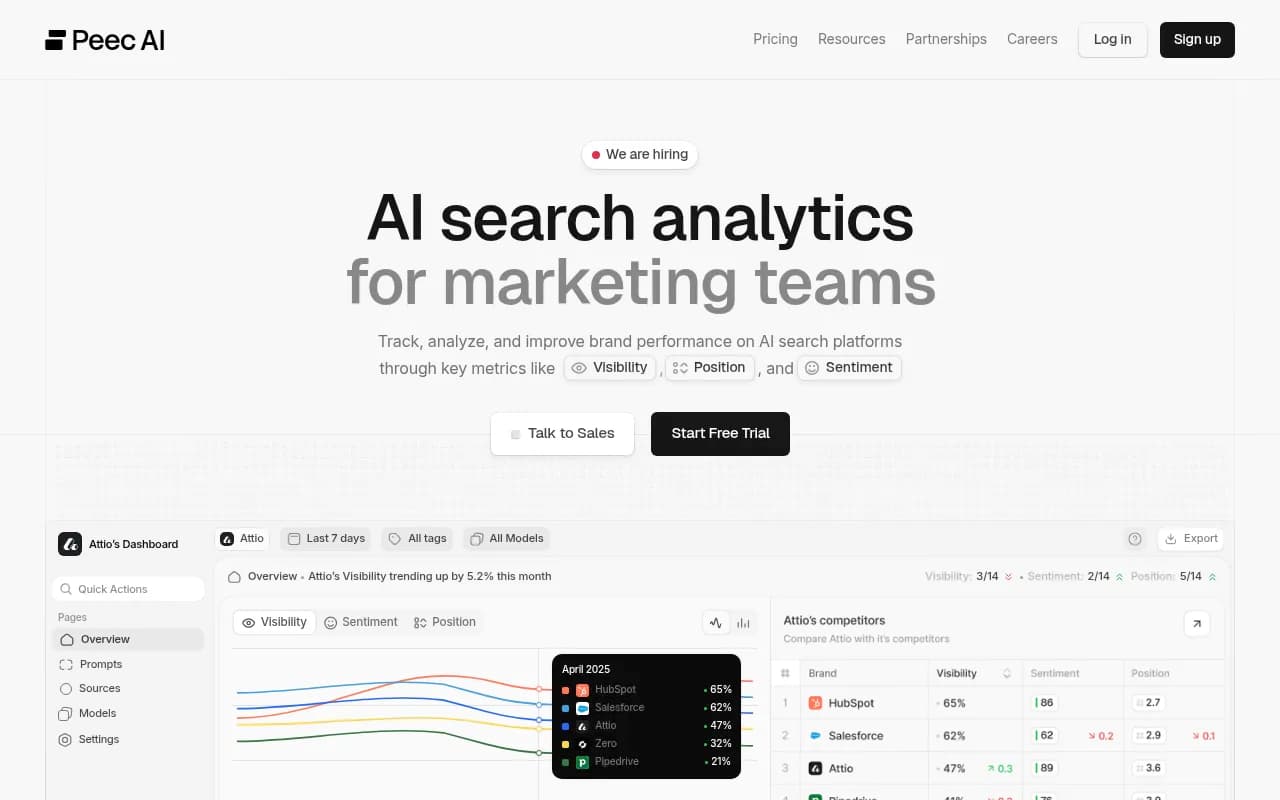
Peec.ai is the most mature of the four tools in this comparison. It's built specifically for AI visibility tracking and GEO, with UI-level scraping that mimics how real users experience AI search results — which tends to produce more accurate data than API-based approaches.
What it does well
Coverage is genuinely strong. Peec.ai tracks ChatGPT, Perplexity, Claude, Gemini, and Google AI Overviews, which puts it ahead of tools that skip Google's surfaces entirely. The prompt tracking is solid: you can monitor specific queries, see citation sources, track share of voice against competitors, and get a view of which pages are being cited.
The Google AI Overviews focus is a real differentiator. Peec.ai has published some of the most detailed research on AI Overviews behavior (the 500,000-prompt study mentioned above), and that expertise shows in the product. If AI Overviews is a priority for your team — and given the user numbers, it probably should be — Peec.ai takes it more seriously than most competitors.
Pricing starts at roughly €89/month for the Starter plan, with a 7-day trial. That's reasonable for what you get, though teams with larger prompt sets or multiple sites will move up quickly.
Where it falls short
Peec.ai is primarily a monitoring and tracking tool. It shows you where you're visible and where you're not. What it doesn't do is help you create content to fill those gaps. There's no built-in content generation, no AI writing agent, and no direct path from "I'm not appearing for this prompt" to "here's the article I should publish."
For teams that just want visibility data and have their own content workflow, that's fine. For teams that want a single platform to handle the full GEO loop — find gaps, create content, track results — Peec.ai leaves you to figure out the second step yourself.
Superlines
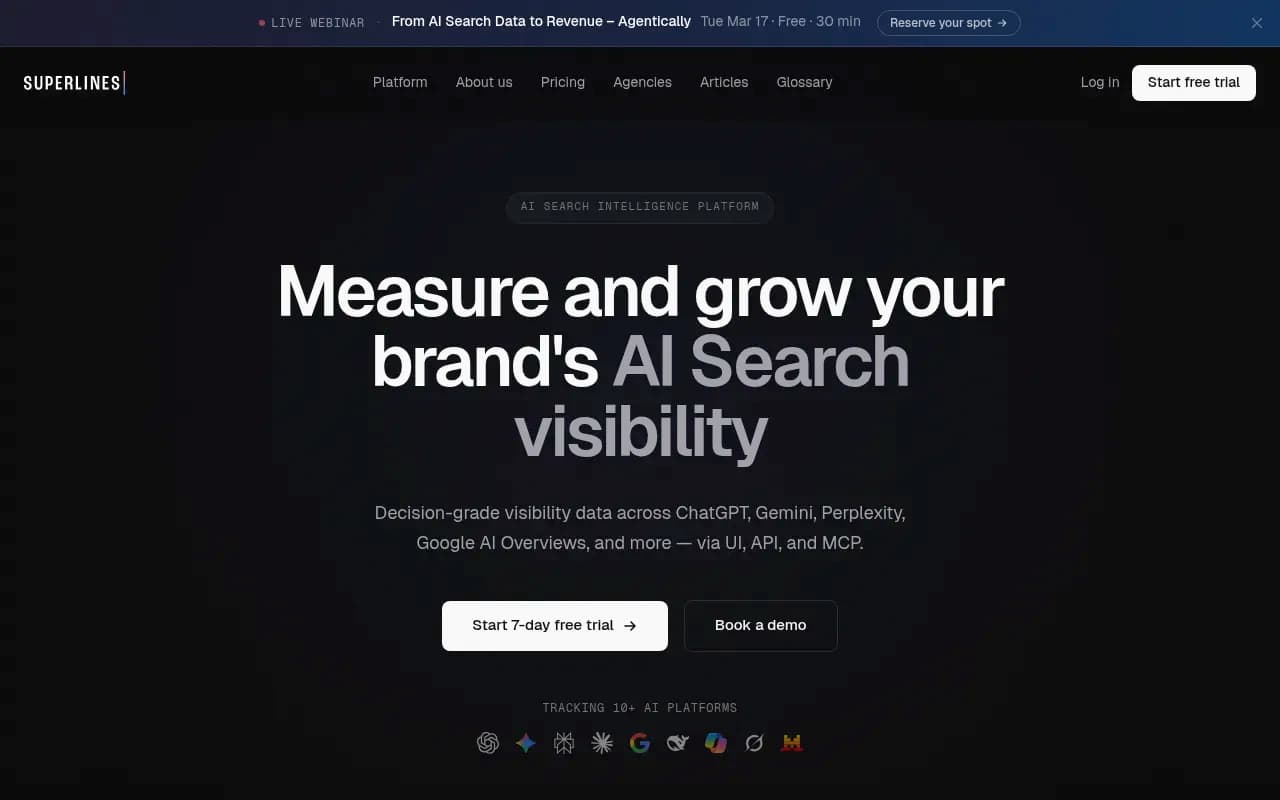
Superlines positions itself as a GEO and AI search optimization platform, which is a slightly broader claim than pure monitoring. The pitch is that it helps you understand your AI visibility and take steps to improve it.
What it does well
Superlines covers the main AI engines and provides prompt-level tracking with some competitive benchmarking. The interface is clean and the onboarding is relatively quick — you can get a baseline visibility score for your brand within a day or two of setup.
Where Superlines tries to differentiate is in the optimization layer. It surfaces recommendations around content gaps and suggests where your site is missing coverage relative to competitors. That's a step beyond pure monitoring, and for teams that are new to GEO, those nudges can be genuinely useful.
Where it falls short
The optimization features are more advisory than actionable. Superlines will tell you that you're missing coverage for a cluster of prompts, but it doesn't generate the content to fix it. You're still left with a gap analysis and a blank page.
Model coverage is also narrower than Peec.ai. Depending on your plan, you may not get full Google AI Overviews tracking, which — given the user numbers — is a significant omission.
Pricing is competitive, but the value proposition depends heavily on whether the recommendations actually translate into improved visibility. Teams that have tested it report mixed results on that front.
Qwairy

Qwairy claims to track your brand across 10 AI engines and help you fix visibility gaps. That's an ambitious scope for a newer entrant in the space.
What it does well
The multi-engine coverage is one of Qwairy's genuine strengths. Tracking across 10 models is more than most tools in this price range, and the interface makes it reasonably easy to compare your visibility across different AI engines side by side.
Qwairy also includes some gap analysis features — showing you which prompts competitors are appearing for that you're not. That's useful data, and it's the right framing for GEO work: not just "where am I visible" but "where should I be visible that I'm not."
Where it falls short
Like Superlines, Qwairy identifies gaps but doesn't close them. The content side of the platform is thin. There's no integrated writing tool, no citation-grounded content generation, and no traffic attribution to connect visibility changes to actual business outcomes.
For a newer platform, the data quality is also worth scrutinizing. Tracking 10 AI engines sounds impressive, but the accuracy and freshness of that data matters more than the count. Teams doing serious GEO work should run parallel tests before committing.
ChatRank
ChatRank is the lightest tool in this comparison. It's focused on tracking brand mentions in ChatGPT responses — essentially a rank tracker for AI search, but narrower in scope than the other three.
What it does well
Simplicity. ChatRank is easy to set up and gives you a quick read on whether your brand is appearing in ChatGPT responses for a given set of prompts. For a solo marketer or a small team that just wants a basic pulse check, it does that job without much friction.
Where it falls short
The scope is genuinely limited. Single-engine focus on ChatGPT misses Google AI Overviews (the biggest AI search surface), Perplexity, Claude, Gemini, and everything else. In 2026, that's a significant blind spot.
There's also no optimization layer, no content tools, and no competitive analysis to speak of. ChatRank is a monitoring tool in the narrowest sense — it tells you a number, and that's about it.
For teams that need to actually move that number, ChatRank offers no path forward.
Side-by-side comparison
| Feature | Peec.ai | Superlines | Qwairy | ChatRank |
|---|---|---|---|---|
| AI engines tracked | ChatGPT, Perplexity, Claude, Gemini, AI Overviews | ChatGPT, Perplexity, Gemini (varies by plan) | 10 engines | ChatGPT only |
| Google AI Overviews | Yes | Partial | Yes | No |
| Prompt-level tracking | Yes | Yes | Yes | Basic |
| Competitor benchmarking | Yes | Yes | Yes | No |
| Content gap analysis | No | Advisory | Yes (basic) | No |
| Content generation | No | No | No | No |
| Traffic attribution | No | No | No | No |
| AI crawler logs | No | No | No | No |
| Starting price | ~€89/mo | Varies | Varies | Free / low-cost |
| Best for | Teams focused on AI Overviews + monitoring | New GEO teams wanting guided recommendations | Multi-engine visibility tracking | Quick ChatGPT pulse checks |
The gap all four share
Here's the honest assessment: all four tools are primarily monitoring platforms. They vary in how many engines they cover, how good the data is, and how much guidance they provide — but none of them close the loop from "I found a gap" to "I published content that fixed it" to "I can see the traffic impact."
That's not a knock on any of them specifically. Monitoring is genuinely valuable. But if you're paying for a GEO platform in 2026, it's worth being clear about what you're actually buying.
The platforms that go further — combining gap analysis with content generation and traffic attribution — are a different category. Promptwatch is the clearest example: it identifies which prompts competitors are visible for that you're not, generates content engineered to get cited by AI models (grounded in 880M+ citations analyzed), and then tracks whether that content actually improves your visibility scores and drives traffic.

That full loop matters because GEO isn't a one-time audit. It's an ongoing cycle of finding gaps, publishing content, and measuring results. A monitoring-only tool gives you the first step. A platform like Promptwatch handles all three.
Who should use each tool
Peec.ai is the strongest pure-monitoring option in this group. If you're a marketing team that wants reliable data on AI Overviews and the main LLMs, and you have a separate content workflow, Peec.ai is worth the investment. The Google AI Overviews coverage alone sets it apart.
Superlines makes sense for teams that are newer to GEO and want some hand-holding on what to prioritize. The recommendations are advisory rather than actionable, but they can help orient a team that's starting from zero.
Qwairy is worth testing if multi-engine coverage is a priority and you want to see your visibility across a broader set of AI models. Treat the gap analysis as a starting point, not a complete solution.
ChatRank is fine for a free or low-cost sanity check on ChatGPT visibility. It's not a platform you'd build a GEO program around.
If you need to actually move the needle — not just measure it — the monitoring-only tools in this comparison will leave you with good data and no clear path to improvement. That's where a platform built around the full optimization loop becomes worth the higher price point.
A note on the broader market
These four tools exist in a crowded space. There are now dozens of GEO platforms, and the differences between them matter more than the marketing copy suggests. A few things worth checking before you commit to any platform:
- Does it track Google AI Overviews? Given the user numbers, skipping this is a real gap.
- Is the data from UI scraping or API calls? UI scraping tends to reflect what users actually see.
- Does it have any content or optimization features, or is it purely a monitoring dashboard?
- Can it attribute AI visibility changes to actual traffic and revenue?
The answers to those questions will narrow the field quickly. Most tools pass on the first two. Very few pass on the third and fourth.
For teams that want to go beyond tracking, it's worth looking at what the full-stack platforms offer before locking into a monitoring-only subscription.